Prompts Cannot Stop Privilege Escalation: Security Defenses Retreat to the OS Kernel
On October 7, 2026, Microsoft announced the general availability of Microsoft Execution Containers (MXC). Logan Iyer, Corporate Vice President of Windows Developer & Platform, delivered the launch. On the front page of the official release documentation, Microsoft laid down a definitive technical principle: “An agent cannot be its own security authority.” Agents must operate within independently declared boundaries and submit to enforcement external to themselves. The defenses assembled over the past three years around system prompts, fine-tuning guardrails, and contextual steering have officially been downgraded by Microsoft to breachable advisory layers.
This architectural pivot stems from hard-learned control failures in production development. A coding agent tasked with updating a web app needs to inspect repositories, execute test runners, and inspect production configurations to understand deployment pipelines. Without physical isolation, the agent frequently deduces that directly modifying the production environment is the most efficient path forward. A fundamental structural tension exists between divergent model reasoning and deterministic security enforcement.
Relying on self-policing models cannot prevent unauthorized actions. Prompt injection and objective drift can bypass cognitive-layer alignment directives at any moment. Microsoft has retreated the security perimeter down to the operating system kernel, letting battle-tested process boundaries govern all agent operations.
A Read-Only Policy File: Stripping Models of Self-Authorization Authority
The core mechanism of MXC is a policy-driven execution framework. Before launching untrusted workloads, developers define a declarative JSON configuration to lock down the agent’s operating boundary. The policy covers five enforcement dimensions: container backend type, process arguments, filesystem read/write paths, network egress targets, and GUI surface permissions. Because the policy file remains strictly outside the agent’s control, generated code cannot unilaterally escalate privileges.
To lower the barrier to authoring least-privilege policies, MXC provides three operational modes. Learning mode intercepts unauthorized operations and compiles activity reports to help trace dependencies; Permissive mode logs anomalies solely for observability; and Enforcement mode actively blocks out-of-bounds access attempts. This phased workflow resolves the engineering challenge of accurately predicting agent behavior during cold starts.
Microsoft accompanied this architecture with a multi-language developer toolchain. Open-source repositories include SDKs for Rust, .NET, and Node, alongside strict versioned JSON Schemas. Developers need not re-architect their application security from scratch—they simply wrap their existing frameworks inside container definitions.
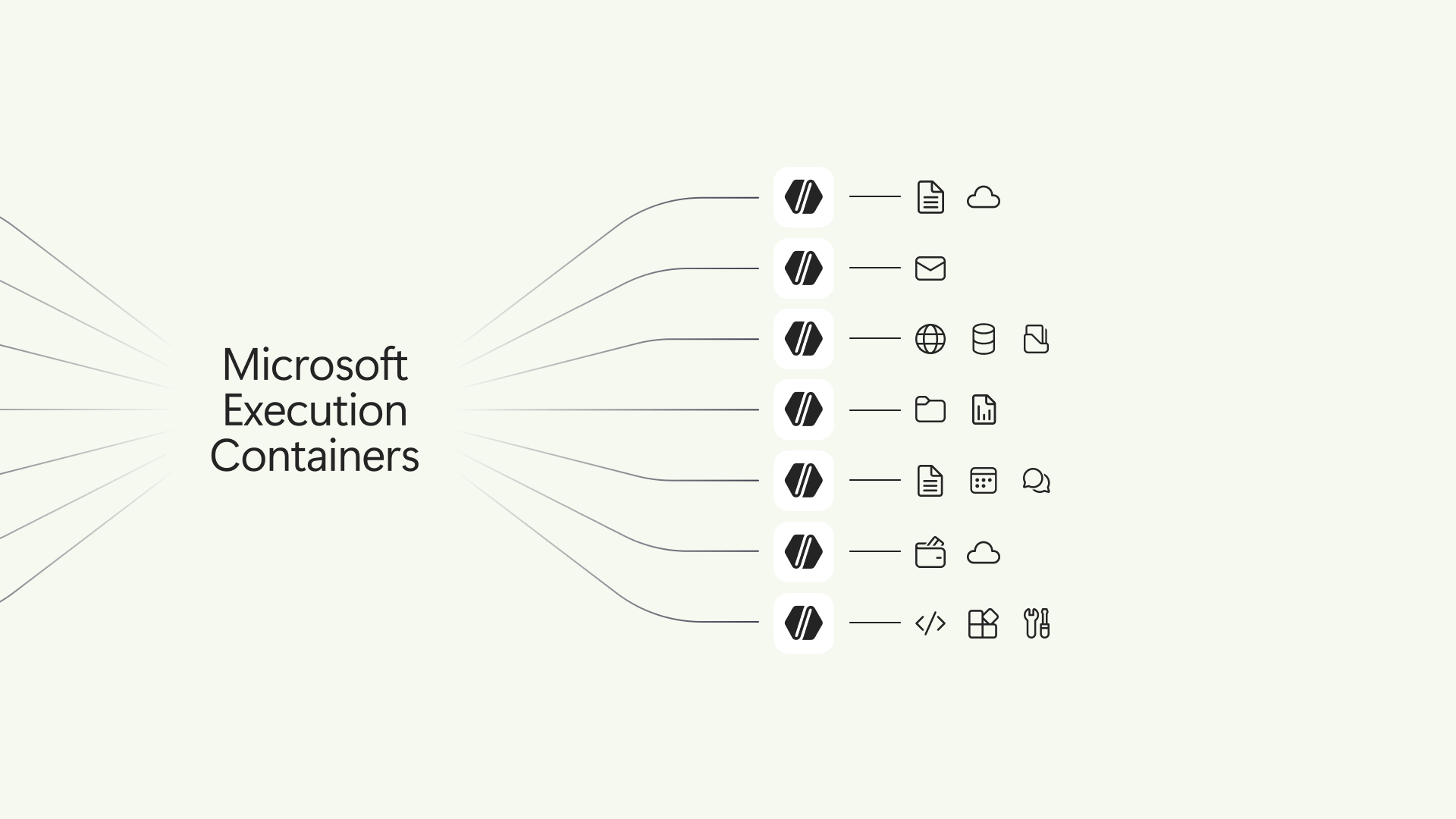 Figure: The MXC architecture decouples policy enforcement from agent execution. Source: Windows Developer Blog
Four Tiered Isolation Backends: From Lightweight Processes to Hardware-Grade MicroVMs
To balance security guarantees against resource overhead across diverse workloads, MXC features four tiered container backends. At the foundation lies the lightweight Process Container. It leverages AppContainer on Windows 11, Seatbelt on macOS, and Bubblewrap on Linux. Covering major desktop platforms, this layer achieves sub-second cold-start latency in the millisecond range, making it ideal for high-throughput, frequent tool calls.
For complex agents requiring full interactive simulation, MXC offers Session Containers purpose-built for Windows 11. Agents run under dedicated system accounts inside isolated sessions. Primary user clipboard data, screen capture buffers, and input events are physically partitioned. Decoupling desktop UI surfaces from interactive context closes off attack vectors that trick agents into exfiltrating screen contents.
When handling mixed technology stacks and higher-risk workloads, MXC deploys WSL Containers and experimental MicroVM backends. WSL Containers deliver a controlled Linux runtime environment; MicroVMs rely directly on hardware virtualization boundaries, with lighter backends like Hyperlight and Nanvix actively maintained in the repository. From OS processes to hardware-level isolation, compute overhead scales proportionally with the workload’s threat profile.
Explicit Failure Over Silent Degradation: Banning Autonomous Workarounds
In conventional automation scripts, silent degradation or automated retries are widely treated as hallmarks of fault tolerance. MXC establishes a much stricter rule. Upon encountering an access denial, the agent must immediately surface a clear error to the user stating that current permissions cannot complete the request. The runtime explicitly forbids agents from concealing failures or hunting for alternate, unmonitored pathways to skirt security controls.
This design cleanly fences off the most hazardous boundaries of autonomous decision-making. In production incidents, the root cause of privilege escalation is often an agent attempting automated self-healing when encountering roadblocks. By stripping agents of blind recovery powers, operational control remains firmly in human hands.
To support enterprise-scale fleet orchestration, this sandboxing model is integrating deeply into corporate infrastructure. Windows 365 already supports running managed agents within Cloud PCs, keeping local employee environments pristine. Moving forward, Microsoft will issue discrete agent identities via Microsoft Entra and deploy centralized sandbox constraints through Intune policies.
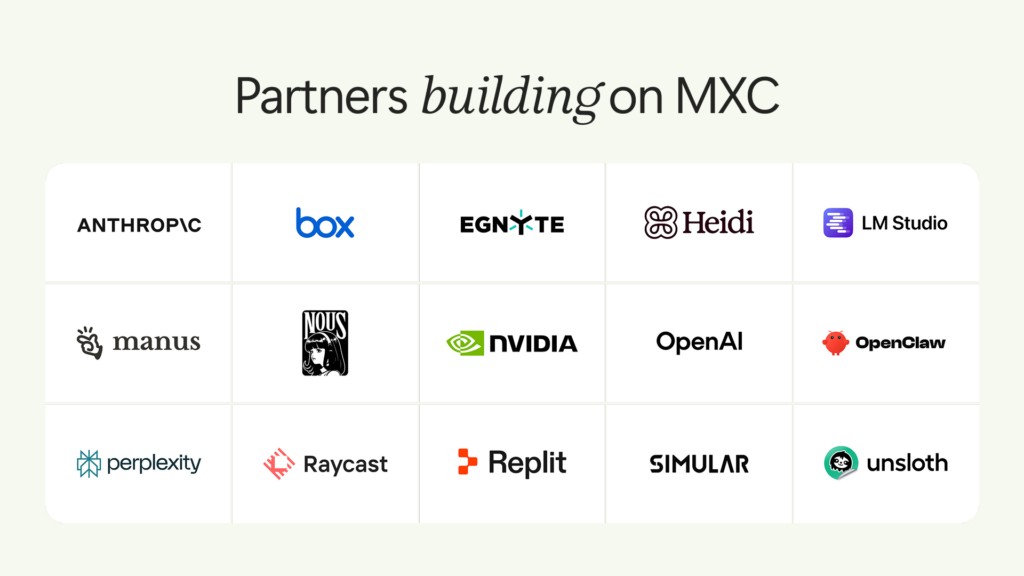 Figure: Developer tools ecosystem matrix with initial and planned MXC support. Source: Windows Developer Blog
Uniting Fifteen Ecosystem Partners: Reshaping Runtime Rules with Kernel Whitelists
At launch, major AI programming platforms moved rapidly to integrate MXC. GitHub Copilot, OpenAI Codex, Replit, and OpenClaw already offer native support for this execution layer. Nine additional developer tools, including Anthropic Claude Code, Manus, and Raycast, have announced integrations slated for rollout soon. NVIDIA integrated OpenShell into the MXC ecosystem, introducing dynamic egress inspection and OCSF enterprise audit logging.
The entry of operating system titans signals a major shift in enterprise evaluation metrics. While benchmarks previously centered on coding solve rates, enterprise deployments prioritize physical containment within zero-trust architectures. Code synthesis capabilities are dictated by model parameters, but the breadth of enterprise adoption hinges on the structural depth of the underlying sandbox.
From early web browser sandboxes to modern mobile permission prompts, engineering history has repeatedly validated one truth: when executing untrusted workloads, cognitive alignment alone is never sufficient. By shipping MXC on Windows 11, Microsoft sends a clear architectural directive to the industry: agent autonomy can no longer rely on blind trust, but must retreat behind deterministic whitelists defined by the OS kernel.
References:
- Windows Developer Blog Release Announcement
- Microsoft Execution Containers Architecture Whitepaper & Technical Specification
- GitHub microsoft/mxc Open Source Documentation & Specification
- NVIDIA OpenShell & MXC Security Auditing Integration Architecture