Framed personal checks for $2.56 hang quietly on the walls of academic studies around the world. For decades, almost nobody has cashed them. Their issuer is Donald Knuth, Professor Emeritus at Stanford University. Beginning in the 1970s, Knuth offered an open bounty for any mistakes found in his published books. Whether discovering a flaw in an algorithmic proof or a misplaced glyph in typography, any reader who pointed out an error received an authentic, signed check.
This tradition endured for nearly half a century, becoming legend across the computing community. While some might assume it was merely a polite scholarly gesture, Knuth turned it into a binding contract through four decades of unbroken fulfillment. By placing a tangible price tag on every flaw, he transformed peer review into an open technical competition.
Spotting a Typo on Page 1, Word 1: A Reader’s Months of Hesitation
In 2006, Thomas Hühn opened Computer Modern Typefaces—Volume E of Knuth’s seminal Computers & Typesetting series, dedicated to algorithmic font design. To his astonishment, Hühn spotted what appeared to be a typographical error right on page 1, paragraph 1, word 1.
Common sense would suggest that such a prominent flaw would be caught immediately. Every single reader starts at line one. Yet over the many years since the book was printed, not a single person had reported it to the author.
Rather than mailing his finding right away, Hühn was consumed by self-doubt for months. He repeatedly consulted dictionaries and typographic standards, worried that he was simply misunderstanding some obscure archaic English usage. When he asked top students at his university, their responses were lukewarm, advising him not to nitpick the opening word. Challenging an established authority is often perceived as an offense, and peers tend to default to polite deference.
These concerns kept the letter sitting on Hühn’s desk for months as he verified it over and over. Human cognition has blind spots: the larger and more prominent a word on the first line, the more readily readers assume it must be pristine. The psychological deference commanded by academic giants quietly raises the threshold for reader scrutiny.
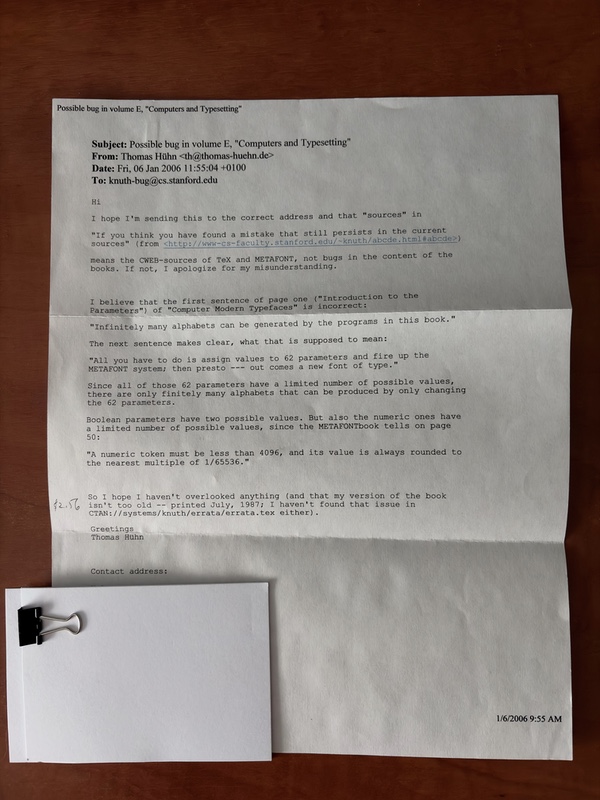 Figure: The draft of the 2006 errata letter sent to Stanford University, detailing a typographic oversight on page 1, word 1 of Computer Modern Typefaces. The reader spent months double-checking before mailing it. Source: Thomas Hühn
After exhaustive deliberation, Hühn finally mailed his letter to Knuth’s Stanford office, detailing the exact page, line number, and proposed correction. That single letter pierced a decades-long cognitive blind spot and initiated a conversation spanning years.
Hexadecimal Bounties: Pricing Academic Scrutiny
Months later, a reply arrived in the mail. Inside was a personal Bank of America check hand-signed by Donald Knuth. The memo line read “E1”, clearly acknowledging an erratum on page 1 of Volume E.
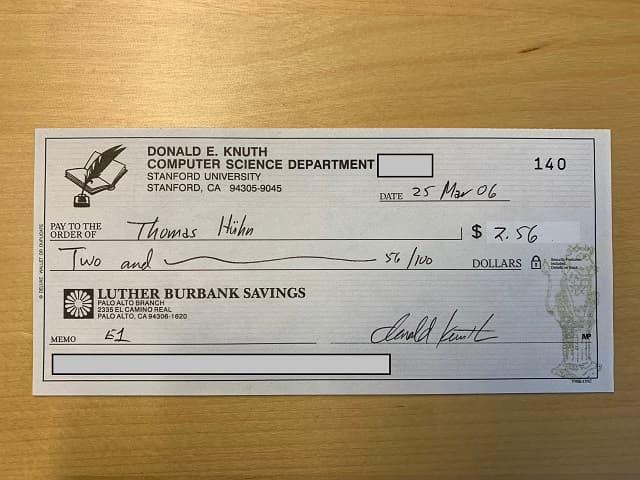 Figure: The Knuth reward check received by Thomas Hühn. The memo line notes “E1” corresponding to page 1 of Volume E; the amount is written as 0x$1.20 ($2.88 decimal). Account details are redacted to prevent fraud. Source: Thomas Hühn
The face value was uniquely calculated. Printed in decimal numbers, it was accompanied by a handwritten hexadecimal sum: “0x$1.20”, which converted precisely to $2.88. In Knuth’s reward system, the classic baseline bounty was $2.56—exactly one “hexadecimal dollar” (256 cents in base-16).
At just a couple of dollars, the sum cannot even buy a fast-food meal. The amount was kept deliberately modest to eliminate any incentive for commercial bounty hunting. In traditional publishing, errata collection relies on volunteer enthusiasm, with authors offering little more than a polite acknowledgment in future printings.
When errors carry a price tag, however, the dynamic shifts entirely. Readers become recognized quality assurance inspectors backed by a mutual compact, operating on equal footing. An open, written bounty instantly dissolves the psychological hesitation of peer review. Knuth demonstrated that uncovering an objective flaw carries intrinsic value—even if it is merely correcting a single letter.
Most recipients choose to frame and preserve their checks rather than cash them at a bank. Cashing a check cancels and destroys it. An intact check signed by Donald Knuth remains one of computer science’s ultimate badges of honor. This ceremonial weight inspired readers across the globe to examine every algorithm under a microscope.
Rewarding Constructive Insight: Why a Refuted Bug Still Earned $0.32
Encouraged by his initial success, Hühn revisited the texts years later and believed he had spotted another error. He worked out the mathematical derivation in detail and mailed it to Knuth. This time, the reply proved his hypothesis wrong. Knuth wrote three meticulous paragraphs explaining why the original derivation was sound, pinpointing a subtle boundary condition that Hühn’s calculations had overlooked.
An authority clarifying a young reader’s misunderstanding is normal enough, but the envelope still enclosed a check. Knuth explained that while the code bug was invalid, Hühn’s accompanying typography suggestion was insightful and had been adopted into the new edition. Valued under the hexadecimal scheme, that constructive suggestion was worth 0x$0.20—exactly $0.32.
This nuance highlights the precise boundaries of Knuth’s feedback loop. When confronted with criticism, many institutions either defensively stonewall or hand out superficial tokens regardless of validity. Knuth made clear distinctions: an invalid bug earned nothing, but genuine improvements were never denied compensation. Academic truth was never blurred to be polite, and minor contributions were never dismissed for being brief.
This mechanism preserved the reader’s appetite for rigorous exploration. As long as readers reasoned in good faith, a mistaken conclusion was met with clarity rather than ridicule. A robust feedback loop accommodates honest misjudgments while vigilantly honoring genuine contributions. Communication returned to objective evidence, keeping technical facts front and center.
Over decades of writing these masterworks, continuous bounties harnessed collective intelligence. Thousands of readers became the most discerning reviewers in the field, with every corrected flaw reinforcing the resilience of the published algorithms.
From Paper Fraud to the Bank of San Serriffe
With the dawn of the internet era, Knuth’s check tradition ran into modern security challenges. Delighted recipients began posting high-resolution photos of their checks on public forums. Printed across the bottom were real routing numbers and personal checking account details, offering an open door for fraud.
Malicious actors attempted to initiate unauthorized electronic withdrawals using the published credentials. In October 2008, faced with growing security liabilities, Knuth announced that he would stop issuing real negotiable paper checks. Yet an institution maintained for over thirty years did not vanish; it adapted to the times.
Knuth established the fictitious “Bank of San Serriffe”, issuing bespoke certificates of deposit. The name paid homage to the fictional island nation featured in the Guardian’s famous 1977 April Fools’ spoof—itself a pun on sans-serif typefaces. Each recipient received a certificate with a personal account number, with every transaction recorded on Knuth’s Stanford University homepage.
This move eliminated the financial risks of check fraud while keeping the prestige mechanism fully intact. Paper currency exited the stage, but the serious fulfillment mechanism beneath it remained untouched. Anyone who spotted a genuine defect continued to have their name entered into an open ledger of honor.
The medium shifted from currency to a virtual certificate, yet the bedrock of credibility never wavered. The core of the system was always formal, written validation from an authority, not a few dollar bills. Even with an imaginary bank, that acknowledgment carries enduring weight in the technical world.
Forcing Text Toward Perfection: Systems Triumph Over Good Intentions
In publishing and software engineering, authors frequently write: “Feedback and errata are warmly welcomed.” In practice, such statements often degenerate into empty formalities. When defects are pointed out, many creators instinctively react with defensiveness, or silently push patches without acknowledging the reporter.
Donald Knuth chose instead to put an open price on his potential mistakes. He credited readers’ names and page numbers in revised editions and sent back binding tokens of proof. Decades of discipline turned scattered corrections into a structured, highly effective engineering QA pipeline.
Textual rigor cannot rely solely on an author’s self-confidence. Even the most brilliant minds cannot anticipate every corner case. When pointing out flaws ceases to be an attack on authority, peer review becomes the cornerstone of lasting quality. Decades of rigorous scrutiny from readers ensured that this monumental work withstood the test of time.
Knuth’s checks are legendary because he built a fulfillment mechanism that endured for forty years. Only authors willing to pay for every single flaw can produce works that truly defy the passage of time. Through decades of real reward checks, he proved that great work welcomes the harshest scrutiny—and earns the deep respect of readers worldwide.
References:
- Thomas Hühn’s Blog: My Knuth Reward Check
- Donald Knuth’s Stanford Homepage: The Bank of San Serriffe
- Wikipedia: Knuth reward check
- Hacker News Discussion (item?id=50034081)