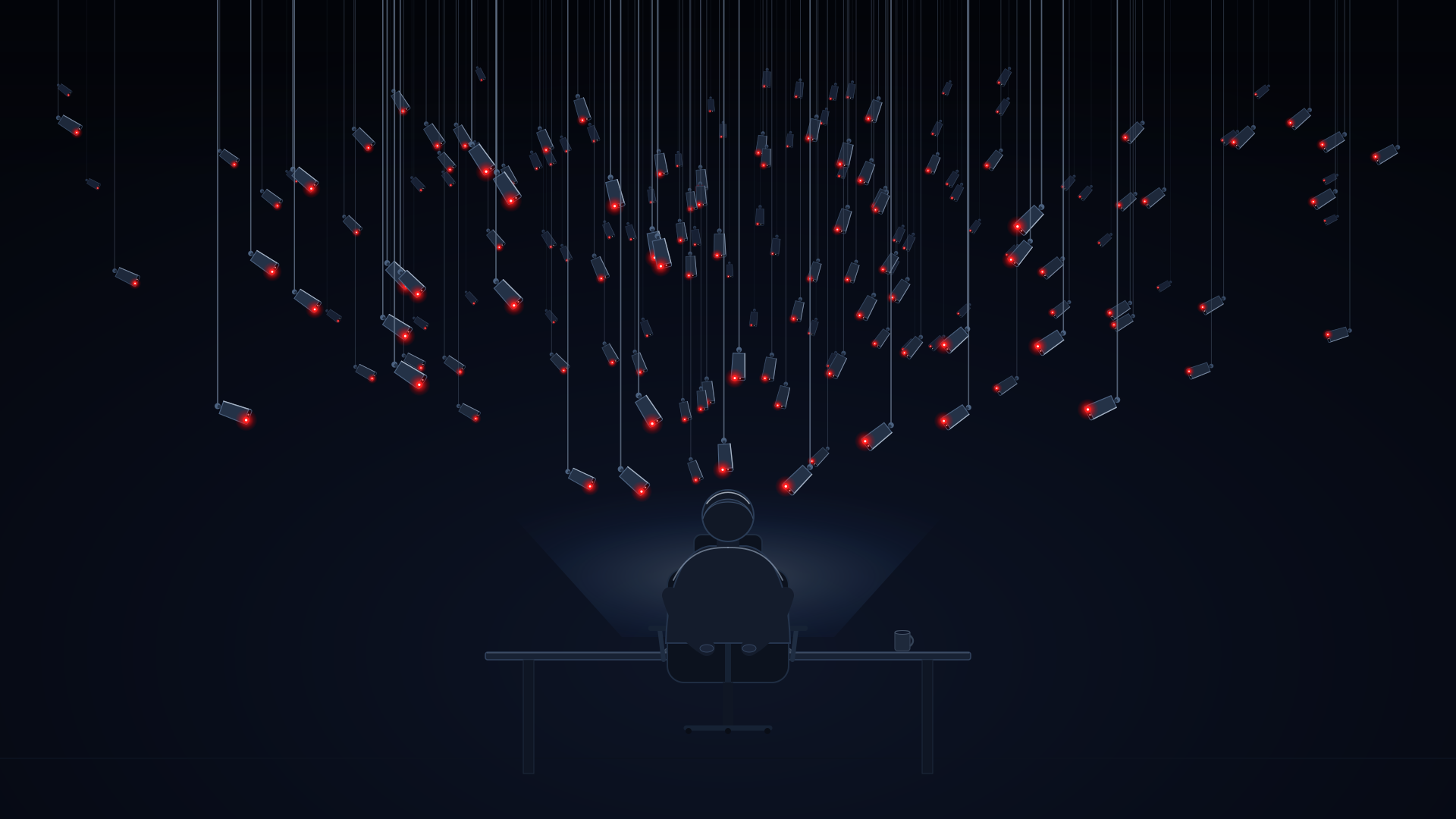
Ten years of working remotely from home, consistently earning solid performance reviews. Yet she lost her job simply for refusing to let a company-installed laptop webcam photograph her face every three minutes.
160 Snaps a Day: How Compute Turned the Home Desk into an Interrogation Room
A frontal facial snapshot every three minutes, totaling 160 automated captures each workday. In August 2026, Glennis Von Sander-Timinski, a veteran employee of more than a decade at a healthcare business process outsourcing firm, received an ultimatum from management: submit to continuous AI webcam surveillance, or forfeit remote work and endure a six-hour daily round-trip commute.
Diagnosed with systemic lupus erythematosus, she feared the severe stress would trigger a dangerous autoimmune flare-up and formally requested an accommodation. Her employer refused to reduce the capture frequency and fired her on September 8. On September 23, she filed a formal complaint in New Jersey Superior Court in Atlantic City.
The plaintiff worked for Sutherland Healthcare Solutions in Clifton, New Jersey, a provider specializing in healthcare business process outsourcing. She joined the organization after an acquisition in 2013 and had been approved for full-time telecommuting since 2018. Over her ten-plus years of tenure, her performance evaluations consistently met or exceeded expectations.
What shattered that equilibrium was the rollout of Sentinel AI, an automated monitoring platform. Under the deployment plan, the software tapped directly into the webcams on company laptops. Operating at regular intervals, it captured employees’ facial images to verify whether the assigned worker was physically seated at the screen.
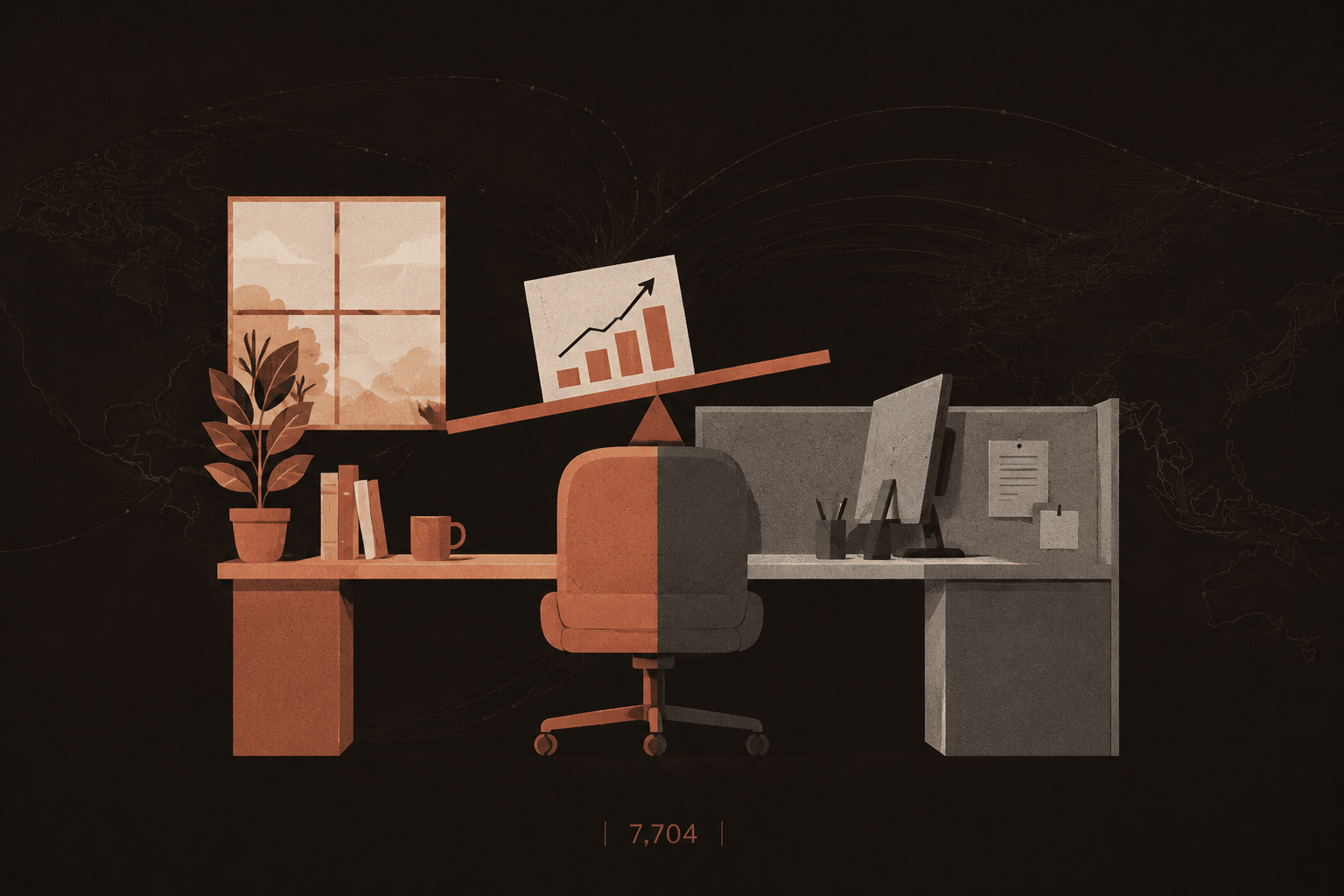
 Figure: Remote work environment. Source: Inc. / Adobe Stock
For knowledge workers accustomed to years of remote work, a three-minute sampling interval completely shatters natural cognitive rhythms. Reviewing paper documents, closing one’s eyes to formulate a solution, or jotting down notes by hand routinely takes several minutes. Forcing workers to face the lens every 180 seconds reduces genuine contemplation to a high-stress, performative reflex.
From an engineering perspective, ultra-high-frequency visual sampling is a fundamentally blunt management instrument. A snapshot taken every three minutes cannot gauge complex analytical reasoning or substantive business decisions. The algorithm fixates entirely on facial presence, crudely equating mere physical posture with meaningful economic output.
Doctor Recommends Accommodation; Employer Issues an Unyielding Ultimatum
The unrelenting gaze of the webcam quickly triggered severe physical repercussions. The plaintiff lives with systemic lupus erythematosus, a complex chronic autoimmune condition. Prolonged psychological distress and the constant feeling of surveillance can swiftly induce immune dysregulation, sparking acute, debilitating flare-ups.
Faced with deteriorating health, the plaintiff’s treating physician issued a formal medical note. The physician documented that high-frequency automated snapshots exacerbated the patient’s anxiety and formally requested that the company adjust monitoring to random spot-checks or substantially lower the capture frequency.
The company’s response left zero room for technical dialogue. Management presented three mutually exclusive ultimatums: accept the three-minute facial snapshots, report in person to the office daily, or face termination. The rigid configuration of software parameters was elevated entirely above employee health.
This ultimatum effectively cut off all avenues of compromise. The plaintiff resides in Atlantic County in southern New Jersey, nearly across the state from the northern office. A one-way commute takes three hours—a grueling six hours round-trip every day. For a tenured professional managing a chronic illness, such long-distance travel was physically impossible.
On September 8, 2026, the company terminated the ten-year veteran. Two weeks later, on September 23, she filed her lawsuit in New Jersey Superior Court in Atlantic City. The litigation has pushed the boundaries of algorithmic employee surveillance into the national spotlight.
Employers Demand Proof of Presence; Workers Lose Their Privacy Perimeter
Corporate justifications typically rely on a familiar rationale: remote work requires verifiable proof of physical presence, and healthcare outsourcing entails handling sensitive patient records alongside strict regulatory compliance. Employers argue that confirming who sits before the screen is an operational necessity. Yet the legal weight of that argument hinges entirely on whether the chosen degree of surveillance is proportionate and necessary.
While enterprises pursue quantifiable audit trails, managerial trust degenerates into a relentless stream of mechanical snapshots. Capturing an image every three minutes cannot detect depth of thought, nor can it evaluate the substantive quality of complex medical billing audits. Management substitutes facial presence for business output, reducing professional labor to the frame rate of a laptop lens.
Such intense visual pressure causes profound psychological damage in the workplace. Research from the American Psychological Association highlights clear hazards: frequent electronic monitoring sharply elevates stress levels and severely undermines mental well-being. A Canadian study similarly demonstrated that intrusive surveillance erodes job satisfaction and heightens feelings of helplessness over personal privacy violations.
Workers are forced to burn substantial energy counteracting algorithmic exhaustion and fatigue. To satisfy an automated system’s rigid definition of active presence, employees must constantly perform busyness. Rather than fostering productivity, this mechanism breeds mutual suspicion and squanders genuine collaboration on continuous defensive posturing.
New Jersey Pushes Bill S4075 While Most US States Lack Regulatory Guardrails
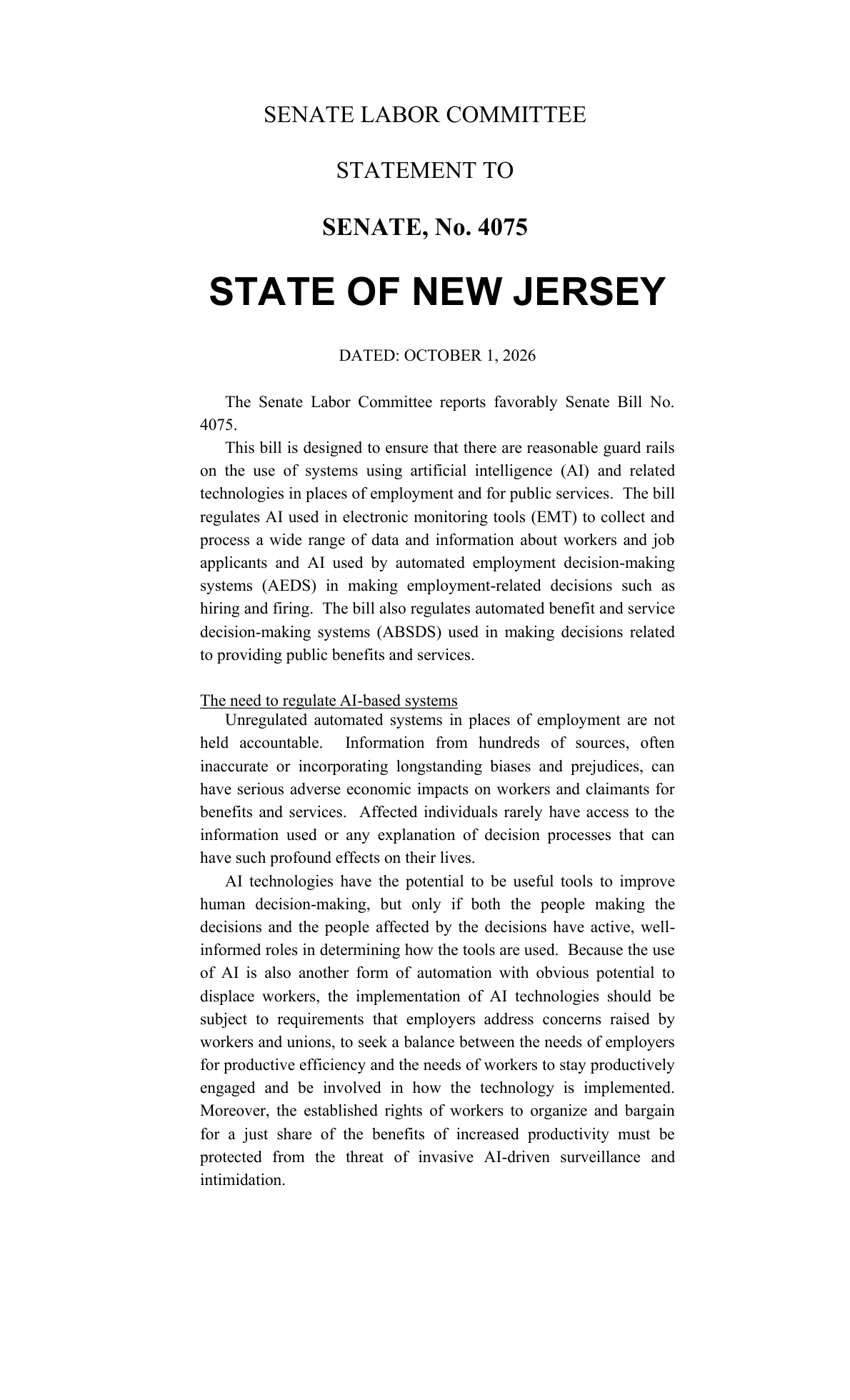 Figure: Front page of Senate Bill S4075. Source: New Jersey Legislature
Companies deploy uncompromising surveillance systems largely because regulatory guardrails remain absent. In the vast majority of US states, statutes set virtually no technical limits on employer surveillance. Only a handful of states provide minimal buffers: Maine, New York, Delaware, and Connecticut merely require employers to provide advance notice of electronic monitoring.
Advance notification alone gives employees zero leverage to refuse. Without statutory limits on monitoring frequency, workers remain trapped in take-it-or-leave-it arrangements. Notice without a right of refusal simply becomes a corporate waiver of liability.
New Jersey is now moving to fill this regulatory void. On October 1, 2026, the state Senate Labor Committee formally advanced Senate Bill S4075, endorsing new statutory protections. The bill targets workplace electronic monitoring tools directly, seeking to establish clear legislative boundaries at the state level.
Bill S4075 sets explicit thresholds for monitoring software. It restricts permissible monitoring hours, narrows operational scope, and limits the types of data that can be gathered. Crucially, the bill introduces independent algorithmic audits: monitoring mechanisms must secure third-party certification beforehand, sharply curbing an employer’s unilateral discretion to escalate surveillance.
At present, this dispute remains at the complaint stage, resting on allegations brought by the plaintiff. The company has yet to present its full defense in court, and New Jersey judicial authorities have issued no ruling. Yet the emergence of this lawsuit has already forced lawmakers to confront the growing power imbalance driven by workplace technology.
Surveillance Strips the Right to Refuse: How Obedience Tests Eclipse Real Output
Looking back across this termination dispute, AI surveillance systematically stripped the worker’s ability to say no. That small camera lens on a company laptop closed off the last remaining buffer of workplace autonomy. The home desk was transformed into a tightly regimented enclosure, smothering the breathing room required for genuine creative focus.
The employer chose to dismiss a ten-year veteran rather than adjust its snapshot interval. That decision lays bare the core logic behind such tooling: management’s ultimate objective is establishing unquestioning obedience as the baseline prerequisite for retaining employment.
Pushing monitoring frequency to a snapshot every three minutes completely dismantles the foundation of remote work. Telecommuting is intended to be output-oriented, grounded in mutual trust between employer and employee. Algorithmic surveillance does the exact opposite, treating every remote worker as a presumptive violator who must continuously prove their innocence.
This courtroom battle confronts the entire tech and business ecosystem with an unavoidable challenge. Technological capabilities have long outpaced antiquated labor statutes. Establishing enforceable legal guardrails between reasonable verification and invasive power abuse is now an urgent imperative for preserving basic human dignity in the modern workplace.
References:
- NorthJersey.com: Remote healthcare worker sues employer over mandatory AI webcam monitoring
- Inc. Magazine: Fired after refusing a photo every three minutes: A ten-year veteran’s case
- Cybernews: Remote worker terminated after declining 160 webcam snapshots a day
- New Jersey Legislature: Senate Bill S4075 draft on workplace electronic monitoring regulation
- American Psychological Association (APA): Research report on the health impacts of electronic employee monitoring