Instant Browser Play, Zero Vendor Textures in the Repository
Swarms of mechs and fighter aircraft clash across rolling hills. This real-time strategy game now runs seamlessly inside a modern web browser. Yet scouring the entire codebase reveals not a single original texture, nor a single track of the classic soundtrack. In October 2026, the open-source project Nanolathe launched its public beta. Players need no game directories, CD rips, or setup installers—launching Chrome, Edge, or Safari brings up three custom campaign missions playable immediately in the browser.
The engine delivers a faithful 2.5D real-time strategy foundation. Its reconstruction target is Total Annihilation, the landmark RTS released in 1997. Renowned for its true 3D elevation maps, simulated projectile physics, and realistic ballistic trajectories, it was among the defining titles that brought physical simulation into real-time strategy. Twenty-nine years later, the original binaries remain frozen in time, leaving modern OS compatibility entirely up to community patches and wrapper hacks.
The development team took a radically different route from traditional repackaged fan mods. Nanolathe is released under the permissive MIT license. The project’s homepage states its three core tenets plainly: play it, understand it, build upon it. The three in-browser missions are entirely custom-built scenarios. To play the full retail campaigns, custom skirmishes, or multiplayer battles, players transition to native desktop builds for Windows, macOS, and Linux, mounting their own legitimately owned retail game data files.
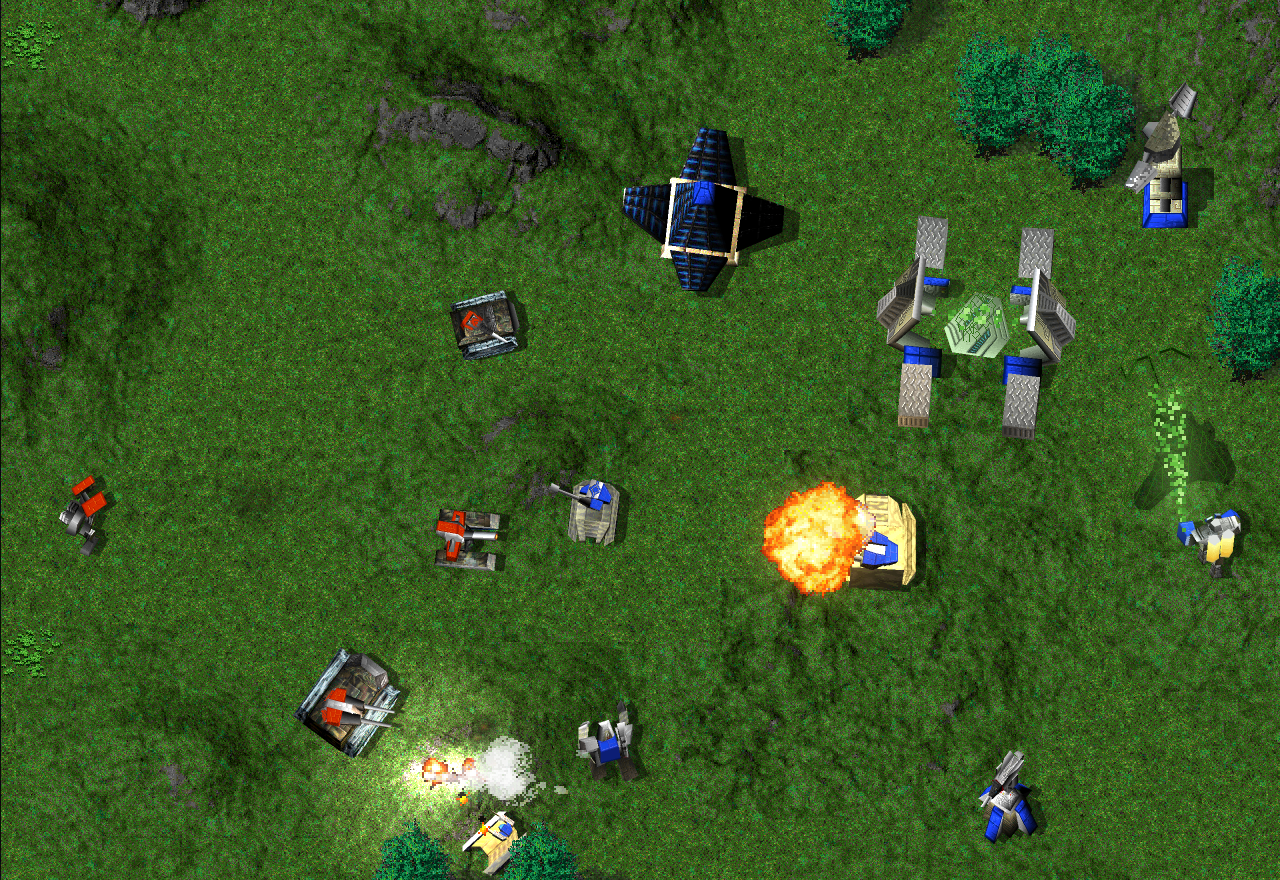 Figure: Panoramic battlefield view in Nanolathe rendered in Modern mode at 2x camera zoom. Source: Nanolathe official website
Decoupling Engine from Assets: A Legal Lifeline for Abandoned Classics
Classic video games frequently face an existential dilemma. Physical CD-ROM media degrades into bit rot, and original publishers cease commercial maintenance decades ago. The moment fan communities bundle and distribute patched game packages, corporate legal cease-and-desist notices promptly arrive. While IP holders are legally entitled to defend their rights, countless pieces of vintage digital heritage vanish in the crossfire.
Nanolathe navigated around this trap by establishing a clean separation of concerns. The game architecture is split strictly in two: proprietary audiovisual assets belonging exclusively to copyright holders on one side, and the underlying simulation engine belonging to the public on the other. The team rebuilt the game’s mechanics through clean-room reverse engineering. Analysts decompiling the original x86 binaries produced only architectural specifications and behavior documentation. Programmers building the new engine worked solely from those specification documents from scratch, never reading or touching a single line of original disassembly.
This disciplined development protocol firmly establishes the game’s simulation logic as a public asset. Nanolathe released three distinct tiers of project deliverables: the MIT-licensed engine source code, comprehensive file format reverse-engineering documentation, and complete clean-room research notes. The team maintains zero employment, commercial, or endorsement ties with the original copyright holders. Players provide their own legally acquired assets, while the engine serves strictly as a parser and deterministic simulator. Under established legal doctrine, copyright infringement claims have no purchase here.
Side-by-Side Renderers: Modern Lighting on the Exact Same Tick
For hardcore competitive veterans, the ultimate benchmark is always simulation fidelity. If a unit’s rotational slew rate drifts by half a degree, seasoned players notice the discrepancy immediately. If an elevation-based artillery ballistic check delays by even a single frame, critics argue that the project lost its soul. To prove the mathematical precision of the new engine, the developers embedded an interactive comparison slider on their homepage, featuring native captures at 960x640 pixels.
The two renderers duel side-by-side across the identical battlefield state. Both views capture the exact same split-second commit at the exact same committed simulation tick, viewed at identical 2x camera zoom. Classic mode faithfully reproduces the original 1997 CPU software rasterizer, featuring low-polygon terrain meshes, flat shading, and untextured surface polygons. Modern mode instantly transforms the scene with 2x synthesized terrain and foliage, paired with dynamic point lights and atmospheric glow effects.
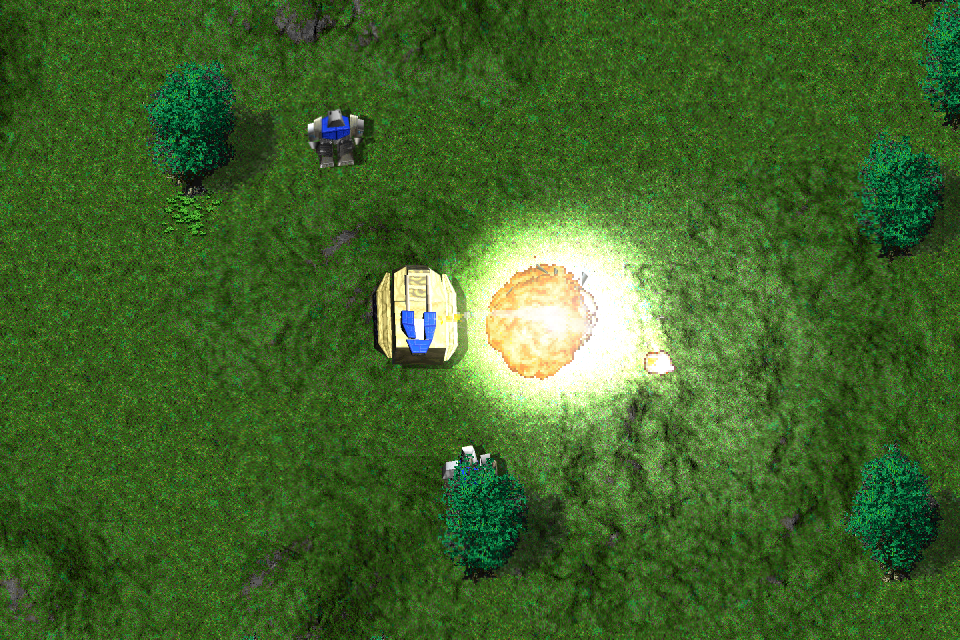 Figure: Dynamic lighting and bloom glow during a battlefield detonation rendered in Modern mode. Source: Nanolathe official website
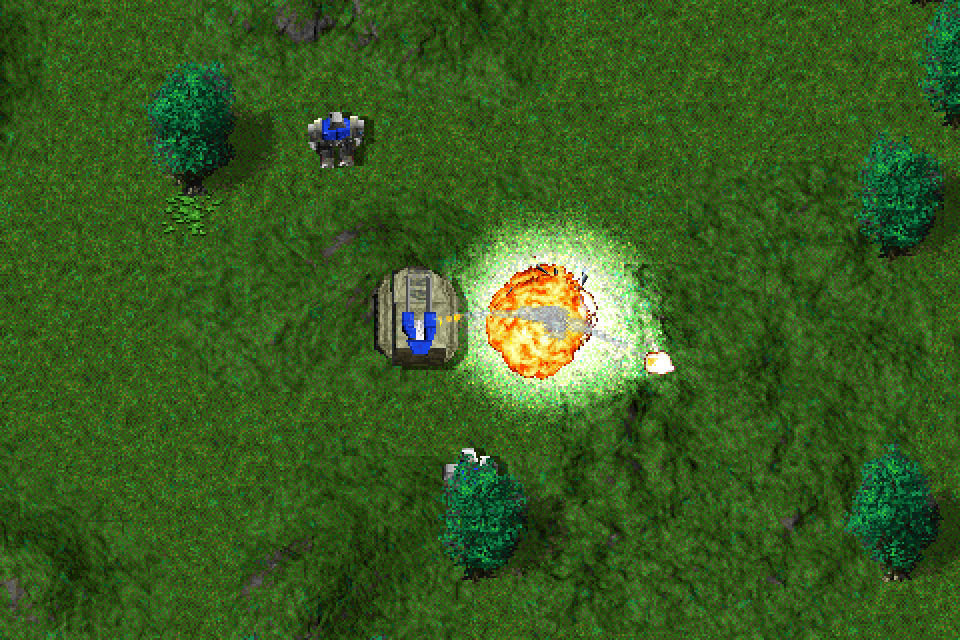 Figure: The original CPU software rasterizer displaying the same detonation at the exact same committed tick. Source: Nanolathe official website
While the aesthetic presentations diverge dramatically, the projectile impact coordinates, blast radii, and damage falloffs match down to the exact pixel and unit coordinate. The project sums it up in one phrase: “Same explosion. Different vibes.” The graphics pipeline can evolve freely with modern display hardware, but underlying collision detection, pathfinding grids, and simulated physical economies remain identical to the byte. Visual evidence proves the team’s governing design rule: graphics may scale arbitrarily, but the simulation core must remain bit-for-bit faithful.
Piracy Skepticism Meets Spiritual Successors: Two Divergent Paths
This hardcore reimplementation sparked spirited debates across the software development community. Critics dismissed the approach as a tedious exercise in legal hair-splitting. Some argued that layering modern shaders and resolution upscalers over a copyrighted game still constitutes derivative infringement, with a few voices even calling for GitHub to take down the repository. In their view, Total Annihilation has active rights holders; terminating commercial patches does not equate to copyright abandonment, and stripping assets alone does not guarantee legal immunity.
Proponents pushed back by citing decades of established legal precedent. Decades ago, Compaq famously reverse-engineered IBM’s PC BIOS, setting the foundational clean-room benchmark that enabled the personal computer clone industry. The open-source emulator community has operated securely under these exact doctrines for generations. If writing an engine completely from scratch using clean-room specifications were deemed unlawful, unmaintained abandonware and vintage digital culture would have no path to preservation. The debate transcends the codebase itself, cutting to the legal boundaries of software preservation.
Meanwhile, another faction of developers has charted a fundamentally different course. The open-source project Beyond All Reason (BAR) abandoned original legacy constraints altogether, rebuilding artistic assets, balance rules, and unit interactions from the ground up to support massive battles with hundreds of players and tens of thousands of active units. The community has thus split into two distinct philosophies: spiritual successors embrace modern competitive scale, while Nanolathe focuses on immaculately preserving the historical 1997 artifact.
Preserving Game Heritage Requires Open Code: Rules as Public Goods
Most commercial remaster efforts fall into the “reskin trap.” Publishers typically commission high-resolution textures and upgraded lighting, but because the original engineering staff departed decades ago, internal movement variables, unit physics, and timing mechanics quietly drift out of alignment. The true engineering hurdle in classic game restoration has never been visual fidelity; it lies in accurately reconstructing nuanced engine behaviors with zero proprietary code, and mathematically proving deterministic parity against the original.
With native desktop clients available for Windows, macOS, and Linux—using player-provided retail data files for campaign progression and multiplayer matches—Nanolathe crystallizes the 1997 simulation rules into clean, modifiable, and openly licensed software. The game’s engine is no longer chained to the commercial survival or licensing whims of any single corporate entity, securing its survival long after legacy platforms fade from existence.
Reference Links:
- Nanolathe Official Website & Documentation
- Hacker News Community Discussion
- Beyond All Reason Official Project