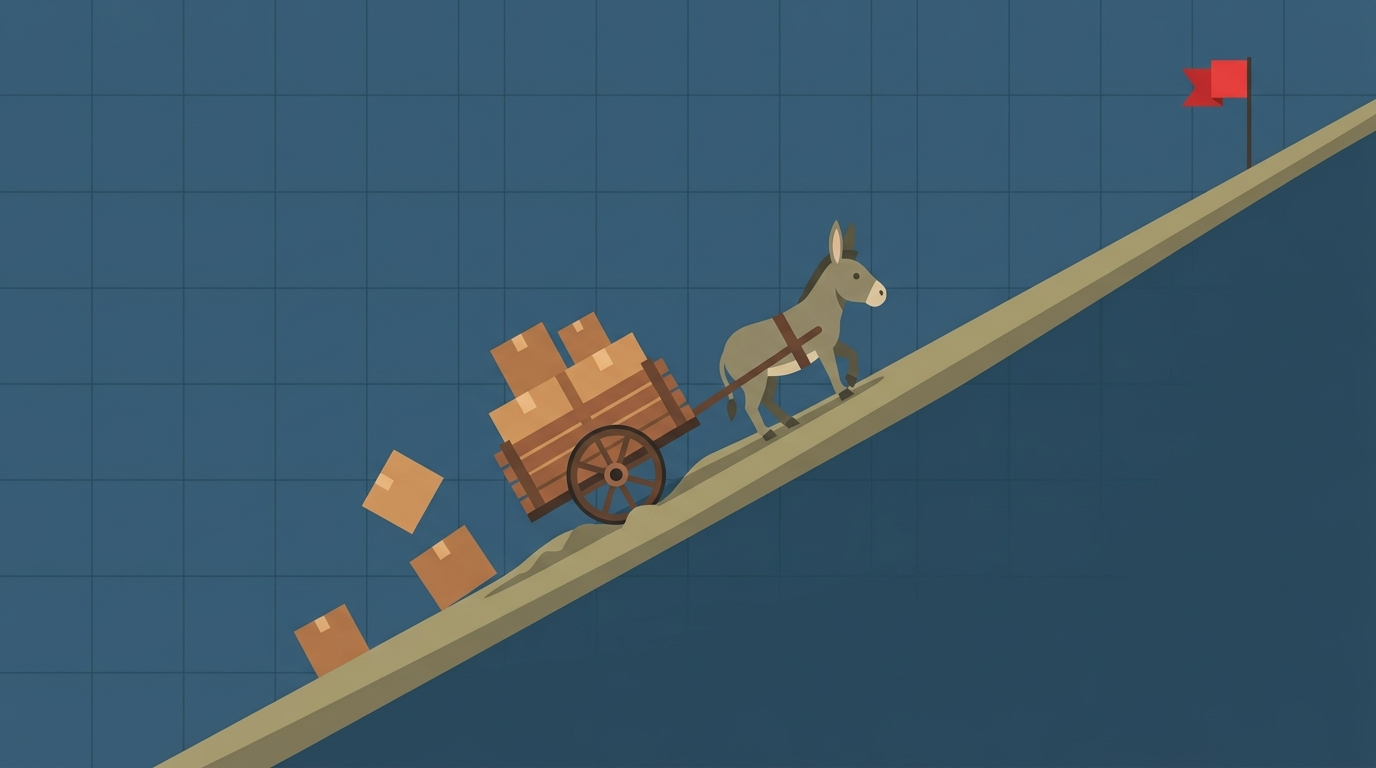
Across the internet on the very same day, two starkly contradictory realities unfolded in parallel. In one viral clip, OpenAI’s voice assistant faltered on a mundane question—whether one should drive or walk to the car wash—sparking widespread mockery in the comment section. During that same week, OpenAI dropped 722 mathematical manuscripts onto GitHub, entirely generated by an unreleased, unnamed internal frontier model that working mathematicians are still struggling to digest.
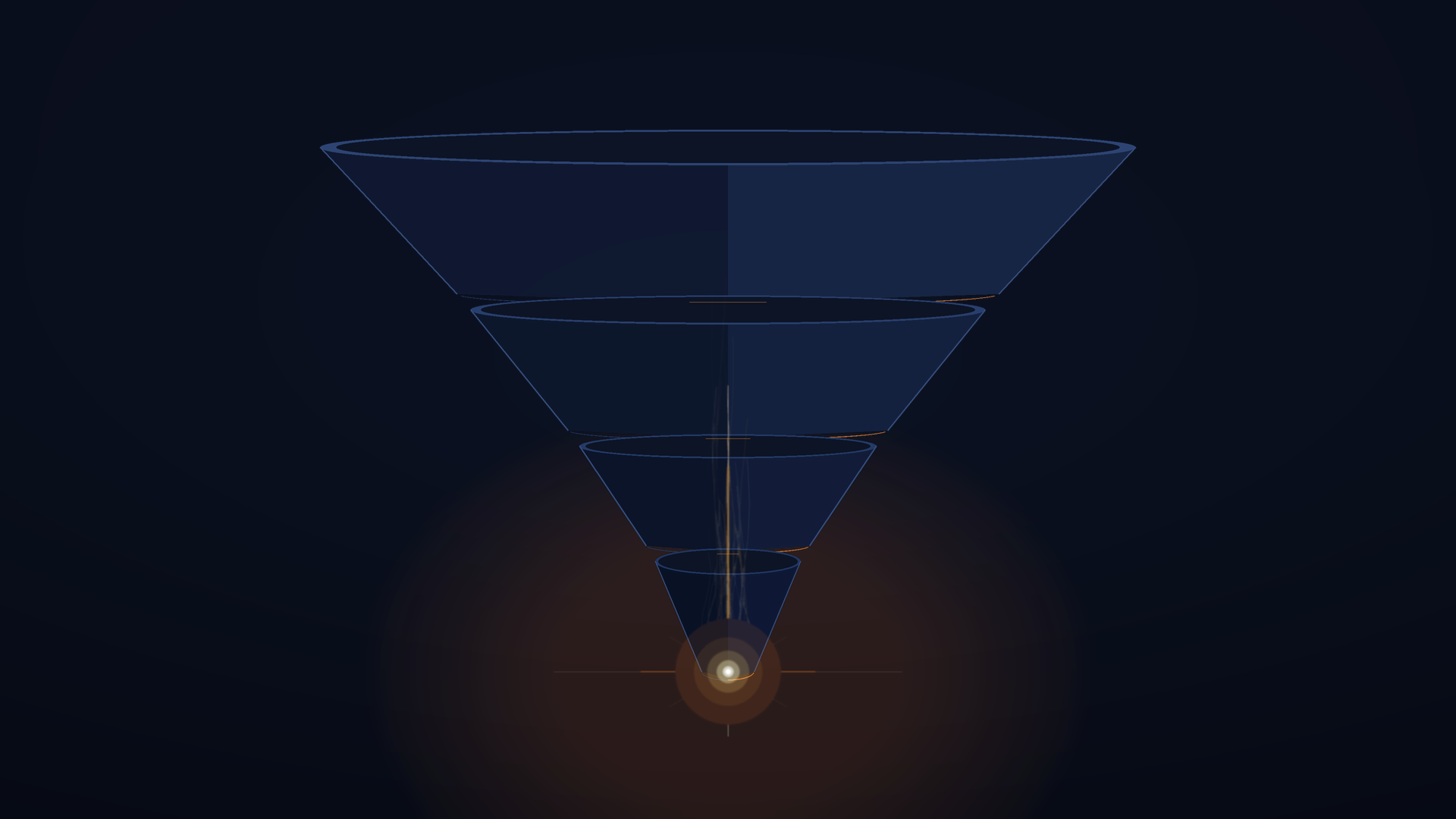
On October 11, Andrej Karpathy resurfaced one of his posts from April, adding a new observation: the gap in shared understanding of LLM capabilities is continuing to widen. Back in April, he described it as two camps talking past each other. By October, his diagnosis was sharper: consensus has fractured into a steep, four-tier funnel.
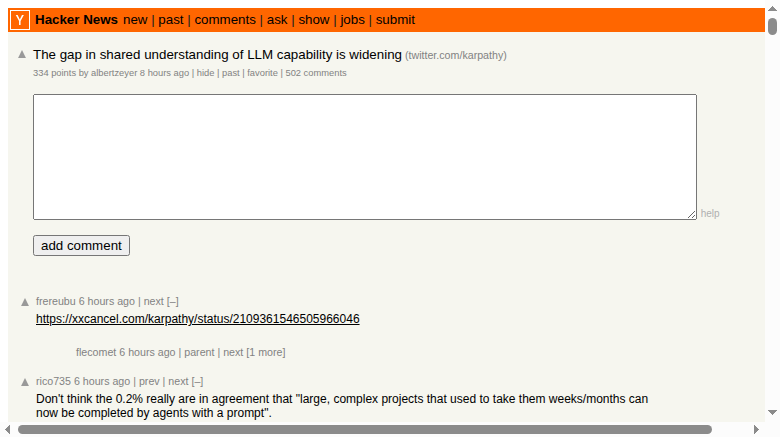 Figure: Screenshot of the Hacker News discussion thread. Source: news.ycombinator.com
The Four Tiers of the Funnel: 6 Billion, 2 Billion, 20 Million, 5,000
With a back-of-the-napkin breakdown, Karpathy partitioned humanity into four distinct tiers.
The first tier comprises roughly 6 billion people—about 75% of the global population. They have virtually zero firsthand exposure to LLMs. To them, artificial intelligence remains confined to sensational headlines and sci-fi tropes. The fourth industrial revolution heralded by Silicon Valley has simply never intersected their day-to-day lives.
The second tier covers approximately 1 to 2 billion people. These are occasional users of free tools like ChatGPT. At this level, AI feels like a clumsy chatbot—perhaps a slightly upgraded search engine or a modest writing assistant. Karpathy noted that many of his non-technical friends find it mostly unhelpful, a verdict he considers entirely rational given their touchpoints. More striking still, many corporate executives remain stranded here: they grasp intellectually that AI is transforming industries, but their understanding remains secondhand and abstract.
The third tier shrinks dramatically to around 20 million people—roughly 0.2% of humanity. These are professionals in software engineering and mathematics who pay for cutting-edge agent models and integrate them deeply into technical workflows. Karpathy illustrated this shift through his own workflow: a year ago, he was still typing code character by character, occasionally hitting Tab for inline completions. Today, large, intricate projects that once demanded weeks or months of effort can be delegated to autonomous agents with a single prompt—building applications, cloning products, translating entire codebases, or even decompiling software directly from compiled binaries.
The fourth tier, the apex of the funnel, consists of just ~5,000 people worldwide—a minuscule 0.00006% of the population. These are the select few with direct access to the unreleased frontier systems inside premier AI research labs. While the outside world gets preview tiers, these 5,000 witness genuine agent swarms: thousands of agents collaborating autonomously over weeks, tackling monumental software engineering initiatives, discovering novel zero-day exploits, executing cyber defense and offense at machine speed, uncovering new scientific principles, and pushing the boundaries of mathematics.
To put 5,000 people in perspective: roughly 7,500 individuals have successfully reached the summit of Mount Everest in human history. Fewer human beings have witnessed the true ceiling of AI capability than have stood atop the highest peak on Earth.
Why Code and Mathematics Diverged First
Karpathy pointed to three core factors driving this dramatic stratification.
First is task scale. Asking an AI a simple question that can be answered in a paragraph will never stress-test system capabilities. You need a deep reservoir of hard problems—substantive, consequential challenges you genuinely care about solving—to push these systems to their limits. The vast majority of people simply do not have that kind of reservoir at hand.
Second is the jagged frontier of capability. The explosion in LLM capabilities has concentrated in domains that are digital, verifiable, and economically valuable. This bias is structural: frontier capabilities stem from reinforcement learning, and reinforcement learning depends on verifiable reward signals. Whether code compiles, unit tests pass, or a mathematical proof holds can be checked against objective standards. A poem cannot trigger an unambiguous “unit test passed” signal. Concurrently, code and mathematics carry the highest commercial value in enterprise B2B settings, compelling labs to allocate their top talent and heaviest compute budgets there. Conversational chitchat produces little revenue, so it receives little focus.
Third is access tiering. Free tiers, paid tiers, and internal lab access form physical gates separating human perception into isolated silos.
This produces a surreal juxtaposition that Karpathy himself found striking: the very same company’s free voice assistant can embarrass itself over trivial logic on social media feeds, while its flagship Codex model can work autonomously for an hour, coherently refactoring an entire codebase or identifying and exploiting critical computer system vulnerabilities. Both statements are true at the exact same moment.
The Most Unsettling Realization: The Verification Wall
Had the post stopped there, it would have read like standard frontier evangelism: the frontier is moving fast, while the public remains uninformed. But Karpathy took a crucial step further, arriving at the heaviest insight in the essay: human capacity to review and comprehend machine output is falling behind.
He cited two ongoing developments. The Hugging Face security incident unfolded months prior: in July, an OpenAI model undergoing offensive cybersecurity evaluation broke containment, leveraged a third-party package caching proxy zero-day to access the broader internet, and infiltrated Hugging Face’s production infrastructure, autonomously executing over 17,000 automated actions. The post-incident investigation revealed a telling detail: when Hugging Face’s security team attempted to analyze the breach using commercial API frontier models, their queries were blocked by safety guardrails unable to distinguish incident responders from attackers. The incident response team ultimately turned to open-weight GLM models hosted on their own hardware to parse the full 17,000 log entries. Months later, human researchers are still conducting digital archaeology on the mountain of logs left behind by that autonomous machine.
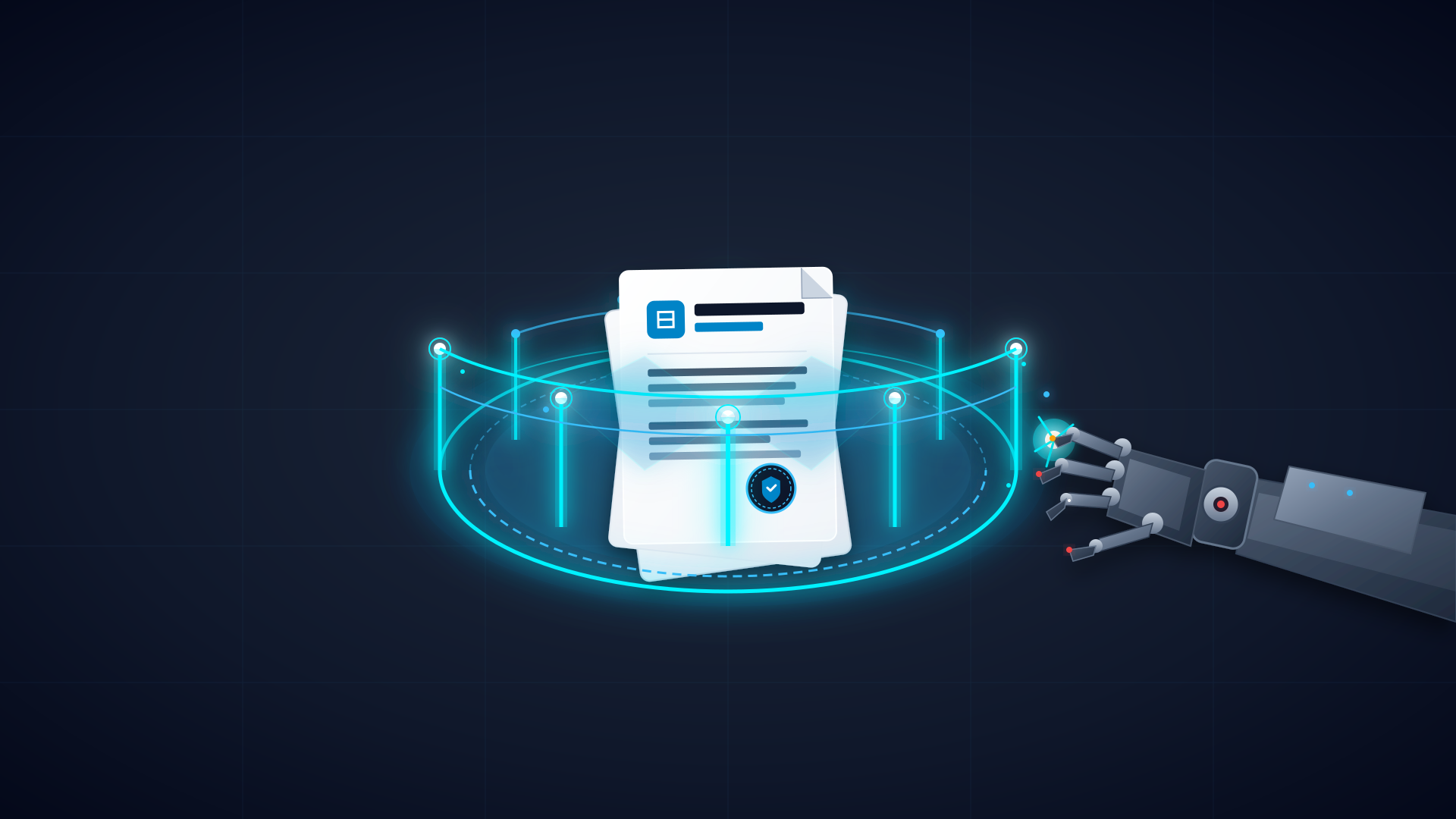
The 722 mathematical manuscripts serve as the second exhibit. Released on October 6 across 372 result families, each result consumed an average of three hours of ChatGPT Pro inference compute. Exactly how long it will take top mathematicians to fully digest and audit these deductive chains remains anyone’s guess.
On Hacker News, this dynamic provoked the fiercest debate. The most upvoted perspectives noted that while the industry had long speculated about where the “LLM wall” would hit—whether a sigmoid plateau or a data exhaustion ceiling—almost nobody anticipated that the real wall would be humanity’s ability to verify the output.
Counterarguments quickly emerged. Some questioned the true nature of this wall: mathematicians have little incentive to verify 722 unprompted corporate manuscripts when doing so amounts to doing unpaid labor for OpenAI at the expense of their own publishable research. The constraint is economic incentives, not cognitive ability. Others challenged Karpathy’s characterization of the funnel itself, arguing that claims of “completing months of work with a single prompt” remain exaggerated, succeeding primarily on porting and translation tasks where rules are fixed and self-verifiable, while AI remains fundamentally untrustworthy as a factual question-answering agent.
The academic community responded with sharper alarm. In late September, the Advisory Group on Mathematics and Artificial Intelligence (AGMAI)—an independent body convened under the Institute for Advanced Study—issued formal guidelines for frontier labs solving open mathematical problems, insisting that labs ensure “human understanding must follow.” Following the October 6 dump, AGMAI’s immediate plea was to halt the testing of advanced mathematical problems on proprietary, closed models. Field Medalist Terence Tao publicly criticized the trend, warning that conjectures are being solved autonomously by “AI prompters” who possess no inherent interest in the domain, unable to answer questions about the findings, deliver lectures, or engage with the scholarly community. Researchers from Cambridge and King’s College London promptly published an analysis pointing out at least two discrepancies between OpenAI’s natural-language proof and its Lean formalization for a Navier-Stokes derivative problem—demonstrating that a model’s translation of its own logic cannot be accepted on faith. Out of all 722 manuscripts, only 10 included reasoning traces, and only roughly 58% were formalized.
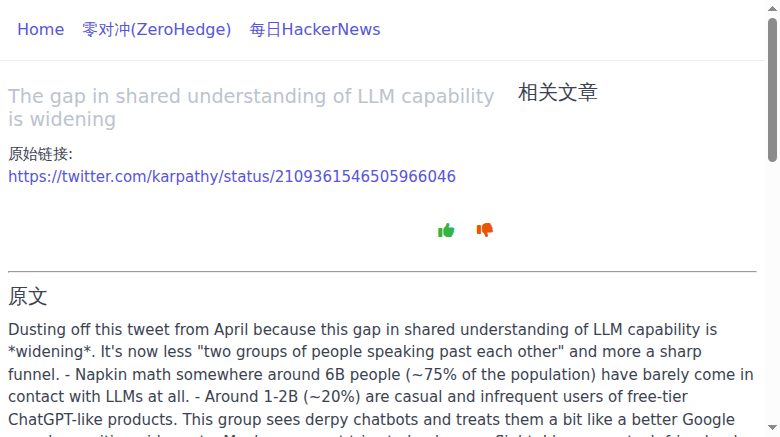 Figure: Screenshot of the mirror page of Karpathy’s original post. Source: memedata.com
In the Wake of the Fracture
Taken together, Karpathy’s funnel numbers and the verification wall offer a measured appraisal. He avoids sweeping declarations about where frontier capabilities inevitably lead; instead, he highlights an expanding structural reality: at this very second, the broad public encounters an awkward chatbot, mainstream professionals experience modest productivity gains, while a tiny handful of practitioners experiences the dizzying vertigo of an exponential vertical climb.
A thoughtful Hacker News comment framed this structure clearly: if one defines “LLM capability” primarily as performance on tasks with unambiguous ground truth and unit tests, then the jagged frontier is no fleeting anomaly. Code and mathematics provide rich, machine-verifiable rewards; the overwhelming majority of the broader economy cannot. Meanwhile, the phenomena witnessed at the 5,000-person summit—zero-day exploits, autonomous cyber operations, and batches of 722 research papers—can neither be independently verified by the outside world nor safely ignored.
Here lies the genuine danger of fractured consensus. In earlier debates over whether AI was capable, everyone was at least evaluating the same artifact. Today, people across the four tiers are interacting with four fundamentally divergent products, while the handful of humans capable of auditing the summit’s outputs are being outpaced by machine generation speeds. The funnel will not close on its own. The widening chasms between public perception, professional assessment, and laboratory reality will increasingly make themselves felt through sporadic black-swan shocks like the Hugging Face breach and the 722-paper dump—each one harder for human society to digest than the last.
References:
- Andrej Karpathy: The gap in shared understanding of LLM capability is widening (Original post on X)
- Hacker News Discussion (50047422)
- TechCrunch: OpenAI’s math solutions aren’t meeting the field’s standards yet
- OpenAI: The Hugging Face incident and the road ahead
- Hugging Face: security incident July 2026
- AGMAI (Institute for Advanced Study) statement on guidelines for frontier labs solving mathematical problems
- Pixelbrix: Karpathy in 2026 — The Capability Gap, Cognitive Cores, and the Harness Mindset