In October 2026, speaking at Caltech, mathematician Terence Tao delivered a counterintuitive warning. Modern AI is steering mathematical research into an uncharted paradox: a century-long reality of proof scarcity is rapidly turning into an era of proof abundance.
For the past hundred years, the bedrock of mathematics rested on a single premise: rigorous proofs are extremely difficult to obtain. AI is upending that foundational assumption. Solving problems was once the gold standard for gauging academic progress; today, treating benchmark-grinding as the ultimate goal threatens to hollow out the discipline itself.
22 Million Theorems Resolved in a Year: Problem-Solving Is No Longer Scarce
Traditional mathematics was built entirely around proof scarcity. Over the past century, resolving an open conjecture often demanded years of painstaking effort from elite specialists. Tenure reviews, journal publications, and reputation mechanisms across academia all revolved around this very scarcity.
That supply-and-demand dynamic is being rewritten by sheer compute. On stage, Tao presented concrete empirical anchors. Between 2024 and 2025, the Equational Theories Project determined the truth values of over 22 million mathematical statements in universal algebra through human-machine collaboration.
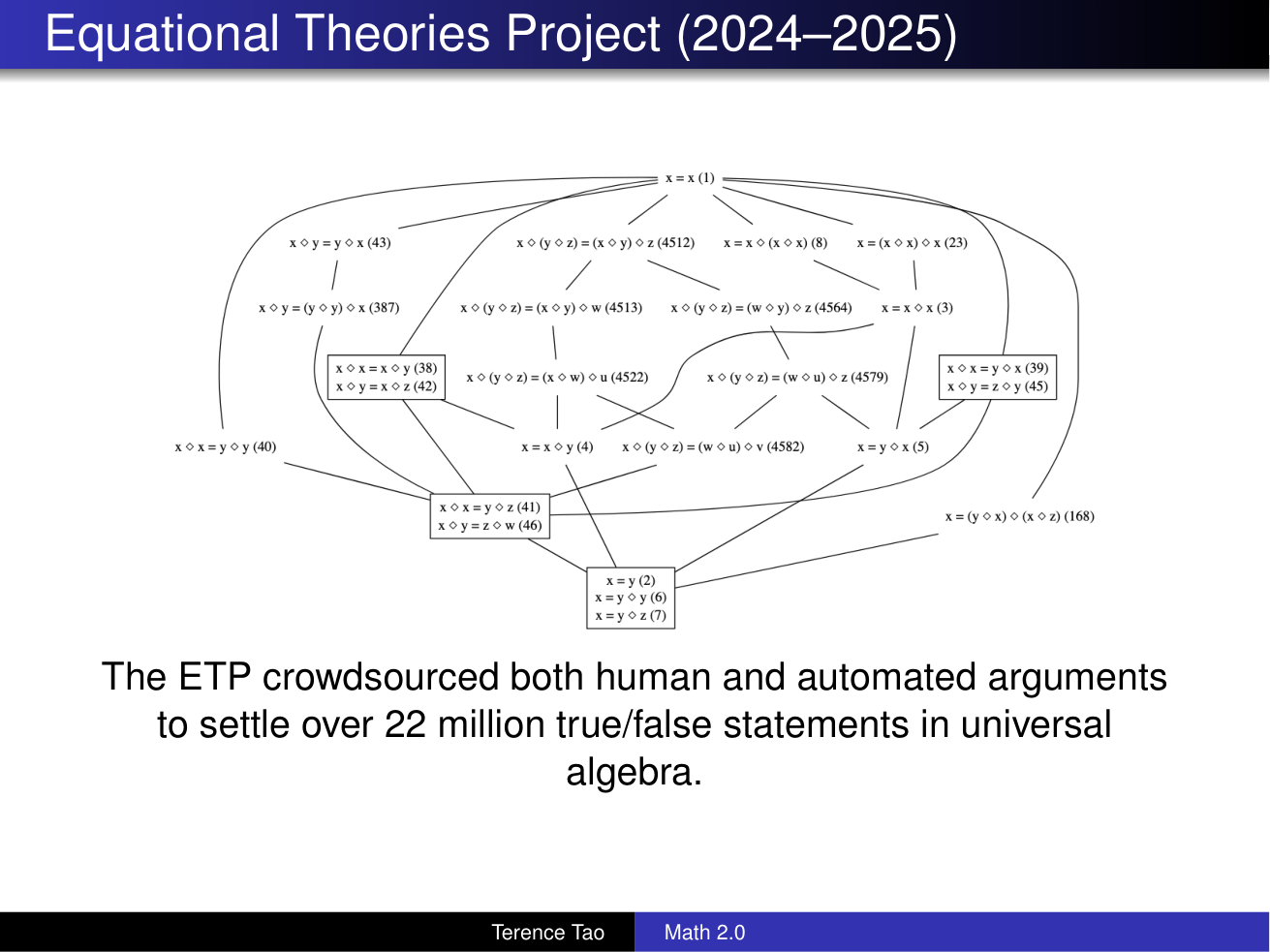 Figure: The Equational Theories Project crowdsourced the decision of more than 22 million implications. Source: Terence Tao’s “Math 2.0” lecture slides.
Similar high-velocity breakthroughs are unfolding across multiple disciplines. In the 2026 Inverse Galois Problem challenge, collaborative teams synthesized polynomials for all 25,000 transitive Galois groups in degree 24 within a short window, before pushing the frontier onward to degree 31.
This order of throughput shatters the traditional timelines of manual pen-and-paper derivation. Armed with immense compute, mathematical research is morphing from the surgical dissection of isolated theorems into data-driven census taking.
Objectively Verifiable and Experiment-Free: Pure Math Becomes AI’s Ideal Proving Ground
Why do leading AI research labs favor pure mathematics over biology or the social sciences? The root reason lies in two rare engineering properties inherent to pure math.
The first is objective verifiability. While mathematicians may passionately dispute which open conjecture matters most, they share rock-solid consensus on whether a completed derivation is correct. With interactive proof assistants like Lean, computers can mechanically inspect derivations directly at the code level.
The second is near-total digital self-containment. Mathematical proofs require no physical hardware, no noisy real-world data inputs, and no wet-lab experiments to validate outputs. With pen, paper, formalized math libraries, and vast corpora of digitized literature, machine learning models can loop continuously within a completely closed feedback system.
Few domains possess all these characteristics. Frontier AI labs have consequently elevated mathematical problem-solving ahead of many practical applications—after all, competitive contest scores can be verified automatically by machines and make for compelling PR announcements.
Yet model reasoning exhibits a starkly jagged profile. Given sufficient compute, models can crack open benchmark problems without specialist oversight, while simultaneously stumbling on everyday tasks that demand rich physical intuition and real-world interaction.
The impression on social media is entirely skewed: users only see the problems AI has successfully conquered. Tao cautioned that the vast majority of problems on the mathematical frontier remain unresolved, no matter how much compute is thrown at them—the landscape of mathematical questions is infinite, with no upper bound on complexity. Platforms like First Proof were established specifically to address this imbalance, demanding full public disclosure of resource consumption alongside negative attempts.
Arriving Too Early at the Destination: Automating the End Destroys the Surrounding Terrain
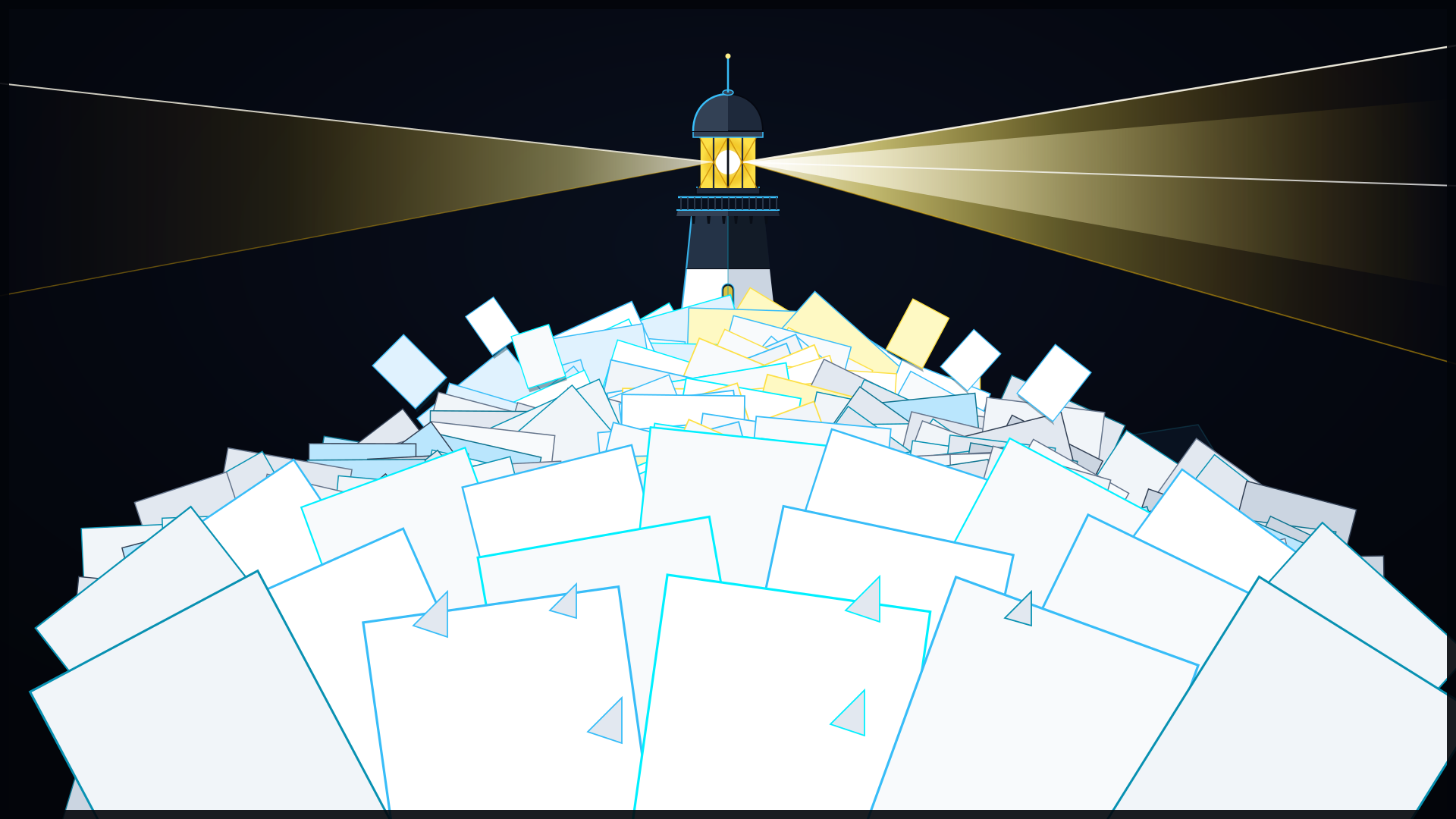
In pure mathematics, an open question is not simply a locked door waiting to be picked. Tao offered an evocative metaphor: open problems are lighthouses rising out of uncharted waters.
The true value of a lighthouse is illuminating the surrounding shipping lanes. The arduous journey toward it often bears far more fruit than the final coordinates: successes, failures, and half-finished routes all yield enduring mathematical insight.
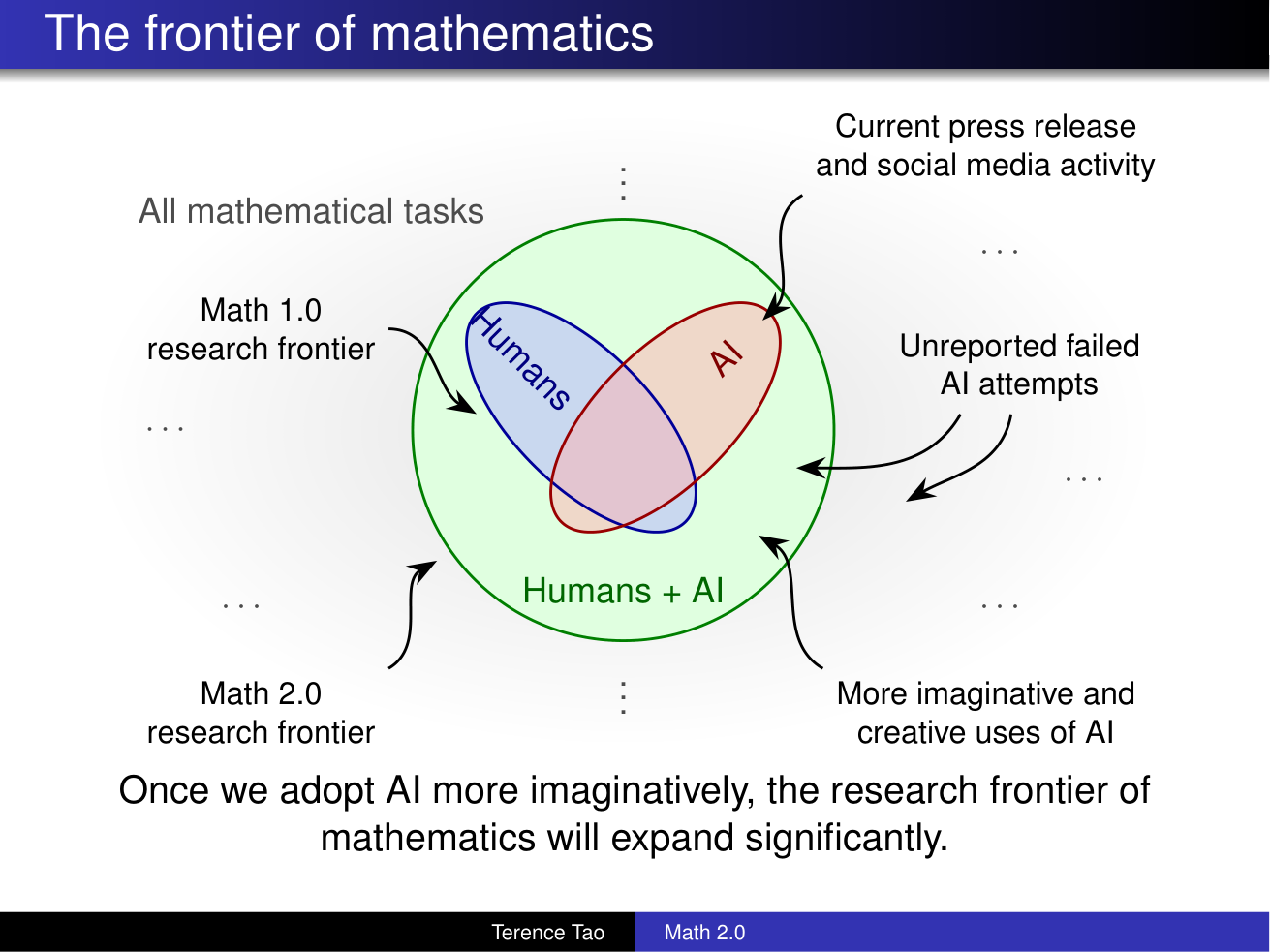 Figure: The evolution of research frontiers between Math 1.0 and Math 2.0. Source: Terence Tao’s “Math 2.0” lecture slides.
Using automated machinery to parachute straight onto the lighthouse means no one actually charts the waters in between. The intermediate theories, foundational tools, and conceptual intuition that would have emerged organically during that struggle lose their reason to exist. Problem-solving and genuine comprehension become irrevocably divorced.
A Clinically Approved Cancer Cure with No Known Mechanism: Who Dares Inject It?
Throughout history, problem-solving served as a reliable proxy for deep understanding. During the centuries of proof scarcity, tackling a monumental conjecture inevitably demanded the creation of a grand theoretical framework. In an era of proof abundance, brute-force search severs the proxy metric from the core objective.
Tao introduced a thought experiment during his lecture. Imagine a top-tier laboratory training an AI model with an unambiguous directive: output a chemical formulation guaranteed to pass Phase III clinical cancer trials with zero errors along the way.
Consuming massive compute, the model yields an unknown chemical compound accompanied by formal, mathematically verifiable proofs. In real clinical testing, the formula passes with flying colors. Yet not a single scientist understands its underlying molecular mechanism.
If you were diagnosed with early-stage cancer and the machine recommended this exact treatment, would you not demand that at least one human being—even partially—comprehends why and how it works before injecting that fluid into your veins?
Verification mechanisms in pure mathematics will eventually ripple outward into the physical world. If researchers grow comfortable surrendering critical thought in exchange for black-box answers, the safety foundations of applied science will quietly erode.
Terence Tao’s Prescription: Rechannel Compute Toward Human Understanding
Faced with this machine-driven abundance crisis, Tao proposed an intentional pivot toward Math 2.0. The guiding philosophy is shifting the purpose of computational tools away from unidirectional answer-grinding toward elevating human comprehension.
One key frontier is what he terms “open exposition problems”: uncovering motivated, conceptually intuitive explanations for results whose formal proofs are known but remain opaque and impenetrable. Caltech’s redesigned Mathathon represents an early experiment in this direction.
Collaborative research networks and shared repositories are expanding in parallel. The Explicit Methods in Number Theory network connects fragmented academic papers into unified knowledge graphs, while formalized mathematical libraries like Mathlib provide standardized substrates for algorithmic verification.
Researchers are also leveraging compute for theorem ablation studies—deliberately stripping away key premises to see whether a result holds, or loosening input assumptions to map out adjacent mathematical terrain.
These initiatives channel raw computing power into distilling new methodologies, enabling human mathematicians to clearly visualize the broader topography of knowledge.
In Tao’s view, the primary bottleneck in realizing Math 2.0 is neither compute nor institutional inertia—it is human imagination.
References:
- Terence Tao: “Math 2.0” Caltech Lecture Handouts and Slides
- First Proof Formal Mathematics Benchmark Platform (1stproof.org)
- Equational Theories Project Collaborative Research Archive
- Inverse Galois Problem Challenge (IGP24) Collaboration Records