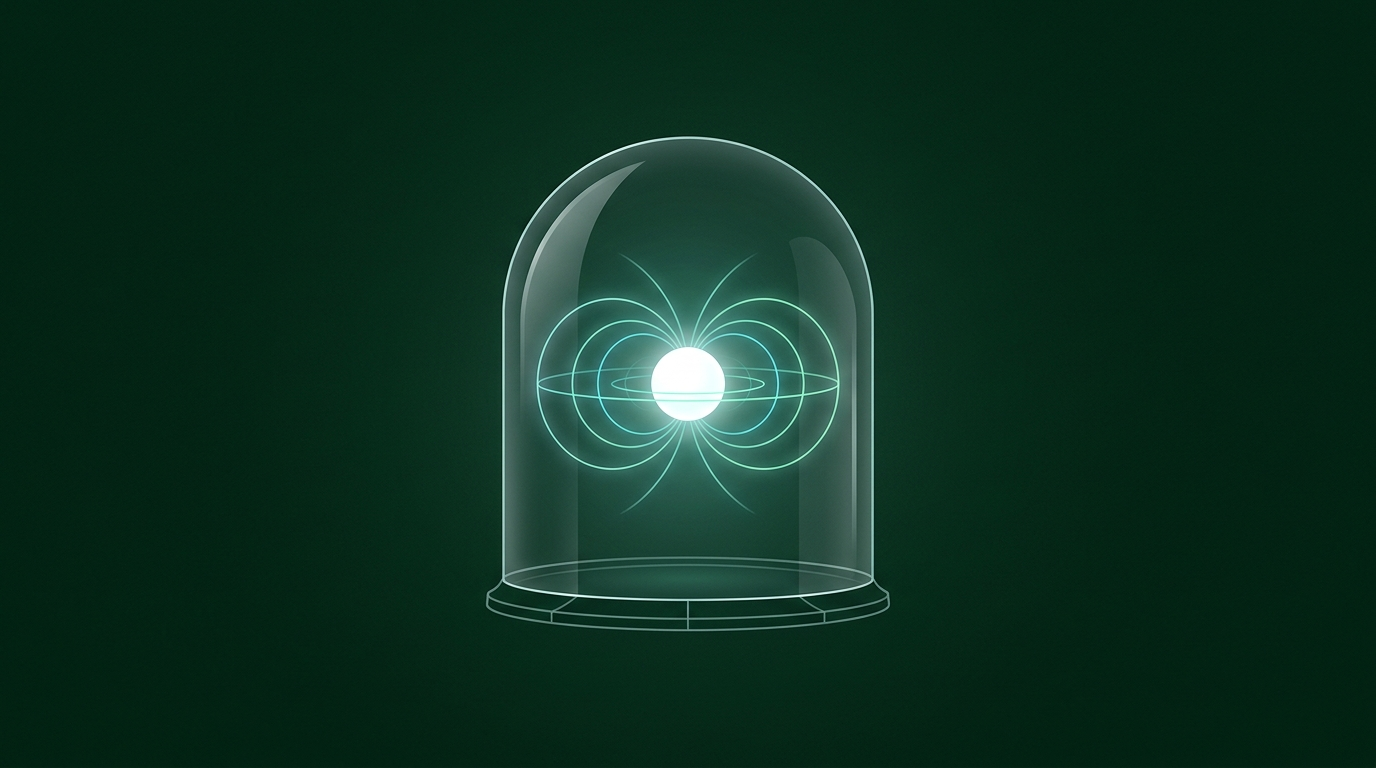
On October 21, 2026, a research team from Northwestern University published a milestone paper in Physical Review Letters. Physicist Gerald Gabrielse, in collaboration with doctoral student Thomas Myers, managed to trap a single positron in their laboratory for a full 30 days. Positrons are the antimatter twins of electrons. The moment a positron touches a single ordinary atom, it vanishes into a burst of gamma rays in less than a nanosecond. Studying antimatter in the past was like trying to carve an intricate ice sculpture under the blazing midday sun; Northwestern has now built a wall-less electromagnetic cage where that delicate snowflake can survive for weeks.
Holding an isolated antiparticle stable for an entire month transforms the ancient mystery of “why the universe is made of matter” into an actionable, measurable experimental parameter. With this extended measurement window, scientists can determine the positron’s magnetic moment to an unprecedented precision of one part in ten trillion ($10^{-13}$). This measurement poses a direct challenge to the Standard Model of particle physics: are matter and antimatter truly symmetrical down to the finest scale?
The Standard Model Says the Universe Should Be Empty, Yet Here We Are
The Standard Model forms the bedrock of modern particle physics. Within this framework, matter and antimatter behave like mirror images. An electron carries a negative charge, while a positron carries an identical positive charge. Their masses, spins, and fundamental physical properties are predicted to match with absolute perfection. Physicist Roni Harnik of Fermilab, who was not involved in the research, used the analogy of a videotape: play the motion of a positron in reverse, and it looks entirely indistinguishable from an ordinary electron.
Look up at the night sky, however, and this elegant theory runs headlong into the cosmos’s greatest paradox. According to the Big Bang model, the birth of the universe 13.8 billion years ago should have created matter and antimatter in strictly equal amounts. If they were perfectly symmetrical, they would have annihilated one another completely in that violent infancy, leaving behind nothing more than a featureless expanse of radiation. Yet today, stars, galaxies, planets, and humans are all made of ordinary matter, while primordial antimatter is nowhere to be found in nature.
The equations of the Standard Model are brimming with symmetry, but our actual universe reveals a blatant asymmetry. To uncover concrete physical clues as to why the Big Bang favored matter, the most direct approach is to place the electron and positron on the exact same scale. Physicists must compare their magnetic moments—the measure of each particle’s intrinsic magnetic strength—digit by digit. Any detectable deviation past the decimal point would reveal the first crack in the Standard Model.
Electrons Measured to Parts per Trillion, While Positrons Vanish in a Flash
This comparison has long suffered from an enormous experimental imbalance. Years ago, Gabrielse’s team pushed the precision of the electron’s magnetic moment down to roughly one part in ten trillion ($10^{-13}$). That level of precision is comparable to measuring the distance from the Earth to the Moon with an uncertainty smaller than the width of a human hair, and it remains one of humanity’s most stringent tests of quantum electrodynamics.
The moment researchers attempt the same test with positrons, the ultimate experimental adversary steps in: the ordinary matter that permeates every corner of a laboratory. Whether a container is forged from stainless steel, glass, or ceramics, its inner walls are composed of regular atoms. If a positron strikes the container wall or collides with a single stray gas molecule in a vacuum chamber, both particles immediately undergo mutual annihilation. Their rest mass is converted in an instant into two back-to-back gamma-ray photons.
 Figure: Positrons instantly annihilate upon contact with ordinary matter, presenting the primary engineering hurdle for high-precision antimatter experiments. Source: Scientific American
Unable to capture positrons and hold them for long, physicists could never achieve the measurement precision possible with electrons. Historically, before researchers could even tune the microwave frequencies of their detectors, captured positrons would drift into the walls and disappear. Reaching parts-per-trillion precision required a non-negotiable engineering breakthrough: a container without walls.
Sodium-22 Yields a Single Particle, Electromagnetic Fields Form a 0.3 Kelvin Wall-less Cage
Where do you get antimatter? That was the first logistical problem the Northwestern team solved. Many particle physics groups rely on multibillion-dollar high-energy accelerators to smash particles together. Myers and Gabrielse chose a much more compact, elegant alternative: Sodium-22 ($^{22}\text{Na}$). With a half-life of roughly 2.5 years, this radioactive isotope continually emits positrons via beta decay, serving as an on-demand tabletop antimatter generator.
Once a positron is harvested, researchers steer it into a custom-designed Penning trap. Because physical surfaces are fatal to antimatter, this trap eliminates physical contact altogether. Electrostatic fields cap the top and bottom of the chamber, driving the positively charged particle toward the center, while a powerful magnetic field wraps around it to force the positron into tightly bounded circular orbits. The entire apparatus is then cooled down to 300 millikelvins—a mere 0.3 degrees above absolute zero.
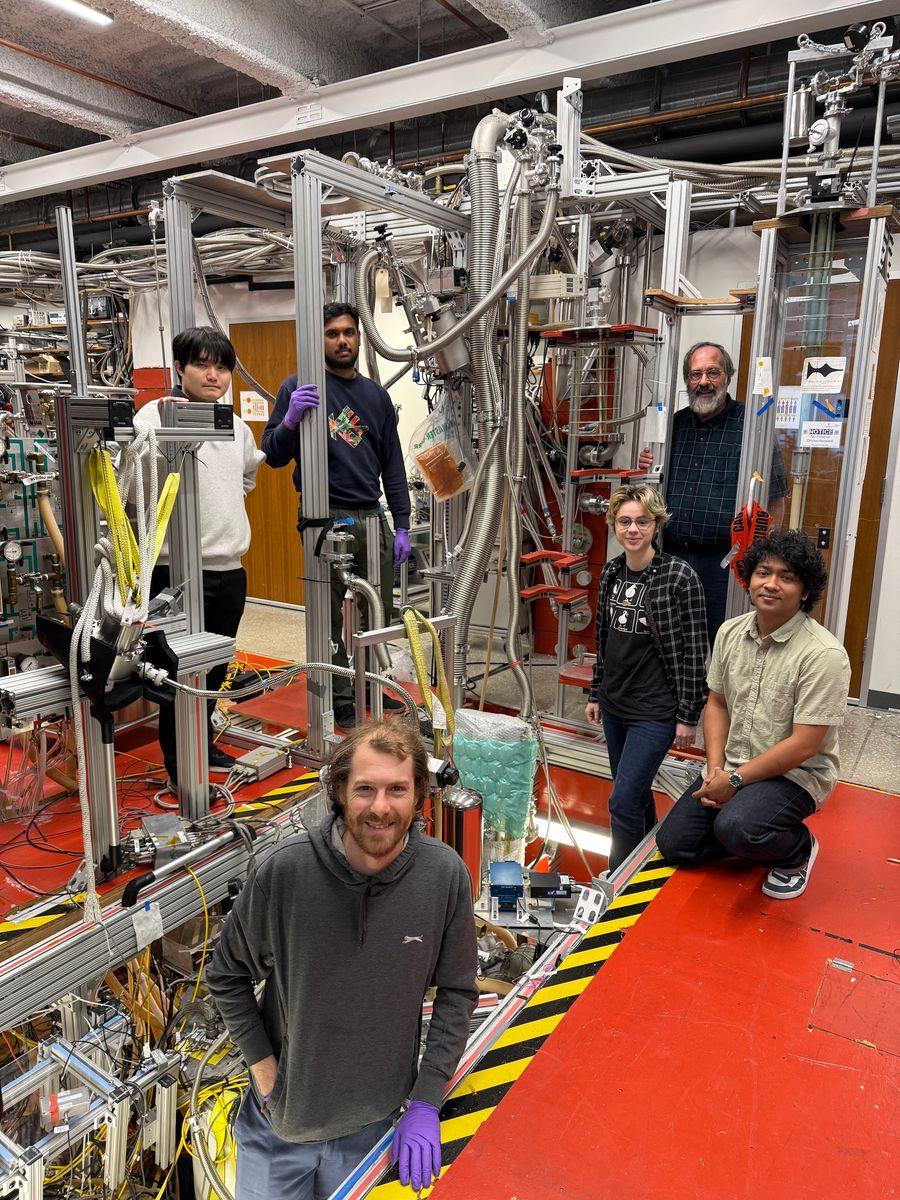 Figure: The wall-less Penning trap system inside Northwestern University’s laboratory uses electromagnetic fields and cryogenic cooling to suspend a single positron in isolation. Source: Scientific American / Northwestern University
Operating at 300 millikelvins accomplishes two critical goals: it calms the positron’s kinetic energy and freezes residual gas onto the chamber walls. In an environment just 0.3 degrees above absolute zero, any remaining gas molecules freeze onto the cold surfaces like frost, creating an ultra-high vacuum at the center. The positron’s thermal motion drops to near stillness. Suspended safely at the geometric center of the electromagnetic fields, the particle remained trapped for a month—and in theory, the apparatus could hold the exact same positron indefinitely.
Flipping Quantum States in a Tabletop Cyclotron to Level the Playing Field
Confining the positron for 30 days is only the first half of the journey. The second half involves performing quantum-state resonance spectroscopy on the isolated particle. Gabrielse’s team refers to the setup as a quantum cyclotron, an architecture inherited directly from their earlier electron experiments. Because positrons share the exact mass of electrons while carrying the opposite charge, researchers simply reverse the electrode polarities to measure the antimatter twin with the very same apparatus.
The measurement takes place at the level of individual quantum states. Scientists inject tuned microwave radiation into the trap, driving the single positron’s spin to flip and causing it to transition from its lowest-energy ground state to its first excited state. By precisely tracking the energy and magnetic frequencies required to trigger this quantum jump, researchers can calculate the positron’s magnetic moment.
When the findings were shared across tech and physics communities, many observers asked: why focus on positrons rather than antiprotons? The answer lies in structural cleanliness. Protons and antiprotons are composite particles packed with three quarks bound together by gluons; strong nuclear interactions muddy high-precision signals. Positrons, by contrast, are point-like leptons devoid of internal substructure, meaning their magnetic moment directly connects to the fine-structure constant. Choosing the cleanest possible particle is what makes it feasible to push measurement errors out to the 13th decimal place.
A Month-Long Trap Ends, and the Standard Model Enters the Test Chamber
Historically, physicists investigating the matter-antimatter puzzle had two main options: construct multi-kilometer particle colliders costing tens of billions of dollars, or push equations on chalkboards. Northwestern’s tabletop confinement approach demonstrates a powerful third way—trading time for precision.
With a single positron held undisturbed for 30 days at 0.3 Kelvin, physicists no longer have to race against nanosecond annihilation timers. They can repeatedly excite and probe the same particle, systematically stripping away magnetic fluctuations and thermal noise. Funded by the National Science Foundation (Grant No. 2110565), this breakthrough tames antimatter from a fleeting streak of light into a stable, tabletop calibration standard.
The fundamental law that antimatter vanishes on contact remains unchanged, but humanity’s observation window has expanded from nanoseconds to a full month. As researchers match the 13th decimal place of the positron’s magnetic moment against that of the electron, one of two outcomes awaits: if both values match identically, the Standard Model will hold its ground once again; but if even the final digit diverges, physicists will hold their first tangible clue to the cosmic mystery of why our universe exists at all.
References:
- Physical Review Letters paper (DOI: 10.1103/gbkc-6nlj)
- Scientific American reporting (Clara Moskowitz)
- Northwestern University press release
- Hacker News discussion thread