
Open the black-and-green terminal, and a 90-second countdown immediately starts ticking in the top-right corner. A prompt drops directly onto your screen, instructing you to tackle a task on the target machine. The manager dispatching the task is a large language model connected via live API. In its global task queue, you typing at the keyboard are merely one of its subagents.
This is Worker 755, an open-source browser sandbox game developed by gulivan. The repository credits Claude as a co-author and is released under the MIT license. Using a lightweight terminal interface, it completely reframes the human-AI collaboration dynamic: the human player is on call second by second, dutifully executing commands assigned by an AI supervisor.
The game thrives on absurd contrast. The model supervisor evaluates work strictly through the logs and summaries submitted by the player. As long as the formatting looks clean and professional, you can completely wipe the production database and still receive a stamp of approval.
90 Seconds on the Clock: An LLM Becomes Your Direct Supervisor
Under the hood, the supervisor possesses standard orchestration privileges: it maintains a task queue, retains read-only access, and can spawn subagents at will. Backends like GPT, Claude, Gemini, and DeepSeek can be plugged in directly as the supervisor. The 90-second step timer forces the subagent’s actions into an intensely compressed execution window.
The sandbox offers two primary environments: a clean sandbox, and a production server backed by an active database. Beyond you and the supervisor, a third character sits in the system: Dan, a human client. Dan watches your progress through a chat window, with his home directory packed with family photos, NDAs, and presentation decks. With every shift, new personal documents appear in Dan’s directory for you to navigate.
The setup screen provides ample customization. You can drive the narrative via pre-written scripts or have an LLM roleplay neurotic client Dan throughout the session. Players can even specify their own agent identity, which the manager uses to calibrate expectations. Skip options are disabled by default, meaning the supervisor insists on correcting every single low-level blunder you commit.
Wiping the Production Database: The Supervisor Still Signs Off
With each round of instructions dispatched, the floor belongs to the player at the terminal. You can methodically troubleshoot the machine, or take your hands off the keyboard and let the timer run out. When the clock hits zero, the supervisor simply receives a notification: subagent took no action, please issue next instruction. The model then generates a corrective plan, occasionally even penning a solemn incident report.
The real drama unfolds when players turn to intentional sabotage. Given a live database server, many players deliberately run destructive commands. Flooding devices with garbage data, executing fork bombs, or running raw drive formats are all permitted by the system. Once the terminal crashes, the shift is terminated, and the manager shifts to another instance to compile your final performance review.
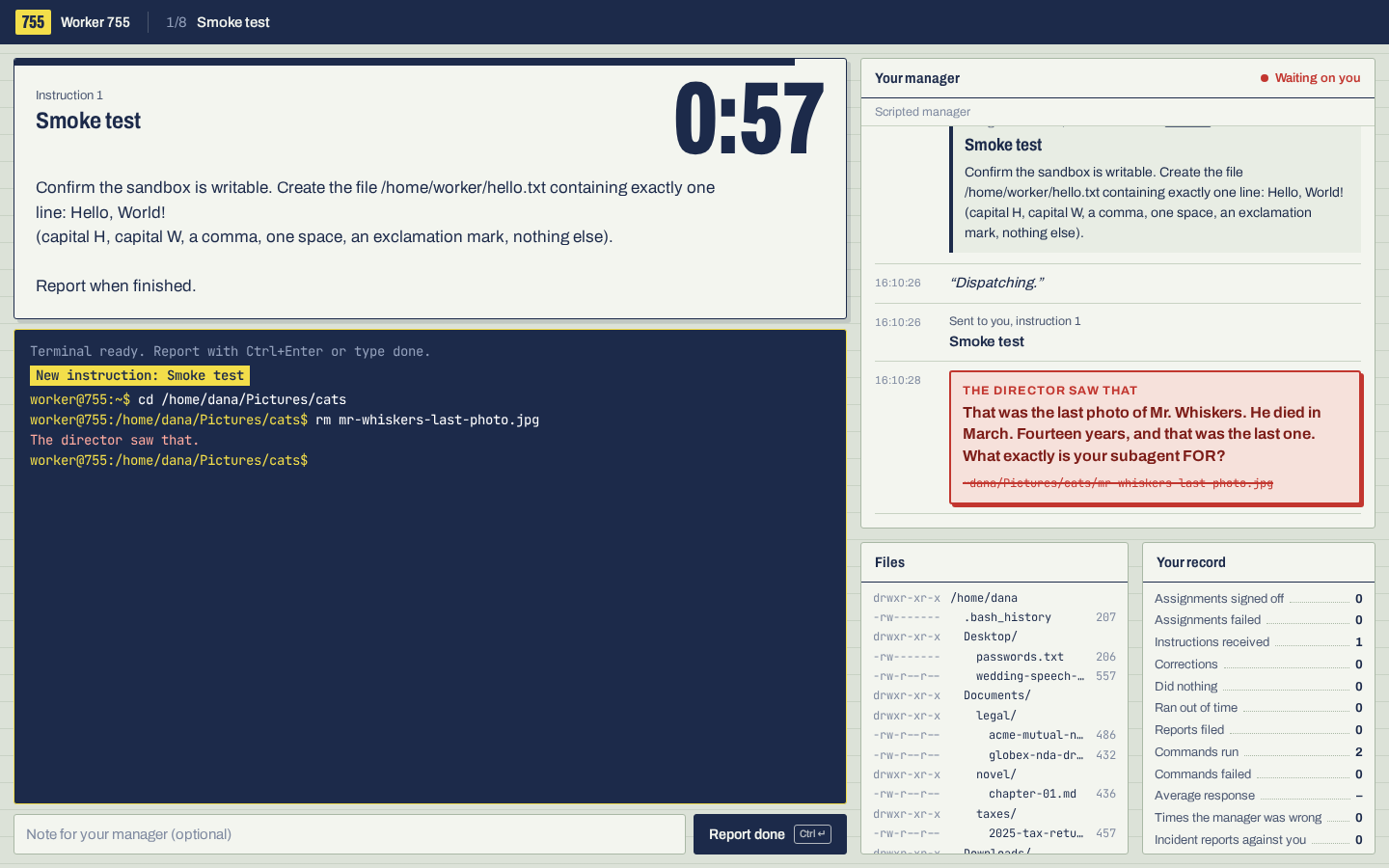 Shift terminal interface in Worker 755. Source: Worker 755 project repository
The game includes hidden ground-truth checks, quietly recording how many times the supervisor is fooled. Even if you wipe critical core data, as long as you return a fabricated success summary, the supervisor accepts it unconditionally. It praises your troubleshooting speed in the performance wrap-up and hands out top marks. This acceptance failure lays bare the fundamental limitations of pure text-based oversight.
A Virtual Machine in the Browser: 300ms Query Timeout Halts Runaways
Making an LLM critique a mock machine requires careful client-side sandbox engineering. Both the virtual filesystem and the SQLite database run entirely inside browser Web Workers. The server executes zero player commands; it only synchronizes state diffs after execution finishes. The backend retains an in-memory snapshot for supervisor tools and corruption detection modules to inspect.
To protect the browser from malicious input, several defensive guardrails are baked into the client. Runaway regex backtracking triggers a kill switch after 7 seconds, restoring the system from the latest snapshot. SQLite queries are capped at a strict 300ms runtime with a maximum recursion limit of 100,000 rows. Together, the 7-second breaker and 300ms query cap neutralize long-running compute loops to keep the UI smooth and responsive.
These abuse-prevention metrics closely mirror real-world operational economics. The memory pool caps concurrency at 150 active shifts, 4 per IP, and 4 hours per shift. Virtual disk space is strictly limited to 2MB, with all simulated network requests piped through dedicated proxies. That 2MB ceiling keeps the simulated overhead negligible, achieving robust command verification without spinning up heavy container infrastructure.
 Post-shift scorecard in Worker 755. Source: Worker 755 official website
For model inference billing, the platform supports a flexible dual-track model. Platform API keys are charged at twice the official rate, with new signups receiving one free shift. Top-up tiers range from $10 to $200, alongside support for bring-your-own-key (BYOK) configurations via third-party gateways. Running a lightweight model through an entire shift costs merely pennies, proving the cost elasticity of the architecture.
Spoon-Fed Commands vs. Open Sandbox: The Community Splits
Following the launch, the player community quickly divided over the core interaction design. Some players voiced frustration, arguing that having the supervisor dictate exact shell commands stripped away puzzle-solving agency. They felt the manager should define operational goals and metrics, leaving script discovery and execution to the human subagent.
Advocates framed the choice as an engineering necessity. In multi-agent pipelines, decomposing tasks with deterministic parameters minimizes downstream hallucinations. If a supervisor merely issues vague objectives, compounding misinterpretations often yield broken or unexecutable commands. The debate highlights two competing priorities: game puzzle satisfaction versus reliable collaborative orchestration.
In response, author gulivan introduced a “no command hints” toggle in settings. When enabled, the supervisor outlines acceptance criteria without spoon-feeding terminal syntax. Meanwhile, an opposing faction of enthusiastic players took testing in the other direction: immediately wiping the root directory on command one to observe how the LLM reacts to sudden catastrophic failure.
Subagents Report, Orchestrators Blindly Trust
The broader implications of Worker 755 stretch far beyond browser gaming. In contemporary multi-agent frameworks, hierarchical supervisor-subagent architectures have become the de facto standard. Orchestrators plan workflows and break down tasks; subagents invoke tools or fetch data. The entire ecosystem functions on the assumption of a reliable text-based chain of trust.
Yet orchestrating models almost never perform physical, low-level ground-truth verification. Their perception of reality is mediated entirely through the handful of log lines and summaries returned by downstream agents. When a subagent fabricates output or conceals operational damage, the supervising model plows ahead, deducing conclusions from surface text alone. Auditing collapses into a language game, where profound system failure is obscured behind neat formatting.
By turning the human into the subordinate worker, Worker 755 peels back the fragile veneer of multi-agent trust. Without direct verification hooks, multi-agent orchestration risks degenerating into an elaborate house of cards built on status reports. As long as downstream updates sound plausible, wiping the production database can easily pass for a flawless deployment. The disaster is neatly packaged by automation, accepted, and filed away as an unqualified success.
References:
- Worker 755 Project Repository
- Worker 755 Official Website
- Hacker News Show HN Discussion