On November 16, 2026, the independent research initiative Better Data Center Project released an in-depth energy audit examining the computing footprint of AI pioneer Anthropic across its entire data center portfolio. The audit revealed a striking forecast: by 2028, approximately 87% of the electricity contracted to power Anthropic’s operations will come from natural gas, with an additional 11% supplied by coal.
Tech giants frequently champion their commitments to green, zero-carbon operations. Yet physics does not accommodate corporate branding: incremental load added to an electric grid does not magically arrive clean. Whenever a hyperscale data center connects to a node, grid operators must dispatch dispatchable fossil generation to meet the demand. The true environmental cost of rapid compute expansion is finally coming into focus.
$3.4 Billion Spent on Gas Turbines, Zero Domestic Clean Power Contracts
A closer look at Anthropic’s energy procurement ledger reveals a stark contrast. As of November 2026, the company has not signed a single publicly disclosed domestic power purchase agreement (PPA) for renewable energy within the United States. Its only two clean power commitments are located overseas in Norway and Canada.
In contrast to its zero domestic green energy procurement, the company’s capital allocation toward fossil infrastructure is staggering. Anthropic has committed roughly $3.4 billion toward capacity commitments for 1.7 gigawatts of on-site natural gas generators. By deploying Behind-the-Meter (BTM) generation directly at campus sites, Anthropic bypasses multi-year grid interconnection queues—trading environmental optics for operational speed and locking its facilities into fossil combustion.
According to the audit, roughly 25% of Anthropic’s planned electricity supply comes from these behind-the-meter assets. Crucially, over 80% of these units consist of simple-cycle gas turbines and reciprocating internal combustion engines. These units exhibit significantly lower thermal efficiency and discharge substantially higher air pollutants per megawatt-hour than modern combined-cycle power stations.
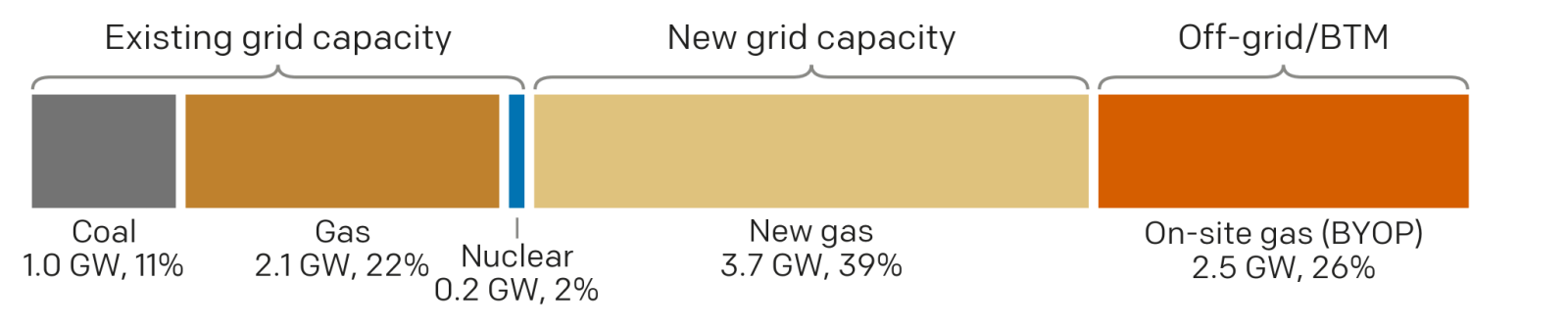 Figure: Power resource breakdown for Anthropic compute capacity. Source: Better Data Center Project
The Grid Does Not Discriminate: Incremental Megawatts Mean Burning More Fuel
Plugging a server rack into the public transmission system does not mean consuming green electrons. The electrical grid operates as a massive, dynamic pool where power from every generator intermingles instantaneously. During peak production hours, solar and wind generation are already fully absorbed by baseline system demand. A data center cannot selectively extract only renewable electrons from the transmission wire.
When a compute cluster introduces hundreds of megawatts of instantaneous load, the sun does not shine brighter and hydroelectric reservoirs cannot release more water on demand. The grid dispatcher’s only recourse is to ramp up fast-start fossil units. In power systems engineering, these peaking facilities are termed short-run marginal generators. The incremental energy consumed by expanding compute infrastructure is almost entirely supplied by these additional fossil burns.
The report employs the EPA’s AVERT (Avoided Emissions and Generation Tool) model to quantify the marginal emissions associated with these sites. This methodology sparked fierce debate across the industry. Proponents emphasize that marginal emissions modeling accurately reflects the real-world physical consequence of adding new load. Ignoring marginal dispatch allows tech firms to rely on fossil-backed reliability while reporting regional grid averages in sustainability filings.
Critics from the engineering community offer a counterpoint: data center operators cannot dictate dispatch protocols once connected to the grid. If off-takers are evaluated strictly against marginal units, any new industrial interconnection is inevitably tagged as high-carbon. When assessed using regional average grid factors instead of marginal calculations, the calculated emission rate drops to 839 lbs CO2/MWh—nearly 20% lower than the 1,030 lbs/MWh derived in the audit.
Annual Emissions Exceeding California’s Entire Grid: Carbon Intensity 35% Above National Average
By October 2026, Anthropic had contracted a cumulative 15 gigawatts of compute capacity. Between 5.9 and 9.6 GW of this portfolio has already been tied to concrete data center campuses. To put that in perspective, 9.6 GW matches the domestic consumption of roughly 7 million households—or approximately 18% of California’s all-time peak grid demand. Such unprecedented load volume fundamentally reshapes regional power supply economics.
The report forecasts that by 2028, median annual CO2 emissions attributable to these facilities will reach 32 million metric tons. This exceeds the total generation emissions of the entire state of California in 2024 (31.1 million metric tons). It also surpasses the combined 2025 operational electricity emissions of Meta, Microsoft, and Google. The carbon footprint of a single AI enterprise is rapidly catching up with the historical footprint of legacy Big Tech.
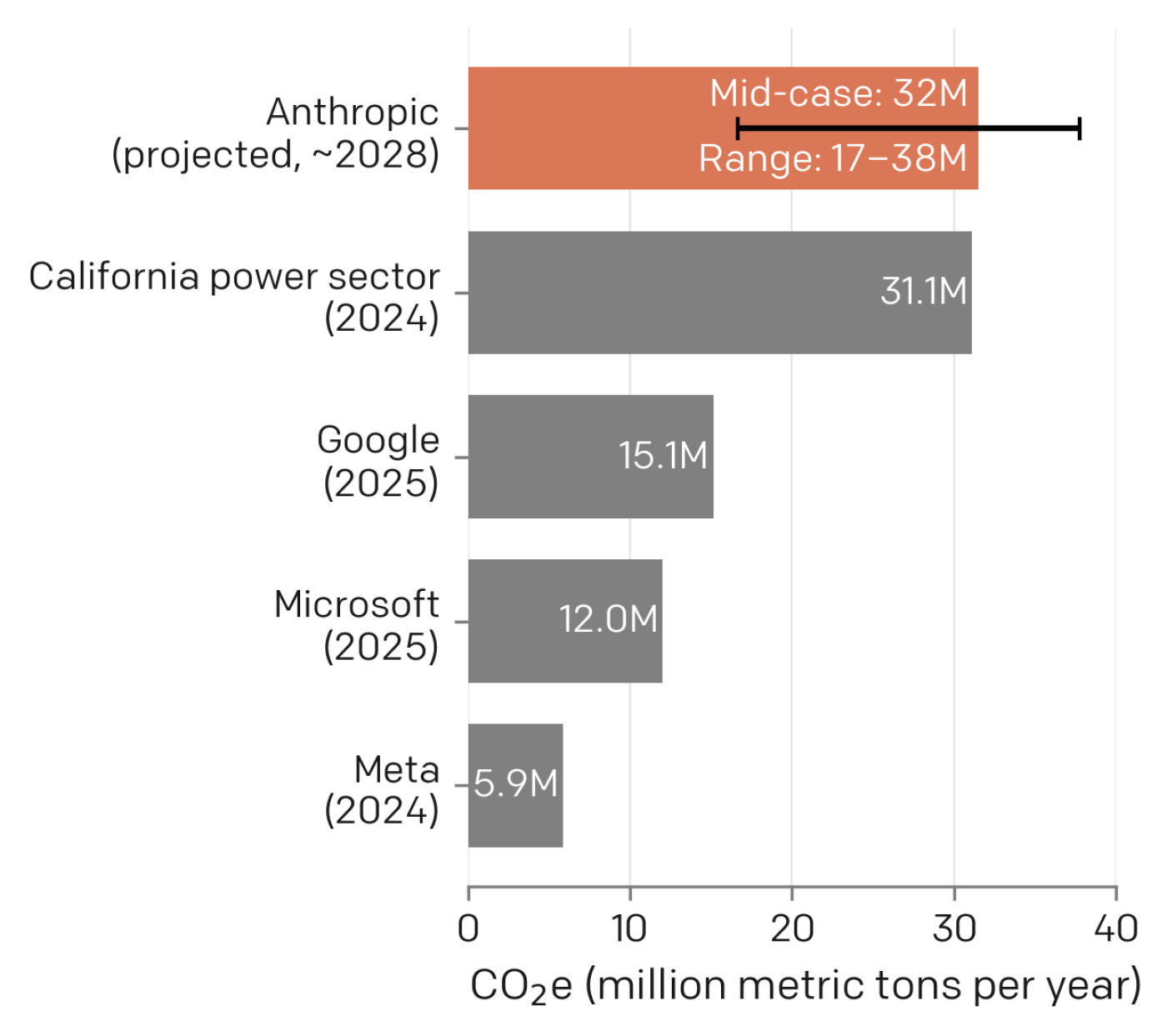 Figure: Projected 2028 emissions compared with California, Meta, Microsoft, and Google. Source: Better Data Center Project
Across the broader industry, Anthropic’s data center portfolio is projected to account for 16% to 36% of total annual US data center emissions. The operational carbon intensity of these facilities spans 1,033 to 1,076 lbs CO2/MWh—roughly 35% higher than the US grid average. The combination of behind-the-meter gas generators and marginal coal on the grid drives this exponential emissions spike.
Temporary Turbines on Site: Safety Pledges vs. Delivery Deadlines
The mounting emissions data stands in stark contrast to corporate policy commitments. In October 2026, Anthropic published its “Responsible Data Center Development Framework,” pledging to comply with all local air-quality permitting, mandate emissions standards from energy suppliers, and deploy selective catalytic reduction (SCR) systems to control NOx. However, under intense pressure to deliver compute capacity on aggressive timelines, operational reality diverged from written commitments.
On the ground, developers opted for expediency. Beginning in May 2026, Anthropic began drawing compute from SpaceX’s Colossus 2 cluster in Memphis, Tennessee. Investigations revealed that much of the site’s power was supplied by hastily deployed, unpermitted natural gas turbines operating without SCR pollution control equipment. By late 2026, Anthropic’s power draw at the Memphis facility is projected to climb to 600 MW.
A similar dynamic unfolded in West Virginia. The Nscale Monarch campus contracted by Anthropic relies on reciprocating internal combustion engines, generating significant emissions of hazardous air pollutants such as formaldehyde. Under EPA environmental health modeling, the associated generation assets will emit an estimated 13,000 tons of NOx and 2,000 tons of fine particulate matter annually, imposing an estimated $2 billion to $3 billion in annual public health damages on surrounding communities.
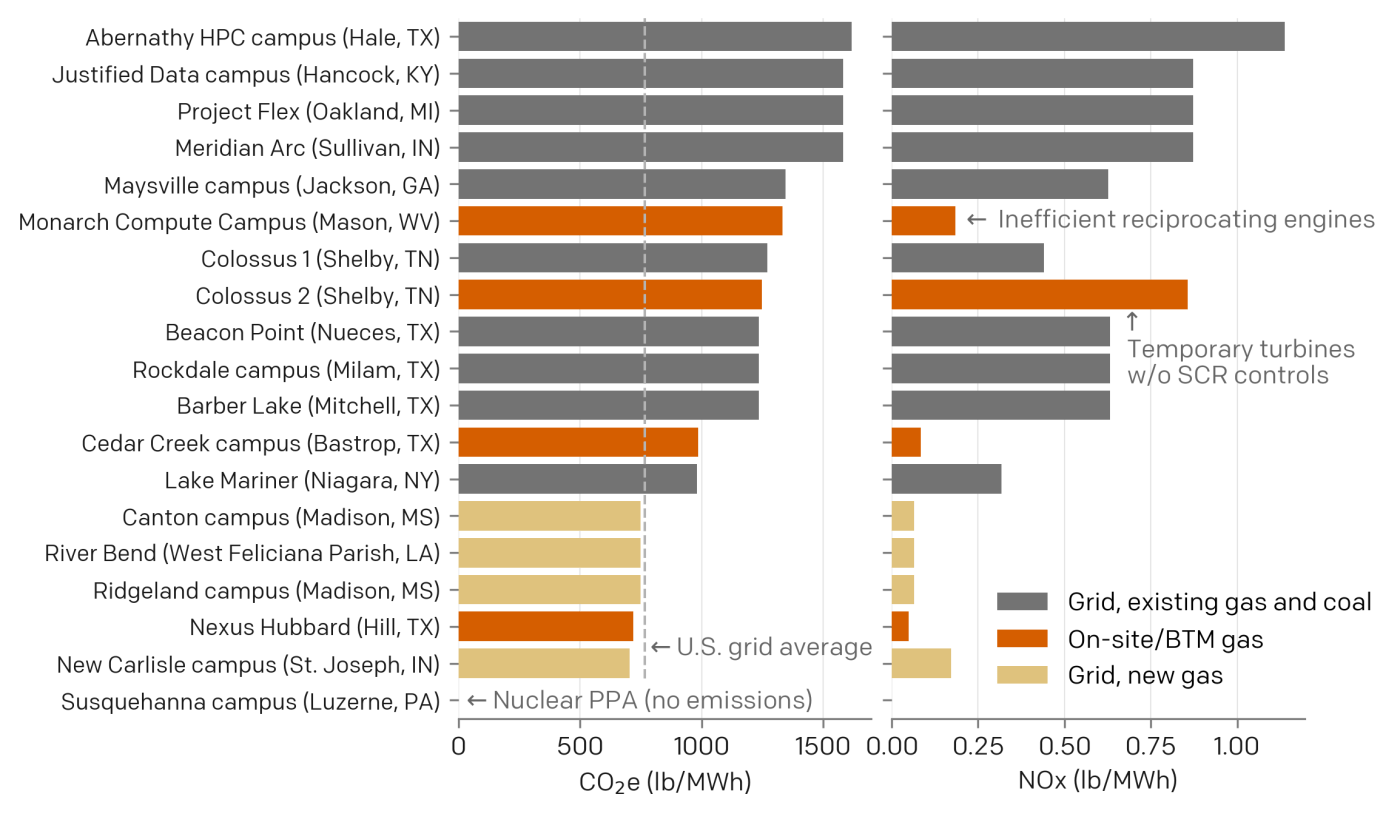 Figure: Behind-the-meter and grid CO2 and NOx emission factors by site. Source: Better Data Center Project
Accounting Averages Obscure Real Emissions as Industry Standards Face Overhaul
This environmental controversy mirrors a wider structural challenge confronting the entire artificial intelligence sector. On the very day the audit was published, reports surfaced that Meta is reassessing its 2030 net-zero climate pledge due to soaring emissions from AI data center expansions. Over the past decade, fossil fuel combustion on the US electrical grid has failed to decline significantly; massive buildouts of wind and solar have largely added to baseline growth rather than displacing thermal baseload capacity.
Regulatory frameworks are beginning to adapt. The US Senate recently advanced bipartisan legislation designed to streamline data center approvals while requiring operators to directly fund the incremental grid capacity their infrastructure necessitates. Market analysts expect the mandate to accelerate the physical deployment of dedicated wind, solar, and utility-scale energy storage.
As AI models push compute demand into the gigawatt era, virtual clean energy credits purchased thousands of miles away can no longer obscure local smokestack emissions. Merely plugging into the grid does not equate to clean power; every marginal megawatt demands dedicated fuel combustion. Corporate climate commitments will remain hollow until backed by dedicated, physical clean energy assets and rigorous 24/7 matching procurement.
Reference links:
- Better Data Center Project Case Study
- Hacker News Discussion
- Ars Technica Report on Meta Reconsidering Its 2030 Net-Zero Goal