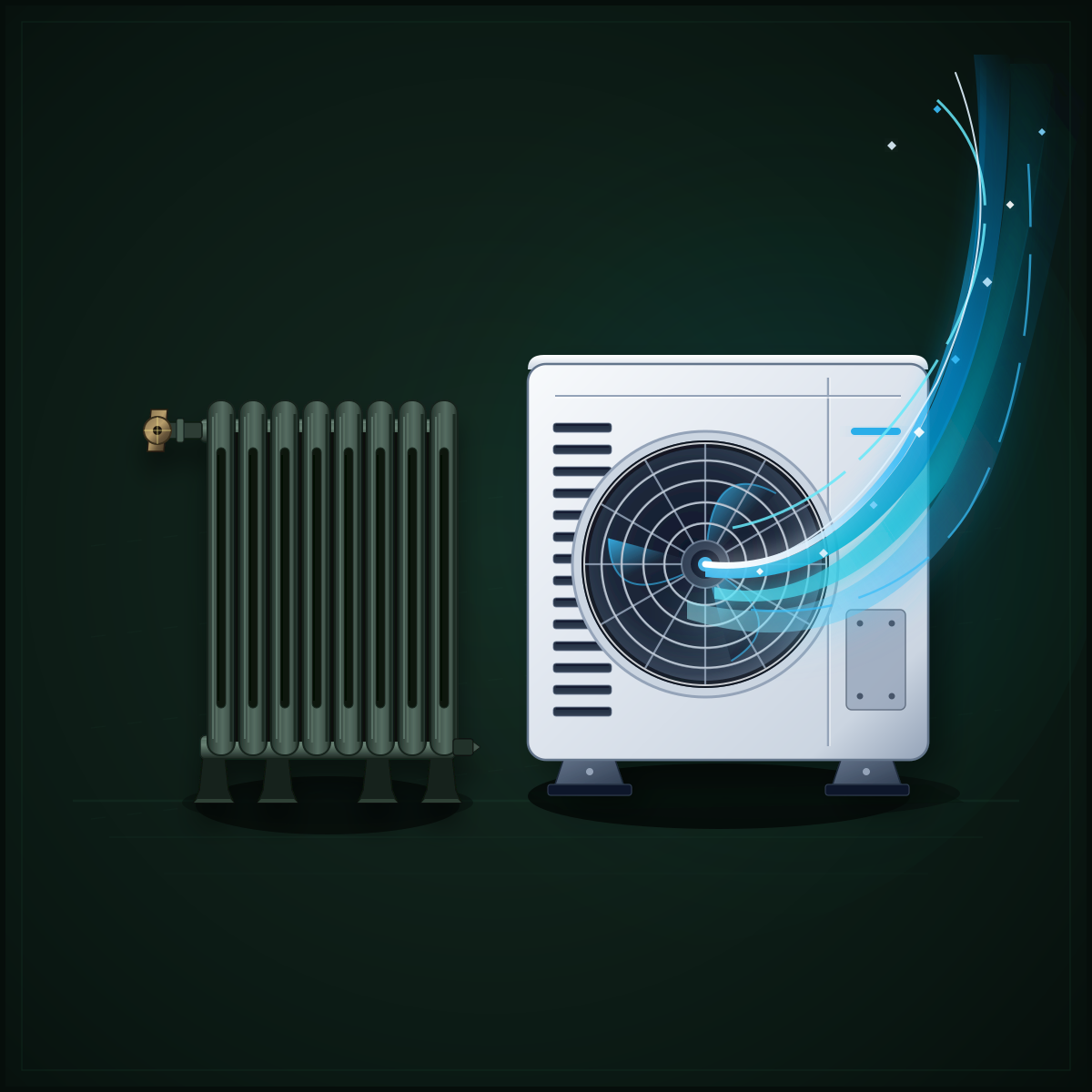
On November 19, 2026, the International Energy Agency (IEA) released its latest World Energy Outlook 2026. Amid its extensive analysis, the executive summary delivered a striking revelation: for the first time in human history, global space cooling demand in buildings has overtaken space heating demand. The historical imperative of keeping warm is being fundamentally rewritten by legions of air conditioning compressors.
While the annual flagship report primarily addresses energy security and fossil fuel supply disruptions, this landmark finding was tucked inside a dedicated chapter on “energy services.” The conclusion swiftly ignited debate across international tech and engineering forums—some hailed it as a decisive historical turning point, while others questioned whether it was merely an artifact of changing statistical metrics.
Two Competing Metrics: Heating Dominates Gross Energy, Cooling Wins Useful Service
Examining raw global energy consumption figures shows space heating remains dominant. Heating spaces using coal, natural gas, and electricity still accounts for roughly one-third of all energy consumed in buildings. Measured in gross primary energy, radiators and furnaces continue to devour the lion’s share of power and fuels.
However, the IEA’s conclusion is anchored in the metric of “energy services”—measuring the actual thermodynamic work delivered, specifically how much heat is extracted from indoor air. Air conditioners are vapor-compression heat pumps: consuming one unit of electricity can move three or more units of heat out of a building. Conversely, standard boilers rely on direct fuel combustion; generating heat equivalent to one unit of energy often yields less than one unit of thermal comfort due to flue losses and system inefficiencies.
The divergence between these two metrics yields two seemingly contradictory realities. By gross physical energy consumed, heating remains far ahead. But measured by the cooling effect delivered to human living spaces, air conditioning has already taken the lead. By mid-century, the global building floor area requiring cooling will exceed that requiring heating for the first time.
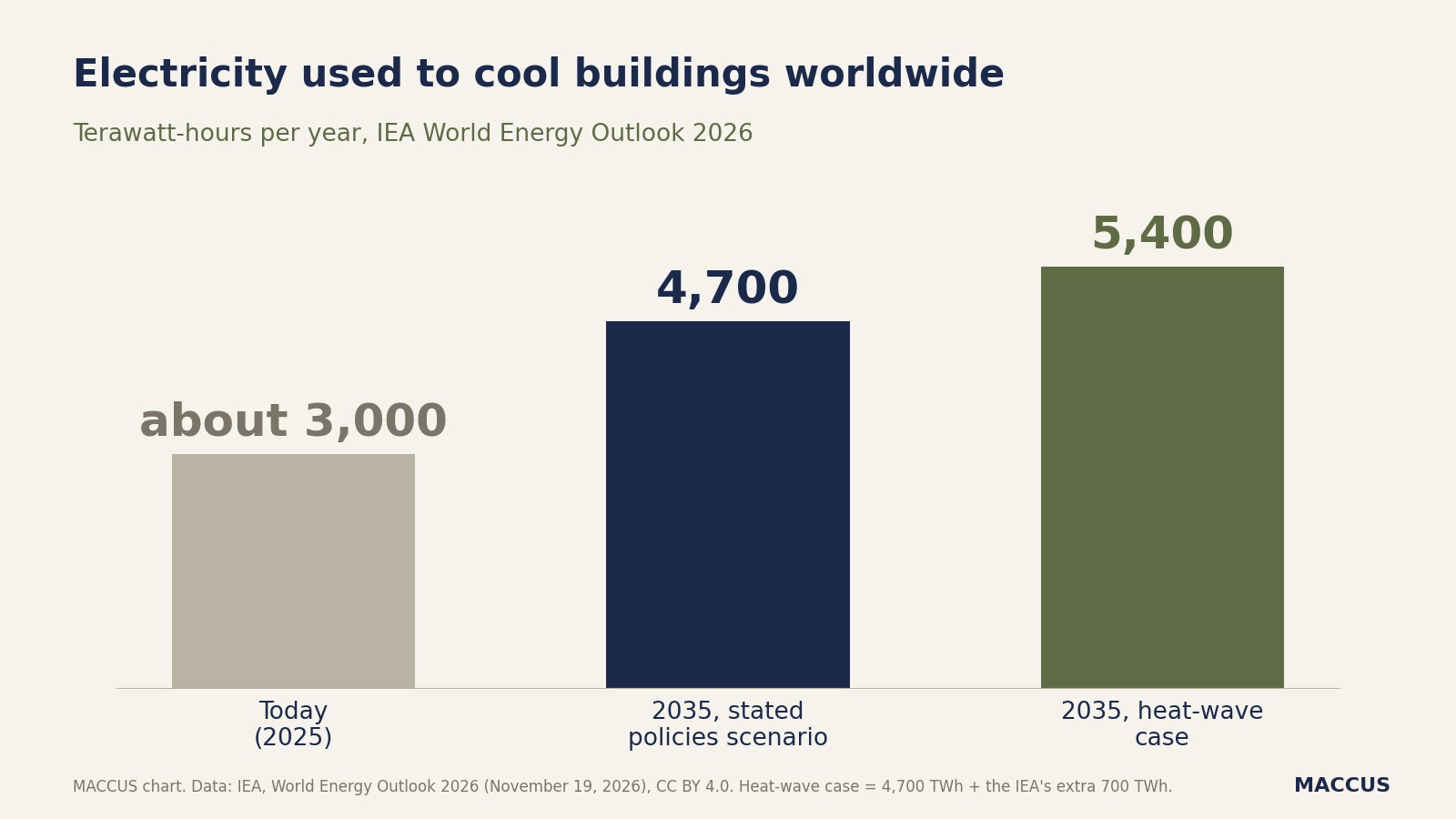 Figure: Projected global electricity demand for space cooling in buildings. Source: MACCUS graphic (Data: IEA World Energy Outlook 2026)
Moving Three Units of Heat with One Unit of Power: The Compressor’s High Leverage
Cooling outpaces heating in terms of useful delivered energy because refrigeration compressors possess inherent thermodynamic leverage. Traditional space heating relies on resistive electric elements or fossil combustion—a direct, one-way conversion of energy. Older boilers suffer severe distribution losses, with effective seasonal efficiencies frequently dropping below 70 percent.
Air conditioning, by contrast, operates as a heat mover. Refrigerant evaporates indoors to absorb ambient heat, then is compressed and pumped outdoors to release it. This cycle easily achieves a Coefficient of Performance (COP) between 3 and 4. Consuming a single kilowatt-hour of electricity removes three to four kilowatt-hours of thermal load from a building.
This thermodynamic efficiency has fueled extraordinary growth over the past decade. Since 2015, global cooling demand has surged by 55 percent. Cooling alone accounts for more than 40 percent of total global growth in energy service demand through 2035—the single largest incremental demand driver across the entire IEA report.
12% of Total Power Tears Open a 30% Peak Deficit: The Grid Cannot Handle Coincident Demand
If cooling is thermodynamically so efficient, why are grid operators sounding alarms? The crisis stems from the stark mismatch between annual volume and instantaneous peak demand. Today, cooling in buildings consumes approximately 3,000 TWh of electricity each year. Under stated policies, cooling electricity demand is projected to hit 4,700 TWh by 2035. That net addition of 1,700 TWh roughly matches India’s total annual electricity consumption today.
Under more severe heatwave scenarios driven by climate volatility, cooling demand could spike by an additional 700 TWh—40 percent above baseline growth. Yet even in 2035, cooling will represent just 12 percent of total global electricity consumption. While 12 percent sounds manageable on an annual balance sheet, electrical grids are engineered for peak load, not yearly averages.
The fatal vulnerability of cooling demand is extreme coincidence. Winter heating spans several months and accommodates fuel switching, stored natural gas, or off-peak thermal storage. Extreme summer heat, by contrast, strikes hardest during a concentrated window from 2:00 PM to late afternoon. When hundreds of millions of AC compressors ramp up simultaneously, cooling consumes over 30 percent of the world’s peak electrical load.
Global peak electrical load currently hovers around 4,700 GW and is projected to expand roughly 40 percent by 2035. Air conditioning alone accounts for 720 GW of that new peak demand—an incremental capacity requirement exceeding the total installed power capacity of India’s entire grid. To prevent blackouts during just two to three peak hours on scorching afternoons, utilities face massive capital expenditures on substations and distribution transformers.
Surging Installations in the Global South: 85% of New ACs in Developing Markets
The geographic center of cooling demand is shifting dramatically. In mature markets like Australia, Japan, and the United States, roughly 90 percent of households already own at least one air conditioner. AC adoption in developed economies is near saturation, and their distribution grids absorbed the initial adoption shock years ago.
In contrast, fewer than one in five households in India and Indonesia currently own an air conditioner. Globally, about 80 percent of the world’s population lives in regions where cooling is necessary for health and productivity, yet overall worldwide household AC penetration stands at only about 40 percent. This creates a vast gap between basic thermal survival needs and current appliance ownership.
As household incomes rise across emerging economies, air conditioning is transforming from a luxury into a prerequisite for survival. Across developing economies outside China, household AC ownership is forecast to rise from under 20 percent today to 32 percent by 2035, and reach 45 percent by 2050. Over the next decade, more than 85 percent of all new residential air conditioning installations worldwide will take place in emerging and developing markets.
Even historically temperate Europe is reeling under unprecedented summer heatwaves. August 2026 broke records as the hottest month in recorded history. European households that rarely considered cooling are rushing to purchase split units and heat pumps, driving sustained sales growth. Combined with other home appliances, cooling will add 2,900 TWh of electricity demand globally by 2035—a volume exceeding the European Union’s entire current annual power consumption.
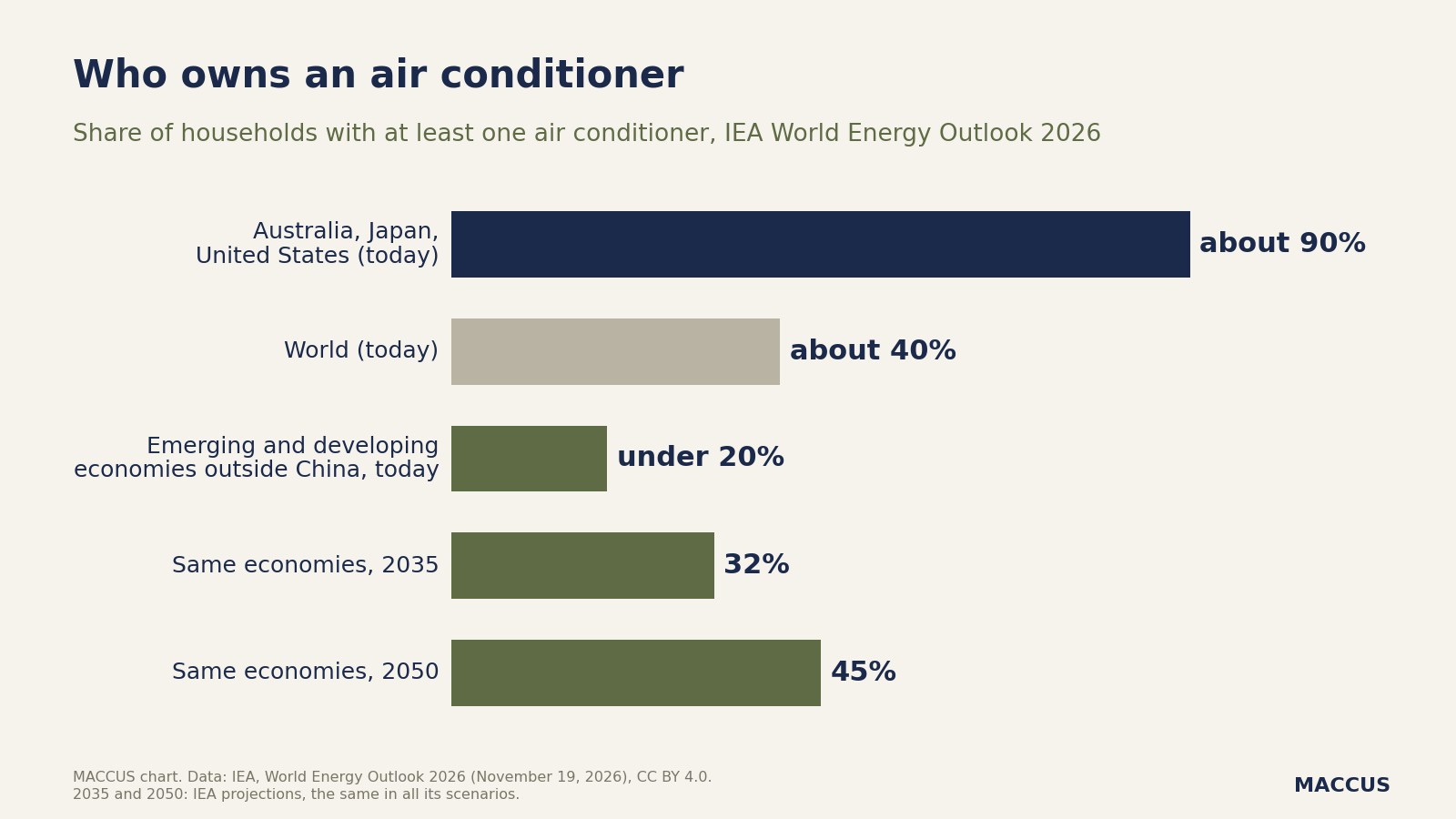 Figure: Household AC penetration rates across selected countries. Source: MACCUS graphic (Data: IEA World Energy Outlook 2026)
Stringent Standards Could Save 800 TWh: Grid Stability Rests on Compressor Efficiency
Relying exclusively on building out generation and grid infrastructure is running headfirst into economic reality. Extreme summer peaks occur for only a few dozen hours each year. Constructing peaker plants and over-dimensioning transmission networks for loads that sit idle 98 percent of the year dramatically inflates electricity costs across society.
The most viable remedy lies in appliance efficiency standards. The IEA estimates that if countries mandated minimum energy performance standards (MEPS) aligned with today’s best available commercial technology, the world could eliminate 800 TWh of electricity demand through 2035. Roughly half of those savings would come from continuously running refrigerators. Under existing weak policy baselines, cooling demand could swell to 4,900 TWh—200 TWh higher than under the central outlook.
The shift from burning coal for heat to running compressors for cooling marks a profound inflection point in how human civilization interacts with the climate. Historically, energy systems were built around gathering fuels to withstand freezing winters. Today, power systems must survive scorching summer afternoons when hundreds of millions of compressors hum in unison. Protecting the grid requires aggressive efficiency mandates before the next heatwave hits.
References:
- IEA World Energy Outlook 2026 Executive Summary
- MACCUS Building Energy and Cooling Trends Column
- Hacker News Discussion