Walking home after work or stepping onto a balcony at night, many people catch themselves glancing up at the sky. Bathed in urban light pollution, only two or three isolated stars typically pierce the darkness. Intuitively, the deep universe feels immutable, and most assume its governing laws were settled in textbooks long ago.
In early 2026, a comprehensive 20-year cosmic census shattered that quiet assumption. The Dark Energy Survey (DES)—an international collaboration uniting over 400 scientists across seven countries—unveiled its definitive analysis.
Over 758 nights of observation, the collaboration charted hundreds of millions of galaxies. Their sprawling photographic archive reveals unmistakable fractures in the standard framework of modern physics. Cosmologists had hoped this definitive survey would place a final seal of confirmation on the classic paradigm. Instead, three cornerstone observational datasets fell entirely out of alignment, refusing to agree with one another.
Rather than validating the old theory, the catalog pried open a fault line: the elusive dark energy driving cosmic expansion may actually be weakening.
758 Nights Atop Cerro Tololo: Building a 570-Megapixel Supercamera
This sweeping endeavor traces back to 2003, when physicists at Fermilab proposed a systematic, large-scale sweep across the southern sky. In observational astronomy, such comprehensive panoramic mapping is known as a sky survey.
To capture the faint glow of the distant cosmos, engineers constructed the Dark Energy Camera (DECam). This purpose-built scientific instrument boasts 570 megapixels. By comparison, consumer smartphone sensors typically offer between 10 and 50 megapixels; DECam’s resolving power equals four or five dozen flagship smartphone sensors stitched seamlessly together.
The team transported DECam to South America and mounted it on the Víctor M. Blanco Telescope atop Cerro Tololo in Chile, equipped with a 4-meter primary mirror. Situated at an altitude exceeding 2,200 meters, where the atmosphere is thin, arid, and remarkably still, Cerro Tololo offers one of Earth’s clearest vantage points into outer space.
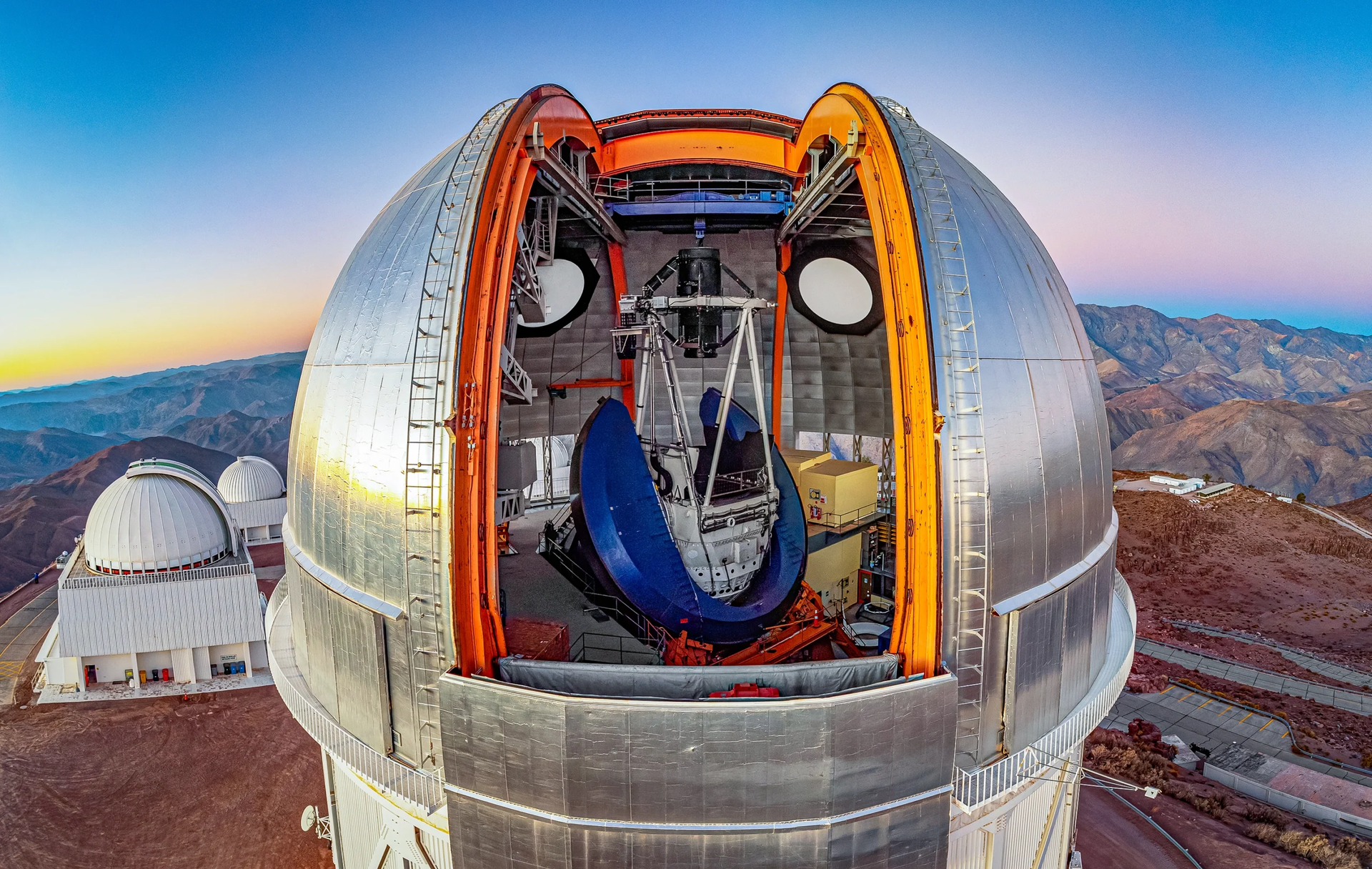 Figure: Inside the dome of the Víctor M. Blanco Telescope at Cerro Tololo, Chile, hosting the Dark Energy Camera on its 4-meter frame. Source: Dark Energy Survey/DOE/FNAL/DECam/CTIO/NOIRLab/NSF/AURA
Full survey operations commenced in 2013 and concluded in 2019. Astronomers manned the mountaintop across 758 individual nights—the equivalent of rotating continuous night shifts on an arid ridge for more than two years. The survey also weathered an intense El Niño event, when abnormal cloud decks blanketed the sky and stretched the timeline by an entire year.
Through meticulous perseverance, the collaboration logged hundreds of millions of galaxies. Their final release also includes a recalibrated catalog of Type Ia supernovae—the violent cataclysms marking the deaths of white dwarf stars. Because their intrinsic peak luminosity is remarkably uniform, astronomers treat them as standard candles for gauging deep-space distances.
This catalog pinpointed the precise positions of 1,600 exploding stars. Accumulated over 758 nights, these exposures expanded humanity’s documented galactic census by a full order of magnitude.
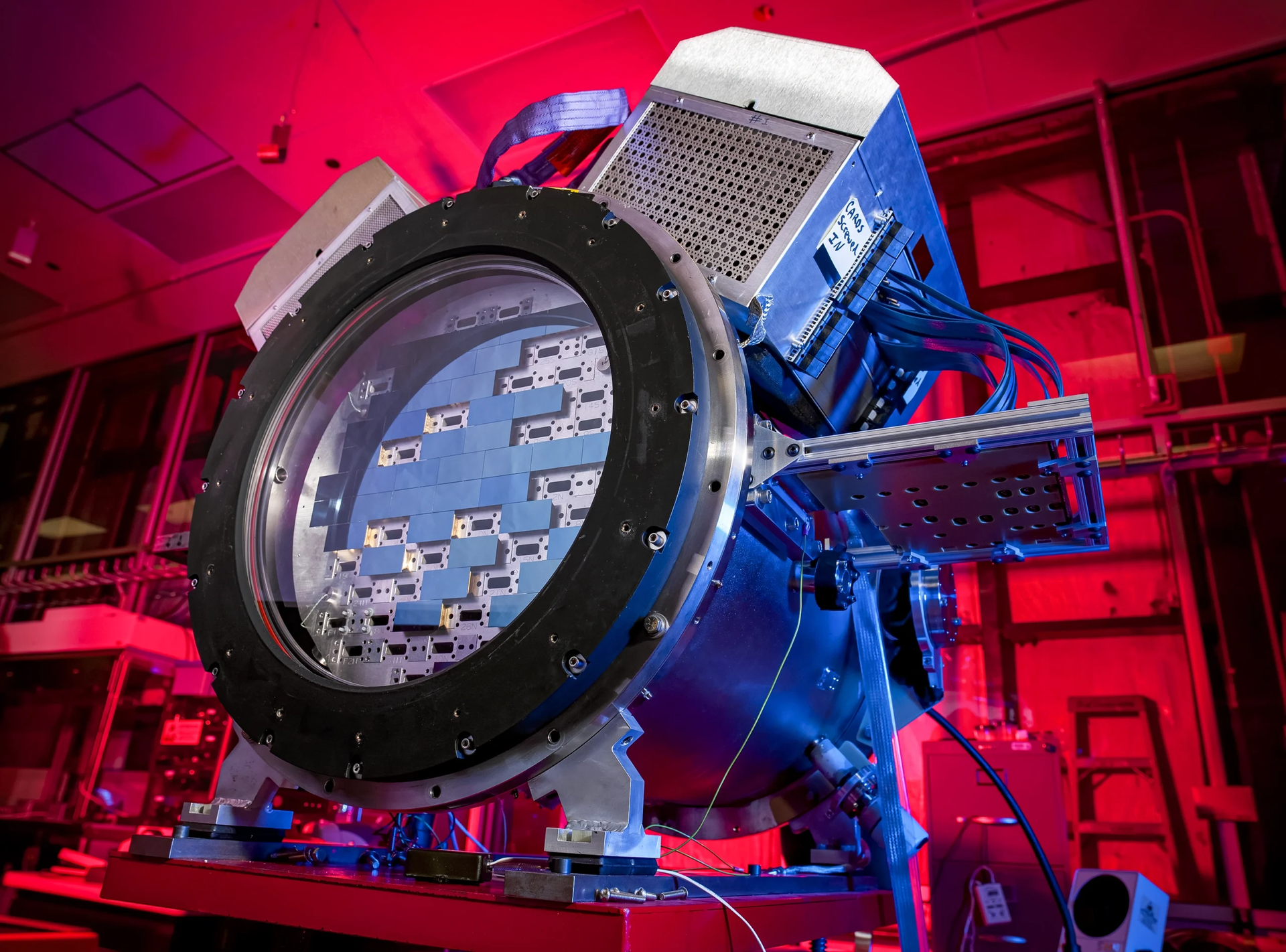 Figure: The 570-megapixel CCD sensor array of the Dark Energy Camera, once the most powerful digital camera in the world. Source: DOE/FNAL/DECam/R. Hahn/CTIO/NOIRLab/NSF/AURA
A Universe 70% Invisible: The Textbook Assumption of a Constant Lambda
Spending two decades cataloging galaxies served a central purpose: putting the standard cosmological model, Lambda Cold Dark Matter (Lambda-CDM), to the ultimate test. For decades, this bedrock paradigm has assumed a cosmos governed by cold dark matter and an invariant dark energy. The baryonic matter we see—stars, planets, interstellar gas, and living organisms—makes up less than 5% of the universe’s total mass-energy budget. The remaining 95% belongs to dark, unseen constituents.
Approximately 25% consists of Cold Dark Matter (CDM), which neither emits nor reflects light, making its presence known solely through gravitational pull that binds rotating galaxies. The remaining 70% is dark energy—a diffuse, negative-pressure force permeating the vacuum of space, driving the expansion of the cosmos at an accelerating rate.
If the cosmos were an assorted bowl of 100 beans, visible matter wouldn’t even total five. Humanity remains largely in the dark about the identity of the remaining 95.
The existence of dark energy was established in 1998 by two independent teams of astronomers tracking distant supernovae. Rather than decelerating under gravitational attraction, the cosmos was discovered to be flying apart faster and faster.
Physicists accounted for this by reviving Albert Einstein’s cosmological constant, Lambda ($\Lambda$), positing that empty space itself possesses a uniform, unchanging energy density. As space expands, total dark energy scales proportionately, steadily pushing galaxies apart. For over a quarter century, Lambda-CDM served as the bedrock of modern cosmology; every large-scale evolutionary simulation relied on dark energy as an unyielding, fixed yardstick. The validity of the standard model relies entirely on the premise that dark energy density remains constant across cosmic time.
Three Independent Puzzles in Conflict: Removing Any Single Piece Solves Nothing
When the DES collaboration unveiled its final findings, it reconciled its measurements against two other independent pillars of cosmological observation. The first was the Cosmic Microwave Background (CMB)—the relict afterglow of the Big Bang, offering a pristine snapshot of the infant universe. The second was DES’s own sprawling map of large-scale galaxy clustering. The third was the newly recalibrated sample of 1,600 Type Ia supernovae.
Each dataset originates from different instruments, capturing the cosmos at vastly different epochs. If the standard Lambda-CDM model were completely accurate, combining these three pieces should yield fully concordant cosmological parameters. Instead, rigorous cross-checks exposed sharp, persistent discrepancies across the board.
The tension forms an interlocking triangle: under Lambda-CDM assumptions, the CMB disagrees with galaxy clustering; galaxy clustering clashes with supernovae; and supernovae fail to align with the CMB. No single observation can simply be discarded to restore equilibrium.
If only one instrument had produced anomalous readings, it might easily be dismissed as a subtle instrumental systematic. But three independent, world-class datasets in mutual conflict point away from experimental error. The mismatch is not an observational artifact; a genuine fracture exists between the cosmos and our current theoretical framework.
A Three-Sigma Discrepancy: Is Dark Energy Waning?
Attempting to resolve the standoff, researchers loosened the model’s central axiom, allowing dark energy’s density to evolve and gently weaken across billions of years. Remarkably, the observational gridlock eased almost instantly.
The DES analysis revealed a three-sigma statistical preference for this dynamical, decaying dark energy over a strict cosmological constant. In statistics, a three-sigma signal indicates a roughly 1-in-370 probability (0.3%) that the discrepancy arose by random chance.
While a 0.3% chance of fluke rules out casual measurement noise, it still falls short of the five-sigma threshold formally required in physics to claim an outright discovery.
Simone Ferraro, a cosmologist at Lawrence Berkeley National Laboratory, noted plainly that fractures have appeared across existing models. Confronted with this divergence, researchers describe feeling equal parts uneasy and exhilarated.
These rumblings are far from isolated. The Dark Energy Spectroscopic Instrument (DESI) at Kitt Peak has also been probing dark energy using thousands of optical robotic fibers to map cosmic expansion. In findings released in 2024 and 2025, DESI observed similar hints that dark energy may not be static. DESI researcher Seshadri Nadathur emphasized that the DES supernova catalog stands as his most trusted cosmic distance ruler.
If dark energy is truly fading, theoretical physicists face a formidable new crisis. Theorists have long puzzled over why the vacuum energy scale is unimaginably tiny compared to naive quantum predictions. If this already minute energy is actively decaying, explaining cosmic evolution becomes doubly baffling. Should dark energy decay over billions of years, our long-term forecasts of runaway cosmic expansion may need to be rewritten.
Rubin Observatory Steps Up: Billions of Galaxies Await Recalibration
Confronting this theoretical fissure, astrophysicists are also considering alternative explanations. Ferraro’s group has suggested that if the very first stars ignited 200 million years earlier than standard simulations assume, part of the tension could dissolve. Yet when the cosmic dawn truly broke remains an open question.
Unraveling the mystery demands vastly larger observational datasets. While DES has reached its conclusion, DESI will continue gathering spectra through 2028. Meanwhile, the Vera C. Rubin Observatory in Chile has entered its commissioning and survey operations.
Equipped with the largest digital camera ever constructed, the Rubin Observatory is projected to catalog approximately 10 billion galaxies. Many veteran DES researchers have brought their hard-won expertise to the Rubin collaboration. This coming deluge of data will deliver a definitive verdict on whether dark energy is truly waning.
Spanning two decades and 758 nights of sweeping observations, history’s most comprehensive cosmic survey declined to rubber-stamp the prevailing model. By honestly charting the fissures between independent measurements, it has reopened the fundamental question of what dark energy really is. For cosmology, this is the most exhilarating piece of bad news in twenty years.
Reference Links:
- In-depth coverage from Quanta Magazine
- Dark Energy Survey collaboration arXiv preprint
- Dark Energy Survey (DES) Year 6 Cosmology Results announcement