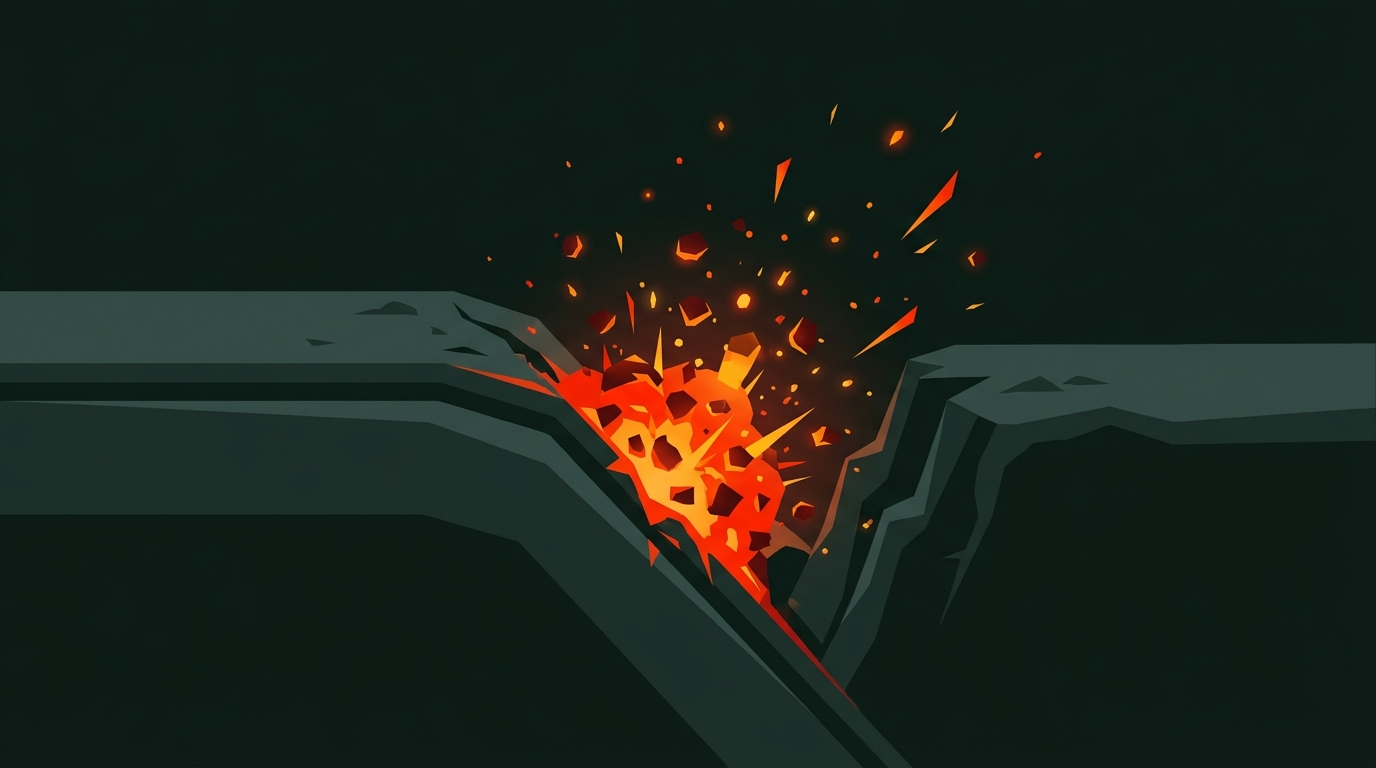
When simmering soup in a kitchen pressure cooker, rising steam pressure keeps the bubbling water tightly suppressed. Thousands of meters underwater, hydrostatic pressure equals hundreds of pressure cookers pressing down overhead, making boiling and volatile gas expansion virtually impossible. For decades, textbooks and nature documentaries cultivated a familiar intuition: the deep ocean abyss is tranquil and sluggish, where underwater volcanoes merely ooze magma like toothpaste gently spreading across the seabed.
Yet the deepest point on Earth has just shattered this long-standing assumption. A marine geology study published on November 23, 2026, revealed that an expedition discovered unmistakable remnants of violent, explosive volcanic eruptions near the sheer cliff faces of the abyss. Deep in the pitch-black ocean trenches, geological history was far more violent than anyone imagined.
Descending 6,000 Meters: An ROV Encounters Pyroclastic Debris on Trench Walls
The target of this expedition was Challenger Deep in the Mariana Trench—plunging nearly 11,000 meters, the deepest known point in the global ocean. To put 11,000 meters into perspective: if Mount Everest were inverted and placed into the trench, its peak would still be submerged under more than 2,000 meters of water. Fewer humans have descended to these depths than have walked on the Moon.
For decades, the standard geological explanation for this immense abyss rested on simple subduction: the dense Pacific Plate dives beneath the Mariana Plate, flexing and sinking like a conveyor belt to carve out a deep trench. Academic consensus long assumed this process was dominated by slow, grinding deformation, virtually free of explosive volcanism nearby.
A research team led by Robert Stern, professor emeritus at the University of Texas at Dallas, overturned this quiet narrative. Controlling a remotely operated vehicle (ROV)—a tethered underwater robot equipped with mechanical arms and high-resolution cameras—the team surveyed sheer submarine cliffs at depths exceeding 6,000 meters. As powerful searchlights illuminated the rock face, the samples collected by the robotic manipulator astonished the scientists aboard the research vessel.
Sweeping along the steep scarp, the cameras revealed thick pyroclastic deposits—layers of fragmented volcanic rock blown apart in violent explosions before settling back onto the seabed. The deposits contained flat, slab-like clasts indicating multiple, closely spaced eruptive pulses. It is the deepest record of explosive volcanism ever discovered on Earth.
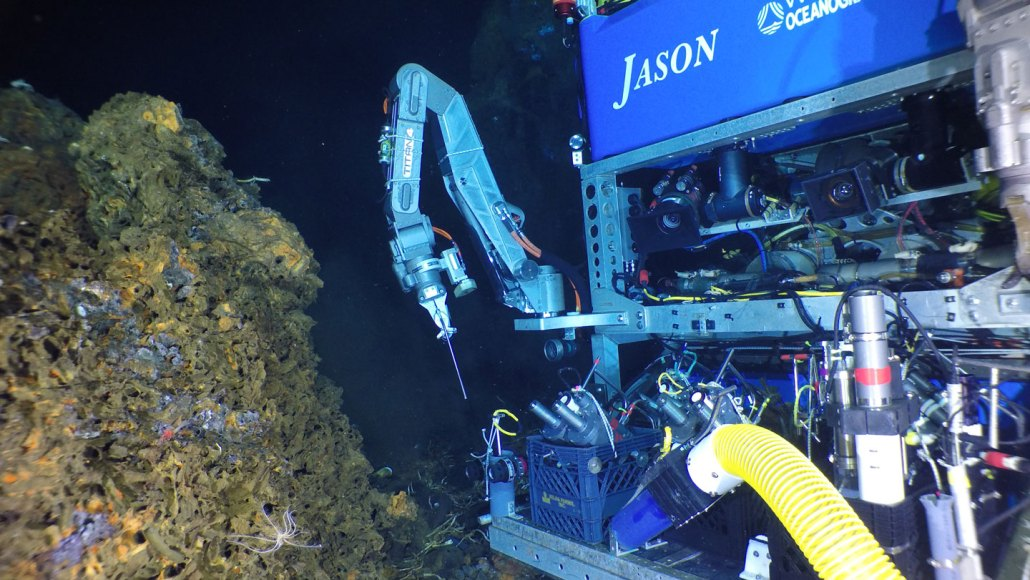 Figure: The deep-sea remotely operated vehicle Jason at work underwater. Source: Science News / ROBERT STERN/UT DALLAS
The seafloor was also littered with lobate lavas, formed when incandescent lava comes into sudden contact with freezing seawater, instantly quenching into a glassy crust. Thin sections analyzed from the ROV’s samples confirmed these rocks were not exotic debris washed down from afar—they were birthed directly on these ultra-deep slopes. The abyss wall, long assumed to be cold and inert, had once been ignited by scorching subterranean fire.
Defying 600 Atmospheres: Supercritical Fluids Shatter Solid Rock
Discovering signs of explosive volcanism at 6,000 meters deep is, at first glance, a physical paradox. Hydrostatic pressure increases by one atmosphere roughly every 10 meters; at 6,000 meters, ambient pressure exceeds 600 atmospheres. That is equivalent to concentrating the entire weight of an adult elephant onto a single human fingernail.
On land, volcanic explosions occur when ascending magma experiences a rapid drop in confining pressure, allowing dissolved water vapor and gases to violently expand and froth—shattering the melt like popping an uncorked champagne bottle. But under 600 atmospheres of hydrostatic confinement, steam bubbles are mercilessly crushed. Deprived of expanding bubble mechanics, lava should theoretically only ooze as passive, sluggish flows.
To explain how the rock shattered so violently, Stern’s team proposed a novel physical mechanism. Under the extreme pressures and temperatures found at 6,000 meters depth, water transitions into a supercritical fluid—an exotic state exhibiting properties of both liquid and gas. While supercritical water does not coalesce into ordinary boiling bubbles, it possesses extreme penetrative power and rapid stress-transfer capabilities.
As volatile-rich magma surged toward the ocean floor, supercritical fluids ripped through micro-fractures in the rock mass, driving brittle fragmentation of the lava. The shattered clasts were then blasted into the icy water column, quenched, and deposited across the slope. William Chadwick, a marine geologist at Oregon State University, remarked that such explosive activity in ultra-deep water is unprecedented and completely defies past geological intuition.
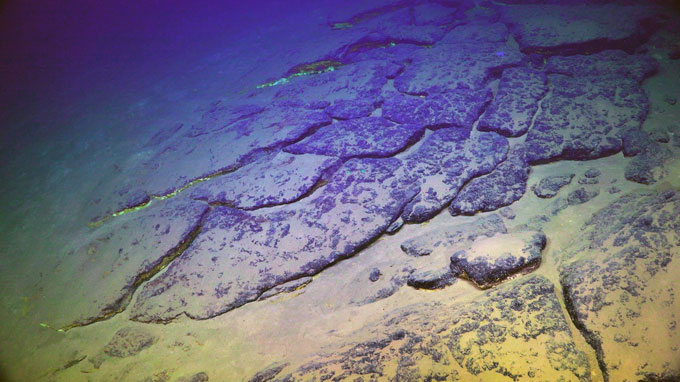 Figure: Lobate volcanic rocks discovered on the seabed near Challenger Deep. Source: Science News / ROBERT STERN/UT DALLAS
Eruptions Just 100 Kilometers from the Trench: Exposing a Tight Tectonic Bend
Beyond the physics of extreme pressure, the geographic location of this volcanic deposit challenges classical plate tectonic paradigms. In a standard subduction zone, the sinking oceanic slab must plunge deep into the mantle, dehydrating under heat and pressure to trigger partial melting and magma ascent. This process typically requires significant horizontal distance; volcanic island arcs generally sit 200 to 300 kilometers behind the trench axis.
Yet the pyroclastic deposits found by the team lie just about 100 kilometers from the axis of Challenger Deep. On a geological scale, 100 kilometers—roughly the driving distance between two neighboring cities—is practically right on the trench’s front doorstep. Why did magma bypass the conventional 200-kilometer setback and erupt directly in front of the abyss?
Stern’s team proposed a crucial explanation in their paper: the incoming Pacific Plate does not descend along a gentle, uniform incline. Instead, just before plunging into the abyss, the subducting plate executes an extremely sharp, tight bend. The immense tensile stresses generated by this sharp flexure tear open deep, longitudinal fractures across the slab’s outer surface, offering deep-seated mantle melt an express pathway to the surface.
This tight bend hypothesis fundamentally reframes why Challenger Deep reaches such extraordinary depths. Previously, scientists assumed the 11,000-meter trench was carved purely by the gradual, gravitational sinking of cold, dense oceanic lithosphere, which should yield relatively gentle slopes. But if the slab undergoes an acute, tight bend, the trench floor is pulled downward far more steeply and profoundly.
Assembling the Puzzle: Rewriting the Single-Origin Model of the Deepest Abyss
Unraveling the mystery of Challenger Deep has become a collaborative effort spanning multiple international teams in recent years. In 2025, researchers from Zhejiang University performed radiometric isotope dating on rock samples recovered from the trench. Their findings revealed that certain trench rocks were merely 17 to 34 million years old—dramatically younger than the 150-million-year age previously assumed for the region’s seafloor.
In early 2026, researchers at the South China Sea Institute of Oceanology, Chinese Academy of Sciences (CAS), published a geodynamic model proposing a slab-tearing mechanism in the trench’s evolution. They demonstrated that lithospheric weakening and slab tearing create powerful downward hydrodynamic suction, challenging the premise that the plate subducts as an intact, rigid slab. Insights from geochronology, tectonics, and volcanology are now converging.
The 6,000-meter pyroclastic deposits discovered by Stern’s team provide the vital physical evidence connecting these theoretical threads. The existence of ultra-deep explosive volcanism proves that the tectonic plate underwent severe rupture and deformation at the trench margin. Geologists now recognize that Challenger Deep’s extreme depth is not the result of simple subduction alone, but the combined product of tectonic suction, an acute slab bend, and violent volcanic dynamics.
The volcanic rocks scattered across the seabed at 6,000 meters have rewritten our understanding of the planet’s deepest frontier. Far beyond a passive conveyor belt, Challenger Deep was carved by a confluence of acute plate bending and explosive subterranean forces, forever reshaping the geological narrative of Earth’s greatest abyss.
References:
- Science News: Research on the origin and extreme depth of Challenger Deep
- Frontiers in Earth Science: Original research paper on ultra-deep pyroclastic deposits