Picture sitting by a window on a quiet Sunday morning with a cup of coffee, sunlight warming your face. Or walking down a busy street after work, surrounded by traffic. In these mundane, serene moments, inside your microscopic world, your cells are waging a relentless salvage operation.
Ultraviolet radiation in the sunlight penetrates skin tissue. Free radicals from normal metabolic respiration bounce around cell nuclei. Even that casual evening glass of wine batters your deoxyribonucleic acid (DNA)—the molecular instruction manual dictating human life. Many imagine DNA as a static blueprint safely locked in a vault. In reality, it is more like an engineering diagram rolled out on an active assembly line. To build proteins, it must constantly be unzipped, transcribed, and replicated, perpetually vulnerable to environmental assaults.
The human body contains roughly 30 trillion cells. Björn Schumacher, a molecular biologist at the University of Cologne, points to a staggering baseline: an individual cell experiences as many as 100,000 DNA lesions each day. Across the entire body, an astronomical number of molecular fractures spread every single second. Schumacher put it bluntly: without constant DNA repair, stable genetic information simply cannot exist.
The tranquility of our everyday lives rests entirely on these intrinsic cellular repair crews. In a detailed report published in Quanta Magazine on November 23, 2026, science writer Annie Melchor untangled the mechanisms behind this repair machinery. The general public often imagines that molecular scissors like CRISPR do everything from start to finish. That is a fundamental misconception. Molecular tools merely make a targeted cut at a specific locus. The true hero that stitches newly introduced code into chromosomes is a DNA repair system honed over four billion years of evolution.
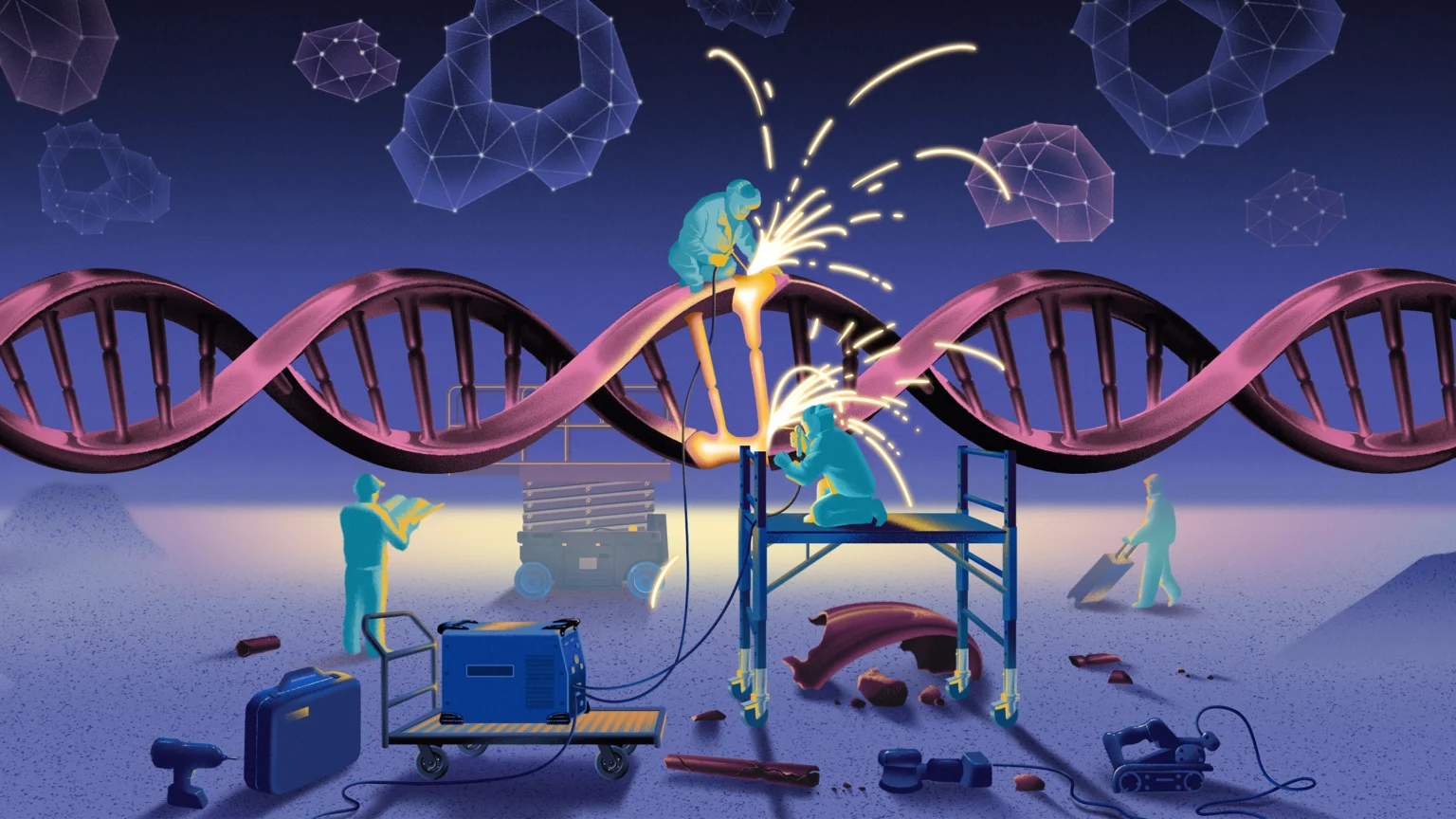 Figure: Artistic rendering of the cellular DNA repair system. Source: Quanta Magazine / Ada Zejun Shen
100,000 Lesions a Day: Cells in Constant Emergency Triage
Professor Schumacher’s research underscores a central truth: DNA damage is the evolutionary default. In the history of life, repair mechanisms emerged virtually alongside genetic material itself. Without the capacity to mend injuries, coherent genetic code could never have bridged generations.
The human genome spans roughly three billion base pairs (the fundamental chemical letters A, T, C, and G that compose the genetic alphabet). If transcribed into ordinary book text, these letters would fill thousands of thick encyclopedias. Flipping through this monumental library tens of thousands of times a day makes page damage inevitable.
To handle various types of damage, the cell deploys a finely tiered repair hierarchy. When a single base oxidizes or degrades, the cell initiates base excision repair—a precision maintenance pathway designed to pluck out a solitary defective letter and pop in a fresh replacement. Specialized enzymes act like eagle-eyed copy editors, clipping out the bad letter and replacing it with a pristine one.
When damage coalesces into a larger structural distortion—such as UV exposure causing adjacent letters to fuse into an abnormal bulge—minor patching is no longer sufficient. Here, the cell mobilizes nucleotide excision repair. This pathway targets bulky distortions, snipping out an entire patch of the damaged strand and synthesizing a clean sequence using the undamaged complementary strand as a pristine template.
Divergent Paths for Double-Strand Breaks: Crude Glue vs. Precision Molds
Among all genetic mishaps, the most perilous is the double-strand break—a catastrophic event where both strands of the DNA double helix backbone are severed simultaneously. This is the molecular equivalent of severing an encyclopedia clean in half; the text on both sides faces permanent loss.
The instant a double-strand break occurs, the cell triggers the DNA damage response—an intricate emergency network comprising more than 500 proteins. As the alarm sounds, the cell hits the pause button. Gene transcription and cell division freeze, redirecting all cellular resources toward hazard mitigation.
Confronted with severed chromosomes, the cell maintains two distinct contingency protocols. Penny Jeggo, a molecular biologist at the University of Sussex, highlighted the trade-offs: one system triumphs in simplicity, while the other excels in sophisticated precision.
The first protocol is nonhomologous end joining (NHEJ)—a rapid emergency sealing technique where the cell trims severed ends flush and glues them straight back together. It acts like an emergency room tourniquet: blazing fast and indifferent to lost letters. The machinery blunts both jagged edges and forces them together. This triage often deletes or inserts a handful of nucleotides. In life-or-death crises, accepting a slight sequence error is vastly preferable to a shattered chromosome.
The second protocol is homologous recombination (HR)—a high-fidelity pathway that uses an intact sister chromatid as a template to rebuild the fracture. HR operates within a narrow window, opening only after DNA replication has completed and before cell division takes place. During this phase, an identical backup chromosome exists. The repair machinery uses this backup as an exact ruler, restoring the break with flawless fidelity.
The 1994 Breakthrough: Cutting the Chain to Stitch New Code
For decades, biologists wrestled with abysmal efficiency when attempting to deliver foreign genes into cells. If you injected a raw DNA fragment into a cell, the genome almost never integrated it.
The decisive breakthrough came in 1994. A team led by Maria Jasin at Memorial Sloan Kettering Cancer Center carried out a pioneering experiment in the lab. Given that cells possess a template-guided homologous recombination engine, could researchers intentionally induce an artificial emergency?
Jasin’s team engineered an ingenious setup. At an engineered target locus in mouse cells, they created an intentional double-strand break. Concurrently, they supplied a donor DNA fragment whose outer ends matched the flanking sequences of the cut, framing an engineered novel gene in the middle.
The results matched theoretical predictions. Pre-cutting the DNA skyrocketed the rate at which foreign genetic material stitched into the chromosome. This experiment established the foundational principle of modern gene editing: molecular tools do not need to do the stitching themselves; by introducing a targeted cut, human engineers can hijack the cell’s innate healing machinery to assimilate donor code into the genome.
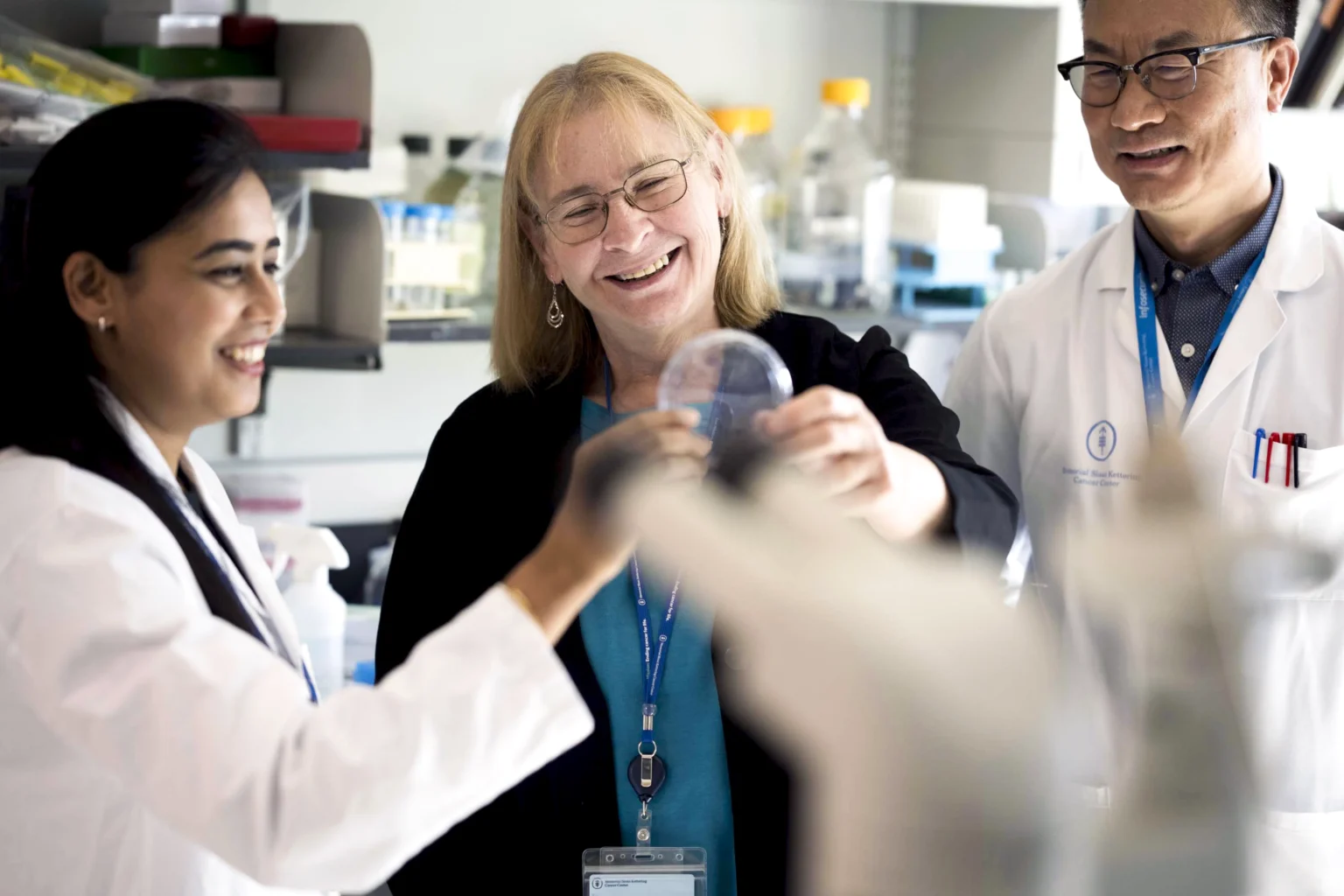 Figure: Maria Jasin’s team demonstrated in 1994 that pre-cleaving DNA dramatically increases gene integration efficiency. Source: Quanta Magazine / Memorial Sloan Kettering Cancer Center
CRISPR Only Cuts: The Cell Does the Rewriting
While Jasin charted the blueprint, finding molecular scalpels capable of cutting exact DNA coordinates took nearly two decades. The true turning point for genetic engineering arrived in 2012, when scientists realized that CRISPR-Cas—a molecular defense system adapted from bacterial immunity, using RNA navigation to guide a Cas cutting enzyme—could be repurposed as a universal gene editor.
Researchers no longer needed to painstakingly engineer bespoke proteins for every target. By synthesizing a short custom guide RNA, the Cas enzyme could pinpoint a target sequence across an ocean of three billion base pairs and cleave it. This breakthrough earned its discoverers the 2020 Nobel Prize in Chemistry.
In popular media, CRISPR is frequently portrayed as an omnipotent molecular paintbrush rewriting the book of life. Strip away the hype, and its cellular role stops at the incision. To knock out a disease-causing gene, researchers direct Cas to make a clean cut and leave the break to the blunt instincts of nonhomologous end joining. Because NHEJ tends to drop or add random letters, the target reading frame shifts, knocking out the gene’s function.
When the objective is to correct a pathogenic sequence, researchers must simultaneously deliver an engineered repair template, coaxing the cell to mobilize homologous recombination. CRISPR acts as the surgeon’s scalpel, opening the tissue at the precise lesion. The subsequent wound healing, tissue closure, and sequence regeneration rely entirely on the cell’s autonomous repair machinery.
Error-Tolerant Evolution: Rewriting the Code Carries Inherent Risk
Technological evolution did not halt at double-strand breaks. In recent years, base editing—a precision modality that bypasses double-strand severance to directly alter single letters chemically—has gained rapid traction. It piggybacks on the cell’s routine base excision pathway, performing letter-by-letter corrections under the molecular microscope.
In 2025, a bespoke base-editing cocktail successfully cured an infant with an otherwise fatal rare genetic disease, offering a glimpse into the future of personalized gene therapy. Yet by 2026, follow-up evaluation studies highlighted that the precision of these modalities remains insufficient for safe deployment in human embryos.
Modern life sciences increasingly illuminate a fundamental truth: DNA has survived as an enduring genetic vehicle for billions of years precisely because its repair mechanisms never demand absolute perfection. The minor variations that occasionally slip through repair seams serve as the primary fuel driving species resilience and evolutionary diversity across changing environments.
When we introduce cuts into this primordial system, errors and off-target risks cannot be magically erased. Recognizing the vast cellular repair network operating behind gene scissors clarifies the true engineering boundaries of modern gene therapy: humans have merely learned how to borrow a small scalpel from the cell’s extensive toolkit. Every healing stitch and recombination beneath that cut remains strictly bound to the physical laws carved out by evolution.
References:
- Quanta Magazine Special Report: The Incredible, Elegant DNA Repair System That Makes Gene Editing Work
- Maria Jasin Laboratory Research, Memorial Sloan Kettering Cancer Center (MSKCC)