
The conventional playbook for boosting LLM intelligence has always been simple: add more parameters. Released on November 23, 2026, Zhipu AI’s GLM-5.4 takes the opposite route. While holding its parameter count at 750 billion, official benchmarks claim its reasoning capability reaches the threshold of 3-trillion-parameter frontier systems.
The extra intelligence stems from deeper execution loops rather than raw model bloat. The engineering team isolated 28 intermediate layers within the foundation model, forcing signals to loop through them a second time. Beyond simply expanding weights, running inference twice over identical layers has emerged as a viable new scaling frontier.
Hitting the VRAM Physical Wall: Trillion-Parameter Race Sparks Recurrent Compute
Over the past three years, the frontier model industry has found itself trapped in an unsustainable arms race. Parameters ballooned from hundreds of billions into multiple trillions, and memory footprints expanded in lockstep. Housing a 3-trillion-parameter giant inside a datacenter demands orchestrated clustering across dozens of flagship accelerators. GPU memory bandwidth warnings flash continuously, while facility power bills skyrocket.
This capital-intensive paradigm is colliding with fundamental physics. Many enterprises can afford the initial silicon, but struggle to sustain the crushing day-to-day inference operational expenses. The larger the model, the more staggering the memory bandwidth required per generated token. Marginal intelligence gains achieved via raw parameter scaling can no longer justify the exponential hardware costs.
Zhipu tackled this dilemma from another dimension. Instead of expanding the model horizontally across more accelerators, they expanded it vertically across execution time. GLM-5.4 locks its parameter budget at 750B, running two sequential forward passes through its core intermediate layers. Compute is converted directly into thinking depth, sidestepping the disastrous memory inflation of unbounded weight growth.
Post-Training Mature Checkpoints: 10% Extra Compute Yields 2x Inference Depth
The concept of routing signals recurrently through deep networks traces back to 2018. Early researchers proposed universal Transformers to curb parameter redundancy. Yet eight years later, mainstream labs rarely deployed them in frontier mega-models. Pre-training recurrent architectures from scratch took too long and frequently underperformed standard dense feed-forward models.
Zhipu circumvented the pre-training bottleneck entirely. Engineers took the mature, fully trained GLM-5 base checkpoint and initiated specialized incremental post-training. By investing merely ~10% additional training compute, the 28-layer block mastered recurrent reasoning. The base model’s rich foundational world knowledge remained intact, while its reasoning capacity doubled through the extra loop.
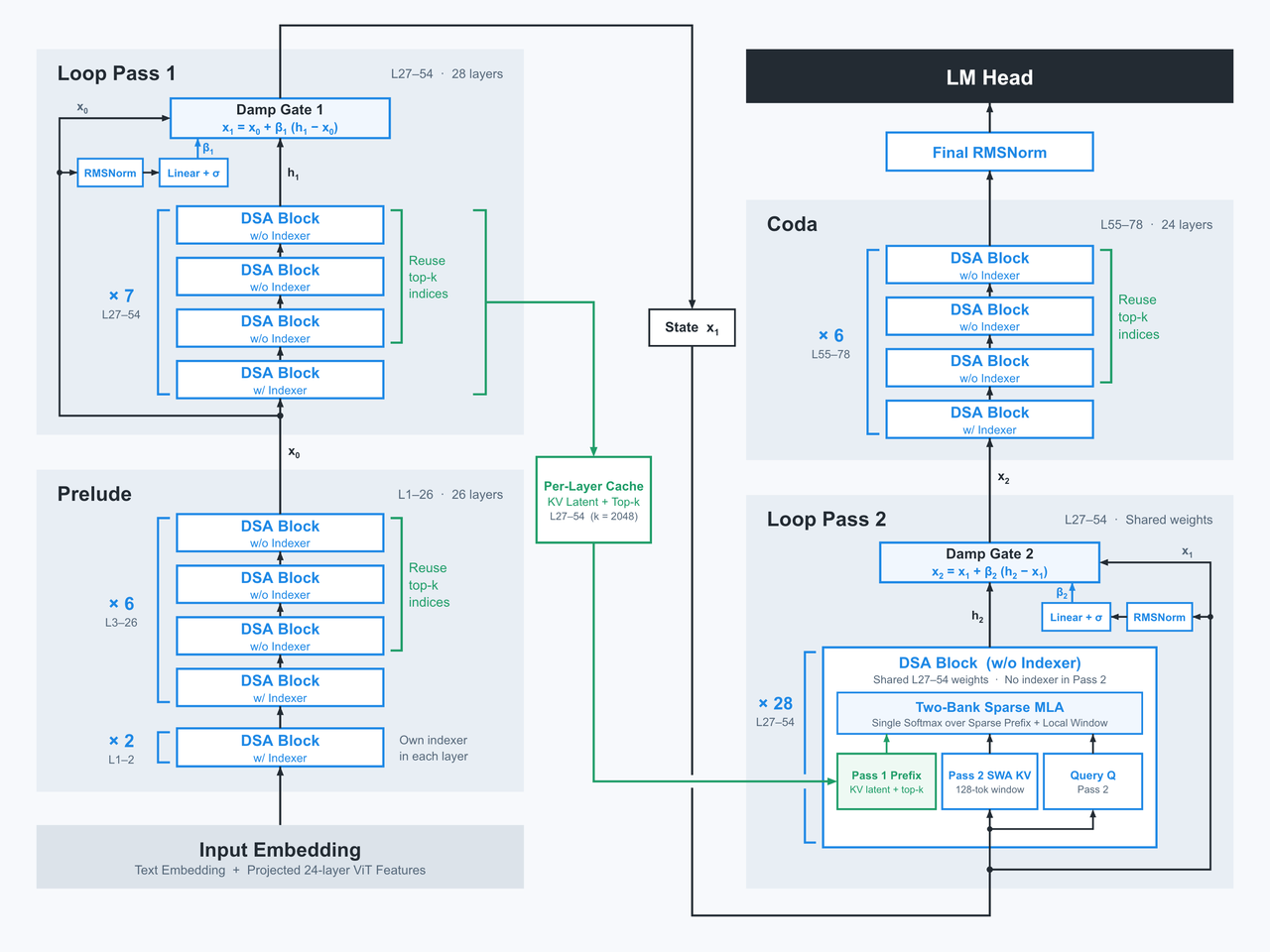 Figure: Internal execution flow of the GLM-5.4 loop architecture. The 28 shared layers process the input twice in sequence — the first pass builds global context, the second refines the reasoning. Source: Z.ai tech blog
This methodology is fundamentally a calculated computational arbitrage. OpenAI tested recurrent loops in GPT-6 Astra, and frontier startup Thinking Machines soon followed. Zhipu pushed this architecture directly into the 750B tier, making it the first Chinese flagship model to achieve frontier status powered by recurrent compute.
Three Engineering Breakthroughs: 1M Context Without Memory Explosions
Running the same weights twice sounds straightforward conceptually, but production deployment is fraught with technical landmines. Standard feed-forward models run a single pass, requiring KV cache allocation for just one pass. Naively duplicating the 28-layer computation would double VRAM consumption and slash decoding speed to commercially unviable levels.
To tame inference overhead, the research team implemented three surgical architectural optimizations. The first is a gated progressive update mechanism. Each token is governed by dynamic gating switches across passes. During pass 1, the gate opens only slightly to establish a coarse global outline; in pass 2, it opens fully to execute fine-grained semantic adjustments. The dynamic gate also adapts step sizes based on prompt complexity, spending compute on challenging problems while gliding through simple prompts.
The second breakthrough is hybrid Key-Value (KV) cache management. During the second pass, the engine discards exhaustive full-history retention in favor of a compact sliding window. Compact representation cached in the first pass is continuously reused, while the second pass holds only transient local memory. When handling ultra-long contexts up to 1 million tokens, the second pass occupies only a sliding window’s footprint, preventing geometric memory explosion and keeping serving costs manageable.
The third optimization targets attention indexing. The second pass directly reuses attention routing and key addressing patterns computed in pass 1. Memory lookup overhead drops to zero while maintaining inference fidelity. Hardware-software co-design neutralizes the duplicate memory access penalty, enabling off-peak throughput of 200 tokens/sec and steady peak throughput between 70 and 80 tokens/sec.
30B Controlled Experiments: Shorter Outputs, but Risk of Infinite Thinking Loops
How much tangible gain does a recurrent loop actually deliver? Zhipu conducted rigorous controlled experiments using a 30B baseline. The recurrent variant, trained with just 10% extra compute, opened substantial performance gaps in complex mathematics, logic, and scientific reasoning benchmarks.
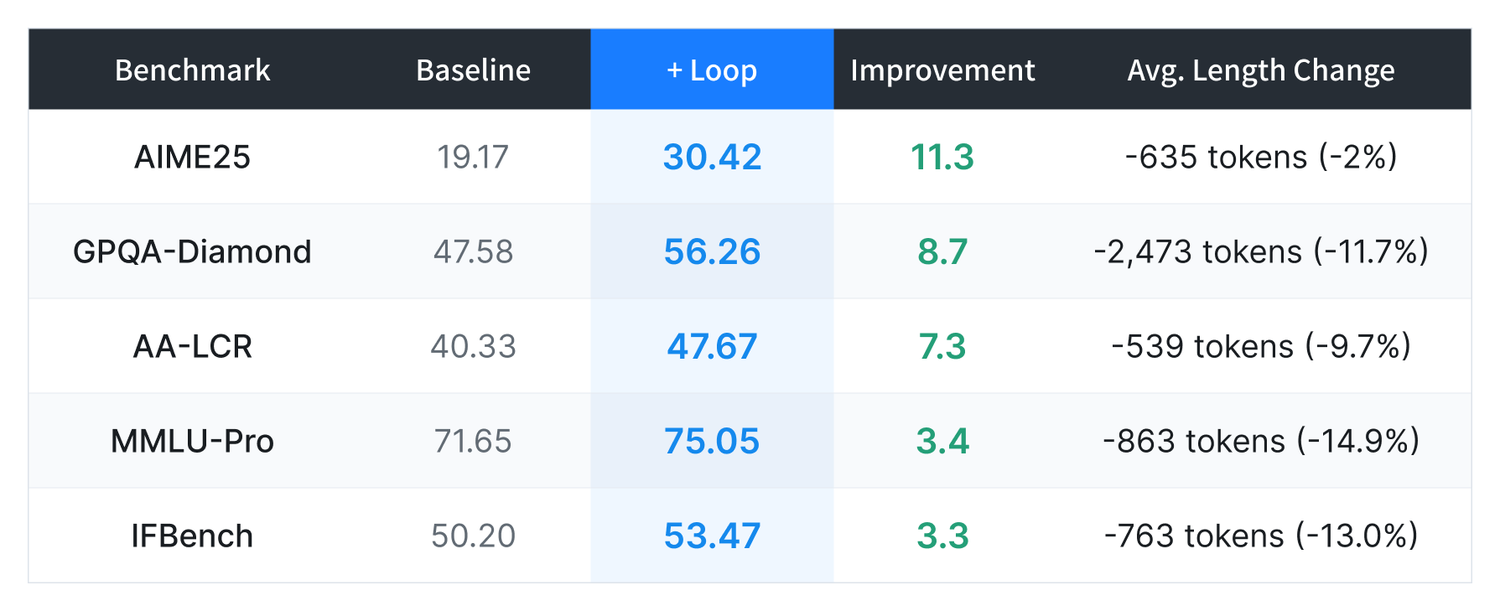 Figure: Benchmark comparison between the loop and standard versions of the 30B model. The loop structure shows a clear advantage in math and multi-hop reasoning. Source: Z.ai tech blog
A fascinating pattern emerged during testing: across scientific QA and advanced commonsense reasoning benchmarks, output length dropped by 10% to 14%. Intermediate thinking steps are compressed directly inside internal recurrent loops, freeing the model from generating tedious scratchpad tokens. While verbose output shrank, final solution accuracy notably increased.
Yet there is no free lunch in systems architecture. Official technical reports acknowledge that recurrent mechanisms introduce new failure modes. The model can succumb to marathon thinking loops: faced with highly ambiguous or adversarial instructions, internal self-correction loops trigger excessively, driving up time-to-first-token (TTFT). This stubborn deliberation secures superior precision, but severely tests user latency tolerance.
General-Purpose Programming Debate: Real Paradigm Shift or PR Packaging?
Alongside the model announcement, Zhipu unveiled an ambitious concept dubbed “General-Purpose Programming.” The company highlighted the model’s ability to solve non-software challenges via executable code: generating narrated musical videos, rendering mechanical robotic arm blueprints, and generating 3D birdwatching simulations via mathematical scripts. Zhipu positions this as a universal bridge for code to orchestrate physical reality.
The developer community reacted with divided opinions. Many practitioners on forums dismissed the branding as PR marketing, arguing that stronger mathematical and scientific reasoning naturally elevates programmatic code generation. Systems architects also pointed out that looping identical layers is essentially a variant of parameter sharing rather than an unprecedented mathematical breakthrough.
Nonetheless, pragmatists recognized its industrial impact. Amid tightening chip supplies and soaring infrastructure costs, scaling parameters into multi-trillion territory is becoming economically unfeasible. By proving that 750B parameters can achieve frontier depth via temporal looping, Zhipu demonstrated the viability of trading execution time for memory space. As GLM-5.4 rolls out to APIs and chat platforms, full independent benchmarks will soon validate its claims.
Whether it can fully supplant a true 3-trillion-parameter titan remains to be tested by community evaluations. But GLM-5.4’s architectural blueprint offers an urgent lesson to the industry: competing on intelligence no longer requires a one-way race toward bloated accelerator clusters. Running identical weights thoroughly may well be the clearest exit ramp from the memory wall dead end.
References:
- Z.ai tech blog
- The Next Web coverage
- The Decoder coverage
- MLQ.ai coverage
- HN discussion (item?id=50609685)