
You can download dozens of browsers across your devices today. Yet scratch beneath their surfaces, and the underlying rendering landscape has spent the past two decades reduced to just three engines: Google’s Chromium dominating desktop and mobile alike, Apple’s proprietary WebKit on iOS and macOS, and Mozilla’s Gecko persevering with single-digit market share in Firefox.
On November 23, 2026, former Apple WebKit engineer Andreas Kling announced that Ladybird has officially reached its alpha release. Built entirely from scratch over four years, the project forks no Google code and relies on zero Apple OS internals. For the first time, a completely independent third modern browser engine is distributing binary installers to the general public.
Rewriting a browser from zero has long been dismissed by engineers as a suicide mission. The modern web has evolved far beyond basic hypertext layout into an application runtime governed by thousands of sprawling standards. In an industry resigned to living as satellites within Big Tech ecosystems, Ladybird marks the first real fracture in a twenty-year monopoly.
Behind the Reskinning Craze, Only Two Foundations Remained
Over the last twenty years, software markets saw a wave of browsers touting fresh innovation. Brave championed privacy and ad-blocking; Arc reimagined tab workspaces. Yet pop the hood, and every single one was powered by the exact same engine: Google’s Chromium.
Maintaining an independent engine carried an astronomical cost. In 2018, Microsoft surrendered its proprietary EdgeHTML engine, transitioning Edge onto Chromium. Years earlier, Opera had abandoned its beloved Presto engine. One by one, tech giants surrendered control, inexorably driving the web’s foundations toward monoculture.
The body of modern web specifications rivals the complexity of an entire operating system. Spanning tens of thousands of pages, standards govern layout math, script virtual machines, and media codecs. Because incumbents shape these standards to their own products, the barrier to entry reached absurd heights. Any new team starting from scratch faced millions of automated compliance tests before even rendering a basic page.
November 2026: An Entirely New Engine Ships
The release of Ladybird version 2026.47.7 on November 23, 2026, confronts this reality head-on. The project released official binary packages for both macOS and Linux. The Apple build targets Apple silicon on macOS 14.4 and newer, while Linux distributions receive synchronized releases via Flatpak, Ubuntu’s apt repository, and Fedora’s dnf repositories.
Ladybird borrows no code from existing browser codebases. Its HTML parser, CSS style cascades, and layout tree were all written by hand. LibJS, its ECMAScript engine, was built from scratch, as was its custom WebAssembly virtual machine. External dependencies are strictly confined to focused libraries: HarfBuzz for text shaping, Skia for 2D rendering, ffmpeg for video decoding, and SQLite for local storage.
Crucially, the release model has matured. Version 2026.47.7 introduces a smooth rolling-update mechanism, allowing regular users to track upstream progress without compiling source code locally. Founder Andreas Kling noted this was the project’s proudest milestone in four years of development. The alpha package ships with built-in ad-blocking rules, native WebDriver support for test automation, and compatibility with the Firefox DevTools remote debugging protocol.
AI Coding Agents Fuel an October Explosion
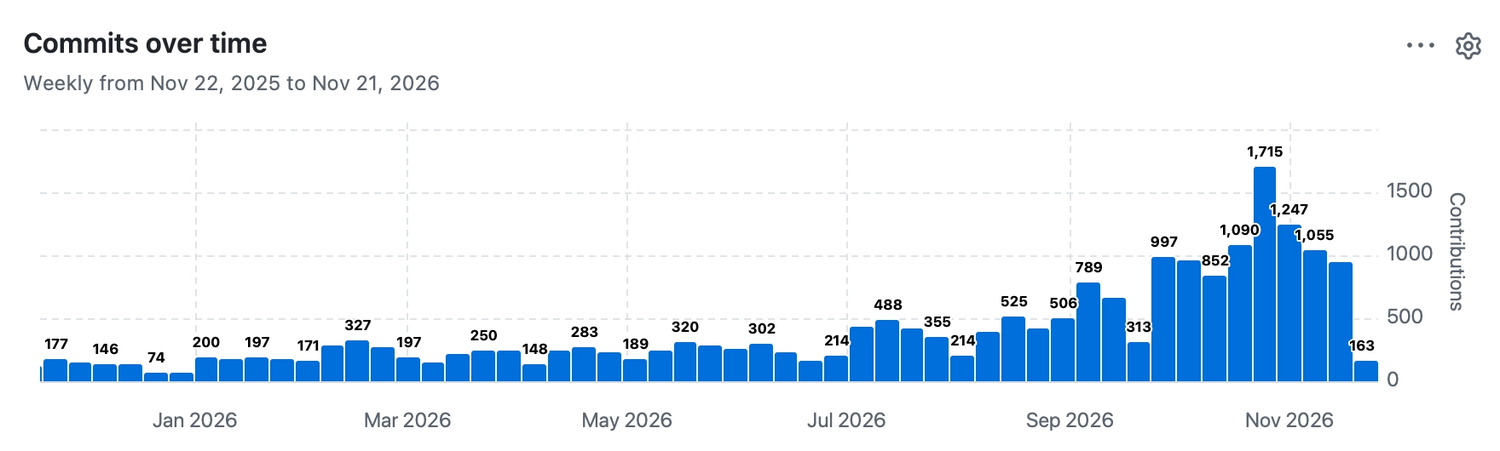 Figure: Ladybird repository commit activity over the past year. Source: GitHub contribution graph.
Activity across the Ladybird repository tells a striking story: commit velocity spiked sharply in July 2026, hitting an all-time peak in late October. During October alone, the team completed three massive architectural refactors. Style resolution and layout computation were decoupled into dedicated worker threads. The team deployed a brand-new JavaScript JIT compiler and overhauled their WebAssembly runtime with Cranelift. On the industry-standard JetStream 3 benchmark, WASM performance surged by a factor of 7x over the previous implementation.
The secret behind this output explosion lies in aggressive adoption of AI coding agents. Back in February 2026, the team shared details on utilizing Claude Code and Codex to accelerate development. In a single two-week sprint, engineers leveraged AI to translate 25,000 lines of LibJS core modules from C++ to Rust. LLMs handled deterministic, rule-heavy code migration and unit test generation, freeing human engineers to focus on state machines and high-level architectural design.
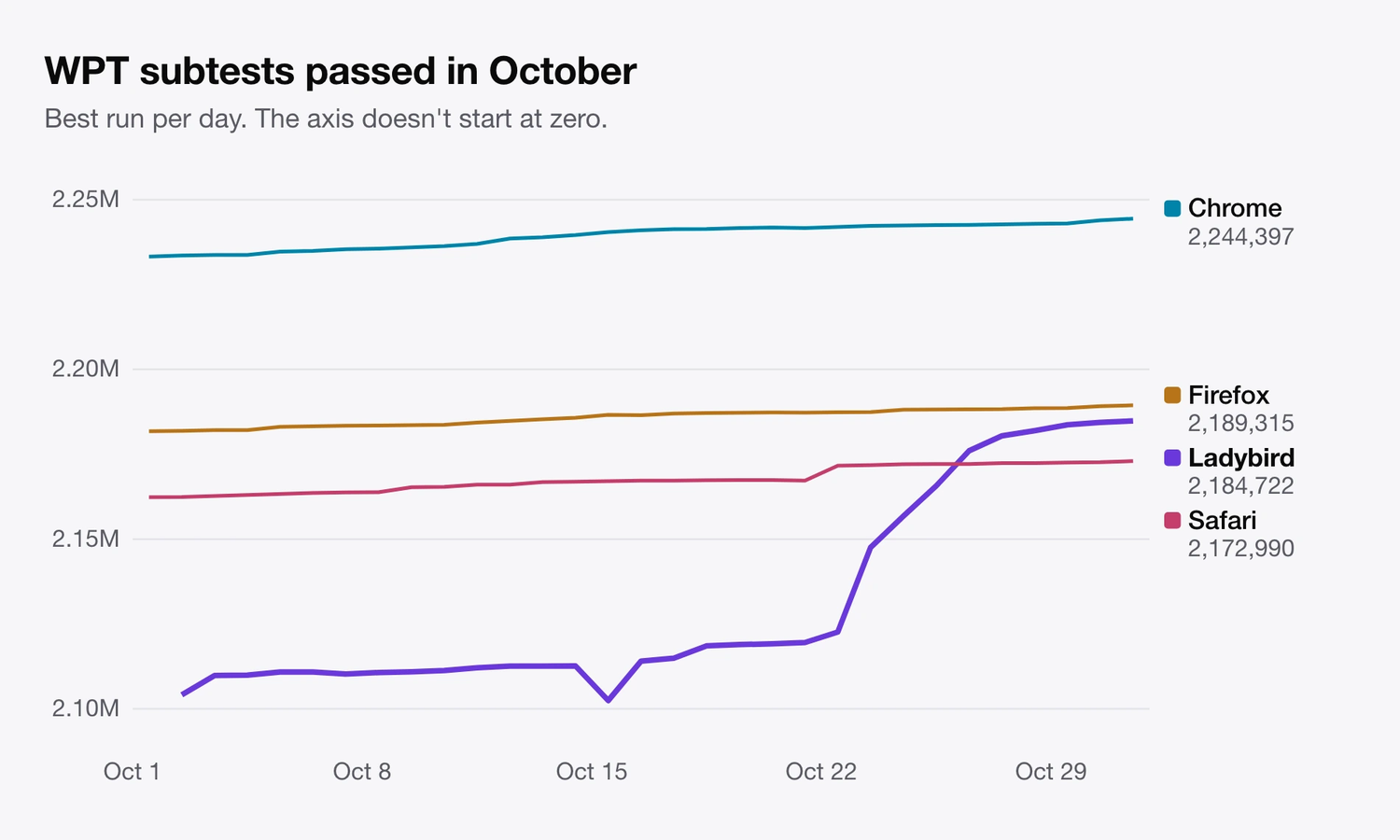 Figure: Web Platform Tests (WPT) subtest pass rate progression in October. Source: Ladybird October Monthly Report.
The industry’s gold-standard compliance suite captured this velocity. Across the roughly 2.25 million test cases in web-platform-tests, Ladybird registered a net gain of 75,650 passing subtests in October alone. By the end of the month, Ladybird reached 2,184,722 passes. For the first time in history, the independent project surpassed Apple Safari’s 2,172,990 passes, closing in on Firefox’s 2,189,315. Surpassing Apple’s official engine on web compliance showcases how small, AI-augmented teams can close decades-old gaps against entrenched tech giants.
Hands-On: Capable of Real Work, Yet Prone to Sudden Crashes
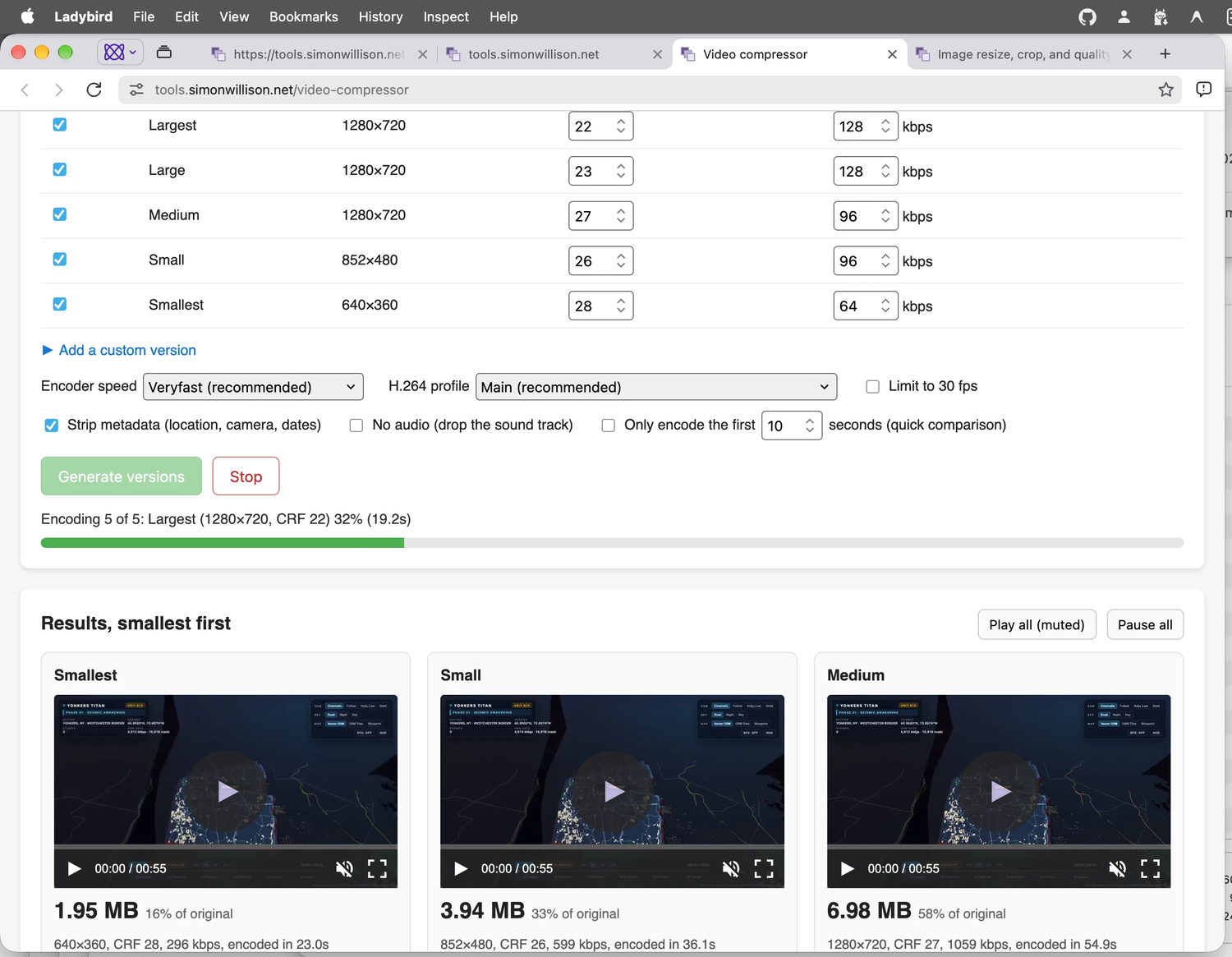 Figure: Simon Willison running ffmpeg compiled to WebAssembly on macOS. Source: Simon Willison’s Weblog.
Prominent developer Simon Willison spent the launch day putting the alpha through its paces. The browser felt responsive and snappy, rendering mainstream web pages cleanly. Demanding workloads—such as running an in-browser WebAssembly port of ffmpeg for video compression or interactive Python environments via Pyodide—executed without issue. Inside a Proxmox virtualization dashboard, its noVNC remote desktop connection felt noticeably more responsive than Firefox.
Under the hood, Ladybird enforces strict process isolation. In an experiment running seven tabs across two windows, the operating system revealed a clean process hierarchy. The main process hovered around 240MB of RAM. Auxiliary helpers—Hub, Compositor, MediaServer, and VideoDecoderServer—coordinated alongside ProcessReaper to reclaim dead resources. Each tab was isolated inside its own WebContent process, ranging from 60MB to 819MB of memory. This multi-process architecture guarantees that a crashed tab will not bring down the entire window.
Still, being an early alpha, its shortcomings are unmistakable. Attempting to launch Datasette Lite triggered an immediate console error: undefined is not a function (evaluated from 'navigator.serviceWorker.startMessages'). Service Worker offline primitives remain unimplemented, with source files peppered with FIXME comments. Complex modern web APIs quickly expose the young engine’s limits.
Showing Scars: The Audacity of a True Challenger
Open Ladybird’s release notes, and the first thing you see is an unvarnished list of flaws. The team states plainly upfront: some websites will fail to open, and crashes will occur without warning. No security guarantees are made. The build includes an integrated site-issue reporter and a crash diagnostic tool. The developers even threw down a gauntlet to security researchers worldwide: break their memory boundaries and submit the exploits.
The project has sparked lively debate across the community. Unlike Servo, which prioritizes modular embeddability and accepts broad contributions, Ladybird currently restricts pull requests, keeping code review tightly held within its core team. Its heavy reliance on LLMs has also triggered discussions among peers regarding long-term codebase maintainability.
Regardless of debate, Ladybird has punctured an entrenched belief. For twenty years, developers assumed the moat around modern browser engines was uncrossable, leaving new entrants no choice but to reskin Chromium. Ladybird arrived bruised, imperfect, and openly ambitious. It proves that starting from scratch is still possible. The era of only two real engines just collided with an unapologetically scrappy third.
Reference Links:
- Ladybird Alpha Announcement
- Simon Willison’s Hands-On Review
- Phoronix Coverage
- TechPowerUp Coverage
- Hacker News Discussion (item?id=50614249)