Mobile Screens Have Become Open-Pit Mines for Large Models
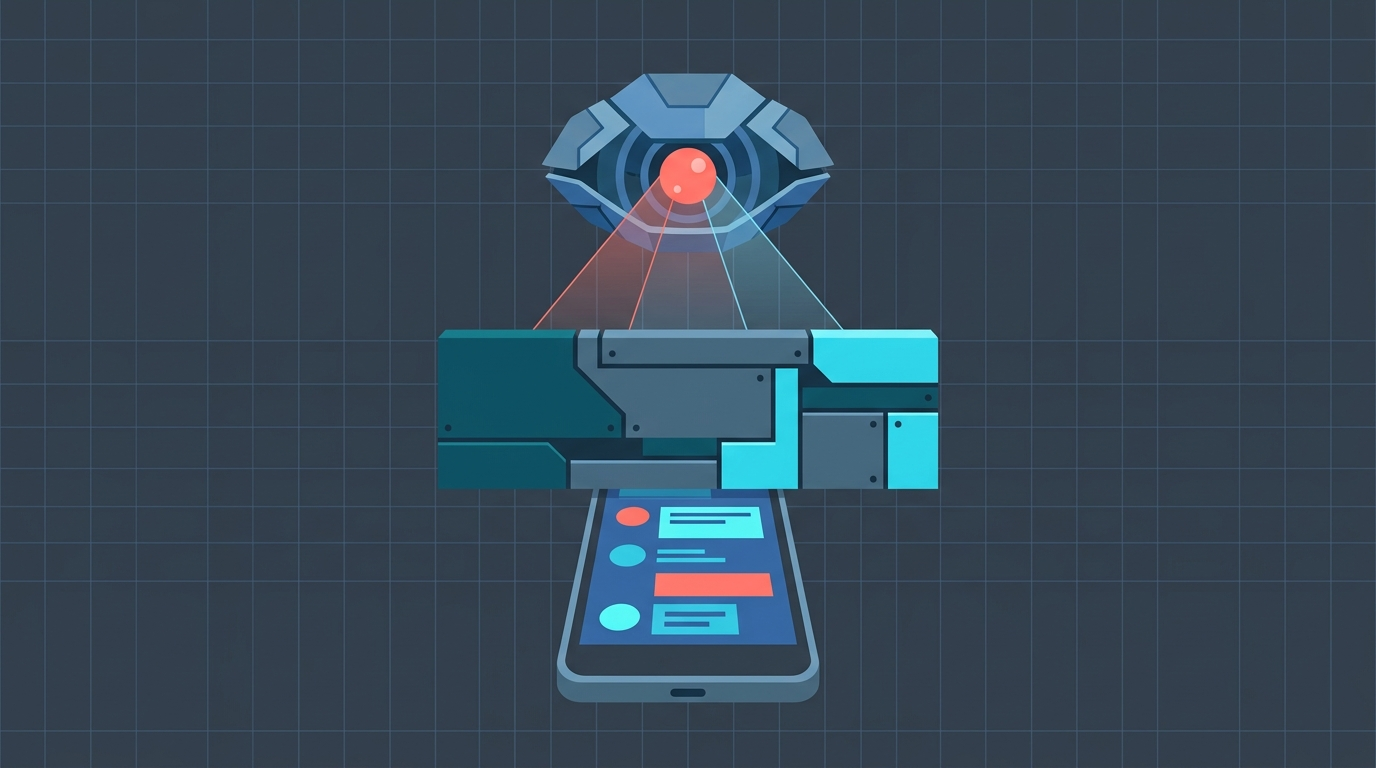
On November 20, 2026, encrypted messaging service Signal announced an unusual defensive measure. Facing Apple’s latest iOS 27 and select Android releases, Signal moved to comprehensively restrict system AI from ingesting its user interface. Whenever the host operating system attempts to capture the messaging window, the screen recorder receives nothing but a blank black canvas.
This defensive barrier directly targets the system-level AI frameworks aggressively pushed by smartphone vendors. Apple baked screen-aware Siri AI directly into iOS 27, while Google embedded Gemini Intelligence straight into the foundation of Android. The headline feature advertised across keynote presentations is real-time pixel scanning: an omnipresent AI continuously ingests on-screen context to book flights, fill out web forms, or assemble personal itineraries.
To deliver frictionless assistance, smartphone displays have effectively been turned into open-pit data mines for large models. Where users once had to copy and paste text manually, background system agents now quietly scrape screens and extract context automatically. For general-purpose productivity suites, this marks a genuine leap in usability. But for a communications tool whose core value proposition is uncompromising privacy, it represents a catastrophic breach of trust.
The foundational assumption of end-to-end encryption is that communication remains visible strictly to sender and recipient. Rigorous cryptographic mathematics protect bits in transit, leaving network eavesdroppers powerless against ciphertext. Yet the moment those decrypted characters are rendered onto an OLED panel, a system-level AI operating with host privileges can silently scrape the raw output straight off the glass.
Protocols Stop Hackers, but Cannot Stop the Host OS
This breakdown invalidates the traditional chain of trust. Cryptographic protocols can be audited, open-sourced, and verified worldwide, offering mathematical guarantees beyond reproach. However, application code must ultimately run inside the execution environment governed by the host operating system. Once low-level OS routines capture framebuffers to feed neural networks, cryptographic guarantees at the application layer become irrelevant.
The dilemma grows exponentially more severe due to the two-way nature of human conversation. Private chats require at least two participants. Even if a user diligently disables every AI feature on their own device, they cannot protect their data in isolation. If the person on the other end of the line leaves screen awareness active, incoming and outgoing messages are scooped up by that recipient’s system assistant just the same.
Once screen telemetry is harvested, its downstream lifecycle escapes application control entirely. The extracted tokens might linger in local SQLite databases, or they could be dispatched to cloud clusters during complex multi-step tool calls. Signal President Meredith Whittaker made the company’s position unmistakably clear: the three major platform gatekeepers are steering their ecosystems toward an environment actively hostile to digital privacy.
 Figure: Signal published an official essay warning that OS-level AI is eroding the foundational boundaries of end-to-end encryption. Source: Signal Official Blog
When Microsoft introduced its Recall screenshot memory engine on Windows 11, Signal responded with comparable defensive countermeasures. Now that exact battle has migrated onto mobile hardware. Platform vendors package persistent screen surveillance as intelligent convenience, passing the hidden cost of privacy exposure directly onto end users.
Blank Documentation Leaves Developers Reverse-Engineering in the Dark
Confronted with entrenched operating system platforms, Signal was forced to adopt remarkably crude defenses. Finding no standardized privacy preservation APIs in platform SDKs, engineering teams resorted to system-level screenshot prevention flags (FLAG_SECURE on Android and secure window wrappers on iOS). In practice, Signal is co-opting legacy anti-piracy mechanisms intended for commercial video players rather than utilizing dedicated “opt-out of AI surveillance” primitives.
On desktop environments, this makeshift workaround collides with outright technical limitations. While macOS exposes APIs to block screen recording, it provides no unambiguous, supported interface to suppress static, single-frame screen captures. Apple’s existing screenshot protection frameworks are reserved exclusively for DRM-protected streaming media, remaining inaccessible to general-purpose software developers. For Mac users, Signal can do little more than urge individuals to manually uncheck Siri scanning in system preferences.
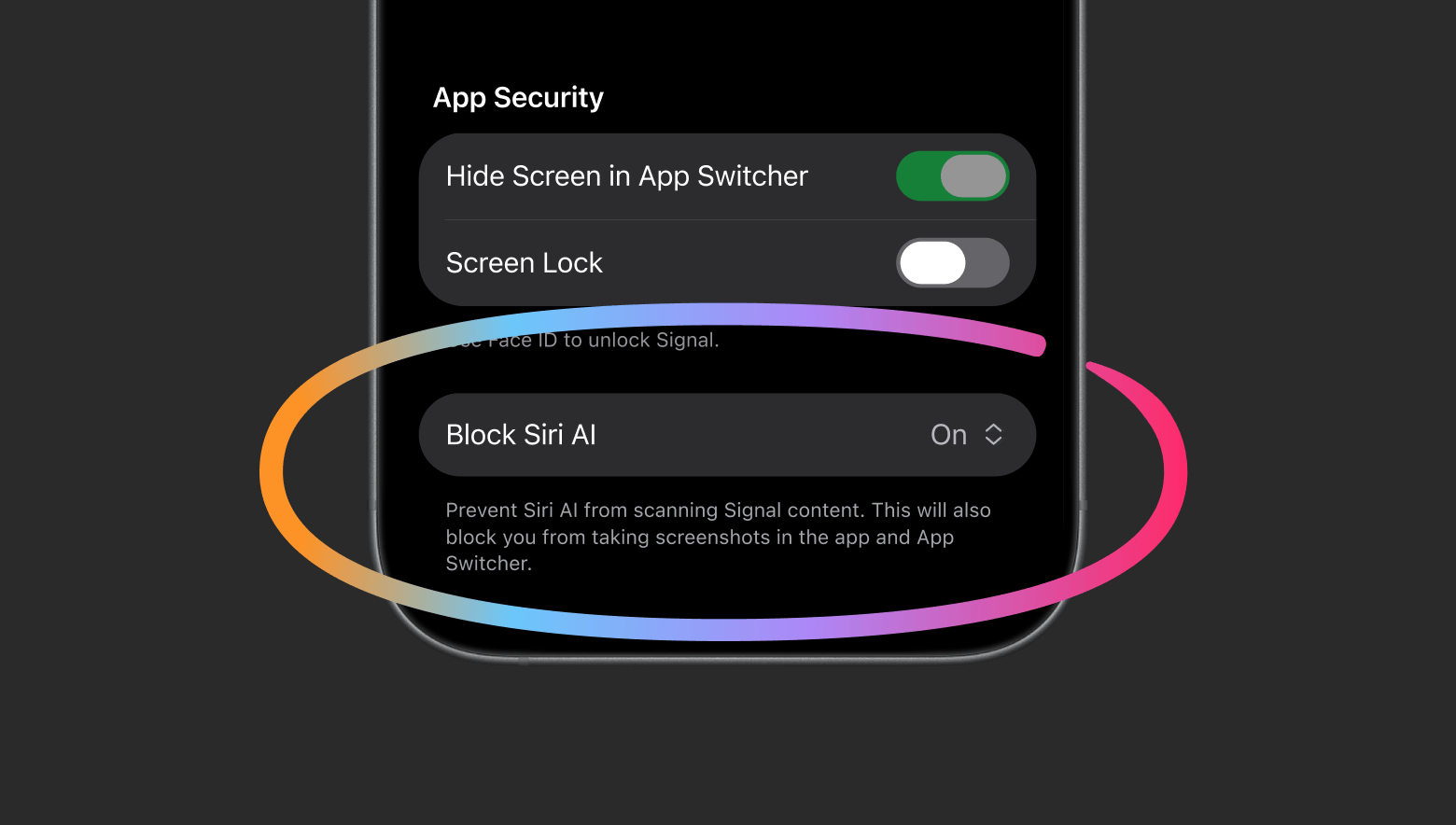 Figure: The Block Siri AI toggle introduced by Signal in iOS 27 settings, designed to prevent the system assistant from ingesting chat conversations. Source: Signal Official Blog
This platform opacity leaves third-party developers in an increasingly vulnerable posture. Over recent months, security researchers and app developers have poured significant engineering cycles into reverse-engineering OS internals just to trace how system AI actually scrapes interface buffers. Because platform vendors refuse to publish comprehensive architectural specifications, developers have no deterministic way of knowing when or how pixels are inspected.
Signal openly acknowledged that blocking screen capture is merely a stopgap. As the engineering team conceded, suppressing screenshots does nothing against deeper system pathways—such as autonomous AI agents scanning local storage volumes directly through file system hooks.
A Safe Deposit Box or a Personal Scratchpad?
Signal’s countermeasures ignited an intense philosophical debate across the developer community regarding the true purpose of instant messaging. The controversy boils down to a fundamental question: should a messaging client function as an ephemeral, strictly confidential speaking tube, or as an indexed personal data warehouse?
Strict privacy advocates strongly endorse Signal’s hardline stance. In their view, digital messaging models real-world spoken conversations and should never be burdened with long-term retention. Several community participants noted their standard operational hygiene: configuring Signal messages to auto-delete after seven days, while routing durable commitments to archived email threads.
Conversely, productivity-focused users operate under completely different expectations. For millions, message threads have long doubled as living personal scratchpads. Addresses sent by acquaintances, ad-hoc work tasks, and saved web bookmarks pile up inside chat histories. Having a system AI automatically index, summarize, and cross-reference these fragmented artifacts saves countless hours of manual searching.
This divide highlights an inescapable architectural tension in modern computing. Users want the cognitive leverage offered by large language models, but refuse to surrender control over their intimate communications. Under current OS paradigms, however, convenience and privacy have turned into a zero-sum game: unlocking automated assistance almost universally requires handing over root-level custody of the display buffer.
The Privacy Perimeter Retreats to the Glass
Apple, Google, and Microsoft control the bedrock of personal computing. Third-party applications survive within walled gardens where platform architects dictate the boundaries of digital sovereignty unilaterally. When an operating system treats every pixel on screen as training corpus and agent fodder, individual software applications cannot win a protracted war against the foundation underneath them.
Signal has laid out two explicit technical demands for the platform triumvirate: platform vendors must provide standardized developer APIs to declare UI sensitivity, and they must publish rigorous, transparent documentation. Granting users and developers the unambiguous right to opt out of scanning is far more dignified than forcing secure messengers to masquerade as copy-protected video streams.
This escalating standoff exposes a sober reality of the mobile era. Against platform privilege, even the most battle-tested cryptographic protocols cannot prevent an OS from scraping pixels off the display. As pervasive AI becomes standard equipment on every handset, the digital privacy perimeter has been forced into a final retreat—right against the surface of the screen glass.
Reference Links:
- Signal Official Technology Blog: Keeping Private Conversations Private
- Lobsters Community Technical Discussion
- Apple Developer Technical Memorandum: Siri AI Screen Awareness
- Microsoft Windows Recall Privacy Architecture Technical Report