“Android phone makers are overwhelmingly betting on 16:9 for their upcoming wide-slab phones. Video playback will look incredible, and software adaptation overhead should be significantly lower.” On November 17, tech blogger @DigitalChatStation reported on Weibo that four major Chinese display manufacturers—BOE, CSOT (China Star Optoelectronics Technology), Tianma, and Visionox—are actively delivering wide-slab display samples to phone OEMs. Wide-slab devices across the Android ecosystem are poised for widespread market debut next year. When display makers collectively prepare capacity for a nascent form factor, supply chain signals reveal reality far sooner than any keynote.

Photo: The Xingmang OSTA O1 Pro listed on Huawei Vmall. Its 16:9.5 aspect ratio makes the front face wider and shorter than typical slab smartphones—the defining visual distinction of the wide-slab category. Source: IT Home (Huawei Vmall official image)
Huawei Put Its Answer on the Shelves First
On the morning of the same day, Huawei listed the inaugural product of its new sub-brand, Xingmang—the OSTA O1 Pro—on Huawei Vmall, scheduling its official launch for November 20. The leaked spec sheet reveals: a 6.39-inch 1.5K LTPS flat display, 16:9.5 aspect ratio, ultra-narrow 1.05mm symmetrical bezels, 6.68mm thin chassis weighing 200g, a Kirin 9030S processor, a 7000mAh battery supporting 66W wired charging, up to 16GB+1TB storage, and a side-mounted fingerprint sensor.
The camera system deserves special examination: a 200MP 1/1.28-inch RYYB primary sensor paired with a 50MP 3.7X periscope telephoto lens, while the ultra-wide lens was eliminated entirely. A 6.68mm body simply has no room for a large-format ultra-wide sensor; internal component trade-offs for wide-and-short proportions are clear and uncompromising. When an upcoming handset marketed as an AI phone foregoes an ultra-wide module, the OEM has explicitly prioritized the wide-screen ergonomic form factor over full focal length coverage.
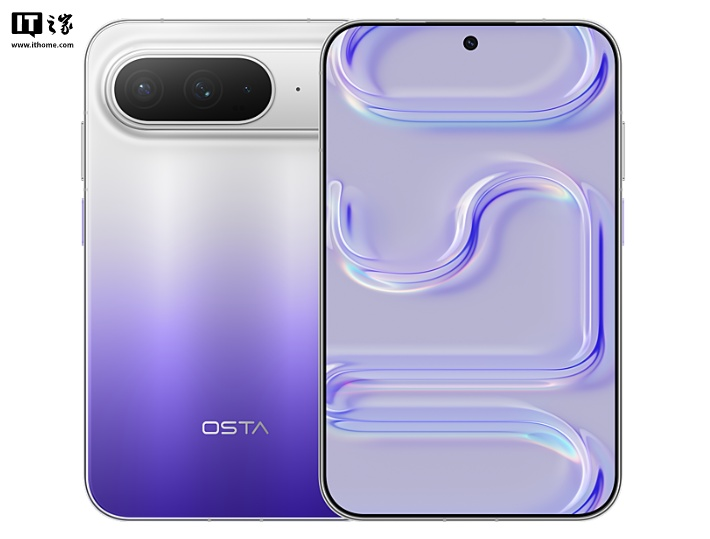
Photo: One of the official listing renders. The wider aspect ratio reduces phone height, keeping thickness and weight firmly in standard slab territory—6.68mm and 200g, thinner than most flagships of comparable diagonal size. Source: IT Home (Huawei Vmall official image)
A teardown by Kuai Technology revealed that the Kirin 9030S shares its underlying architecture with the Huawei Pura X View: 1×2.69GHz prime core + 3×2.15GHz big cores + 4×1.62GHz medium cores, paired with a Maleoon 935F GPU clocked at 933MHz. RAM is boosted to 16GB, while non-essential peripherals have been scaled back—omitting the ultra-wide lens and Beidou satellite messaging. Repackaging a proven platform into a brand-new shell allows the Xingmang sub-brand to scale wide-screen form factors quickly while isolating trial-and-error costs.
Why Display Manufacturers Are Placing Bets Early
Leaked specifications from @DigitalChatStation in July offered detailed dimensions: a 6.3-to-6.4-inch display, 1.5K LTPO panel, and ultra-narrow symmetrical bezels, with commercial shipments slated for the first half of 2027. Deploying LTPO indicates this is far from a low-tier experimental project; panel makers are allocating capacity on primary production lines.

Photo: The original leak mentions BOE, CSOT, Tianma, and Visionox side by side. With every tier-one domestic display maker onboard, sampling volume far exceeds custom orders from any single customer. Source: Weibo @DigitalChatStation (via IT Home)
Display panel vendors traditionally expand production capacity only after demand has been validated. Sampling across all four manufacturers simultaneously requires formal project initiation signals from multiple OEMs. By establishing a robust supply chain upstream, unit bill-of-materials costs and delivery risks drop for device makers downstream. Supply and demand reinforce one another, propelling 16:9 back to the main stage.
Content Formats Have Always Favored Wide Screens
The vast majority of video content consumed by users sits natively near the 16:9 horizontal format. On a tall 20:9 screen, horizontal 16:9 playback uses only about one-quarter of the display area, leaving massive black letterboxing bars to consume the rest. On a 16:9 display, identical footage fills the screen almost edge to edge. Aligning display proportions with content format represents the most intuitive driving force behind this pendulum swing.
Software adaptation costs heavily favor wide screens as well. Foldable smartphones have already spurred developer adoption for 16:9 and 16:10 user interfaces. Porting the unfolded aspect ratio of foldables onto rigid slab form factors requires almost no redesign from app developers. That reality underpins @DigitalChatStation’s observation that “software adaptation overhead should be significantly lower.”
Internal engineering also benefits: an elongated 20:9 chassis struggles to accommodate large-footprint battery cells, whereas a shorter, wider 16:9 body unlocks ample planar area. The OSTA O1 Pro packs a massive 7000mAh battery into a slender 6.68mm profile—a direct hardware payoff delivered by geometry.
OPPO and Honor Follow: Top 5 Chinese OEMs Committed for 2027
On the product roadmap, OPPO has moved the fastest. On July 15, @DigitalChatStation revealed that OPPO officially initiated its first wide-slab smartphone project—the second vendor after Huawei and the first in the broader Android ecosystem to greenlight such a model. Featuring an aspect ratio close to 16:10, its form factor resembles an “unfoldable wide foldable.” Simultaneously, OPPO is testing a dedicated wide foldable targeted for Q1 2027, executing a dual-track strategy across rigid and folding devices.
Honor is trailing closely behind, while other competitors are finalizing project pipelines spanning specialized camera-centric wide slabs, mid-range wide slabs, and performance-focused variants. Leaks on November 17 confirmed that all top five Chinese smartphone manufacturers have committed to wide-slab models for 2027, having completed product initiation and entering accelerated testing phases.
A comment thread highlighted industry timing: when users urged OPPO to equip its wide-screen handset with Qualcomm’s 9600p platform, the insider responded that “it will most likely launch separately from the wide foldable to allow adequate polish.” Leading brands are intentionally spacing out release windows between slab and foldable form factors to prevent cannibalizing their own lineups.
Regressive Step or Inevitable Evolution?
The 16:9 aspect ratio was previously dismissed in the mobile industry. During the bezel-less revolution, ultra-tall 20:9 screens dominated the market by offering narrower palm widths and easier one-handed handling. Yet the premises behind today’s resurgence are fundamentally different: the foldable ecosystem spent three years standardizing wide-screen app layouts and proving battery capacity gains, while panel manufacturers have already amortized production lines for these dimensions.
In the supply chain, wide-slab and wide-foldable panels represent two different packaging methods for essentially the same screen logic. The former offers lower costs, superior durability, and longer battery life; the latter delivers transformative flexibility. Following the Huawei Xingmang O1 Pro launch on November 20, retail sales will deliver the initial verdict. If a 6.39-inch 16:9.5 device captures consumer interest, the 2027 wide-slab lineups from the top five manufacturers will turn from speculative bets into an established reality. Winning the screen ratio battle is never decided on a spec sheet—it is proven by monthly sales off retail shelves.
References:
- IT Home: BOE, CSOT, Tianma, and Visionox actively sampling wide-slab displays
- IT Home: Huawei Xingmang OSTA O1 Pro wide-slab phone listed on Vmall
- IT Home: Key specifications leaked for OSTA O1 Pro
- CNMO: Report suggests OPPO’s first wide-slab smartphone greenlit
- Weibo @DigitalChatStation: Leaks on display manufacturers sampling wide-slab panels