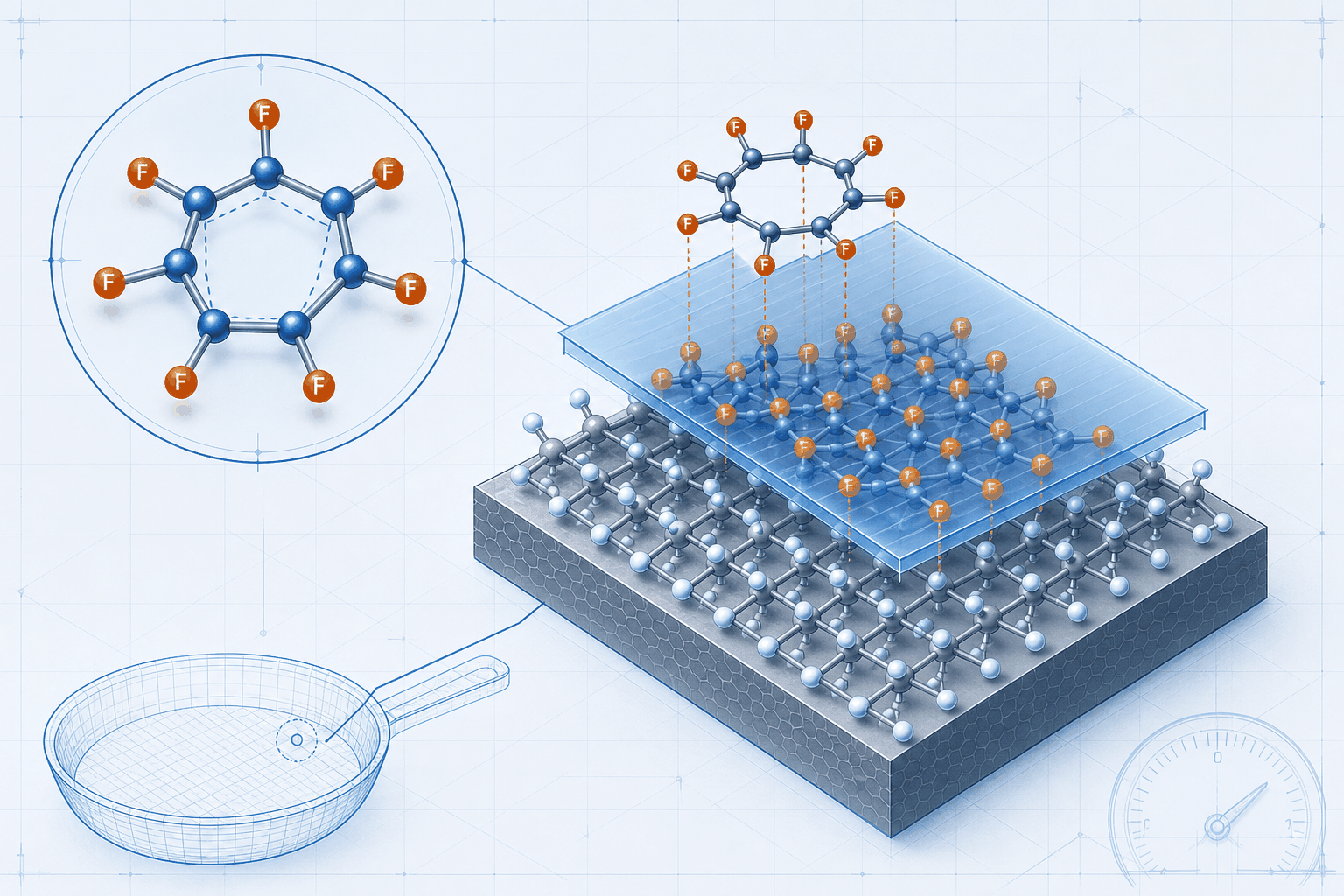
On July 16, 2026, Chemical & Engineering News (C&EN) reported on a striking breakthrough: chemists at the University of Tokyo have developed a glue that not only adheres firmly to Teflon (polytetrafluoroethylene, or PTFE) but also wipes off completely using plain ethanol.
The experiment speaks for itself—two plates of untreated PTFE joined by just 7 square centimeters of glue contact area held an 8 kg weight after 10 minutes of cooling. Eight kilograms is equivalent to two full water jug bottles, suspended from a contact patch smaller than a standard credit card.
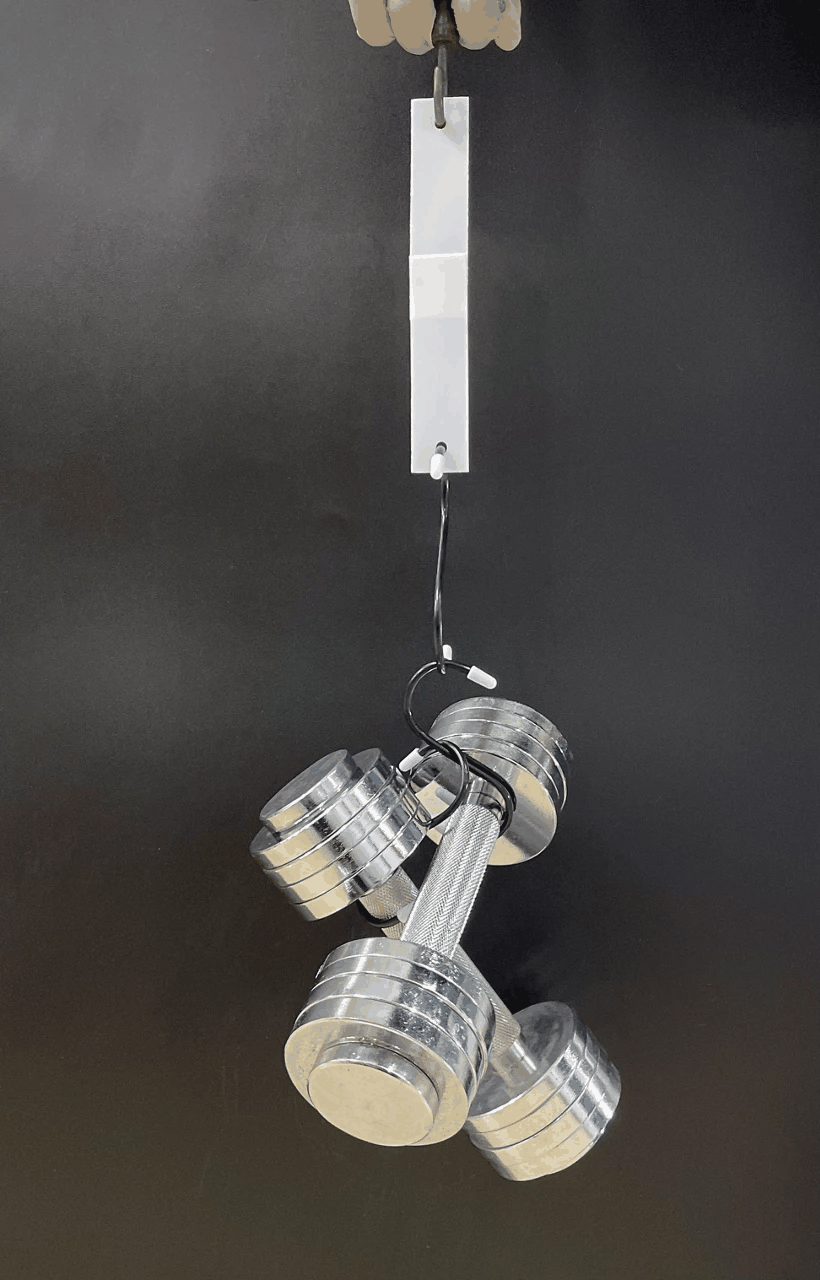 Two PTFE plates hold an 8 kg weight with only 7 cm² of contact area. Photo: Kohei Kikkawa
This result directly defies conventional wisdom. Teflon earns its nonstick reputation from an extremely low surface energy—so low that glue molecules cannot find a foothold. For decades, engineers and technicians dealing with damaged PTFE components had only one choice: total replacement. No commercial adhesive could form a reliable bond on untreated PTFE.
That dogma has now been dismantled by a small molecule code-named Cyclic FP-fmoc.
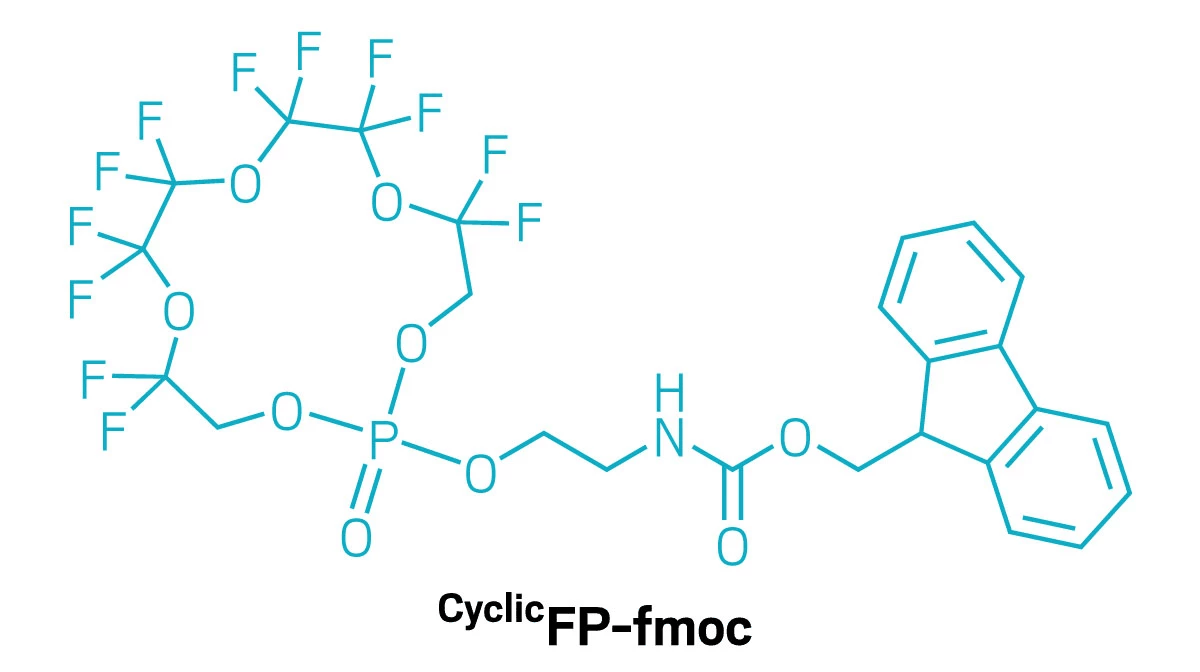 Molecular structure of Cyclic FP-fmoc. Dense fluorine atoms adorn the macrocycle on the left, while three fused rings on the right enable π–π stacking. Photo: Kohei Kikkawa / C&EN
Small-Molecule Adhesive: Sidestepping the Strength–Ductility Trade-Off
To appreciate this work, one must understand the fundamental conflict in adhesive science.
Traditional adhesives fall into two main categories. High-strength glues, such as epoxies, rely on densely cross-linked polymer chains that form a rigid, three-dimensional network. They offer high structural strength, but they are brittle: once applied stress exceeds a critical threshold, the entire network fails catastrophically without warning.
On the other side are pressure-sensitive adhesives—the material behind clear sticky tape and Post-it notes. Their molecules can slide past one another, separating gradually under load to yield high toughness. However, their load-bearing capacity is minimal—hardly enough to hold a set of keys.
In materials science, this dilemma is known as the strength–ductility trade-off. Combining high strength with high ductility in a single adhesive has proven notoriously difficult.
Cyclic FP-fmoc takes a radically different third path. It is a small molecule—a crystalline white powder with a molecular weight far lower than traditional polymers. Both its adhesion mechanism and internal cohesion operate on entirely different principles.
Fluorine–Fluorine Pairing: Speaking the Enemy’s Language
Teflon’s defining chemical characteristic is its carbon backbone densely covered with fluorine atoms. The carbon–fluorine bond is among the strongest single bonds known, and fluorine’s extreme electronegativity leaves almost no room for interaction with other molecules.
Standard adhesives try to bond via hydrogen bonds or van der Waals forces, which is akin to attempting to dissolve oil in fresh water—it simply does not match.
The team led by Takuzo Aida adopted a different strategy: since Teflon speaks the language of fluorine, speak back in fluorine.
The Cyclic FP-fmoc molecule features a carefully designed fluorinated crown-ether phosphate core heavily loaded with fluorine atoms. When applied to the PTFE surface in its molten state, the fluorine atoms on the adhesive interact directly with those on the PTFE surface through fluorine–fluorine (F–F) interactions. Solid-state nuclear magnetic resonance (NMR) spectroscopy confirmed the presence of this strong interfacial bonding.
Yet surface attachment is only half the battle. How much pulling force the adhesive can endure depends on how tightly its own molecules bind to one another.
The internal cohesion of Cyclic FP-fmoc stems from dual noncovalent networks: a hydrogen-bonded network between carbamate units and π–π stacking interactions among fluorenyl rings. Acting like twin zippers, these noncovalent forces impart extraordinary toughness to the material—an achievement previously thought unfeasible for small-molecule systems.
The result is a lap-shear strength of 1.3 ± 0.1 MPa. By comparison, typical commercial epoxies on untreated PTFE yield values between 0.1 and 0.7 MPa, while acrylic and silicone adhesives perform even worse. Cyclic FP-fmoc more than doubles the performance of conventional options.
Wiped Clean with Ethanol
Achieving high strength with traditional glues usually requires forming covalent networks—once cured, separating the parts requires aggressive solvents or harsh mechanical grinding, making recycling impossible.
Here lies the unique advantage of small-molecule adhesives: because bonding relies on noncovalent interactions, debonding requires simply disrupting those same noncovalent forces.
A brief rinse or wipe with ethanol detaches Cyclic FP-fmoc completely from the PTFE surface, leaving zero residue. Ethanol molecules interact more strongly with the glue molecules than the F–F interactions do, competitively displacing the interfacial bonds. Crucially, the recovered adhesive can be reused directly without losing strength, maintaining ~1.2 MPa even after multiple cycles.
As project leader Takuzo Aida, a polymer chemist at the University of Tokyo, noted via email: “Ethanol is the primary component of hand sanitizer, so in practical scenarios, one could simply use hand sanitizer for debonding and recovery.”
While standard superglue permanently bonds fingers on contact, this advanced material cleans off with hand sanitizer—a vivid contrast between daily life and scientific innovation.
Application Scenarios: From Healthcare to Aerospace
The true value of this technology becomes clear when considering environments where nothing else adheres.
Semiconductor Manufacturing: PTFE is widely used in wafer processing tanks, piping, and seals due to its chemical inertness, which prevents wafer contamination. However, when parts wear out or damage occurs, entire assemblies must be discarded. An ethanol-reversible adhesive means PTFE components can be disassembled, cleaned, and re-bonded—significantly reducing line downtime, yielding operational savings far exceeding the cost of the parts themselves.
Medical Devices: Endoscopic catheters and surgical tools frequently feature PTFE coatings. Traditional adhesives carry contamination risks and make disassembly difficult. Reversible adhesives streamline maintenance and sterilization processes by orders of magnitude.
Aerospace: PTFE is vital for wire insulation and sealing components under high-reliability conditions. An adhesive that delivers reliable bonding alongside clean separation represents a step-change for maintenance and repair.
Everyday applications are equally promising. A loose handle on a nonstick pan or fixed attachments on PTFE-coated cookware—problems that once meant throwing items away—could soon be resolved with a bottle of glue and common ethanol.
Environmental Considerations: The Shadow of PFAS
Towards the end of the report, two independent experts—mechanical engineer Alban Sauret from the University of Maryland and bioengineer Phillip Messersmith from UC Berkeley—raised a shared concern: the environmental footprint of such fluorinated molecules must be carefully evaluated upfront.
Cyclic FP-fmoc contains numerous carbon–fluorine bonds in its structure, classifying it within the per- and polyfluoroalkyl substances (PFAS) family. Known as “forever chemicals,” PFAS resist degradation in the environment and human body, with certain compounds presenting established health risks.
Aida’s team emphasizes that the noncovalent nature of the material allows it to be collected and reused after operation, theoretically preventing large-scale environmental release. Sauret also urged a careful distinction between structural classification and actual hazard: “Whether it behaves like problematic PFAS remains a separate question.”
This reflects responsible engineering judgment: technological breakthroughs and environmental impacts are distinct issues. The former inspires excitement; the latter demands empirical data.
Breaking the Laws of Physics? No, Understanding Them
This achievement is best viewed not as “defying physics,” but as mastering it: scientists have finally engineered a molecular architecture capable of establishing an effective dialogue with ultra-low-surface-energy materials like Teflon.
Fluorine–fluorine interactions themselves are not novel. However, integrating them with hydrogen bonding and π–π stacking inside a single small-molecule framework—achieving high strength, high toughness, and reversible removal simultaneously—is a true engineering triumph. It violates no physical laws; rather, it combines established principles with exceptional elegance.
Should this adhesive move from the lab into industrial practice in the coming years, its impact could rival how Post-it notes transformed office workflows. And provided environmental safety checks out, it may fundamentally reshape our view of permanent bonding: some things, once joined, were always meant to be cleanly separated.
Reference Links:
- C&EN: This glue bonds to nonstick surfaces and wipes clean with ethanol
- J. Am. Chem. Soc. 2026: Small-Molecule Adhesives with Strong and Ductile Adhesion to PTFE, Yet Allowing Easy Wipe-Off Removal
- TechTimes: Teflon Gets Its First Reversible Adhesive, Beating Epoxy On Untreated Surface
- HN Discussion (item?id=49020993)
- ACS Figshare: Supplementary media for Cyclic FP-fmoc study