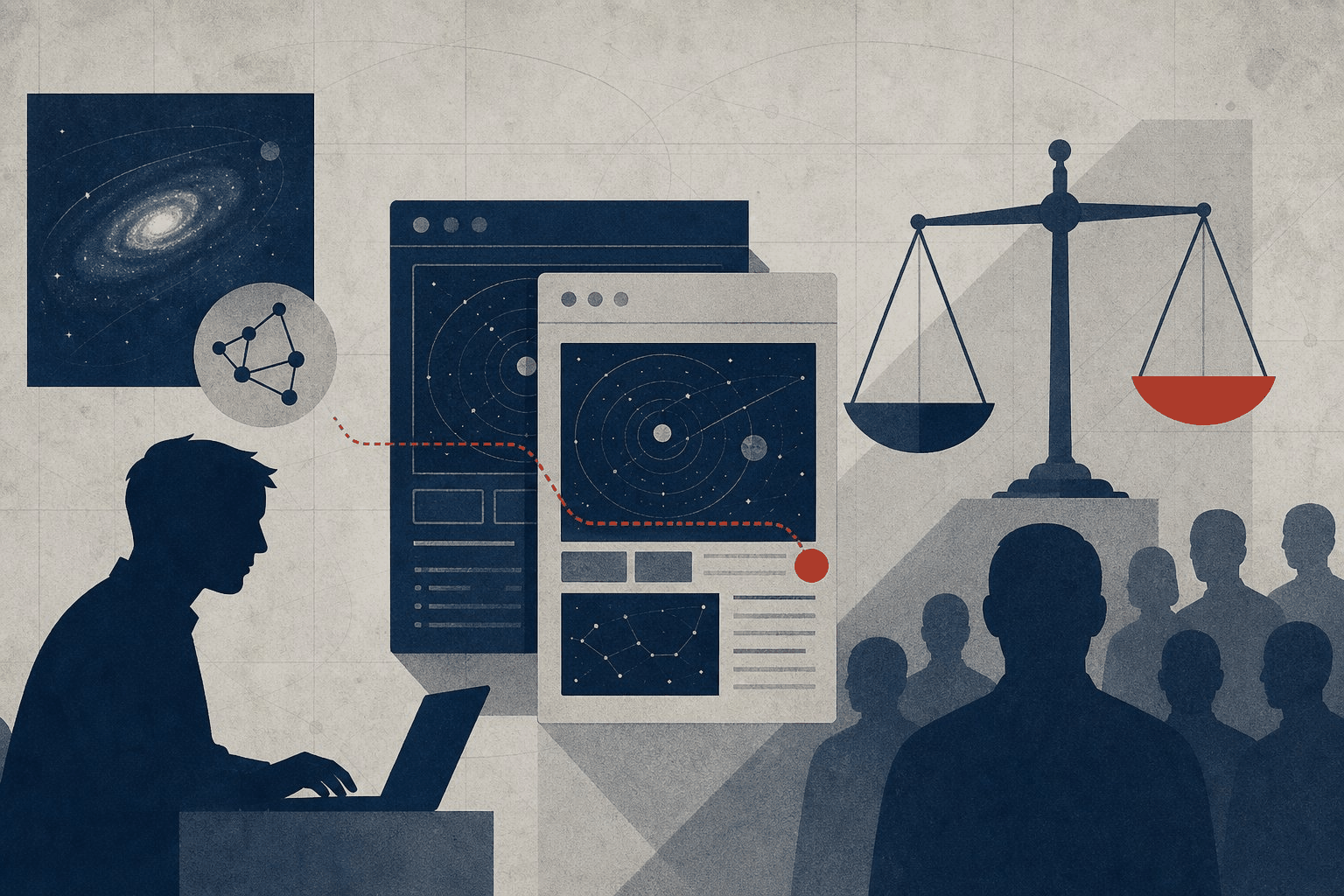
On July 20, 2026, Chief Judge Yvonne Gonzalez Rogers of the U.S. District Court for the Northern District of California dismissed Google’s DMCA lawsuit against SerpApi. Google had attempted to use a law originally enacted to protect DVD encryption to stop a 40-person startup from scraping its search results. The judge’s response was direct: search results are public facts and fall outside the scope of copyright law.
A Trillion-Dollar Irony
Google was founded in 1998 on the premise of scraping the entire internet. The foundation of the PageRank algorithm was a web crawler—it traversed web pages across the globe, copied content to construct an index, and built a commercial empire valued near two trillion dollars by organizing that information and selling advertisements.
In December 2025, that exact same company filed a lawsuit against a startup named SerpApi. SerpApi’s core operation was essentially identical to what Google did in its early days: scrape web pages, structure the results, and sell access via an API. The only difference was that SerpApi scraped Google’s search result pages.
Google alleged that SerpApi bypassed its SearchGuard anti-scraping system to issue billions of automated queries, violating Section 1201 anti-circumvention provisions of the Digital Millennium Copyright Act (DMCA). Passed in 1998 alongside the DMCA, Section 1201 was originally intended to prevent individuals from breaking DVD region codes and encryption protections. Statutory damages under the statute are calculated per violation, meaning billions of queries yielded a liability figure large enough to force SerpApi out of business immediately.
Techdirt’s Mike Masnick commented in December 2025 that “almost every aspect of this suit is gross”—noting that “the most distasteful aspect is that Google’s entire business was built on scraping the web… Suing someone for scraping them feels… predatory.”
The Judge’s Core Ruling: A Lock Must Be on the Book, Not the Building
SerpApi filed a motion to dismiss in February 2026. The court held a hearing on May 19, 2026, and on July 20, Judge Rogers granted the motion to dismiss.
The ruling’s central rationale can be understood through two distinct buckets. Under Section 1201 of the DMCA, it is unlawful to circumvent a technological measure that “effectively controls access to a work protected under” title 17. Google argued that SearchGuard blocked automated scrapers from accessing search result pages, which contain third-party licensed images (such as images within Knowledge Panels), and therefore bypassing SearchGuard constituted a DMCA violation.
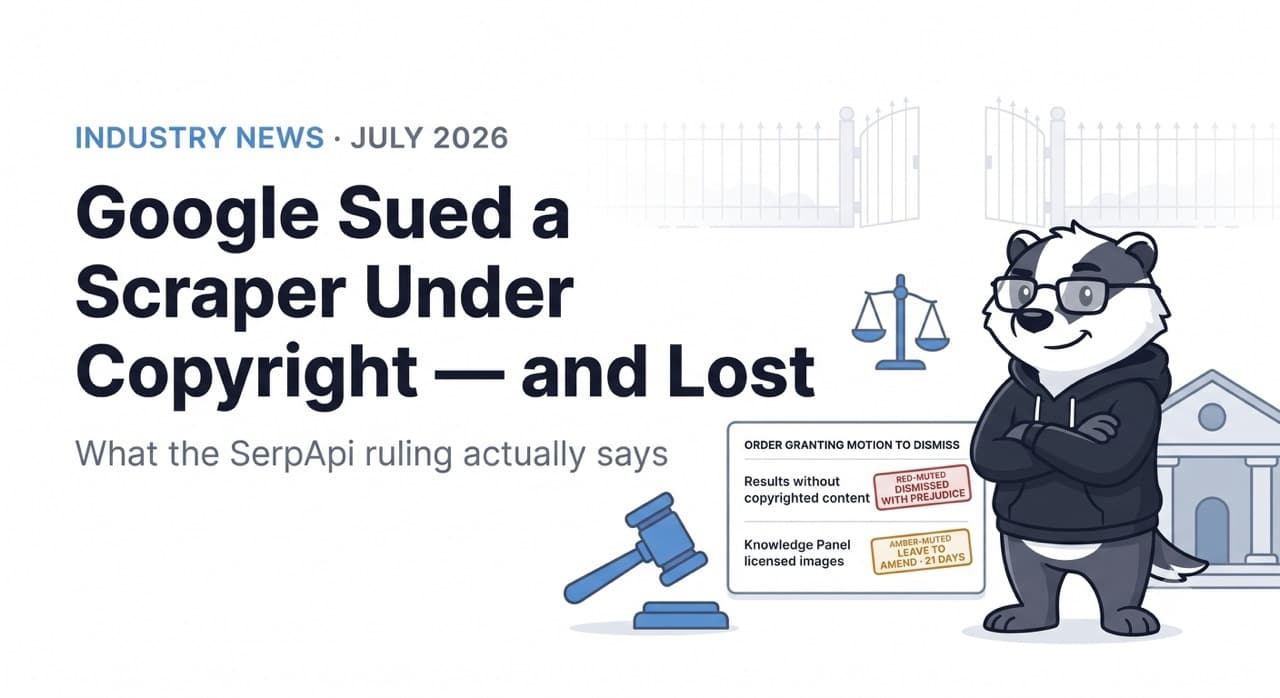
Judge Rogers separated the claims into two categories:
Bucket One: Search results containing any copyrighted content. This portion was dismissed with prejudice. The court held that URLs, snippets, and ranking positions on search result pages are public facts, not copyrighted works. Because SearchGuard controls access to material that is not protected by copyright law, the baseline threshold for applying the DMCA does not exist.
Bucket Two: Search results containing licensed images (e.g., Knowledge Panels). This portion was also dismissed, but with leave for Google to amend its complaint. The key hurdle here is authorization: Section 1201 requires technological measures to operate “under the authority of the copyright owner.” Google does not hold the copyright to those Knowledge Panel images; they are licensed to Google by third parties for display. Google failed to present evidence that those copyright holders authorized Google to deploy SearchGuard to protect their copyrighted works.
SerpApi’s counsel struck at the core of the issue with a vivid analogy: a lock must be placed on the book, not the building. An anti-scraping system safeguarding all of google.com cannot be classified as a copyright protection measure simply because a few licensed images happen to be hosted within it. When Congress passed Section 1201, the legislative history explicitly framed its purpose as stopping electronic conduct “equivalent to breaking into a locked room.” Erecting a fence on a public beach cannot be justified as protecting a single towel lying on the sand.
Reporting from ScrapeBadger highlighted another critical finding by the court: SearchGuard’s functional purpose is to “manage automated access, not to protect copyrighted works.” In other words, Google engineered the system to safeguard ad revenue rather than copyright.
Why Did Google Use Copyright Law to Fight Scraping?
Understanding the deeper implications of this lawsuit requires reviewing how platform anti-scraping strategies have evolved over recent years.
For the past decade, the primary legal instrument used by platforms to block scrapers was the Computer Fraud and Abuse Act (CFAA), asserting that scrapers breached “authorization” barriers set by websites. However, in 2022, the U.S. Court of Appeals for the Ninth Circuit ruled in hiQ Labs v. LinkedIn that scraping publicly accessible data does not violate the CFAA. That decision effectively rendered the CFAA unusable as an anti-scraping tool for public web pages.
Breach of Terms of Service (ToS) claims fall under contract law, where available damages are limited and provide insufficient deterrence against large-scale commercial scrapers. Standard copyright infringement claims also fail when applied to search results due to their factual nature.
Consequently, major platforms began experimenting with Section 1201 of the DMCA. The danger of Section 1201 lies in its lack of a requirement to prove actual copyright infringement—the mere act of “circumventing a technical protection measure” constitutes a violation, accompanied by steep statutory damages. Reddit initiated a similar DMCA lawsuit in the autumn of 2025 against SerpApi and Perplexity, which remains ongoing.
What Does This Ruling Mean?
From a legal standpoint, the decision carries two levels of significance.
The first level is the direct ruling: for standard search results lacking copyrighted content, Google can no longer sue scrapers under the DMCA. Following the judgment, SerpApi CEO Julien Halégu issued a statement saying: “We are pleased the court rejected Google’s attempt to stretch the DMCA to public web page access controls. The internet’s founding principles—open access to available information—are vital to driving innovation.”
The second level is the precedential effect. If Google ultimately cannot produce evidence showing that copyright holders authorized SearchGuard for licensed images, that remaining portion of the claim will likely be abandoned. Industry observers suggest Google may eventually settle with SerpApi rather than narrowing its suit to argue over a handful of Knowledge Panel images.
However, the broader significance of the case lies in establishing a judicial marker. At a time when the AI era has made data more valuable than ever, and platforms are building walled gardens, the court stated clearly: you cannot conflate an anti-scraping system with copyright protection.
Scraping Everyone Else While Blocking Everyone Else
Google’s stance is not an isolated phenomenon; the SerpApi case is the latest example of platforms pulling up the ladder on an open internet.
Over the past two years, Google has escalated technical anti-scraping measures. In September 2025, Google removed the num=100 parameter from search result pages—a parameter that previously allowed a single request to return 100 results—thereby increasing the cost of scraping full datasets tenfold. When DataForSEO discovered a workaround that reduced costs by 80%, Google patched the loophole within weeks.
Simultaneously, Google entered into an exclusive API content licensing agreement with Reddit, after which Reddit turned around and sued third-party services scraping Reddit content from Google search results. One company pays to license content, another protects it with an anti-scraping system, and then copyright law is leveraged to sue anyone accessing it through public channels—a complete logical stalemate.
Reporting on the verdict, Techdirt’s Masnick quoted the closing line of SerpApi’s statement: “The internet’s founding principles—open access to available information—are vital to ensuring everyone can benefit from data’s promise.” The quote echoes Google’s famous early motto: “Don’t be evil.”
What Lies Ahead
Google has 21 days to file an amended complaint. If it chooses to narrow its scope strictly to search results containing copyrighted content (such as Knowledge Panels), the lawsuit could theoretically move forward. Before amending, however, Google must address a question it currently cannot answer: did its copyright holder partners provide explicit written authorization for SearchGuard?
Judge Rogers specifically cited the Ninth Circuit’s opinion in Blizzard v. Bossland, which established that effective access control measures must be deployed by the copyright owner or an authorized party. Google currently holds only display licenses for those images, which does not provide legal standing to deploy anti-scraping systems under the DMCA.
For SerpApi, the lawsuit has already proven costly—a 40-person company forced to absorb the full weight of Google’s legal apparatus. Nevertheless, the ruling provides a crucial breathing window for the entire web scraping ecosystem. For search engine optimization tools, rank tracking services, and market research platforms dependent on SERP data, the court’s answer is clear: at least for now, public search results remain a public resource.
For the general public, the case underscores a fundamental question: when the world’s dominant search engine attempts to use copyright law to fortify its walled garden, can we still preserve an open internet?
Reference Links:
- Techdirt: Judge Rejects Google’s Attempt To DMCA Its Way Out Of Being Scraped
- ScrapeBadger: Google Sued a Scraper Under Copyright Law and Lost
- ProxyCove: Google Lost the Lawsuit Over SERP Scraping
- Search Engine Roundtable: Google Lawsuit Against SerpApi Dismissed
- PPC Land: Google Loses DMCA Bid to Treat Search Scraping Like DVD Piracy
- HN Discussion (item?id=49073513)