Blaming AI for App Plagiarism: The 2026 Version of “The Dog Ate My Homework”
On August 9, developer Terry Godier published an apology titled with the Latin phrase “Mea Culpa” (“my fault”). He admitted that his newly launched astronomy app, “Dark Hours”, had replicated another developer Miguel Beher’s open-source project almost verbatim—from its name down to its codebase. Even a bug that Beher had previously fixed was present line-for-line in Godier’s code.
His explanation? He claimed he had never seen the original project, and that the AI coding assistant Claude had accidentally cloned it.
The apology surged to the top of Hacker News, amassing over 530 points and 244 comments. The overwhelming sentiment in the comment section boiled down to disbelief. As one commenter put it, this was simply a modern tech variation of “the dog ate my homework”—except in 2026, the dog’s name is AI.
First an Astrology App, Then an “Unjustly Rejected” Astronomy App
The story began eight months ago. In January of this year, Godier submitted an app called “Asterly” to the Apple App Store, focusing on astrology and tarot cards, featuring a “Daily Tarot” function. Apple’s guidelines explicitly discourage fortune-telling applications, and Asterly was rejected; his appeal was turned down in April.
According to Godier’s account, after the rejection, he pivoted the content toward astronomy, first creating a website called “Dark Hours”, which launched in early August. Around the same time, he contacted a prominent figure: John Gruber, one of the most well-known commentators in the Apple community, who has been writing his blog for 24 years.
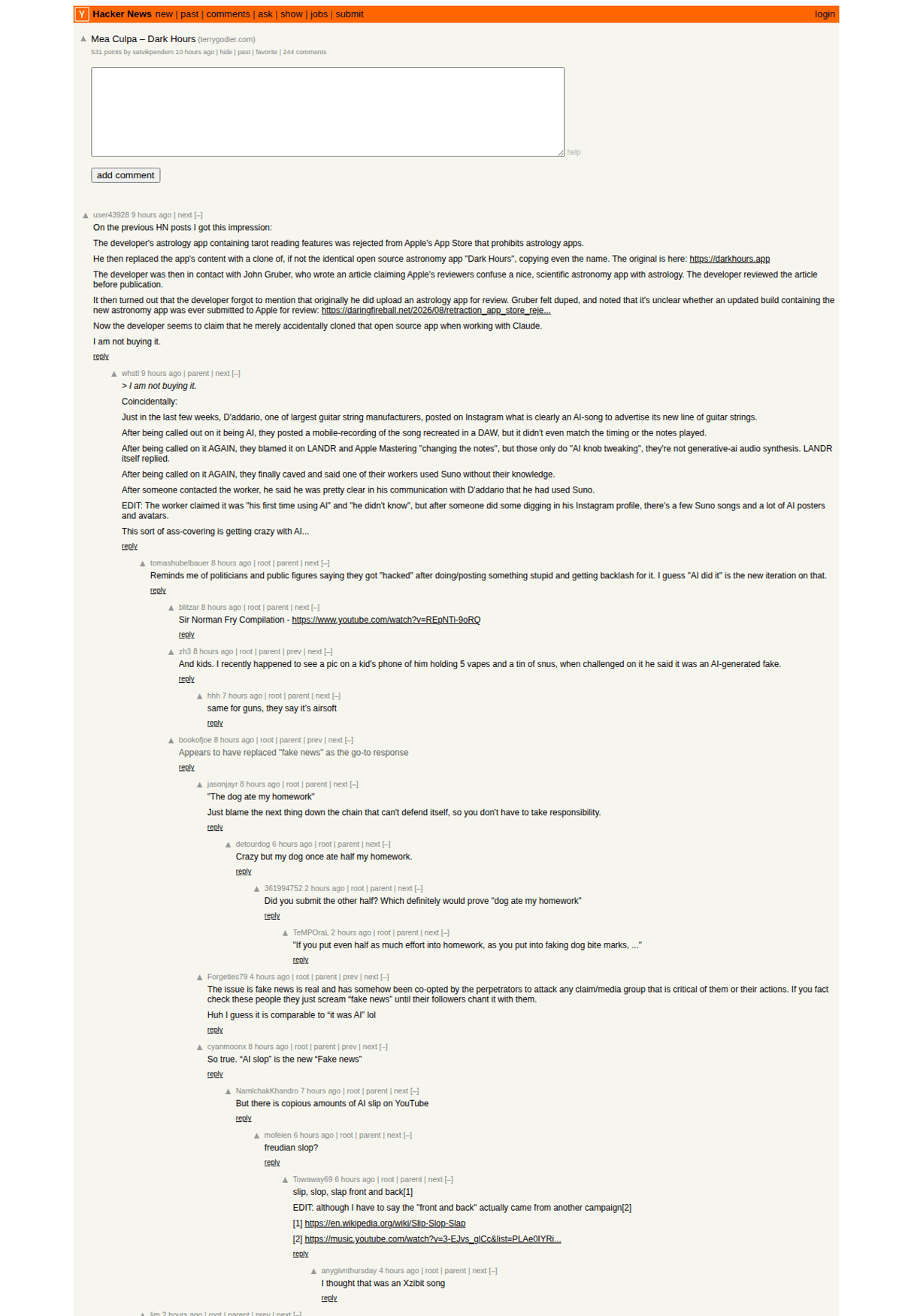 Image: Hacker News top story of the day with 530 points and 244 comments. Source: news.ycombinator.com
On August 7, Gruber published an article titled “This Week’s App Store Injustice: Dark Hours”, criticizing Apple for mistakenly shooting down a legitimate astronomy app as an astrology app. Before publishing, he sent the draft to Godier for review; Godier raised no objections and expressed only gratitude.
The turning point came on August 8. Community members uncovered the full timeline: the app rejected by Apple was the astrology app Asterly, while the “unjustly rejected astronomy app” Godier spoke of had never even been submitted for review. On the same day, Beher pointed out on social media that Godier’s Dark Hours was nearly identical to his own open-source project DarkHours—differing only by a space in the name, sharing identical features, and even replicating the exact same fixed bug: users were navigated to a random field in Mexico.
On the evening of August 8, Gruber retracted his article. In his retraction statement, he noted that this was the first retraction in his 24 years of blogging: “I was misled, but what I publish is my responsibility.” On August 9, Godier posted his apology, redirected his domain to Beher’s original site, and abandoned his iOS plans.
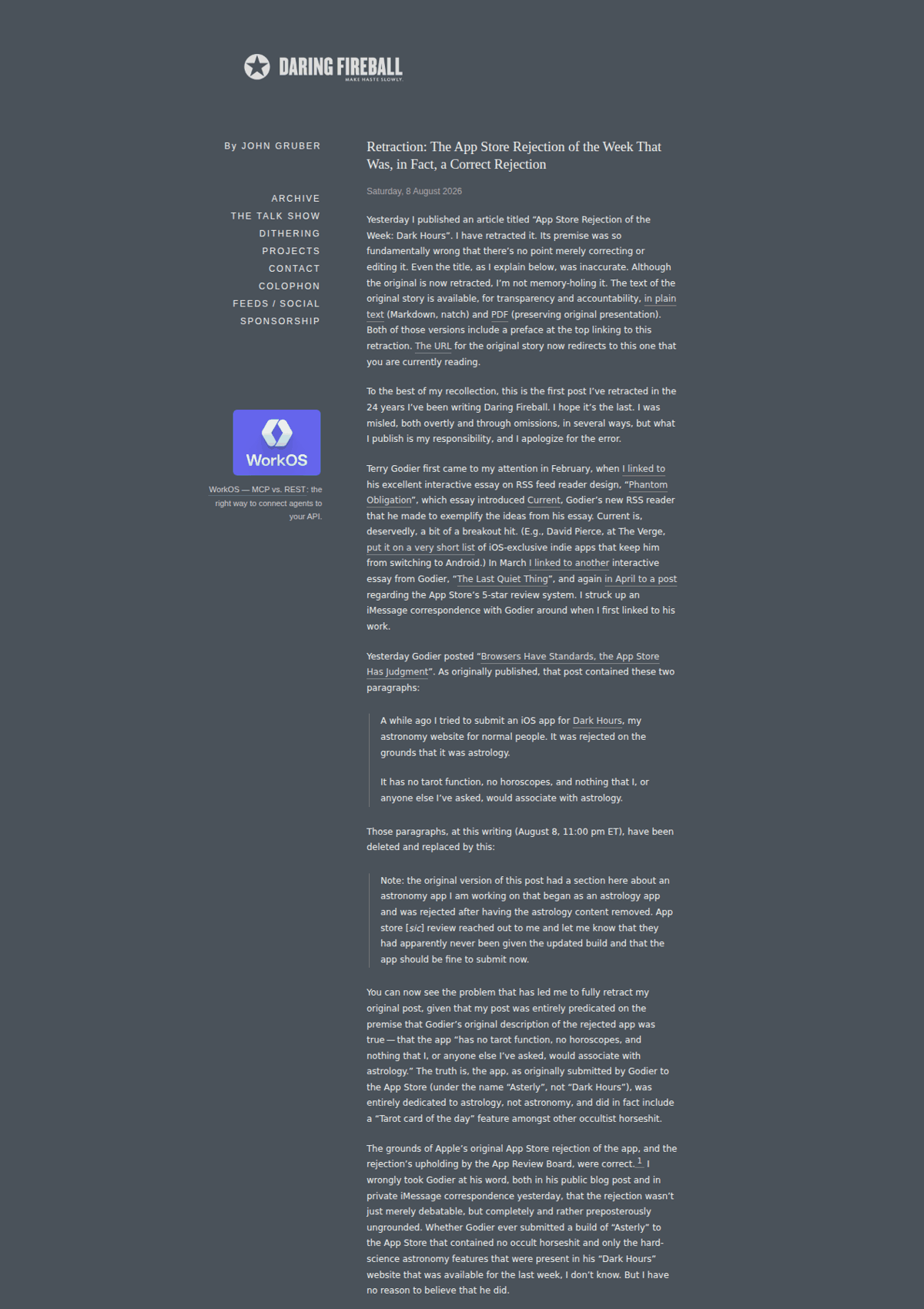 Image: Gruber’s retraction statement titled “This Week’s App Store Injustice: Actually, Rightful Rejection”. Source: daringfireball.net
Three Flaws: There is a Limit to Coincidence
Why didn’t the tech community buy his story? Three flaws stacked up against him.
First was the name. Two developers independently building apps with similar functionality is plausible. Colliding on the exact same name is already low probability. Meeting at a difference of a single space reduces that probability to practically zero.
Second was the bug. Software bugs are a developer’s digital fingerprints. Two people writing separate codebases and reproducing the exact same bug is rarer than writing the exact same sentence. Furthermore, Beher had already fixed that bug—the copier even imported what the original author had already resolved. Features can collide; bugs do not.
Third was the motive. After his astrology app was rejected, Godier needed a “legitimate astronomy app” to make a comeback, and right in front of him was a ready-made, free, beautifully crafted solution. Open source means the code is public and free for anyone to use, provided original attribution is maintained. Taking the code along with the name, adding no attribution, and promoting it everywhere as an original creation is entirely different from legitimate “use.”
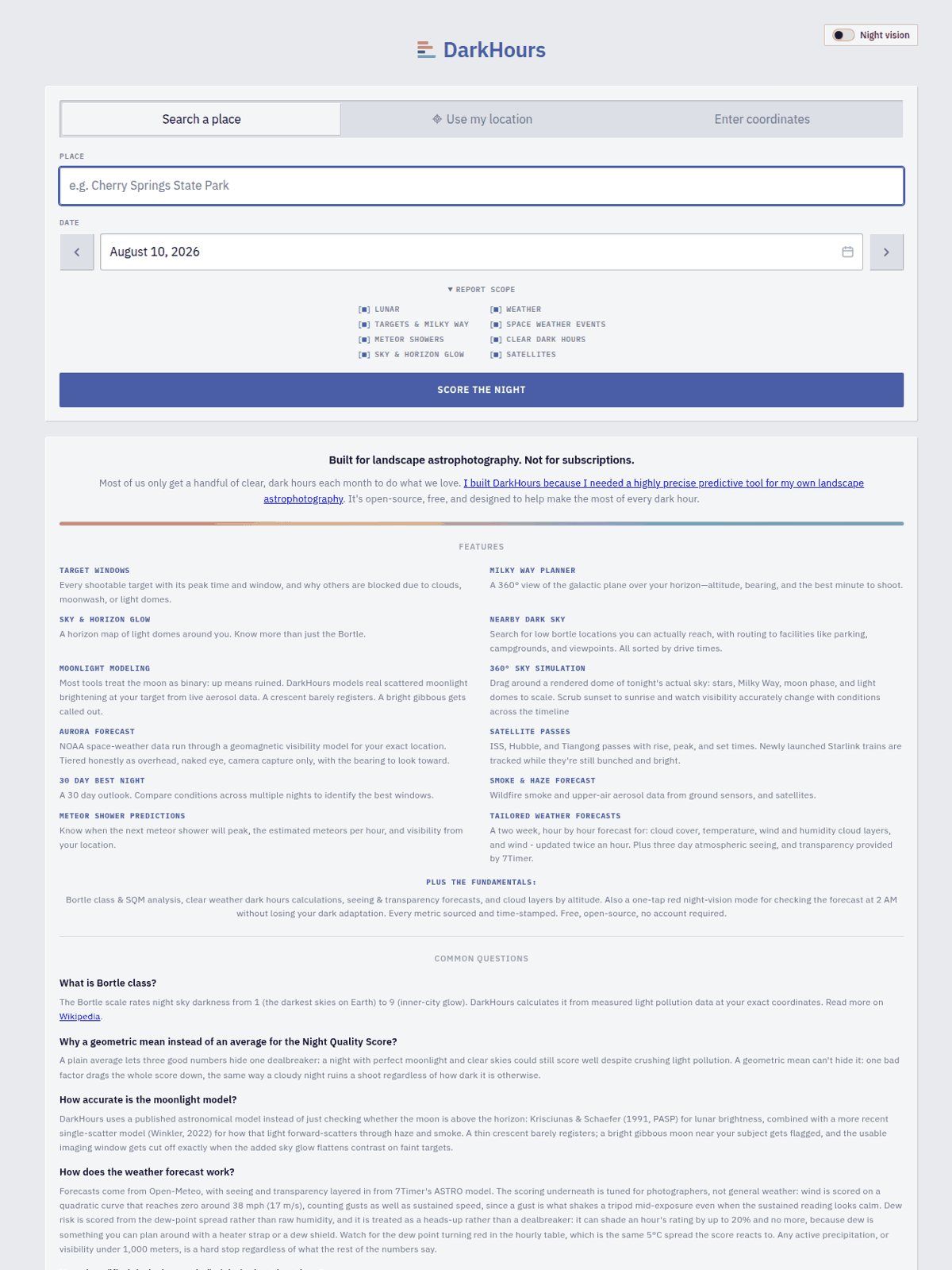 Image: Beher’s open-source astronomy planning tool DarkHours (no space), with MIT license and author listed in the footer. Source: darkhours.app
Why “AI Did It” Is Becoming the Go-To Excuse
The AI era has introduced a novel dilemma: when code is generated by AI, the concept of “authorship” becomes blurred. Developers can claim “I didn’t know what the AI wrote”—a statement that is difficult to disprove, because AI training data may indeed contain the original project’s code, and the model could conceivably recall and reproduce it.
This is precisely the appeal of this tactic: AI has no identity, no property, cannot appear in court, and cannot talk back. Criticizing it causes it no harm. The chain of accountability stops cold at the AI.
But does the chain really break? A top comment on Hacker News noted sarcastically: since AI cannot bear responsibility, the most sought-after job in the future might be “Professional Scapegoat”—someone hired by a company to take the fall when things go wrong, because AI cannot be held accountable. Though intended as a joke, it highlights a fundamental truth: Tools carry no responsibility; the people using the tools do.
Another comment cited a precedent. When guitar string manufacturer D’Addario used the AI music tool Suno for a commercial jingle and was called out by fans, they initially claimed it was “modified by mastering software.” When pressed further, they shifted the blame to “an employee who used AI without our knowledge.” The employee later responded that they had clearly disclosed using Suno from the start. Passing the buck down layer by layer, until there is no one left to pass it to.
“AI did it” is simply the 2026 version of “the dog ate my homework.” Neither dogs nor AI can speak up to defend themselves. Picking a scapegoat that cannot argue back is the common thread in this playbook.
Even If You Don’t Write Code, This Concerns You
What does plagiarism among software developers have to do with everyday smartphone users? More than you might think.
First, the apps on your phone are far more likely to be cheap clones than you realize. Generative AI has brought the marginal cost of creating an app down to near zero, leading to a surge of low-quality copycats in app stores. When two nearly identical apps sit side by side, distinguishing the original becomes increasingly difficult—and the cloned version might carry bugs the original creator already fixed, or introduce unverified data security risks.
Second, the “AI did it” defense erodes societal trust. When AI becomes an all-purpose excuse, every explanation becomes suspect. When assessing credibility, actions speak louder than words. What did Godier actually do here? He pulled the app, redirected the domain, and apologized. Those actions were real; but the words “Mea Culpa” were spoken only after he was caught red-handed.
Third, AI is reshaping how we define responsibility. In the past, who wrote a piece of work was clear-cut. Today, AI-generated content and human writing are intertwined, leaving attribution as the final clue. Whose name is on the work is who remains responsible. When signing off on “AI did it,” you are still signing your own name.
Arguments on Both Sides
To be fair, supporters of Godier might argue: AI training datasets encompass vast amounts of open-source code, and models can indeed output highly similar structures. Declaring him a liar without definitive proof lacks rigor. Furthermore, his ultimate decision to pull the app and issue an apology is better than those who refuse to admit fault at all.
Skeptics counter: the alignment of name, bug, and motive creates a triple coincidence with astronomical odds against it. Moreover, his silence regarding the astrology app’s history when submitting his draft to Gruber can hardly be explained as simple “forgetfulness.”
This author takes no stance on delivering a verdict. But one thing is clear: if using AI excuses one from the responsibility of verification, then for every error produced by AI, there will be an innocent person claiming ignorance. Reviewing your output has always been the author’s duty. The tools may change, but the obligation remains the same.
Final Thoughts
It is not the intention of this article to condemn either party. What is truly worth remembering from this incident is a simple truth: AI can write code for you, but it cannot take responsibility for you. The more powerful the tool, the more the user must know what they are publishing. The next time you hear “AI did it,” ask one simple question: What were you doing?
Reference Links:
- Terry Godier Blog: Mea Culpa – Dark Hours
- HN Discussion (item?id=49231154)
- daringfireball: John Gruber Related Articles
- daringfireball: Retraction Statement (2026-08-08)
- darkhours.app: Miguel Beher’s Original Open-Source Project
- HN Comment Reference: D’Addario Suno Commercial Controversy


