In 2024, a study published in the British Medical Journal (BMJ) analyzed nearly 9 million death certificates in the United States, comparing cause-of-death data across 443 occupations. The results were striking: taxi drivers and ambulance drivers had the lowest rate of death from Alzheimer’s disease among all occupational groups. Even after adjusting for age, sex, race, and education level, their Alzheimer’s mortality rate was roughly 1 in 100, compared to 1 in 60 for the general population.
The findings made the researchers pause. The primary commonality between these two professions is finding ways—building and updating maps inside their heads.
Beyond Driving: A Continuous Real-Time Navigation Exercise
If driving itself protected against neurodegeneration, bus drivers and pilots ought to see similar benefits. But the data showed they do not. What sets taxi drivers apart? Bus drivers follow fixed routes, and pilots follow predetermined flight paths. Taxi drivers, by contrast, face a brand-new problem on every trip: Where am I? Where do I need to go? Is traffic congested ahead? Which alternative route should I take?
Researchers refer to this cognitive demand as “continuous real-time navigation”: constantly self-localizing and updating mental spatial maps. Fixed-route drivers do not perform this continuous mental heavy lifting and thus miss out on its protective effect. The key isn’t holding a steering wheel; it’s the constantly redrawn map inside the brain.
Why is spatial navigation tied so closely to Alzheimer’s? Because both depend on the exact same brain structure: the hippocampus. It is the core region responsible for memory and spatial orientation—and notably, it is also among the very first regions attacked by Alzheimer’s pathology. A declining sense of direction and getting lost frequently often manifest long before memory loss for names or words.
London’s 25,000 Streets
The most famous evidence linking spatial navigation to brain structure comes from London taxi drivers.
To earn a taxi license in London, applicants must pass an extraordinarily demanding examination known as The Knowledge: memorizing more than 25,000 streets and thousands of landmarks within a 6-mile radius of Charing Cross station. Preparation typically takes three to four years, making it a formidable cognitive sieve.
In 2000, neuroscientist Eleanor Maguire and her team at UCL scanned the brains of licensed London taxi drivers using MRI and compared them to control subjects. They discovered that taxi drivers had significantly larger posterior hippocampi. Crucially, the size of this region correlated directly with the number of years spent driving a cab. Brain structure physically changes in response to sustained mental training—providing one of the earliest neuroimaging proofs of adult brain plasticity.
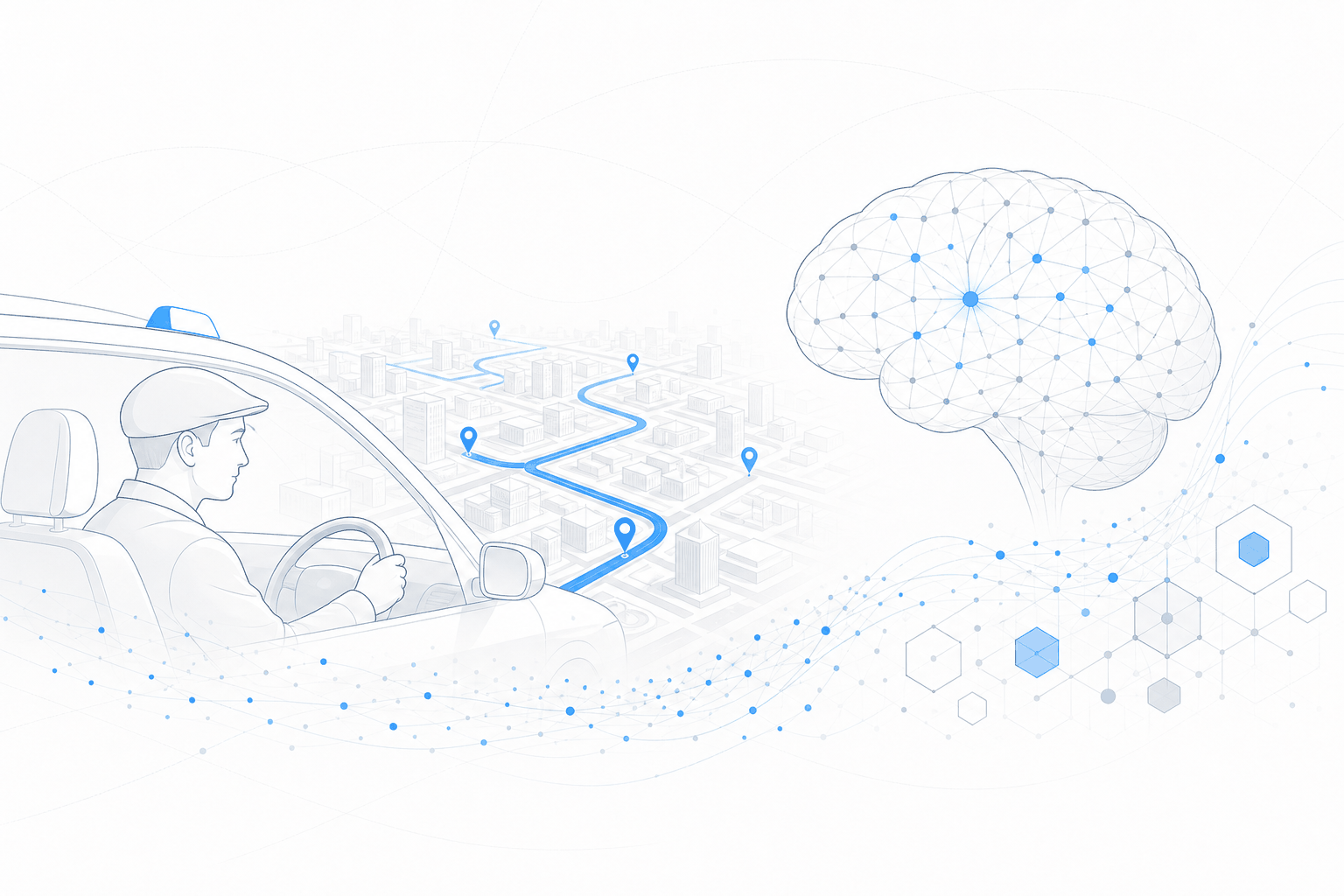
 Figure: A taxi driver’s daily work requires building and revising a mental map of the city day after day. Source: theconversation.com
The Hippocampus: The Brain’s Built-In GPS
What exactly does the hippocampus do? Think of it as the brain’s internal navigation system, constructing a “cognitive map” from spatial experiences. This map encodes geometric and spatial relationships between city blocks—which direction streets face and how to take shortcuts between destinations.
Alzheimer’s pathology hits the hippocampus first, which is why getting lost on familiar routes is often one of the earliest clinical signs of dementia. Losing your way is not just a normal part of aging; it can be an early SOS signal sent by the brain.
A 2023 study reinforced this phenomenon from a different perspective: researchers used machine learning to analyze health data from over 22,500 individuals and found that people living in “spatially complex” environments—neighborhoods with high street density, irregular intersections, and multiple route options—had lower rates of Alzheimer’s disease, with predictive models reaching 84% accuracy. Navigating complex environments forces the brain to continuously update its internal map, exercising the hippocampus in the process.
 Figure: The more complex urban environments are, the more the brain must construct active spatial maps—a requirement associated with lower rates of Alzheimer’s. Source: theconversation.com
Hold On: Correlation Does Not Equal Causation
So far, the narrative sounds straightforward: active navigation expands the hippocampus, which guards against dementia. Scientifically, however, two major caveats remain.
First is reverse causation. Individuals with superior spatial reasoning and memory are naturally more likely to pass The Knowledge and thrive as taxi drivers. It could be that “people with resilient brains choose to drive taxis,” rather than “driving taxis builds a resilient brain.” The 2000 cross-sectional data could not fully rule out this pre-selection effect.
Second is survival and mortality bias. As pointed out in discussions on Hacker News, the average age of death for US taxi drivers in occupational mortality databases is around 67.8 years, compared to roughly 74 years for the general population. Meanwhile, the average age of Alzheimer’s diagnosis is around 79. In short, many taxi drivers may die from cardiovascular disease, accidents, or lifestyle-related causes before reaching the typical age of Alzheimer’s onset. Although researchers controlled for age, completely eliminating this survivor bias remains difficult.
The academic consensus on the “cognitive reserve hypothesis” is cautious: the mechanism is plausible, but conclusive proof is still pending. While complex cognitive work correlates repeatedly with lower dementia risk across multiple cohort studies, establishing strict causation requires long-term longitudinal tracking. The key takeaway: view these findings as a compelling clue rather than a settled conclusion.
The Navigation Generation: Outsourcing Your Hippocampus
If navigating roads actively exercises the brain, a compelling question arises for our era: Is anyone in our generation still navigating manually?
Turn-by-turn GPS voice prompts have effectively offloaded route planning from our brains onto smartphones. Studies indicate that habitual GPS users perform significantly worse on unassisted spatial navigation tasks. Neuroimaging research shows that when individuals follow GPS instructions, brain regions responsible for active route planning essentially “go quiet.” While sample sizes in these studies remain modest and debates continue, the direction is consistent: the more we outsource, the less we exercise our innate circuitry.
A vivid illustration emerged on Hacker News: a passenger recalled riding with an Uber driver through downtown Chicago’s skyscraper corridor. When GPS signals glitched, the driver looped around the exact same block three times—completely lacking any independent spatial judgment. It served as a stark demonstration of technological reliance displacing human cognitive ability.
The brain operates on a strict “use it or lose it” principle. London cab drivers demonstrated that continuous use strengthens the hippocampus. But will continuous disuse weaken it over time? No researcher can definitively say yet. Widespread GPS usage has only existed for about fifteen years, while Alzheimer’s develops over decades. We will only have a definitive answer as our generation ages.
What Can We Do in Daily Life?
No one is suggesting you memorize 25,000 street layouts. For most people, scientific recommendations are far simpler:
In familiar cities, occasionally turn off GPS navigation and rely on memory to get around. When visiting a new city, study the map beforehand rather than passively obeying turn-by-turn voice directions. When traveling with children, let them take turns navigating and giving directions. These habits cost nothing and take no extra time; they simply reclaim a portion of the “navigation” workload from our devices.
Brain plasticity is a two-way street: use it or lose it. The London cab drivers proved the first half of that equation; the GPS era is currently testing the second. The best takeaway is simple: while no one knows the final outcome, giving your brain a bit more work to do is rarely a bad investment.
Reference Links:
- The Conversation: Taxi drivers rarely die of Alzheimer’s – how complex mental maps and spatial reasoning protect your brain
- Hacker News Discussion: Taxi drivers rarely die of Alzheimer’s (item?id=49232253)
- BMJ 2024: Patel VR et al., Alzheimer’s disease mortality among taxi and ambulance drivers: population based cross sectional study
- Nature 2000: Maguire EA et al., Navigation-related structural change in the hippocampi of cab drivers
- Nature Communications 2017: UCL Study, GPS navigation suppresses brain regions involved in route planning
- Scientific Reports 2020: Dahmani & Bohbot, Habitual use of GPS negatively impacts spatial memory during self-guided navigation