Silent Cargo Vessels Are Hidden Carbon Chimneys
Walking along a riverbank, we often see diesel cargo ships drifting downstream loaded with rice, construction materials, or gravel. They produce no deafening roar like heavy trucks, nor do they leave white contrails across the sky like cargo planes. Water transport has long been regarded as the greenest logistics choice. Yet this seemingly quiet river journey actually emits far more carbon dioxide than previously imagined.
Under traditional assumptions, the diesel consumed by a single freighter hauling thousands of tonnes of cargo yields far lower carbon emissions per tonne-kilometre than road transport. However, such simple per-unit calculations overlook the massive global scale of inland shipping and its extremely narrow geographic footprint. When researchers aggregated the diesel exhaust from all inland vessels worldwide for the first time, they uncovered a long-underestimated carbon ledger.
20 Billion AIS Signals: Mapping the First Global River Carbon Footprint
Calculating total emissions from global inland shipping is far more challenging than measuring open-ocean maritime traffic. Ocean-going vessels follow fixed routes subject to strict international regulation, whereas river barges, ferries, and medium-sized freighters are vast in number, weaving through winding channels where GPS signals are frequently lost or interrupted. To untangle this hidden accounting, a research team led by the Chinese Academy of Sciences analyzed approximately 20 billion global AIS records.
The Automatic Identification System (AIS)—essentially a GPS broadcasting beacon fitted on each vessel—transmits real-time position and speed. Using a custom trajectory-completion algorithm, the researchers reassembled missing movement data like broken puzzle pieces to reconstruct exact sailing routes and speeds for inland vessels worldwide. Combining ship dimensions and engine power, scientists calculated high-resolution global inland vessel CO2 emissions for the first time, publishing their findings in Nature Climate Change in July 2026.
0.4% Water Surface, 25% of Maritime Emissions
The study’s core finding is striking: in 2022, global inland vessels emitted 164 million metric tonnes of CO2—equivalent to 164 Tg (teragrams, a unit of mass where 1 Tg equals 1 million tonnes, roughly matching the annual municipal waste of a major metropolis). This represents 24.7%—nearly one-quarter—of all global waterborne shipping carbon emissions that year.
When mapped geographically, the contrast becomes even sharper. The combined surface area of all navigable rivers on Earth accounts for less than 0.4% of the world’s total water surface. This means nearly a quarter of global waterborne carbon emissions is concentrated within narrow channels representing less than four thousandths of global water area, resulting in a carbon emission density along river corridors nearly 100 times higher than that of ocean shipping lanes.
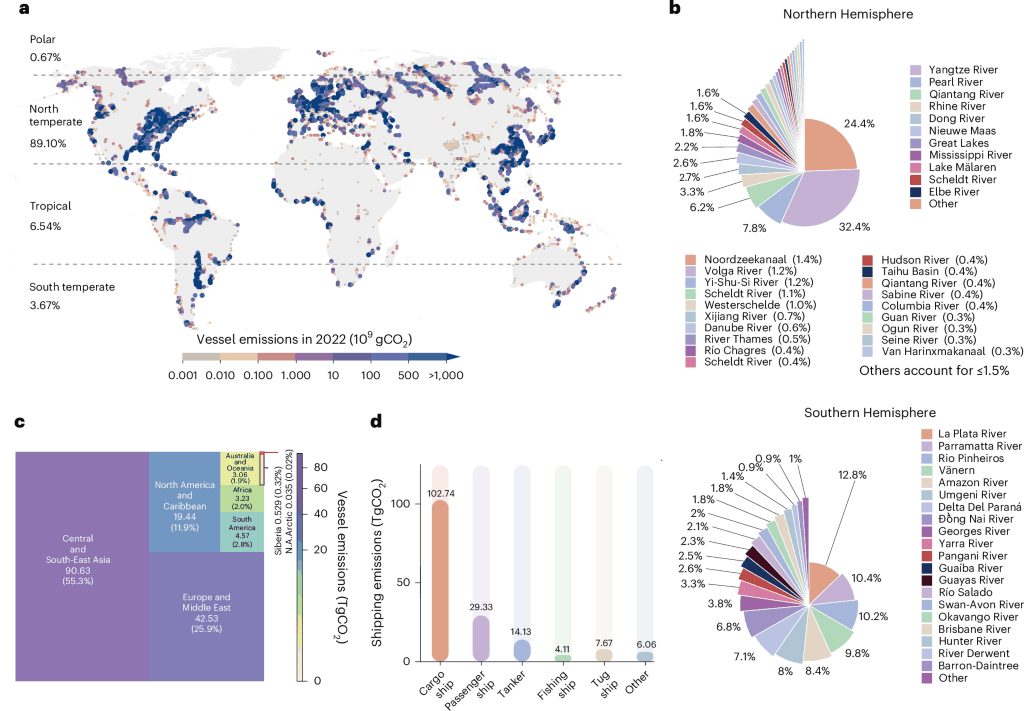 Figure: Global CO2 emission distribution of inland shipping vessels. Source: Nature Climate Change, Lu et al., 2026
The Yangtze and 20 Waterways Bear the Heaviest Carbon Burden
The study further reveals that these emissions are heavily concentrated along a few vital river arteries. The Yangtze River, together with 19 other busiest navigable waterways worldwide, contributed nearly 70% of global inland shipping emissions in 2022. While bustling river logistics foster economic prosperity, they have also turned these river corridors into dense carbon hotspots.
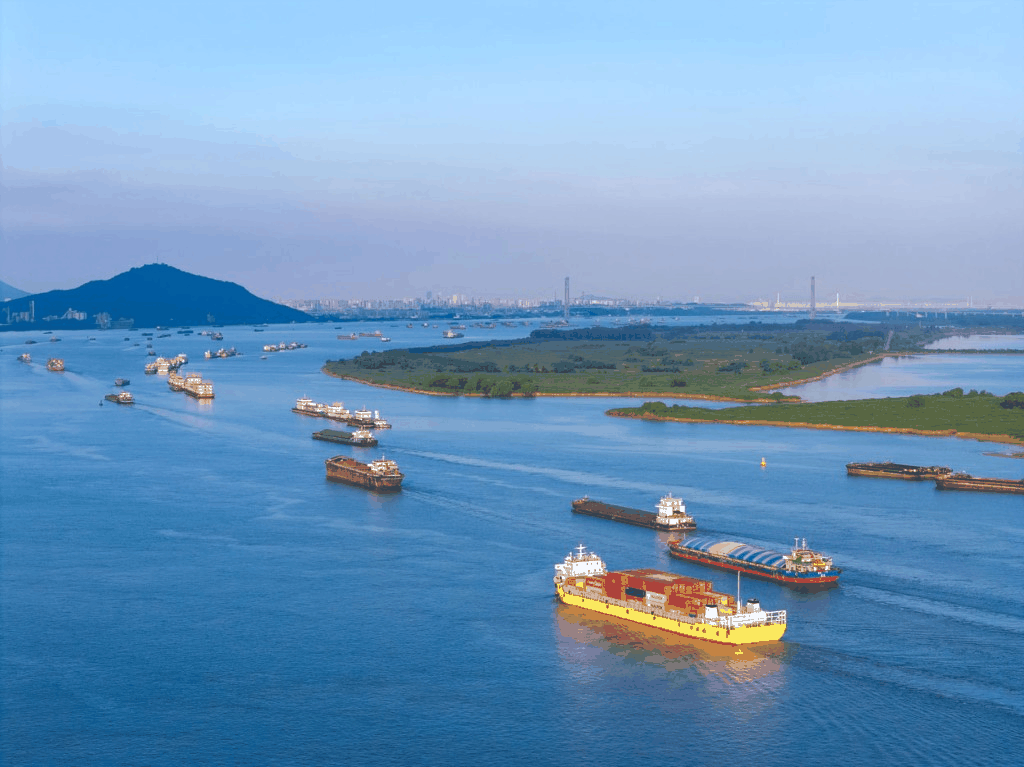 Figure: Aerial view of cargo ships and barges on the Yangtze River. Source: Feature China/Future Publishing/Getty, via Nature
Furthermore, exhaust emissions from inland shipping interact with natural river biogeochemical processes. Microbes in river water naturally release carbon dioxide into the atmosphere as they decompose organic matter—a process known as riverine CO2 evasion. Dense anthropogenic shipping emissions overlap directly with river corridors, significantly altering the micro-ecology of carbon exchange between rivers and the atmosphere.
In addition, emission volumes fluctuate sharply with seasonal hydrological conditions and droughts. During monsoons or high-water seasons, ships travel faster with higher carrying capacity, driving emissions upward; during dry seasons with low water levels, vessels are forced to slow down or halt. This dual constraint of hydrology and climate presents inland decarbonization with complex natural variables absent in land transport.
Uncovering the Ledger is the Starting Point for Green Rivers
In the past, inland shipping was routinely treated as an inherently green alternative, with policies encouraging modal shifts from road to river. However, this study demonstrates that river shipping is far less low-carbon than assumed. Unchecked growth in inland freight volume could create a major loophole in global climate governance. Fortunately, the extreme concentration of river traffic along a small number of corridors offers an ideal window of opportunity for targeted decarbonization.
Deploying electric barges, shore power infrastructure, and hydrogen fuel alternatives across a handful of busy waterways will yield far higher emission-reduction efficiency than indiscriminate retrofits of ocean-going fleets. What was once considered the greenest mode of transport conceals a severely underestimated carbon footprint. Accounting for this balance sheet provides the foundation for driving every tonne of cargo moving along the world’s rivers toward true sustainability.
Reference Links:
- Nature Climate Change Original Paper
- Nature Special Report