Looking up at the Milky Way late at night, deep inside that seemingly serene nebula, a cosmic high-speed chase is unfolding. On August 19, 2026, the journal Nature published groundbreaking research from a collaboration led by the European Southern Observatory (ESO): astronomers have discovered S301, the fastest star ever detected in the Milky Way.
With a mass roughly 1.5 times that of our Sun, S301 accelerates to a staggering peak velocity of 25,000 kilometers per second—about 8% of the speed of light—as it sweeps past the galactic center. That is nearly 100,000 times faster than a commercial airliner, fast enough to cross half the Earth in just a few seconds.
S301 does not merely travel at extreme speeds; its orbit is exceptionally unique, grazing the supermassive object at the heart of our galaxy. This perilous close encounter provides scientists with a long-sought cosmic ruler, offering humanity its first opportunity to directly measure how fast a black hole weighing 4 million solar masses is spinning.
25,000 km/s: The Milky Way’s Speed-Demon Star Screams Past the Black Hole
Sagittarius A*—the supermassive black hole at the center of the Milky Way with a mass about 4 million times that of the Sun—has long fascinated astronomers. To peer into the realm surrounding it, the GRAVITY+ international collaboration utilized the European Southern Observatory’s Very Large Telescope Interferometer (VLTI), an astronomical observatory array combining multiple giant optical telescopes, capturing light four billion times fainter than the limit of the naked eye.
Astronomers first captured clear imagery of S301 in 2023, subsequently combining the last two years of new observations with archival data dating back to 2017 to reconstruct an elongated elliptical orbit spanning a period of 8.7 years. While the far end of its orbit stretches far outward, at pericenter—its closest approach to the black hole—S301 passes just 1.7 billion kilometers from Sagittarius A*.
While 1.7 billion kilometers sounds vast on a human scale, comparing it to our solar system highlights its extreme proximity. It is only slightly farther than Saturn’s distance from the Sun (about 1.4 billion kilometers). At the center of the Milky Way, where distances are typically measured in light-years, S301 is practically skimming the edge of the black hole’s event horizon.
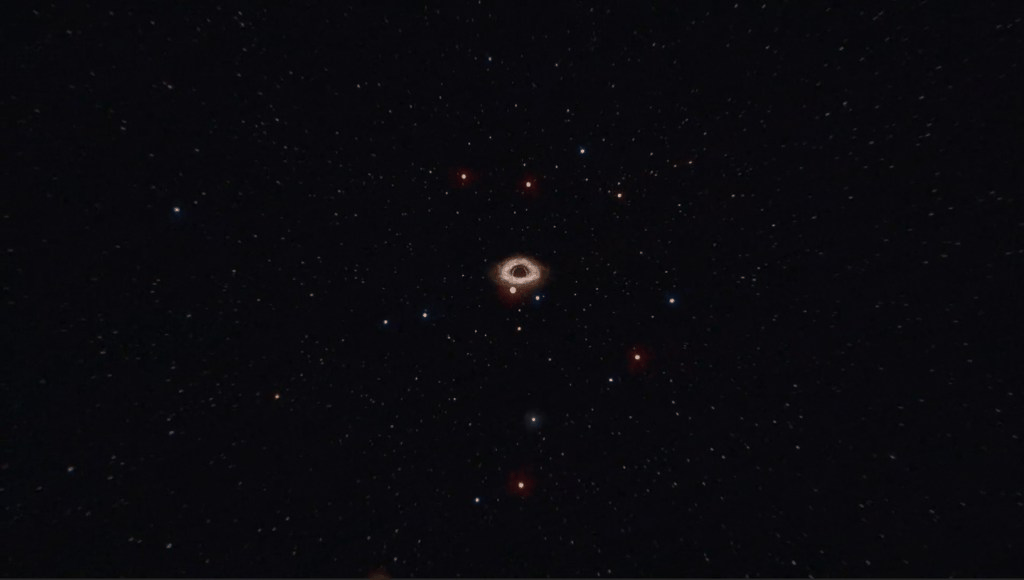 Image: Diagram: S301 (orange dot) skimming past the Milky Way’s central black hole. Source: MPE / Science News
Why Measuring Black Hole Spin Was Like Guessing Shadows Through a Window
For decades, measuring the spin rate of a black hole has remained one of astronomy’s toughest challenges. Spin shapes everything around a black hole, yet previous measurement techniques relied almost entirely on indirect calculations—akin to guessing a person’s movements in a room from behind thick curtains.
Previously, scientists relied primarily on two indirect methods: first, analyzing X-rays emitted by the accretion disk—the disk of gas and dust rotating at high speed and falling into the black hole under immense gravity; second, detecting gravitational waves—ripples created in the fabric of space-time by the violent collision and merger of two black holes.
Both approaches require feeding complex physical models and initial assumptions into computers, resulting in spin estimates that frequently sparked academic debate. Astronomer Christopher Reynolds of the University of Maryland, who was not involved in the study, noted that while indirect measurements have value, this star provides humanity with an opportunity for direct measurement.
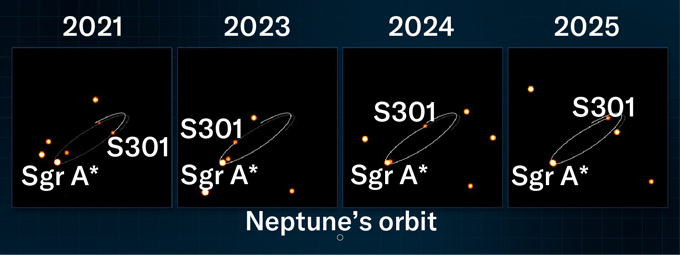 Image: Multi-year VLTI observations tracking S301’s orbit, shown alongside Neptune’s orbit for scale. Source: GRAVITY Collaboration/ESO / Science News
A Vortex Dragging Space-Time: The Close-Passing Star as a Precision Ruler
According to Einstein’s General Relativity, a rapidly spinning supermassive black hole not only pulls in matter but also profoundly warps the surrounding space-time. This phenomenon is known as frame dragging—a physical effect where a rotating massive object drags the surrounding space-time along with its rotation.
Imagine a black hole as a spoon spinning rapidly in thick honey; the surrounding honey swirls in the direction of the spoon’s rotation. As the black hole spins, space-time nearby is dragged along, causing the orbit of nearby celestial bodies to undergo a subtle directional shift after every close flyby.
The closer a star is to the black hole and the faster the black hole spins, the more pronounced this frame-dragging effect becomes on the orbit. Previously, astronomers successfully calculated the mass of Sagittarius A* using the orbits of other stars, but those stars were not close enough to detect the subtle perturbations caused by spin. The discovery of S301 fills this critical gap, making it the closest known observational outpost to the black hole.
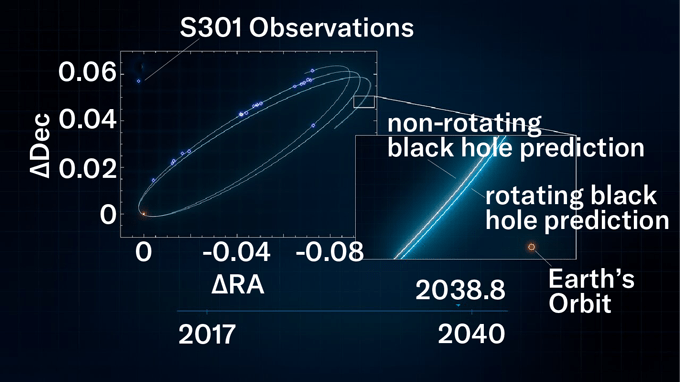 Image: Diagram: Orbital differences of S301 around a spinning black hole (bottom) versus a non-spinning one (top). Source: L. Calçada / GRAVITY Collaboration/ESO / Science News
Regular Feeding or Unruly Buffet? The Galactic Secrets Hidden in Spin
Determining the spin rate of the black hole is vital for understanding the evolutionary history of the entire Milky Way. Spin records how the black hole grew over cosmic time and directly determines how energy jets and interstellar winds influence star formation in the surrounding galaxy.
Astronomer Laura Brenneman of the Harvard-Smithsonian Center for Astrophysics, who was not involved in the study, offered a vivid analogy: if the black hole spins extremely fast, it suggests it has been steadily consuming gas from the same direction over eons; if it spins slowly, it indicates that it swallowed chaotic material arriving from random directions, akin to an unpredictable buffet.
Study co-author Stefan Gillessen, an astronomer at the Max Planck Institute for Extraterrestrial Physics, expressed great excitement over the star’s immense potential. If future observations reveal a spin value of zero or one that breaches the upper limits predicted by General Relativity, it could even challenge the foundational principles of modern physics.
A 15-Year Chase: Waiting for Pure Cosmic Data
Measuring the tiny orbital precessions caused by frame dragging requires immense patience. Because S301 has an orbital period of 8.7 years, astronomers need to track it through several full orbits, expecting to collect the first conclusive spin data within the next 10 to 15 years.
Though painstaking, this approach avoids reliance on heavy theoretical assumptions, extracting data directly from the geometric shifts of the physical orbit. With continuous observations from the VLTI, every minute deflection experienced by the star at pericenter will be precisely logged.
Chasing this record-breaking star is ultimately using a cosmic instrument to read the true rotational cadence of space-time’s vortex. S301 acts like a precision ruler placed right at the black hole’s edge, allowing humanity for the first time to directly listen to the rotation rhythm of the giant at the heart of our galaxy.
Reference Links:
- Nature Paper: Discovery of a star sensitive to the spin of Sagittarius A*
- European Southern Observatory (ESO) Official Press Release
- The Guardian Science Report
- Science News Astronomy Column