When you turn off the bedroom lights at night, an air purifier in the corner often keeps a faint red indicator light burning. Move that tiny red diode ten meters away into an unlit corner, and it becomes almost invisible in the dark.
Across more than 12 billion light-years of space, in the chaotic dawn of the early universe, astronomers have captured hundreds of remarkably similar faint red dots. The instrument responsible is the James Webb Space Telescope (JWST)—the largest infrared observatory ever launched into space, built specifically to detect the faint, stretched-out infrared light from the first billion years of cosmic history. In Webb’s deep-field imagery, each dot spans barely one or two pixels, appearing unassuming and fragile.
Yet the photometric and spectroscopic measurements shook astrophysics to its core. Originally cataloged as garden-variety ancient galaxies, individual dots turned out to be shining with the total luminosity of the entire Milky Way. The Milky Way contains hundreds of billions of stars. Twelve billion light-years away, that light departed when the universe was less than a tenth of its current age. How could so many compact, blindingly radiant red objects assemble within just a billion years of the Big Bang?
Tiny Red Dots Shining with the Fury of Entire Galaxies
Ever since the first batches of deep-space data were transmitted in 2023, astronomers have spotted these peculiar objects in nearly every deep-field exposure. The astronomical community promptly dubbed them “little red dots.” As their light traversed billions of light-years across expanding space, cosmic expansion stretched visible wavelengths into the infrared spectrum, showing up as vibrant crimson specks on Webb’s sensitive detectors.
Researchers initially assumed they were viewing nascent proto-galaxies in their infancy. However, when spectrographs broke down the incoming light into its constituent wavelengths—creating a spectral barcode of the objects’ physical properties—they uncovered intense broad line emission in hydrogen.
Broad emission lines typically signify gas churning at furious velocities of thousands of kilometers per second. In the modern universe, this is the classic calling card of gas swirling around an active supermassive black hole. Yet astronomers quickly hit a theoretical wall. Standard supermassive black holes feeding on gas radiate ferocious torrents of high-energy X-rays, and their luminosity flickers erratically as clumpy gas is consumed. These little red dots showed virtually no detectable X-rays, and their brightness remained remarkably steady—contradicting every conventional black hole profile known to science.
Hydrogen Spectra Spark a Fierce Astronomical Debate
On March 20, 2025, three independent research teams released landmark findings simultaneously. While analyzing spectra from two particularly luminous red dots, Anna de Graaff of the Max Planck Institute for Astronomy and Rohan Naidu of the University of Hawaiʻi identified an unmistakable anomaly: a sharp Balmer break—the classic spectral cliff where hydrogen absorption causes light intensity to plunge at specific wavelengths, a defining hallmark of a star’s gaseous surface.
The data indicated that the outer gas possessed an effective surface temperature between 4,200 K and 4,800 K—temperatures typical of ordinary stellar surfaces. Yet here was an object spanning just a few light-years across, presenting the exterior signature of a gentle, cool star while outputting the collective energy of hundreds of billions of suns.
To reconcile these paradoxical observations, the teams proposed a bold hypothesis: the “black hole star.” In this picture, the object harbors a ravenous, rapidly growing black hole at its core, completely enveloped in a colossal shroud of hydrogen gas.
A Stellar Gaseous Shroud That Would Engulf the Solar System
If our Sun were replaced by a black hole star, its hydrogen mantle would expand into a monstrous pseudo-photosphere—the glowing outer gaseous shell from which radiation escapes. This photosphere would span a radius of 700 to 2,000 astronomical units (AU, where 1 AU is the average distance from Earth to the Sun, roughly 150 million kilometers). In other words, its gaseous envelope would stretch up to 12 times farther than the orbit of Pluto, comfortably swallowing most of the solar system.
The internal physics of a black hole star are extraordinary. At the very center sits a “heavy black hole seed”—an initial black hole tens of thousands of times the mass of the Sun, formed in the early universe through the direct collapse of a pristine gas cloud. As this central seed feasts violently on matter, the immense radiation pressure pushes unswallowed surrounding hydrogen outward, inflating a gigantic gaseous cocoon.
Mauro Giavalisco, an astronomer at the University of Massachusetts Amherst, offered a vivid analogy: inside our Sun, billions of hydrogen bombs detonate every second, yet we see none of the explosions directly because the dense outer layers absorb and thermalize the core radiation. A black hole star’s cocoon functions in precisely the same way, absorbing and diffusing the harsh high-energy X-rays generated by the feeding black hole at its heart.
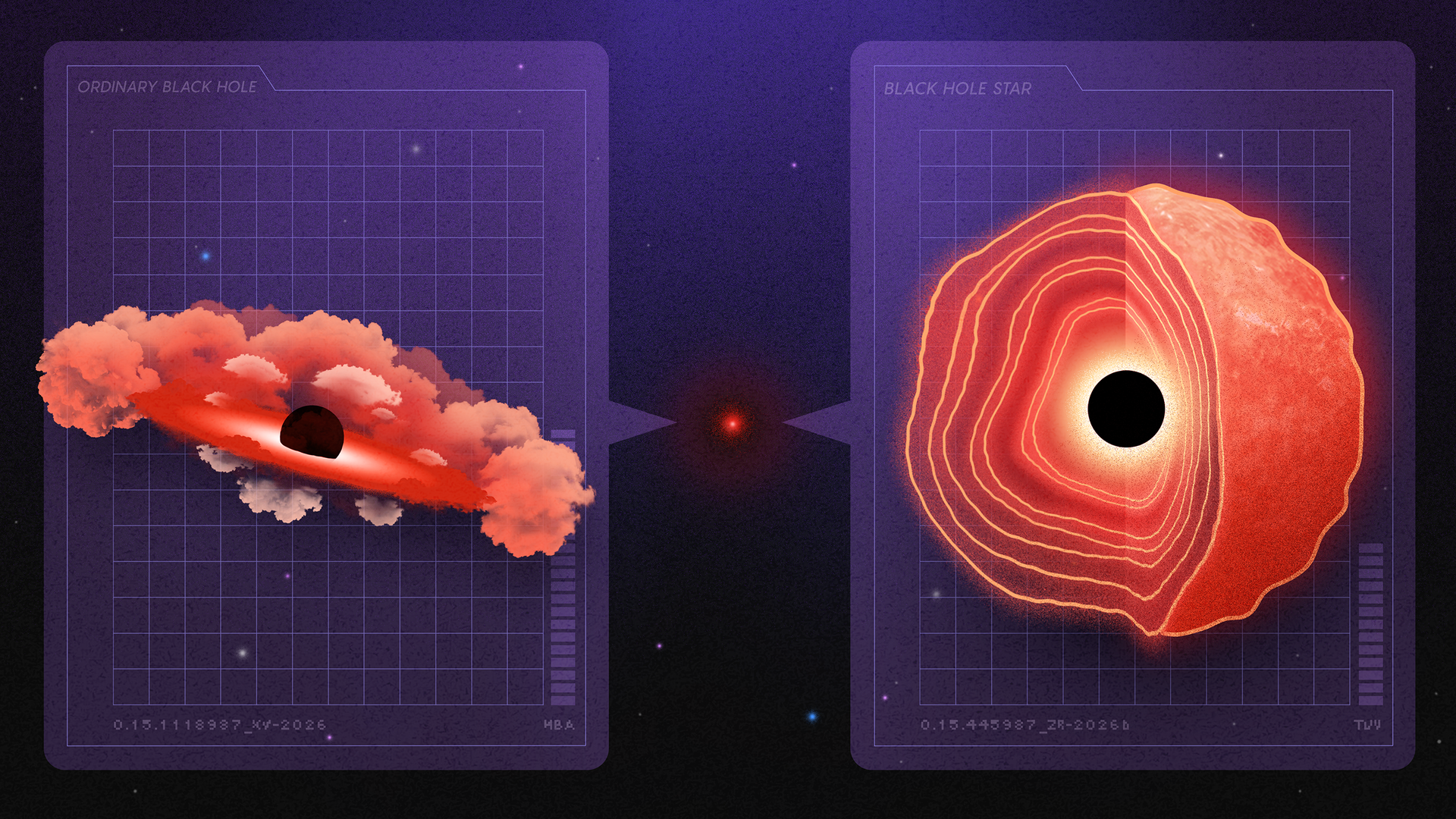 Figure: Artist’s concept of a black hole star, harboring a feeding black hole within a glowing red shroud. Credit: Quanta Magazine
117 Spectra Trace the Birth of Heavy Black Hole Seeds
The black hole star hypothesis initially drew skepticism from parts of the astronomical establishment. In spring 2026, Roberto Maiolino of the University of Cambridge pushed back, arguing that the little red dots were simply standard supermassive black holes obscured by thick, toroidal doughnuts of gas and dust. In Maiolino’s model, electron scattering could broaden hydrogen lines without invoking a stellar envelope, and the intense redness was merely an orientation effect caused by viewing the dusty accretion disk edge-on.
As observational data accumulated, the debate reached a decisive turning point in September 2026. A team comprising Rohan Naidu, Anna de Graaff, Anna-Christina Eilers, and their collaborators published a comprehensive study stacking and modeling the spectra of 117 little red dots.
The resulting composite fit stellar atmosphere models with remarkable precision. The data matched a uniform surface temperature between 4,200 K and 4,800 K. Calculations revealed that these 117 objects harbored central black hole seeds ranging from 10,000 to 100,000 solar masses. For decades, astrophysicists could not explain how billion-solar-mass monsters formed so rapidly in the early universe. This dataset provided the first empirical evidence of heavy black hole seeds caught in the act of incubation.
 Figure: Astronomer Anna de Graaff stands among an array of physical models representing little red dots. Credit: Quanta Magazine
Cosmic Puberty: Shedding Gaseous Envelopes to Reveal Monsters
In August 2026, astrophysicist Dale Kocevski completed an extensive census of these objects. He discovered that little red dots appear almost exclusively during the first billion years following the Big Bang. By the time the universe reached an age of two to three billion years, the little red dots had virtually vanished from deep-field surveys.
This distribution demonstrates that black hole stars represent a transient “puberty-like phase” in cosmic evolution. The central black hole feeds voraciously within its protective nursery. Once its gravitational mass and radiation pressure cross a critical threshold, the intense outward radiative wind blasts the outer hydrogen envelope into interstellar space.
Stripped of its gaseous cocoon, the unmasked supermassive black hole finally stands revealed to the cosmos as a brilliant, shining quasar. As Rohan Naidu remarked, these little red dots are the long-sought seeds: humanity has been fortunate enough to witness the cradle where every massive black hole in the universe was born.
Webb’s tiny red dots have delivered baby pictures of the universe’s greatest gravitational behemoths. By masking their violent gravitational engines beneath the warm hydrogen cloak of a giant star, they reveal how heavy seeds took root in the primordial dawn. Those faint, crimson pixels preserve the breathtaking moment when supermassive black holes broke free from their cosmic cocoons.
Reference links:
- Quanta Magazine coverage (Charlie Wood, 2026-09-14)
- arXiv:2609.09274 paper (Sun, Naidu et al.)


