
Turn off the bedroom lamp late at night, and the instant your phone screen fades, the room plunges into pitch darkness. Humans struggle to navigate even a familiar dark room. Yet thousands of meters beneath the ocean surface, where sunlight has never reached for millions of years, the world is never truly extinguished.
For decades, conventional wisdom held that only jellyfish, squid, or deep-sea anglerfish dangling glowing lures could pierce this endless gloom. But in the deep trenches off Australia’s eastern coast, marine scientists have hauled up something unexpected: giant sea spiders that emit an otherworldly glow.
The discovery overturns long-standing biological assumptions. Sea spiders belong to the arthropods—the segmented, exoskeleton-bearing phylum that includes shrimp, crabs, and terrestrial spiders. Lacking any dedicated light-emitting organs of their own, they turn their eight spindly legs brilliant blue entirely through the food they eat.
Hauling 25,000 Specimens from 5,000 Meters Deep
In 2017, the Australian research vessel RV Investigator embarked on an expedition off the continent’s southeastern coast. Scientists cast heavy bottom-trawling nets into the abyss, dragging them through muddy sediments nearly 5,000 meters beneath the waves.
A depth of 5,000 meters is the equivalent of stacking 12 Eiffel Towers end-to-end straight down into the sea. Sunlight is entirely absorbed within the first 200 meters. At 5,000 meters, nothing remains but crushing pressure and perpetual night.
Jérôme Mallefet, a marine biologist from the Catholic University of Louvain (UCLouvain) in Belgium, joined the voyage. Aboard the ship, he set up a makeshift darkroom chilled to 6°C. In the bitter cold and darkness, he methodically examined 25,000 deep-sea specimens hauled up in the nets.
Among the sprawling collection of abyssal life, two species of giant sea spiders caught his eye: Colossendeis tasmanica and Colossendeis minor (C. minor).
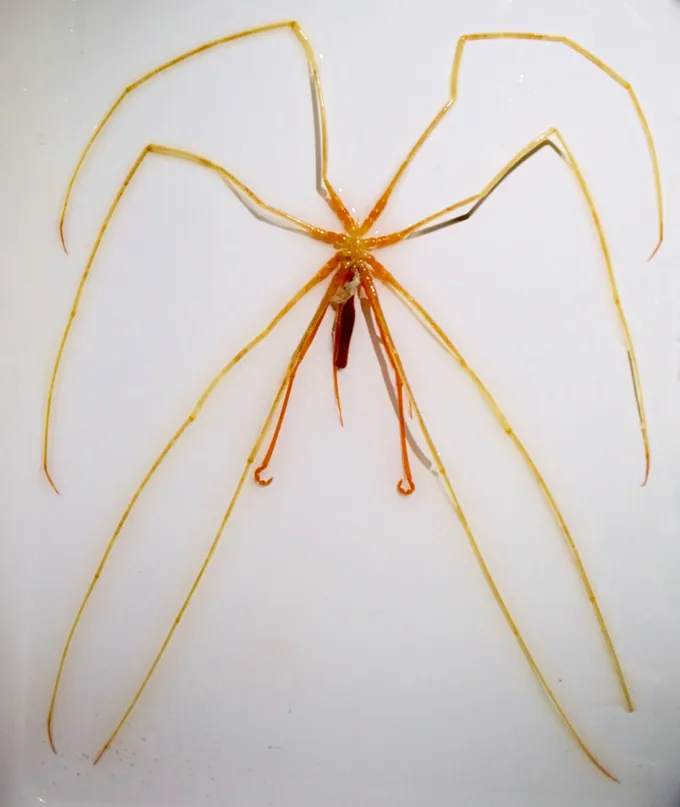 Figure: A finger-sized body with legs stretching up to 25 centimeters long. Source: Science News, Photo: Jérôme Mallefet.
A Finger-Sized Body and 25-Centimeter Legs Glowing Blue
Colossendeis tasmanica possesses a truly bizarre body plan. Its central torso is barely the size of an adult human finger, yet its eight spindly legs span up to 25 centimeters across.
A 25-centimeter leg span is roughly the distance from an adult’s elbow to the tip of their palm. Because the body is so compact, a sea spider’s internal organs and reproductive systems are packed directly inside its hollow legs.
Working in his darkroom, Mallefet gently stimulated the sea spider, and its legs immediately flickered with a faint blue glow. When he applied potassium chloride (KCl)—a salt compound known to excite bioluminescent cells—the creature’s eight long legs shone with steady blue light for up to 10 minutes.
Instrumental measurements determined that this blue luminescence peaks at a wavelength of 449 nanometers (nm). Light around 450 nm travels farthest through seawater, matching the visual sensitivity of most deep-sea organisms. The glow was brightest at the tips of the legs and tapered gradually toward the body.
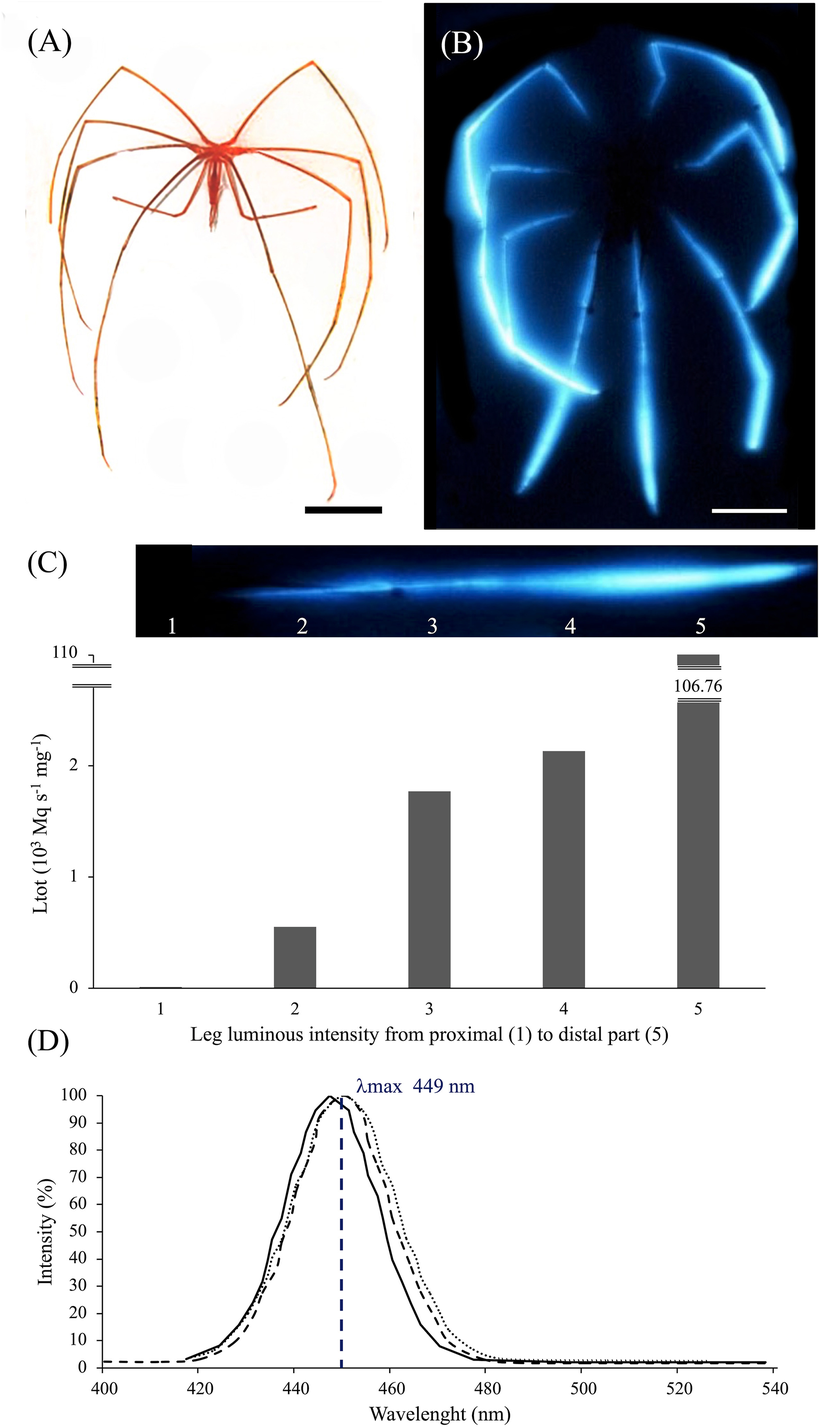 Figure: Experimental records of glowing sea spiders. Source: Deep Sea Research Part I paper, Mallefet et al.
No Light Organs of Their Own: Borrowing Radiance by Eating Anemones
The vast majority of bioluminescent marine organisms produce their own light through endogenous chemical reactions. Typically, they synthesize a substrate called luciferin alongside a luciferase enzyme, producing photons when the two interact in the presence of oxygen.
Yet biochemical assays revealed that the sea spiders’ tissues showed zero reaction to luciferin. Instead, their emission was consistent with a calcium-dependent photoprotein system—a bioluminescent mechanism activated by calcium ions.
Histological cross-sections revealed the anatomical secret. The spiders’ light-emitting cells were concentrated around the intestinal caeca (gut diverticula) extending throughout the legs, tightly nestled alongside digestive tissues.
From this evidence, Mallefet deduced that sea spiders never evolved dedicated bioluminescent glands. Instead, they graze on luminous seafloor prey such as deep-sea anemones, sequestering the glowing compounds in their leg-bound digestive tracts—effectively borrowing their light from their dinner.
With 76% of Deep-Sea Life Glowing, Even Baseline Arthropods Light Up
Bioluminescence has a remarkably deep evolutionary pedigree on Earth, dating back at least 540 million years to the Cambrian explosion, when marine creatures first evolved hard skeletons.
Modern oceanographic surveys indicate that roughly 76% of all deep-sea creatures possess the ability to produce light. That means roughly three out of every four inhabitants of the deep carry their own biological flashlights.
Arthropods have long been considered an evolutionary “baseline” in deep-sea ecosystems. Given their rigid exoskeletons and conservative body plans, biologists long assumed they lacked the anatomical plasticity to evolve specialized light organs.
Confirming bioluminescence in sea spiders rewrites that chapter. Deep-sea luminescence is even more pervasive than textbooks have acknowledged. Even without dedicated bioluminescent organs, animals can acquire the power to illuminate the abyss through the food web.
Beyond bioluminescence, researchers observed green fluorescence—a physical process where an organism absorbs higher-energy light (such as ultraviolet or blue) and re-emits lower-energy light—in three sea spider species under UV illumination. This fluorescence might serve to attract mates, lure prey, or deter predators.
A Century-Old Poetic Log Confirmed with High-Resolution Photos
More than a century ago, early deep-sea expedition logs recorded an intriguing observation: “The creature, as it lay on its back, shone like a star, all its legs being lit along their ventral surface with a strange blue radiance.”
Lacking preservation techniques and photographic equipment, this poetic entry was dismissed for over a hundred years as romantic exaggeration.
Mallefet’s experiments in the 6°C darkroom, paired with high-sensitivity imaging, have finally provided definitive experimental proof and high-resolution photographs.
Discovering that deep-sea spiders glow proves that bioluminescence in the deep ocean is far more widespread than previously recognized. A light source can be acquired from what an animal digests—allowing even structurally austere arthropods to turn their prey’s brilliance into a beacon on the ocean floor.
Reference Links:
- Science News Report
- Deep Sea Research Part I Paper