Don’t Confuse Unsolvability with Absolute Chaos
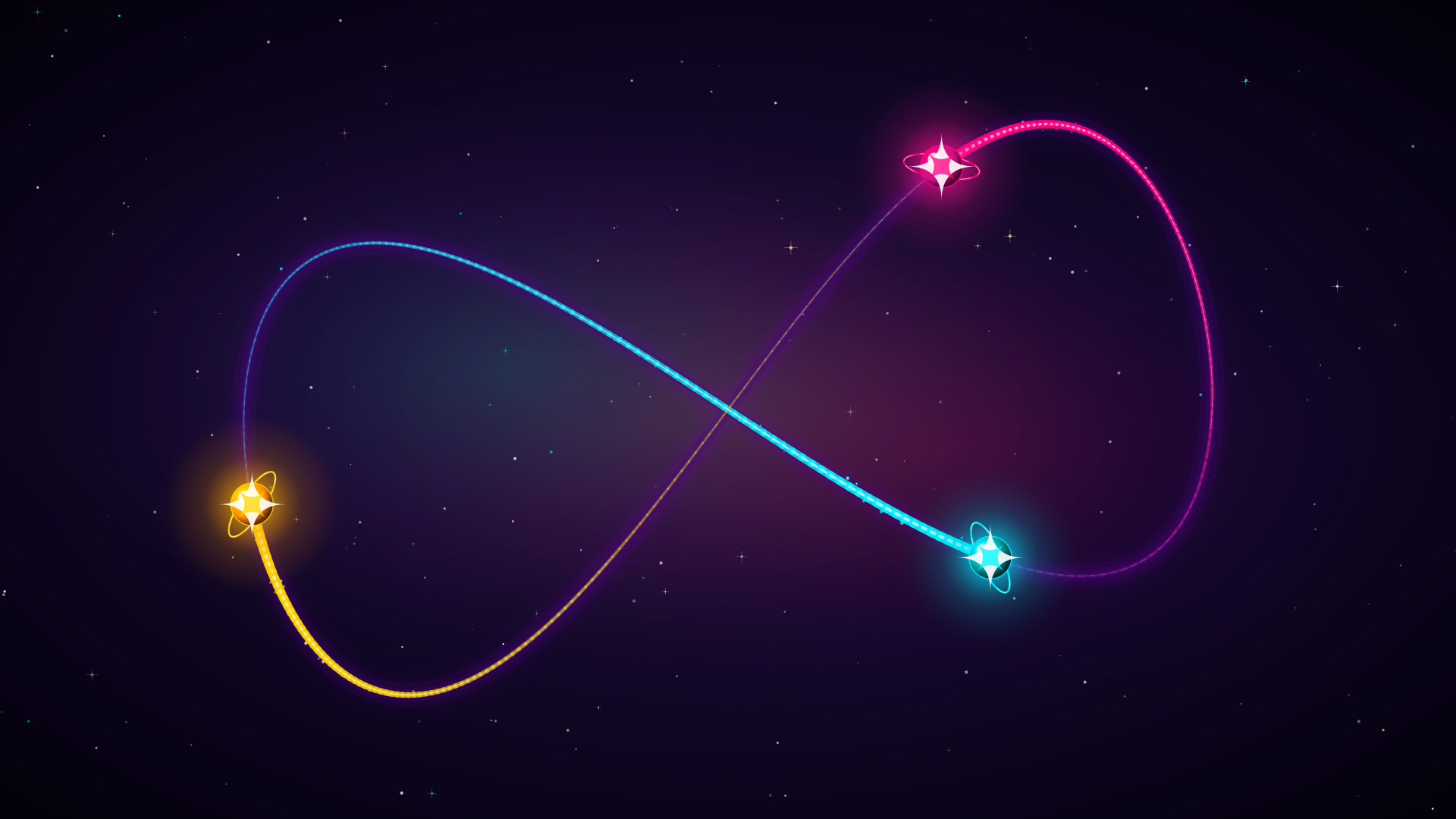
In Liu Cixin’s sci-fi epic The Three-Body Problem and broader public consciousness, the three-body problem is often viewed as the ultimate emblem of unpredictability. But this stems from a century-long misunderstanding. In the 1880s, Henri Poincaré demonstrated that there is no general closed-form analytical solution (first integrals) for the motion of three celestial bodies—a discovery that directly catalyzed modern chaos theory. Yet the absence of a universal formula does not mean a chaotic system contains no exact, periodic solutions.
A web project called Three Body Orbits has curated 3,915 exact periodic solutions from 13 research papers into an interactive atlas. Under these carefully calibrated initial conditions, three equal-mass bodies complete full orbital cycles, returning precisely to their initial positions and velocities. A lack of general closed-form formulas in theoretical mathematics is fundamentally different from computational unpredictability in engineering. When sufficient computing power is brought to bear, islands of stable order can still be charted in the stormy sea of chaos.
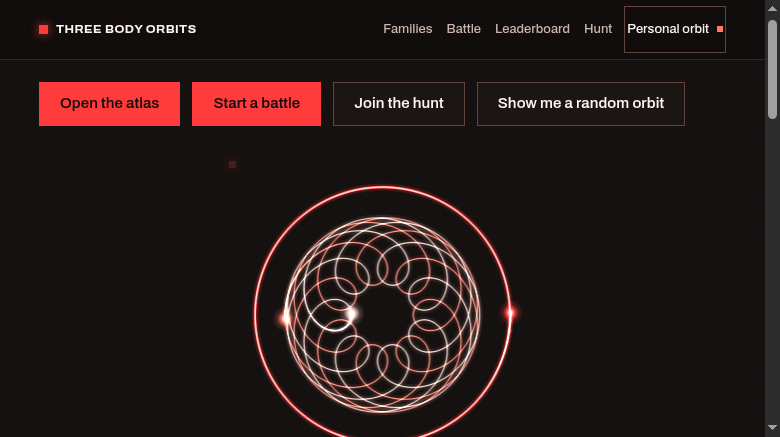 Figure: Overview of the Three Body Orbits homepage, where each periodic orbit occupies a position on the celestial map and similar trajectories cluster into islands. Source: Three Body Orbits website capture
Pushing Past 32-Digit Arithmetic Limits, Skipping Real-Time Browser Simulation
Behind the 3,915 orbits cataloged in the atlas lies an exacting feat of numerical reconstruction. The site’s creator did not merely transcribe the initial conditions reported in academic papers. Due to typesetting constraints, academic publications typically print values rounded to only 10 to 15 significant digits. In a chaotic system like the three-body problem, even a microscopic truncation error on the order of 10⁻¹⁵ is amplified exponentially within just a few cycles, causing orbits to rapidly diverge and disintegrate.
To ensure that each orbit closes seamlessly from end to beginning, the author re-converged the Poincaré return maps of the governing differential equations using arbitrary-precision arithmetic libraries and Newton-Raphson iteration. By repeatedly refining the initial positions and velocities to 32 decimal digits of precision, they brought the median closure error down to an astonishing 1.4 × 10⁻²⁴. At this scale, the residual position error after a full orbital period is far smaller than the diameter of an atom. A total of 3,889 orbits close with precision better than 10⁻⁹.
These trajectories, generated at extreme numerical precision, posed a dilemma for frontend engineering. If the site had chosen real-time browser simulation—letting JavaScript integrate equations on the fly using native 64-bit double-precision floating-point numbers—accumulated rounding errors would have caused the closed orbits to visibly drift within seconds.
Instead, the site adopted a “precomputed splines + client playback” architecture. The backend compresses the high-precision simulated coordinates into over 9.7 million high-degree polynomial spline knots and streams them to the client. The frontend simply interpolates and renders these knots smoothly along the timeline. By trading precomputed storage for runtime numerical fidelity and isolating heavy computation to the backend, the browser reserves all its performance for fluid, 60 FPS visual rendering.
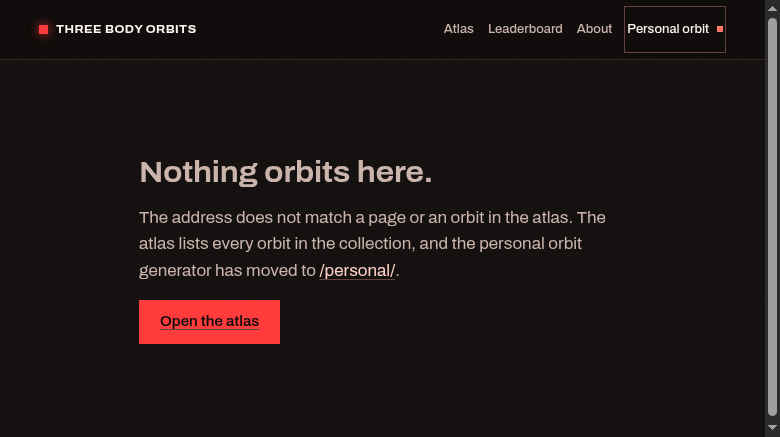 Figure: The iconic Figure-8 orbit page, showing the three bodies tracing an intertwined path in a long-exposure view. Source: Three Body Orbits website capture
Three Generations of Researchers Compute 3,915 Exact Solutions
These 3,915 orbits represent decades of collective progress in nonlinear dynamics. Rather than the output of a single lab, they form a vast classification map assembled across generations by international research teams utilizing supercomputers.
The team led by Shijun Liao at Shanghai Jiao Tong University (the Li–Liao group) contributed the lion’s share: 1,964 orbits. Using supercomputer clusters and their Clean Numerical Simulation (CNS) methodology, they systematically swept parameter spaces to uncover hundreds of previously unknown topological families. A research group at Sofia University in Bulgaria contributed 709 complex orbits, greatly expanding the diversity of high-harmonic families. The famous “Choreographies” account for 583 orbits—systems where the three bodies dance along a single shared closed curve like acrobats on the same high wire.
In addition, there are 311 special solutions featuring free-fall characteristics, and 230 geometrically elegant solutions discovered by the Belgrade research group in Serbia (Šuvakov and Dmitrašinović). The catalog even includes 52 classic orbits originally derived by Roger Broucke in 1975. Together with 66 newly discovered orbits found through the site’s own crowdsourced search, they form an exhaustive catalog of three-body dynamics. Every set of initial coordinates represents hundreds of thousands of core-hours burned on supercomputer clusters.
Testing Floquet Stability Boundaries with a Kick Slider
Within the atlas, 1,593 orbits are explicitly classified as “linearly stable,” accounting for 40.7% of the total. In dynamical systems, the gold standard for assessing an orbit’s resilience against physical disturbances is the Floquet multiplier. It quantifies how infinitesimal perturbations evolve after a full period.
If the absolute value (magnitude) of a Floquet multiplier exceeds 1, perturbations grow exponentially and the system rapidly tears itself apart. But when the maximum Floquet multiplier is strictly equal to 1.000, the system rests on the edge of stability. That 1.000 indicates that perturbations induce only bounded periodic oscillations while the overarching orbital topology remains intact. A multiplier of 1.000 serves as the mathematical anchor confirming an orbit’s enduring presence in the sea of chaos.
To provide a visceral demonstration of the difference between stable and unstable orbits, the website places an interactive “Kick” slider on the right side of the screen. Adjusting the slider applies an instantaneous velocity vector nudge to one of the bodies, prompting a client-side numerical integrator to immediately take over from the precomputed splines.
For linearly stable trajectories like Broucke R12, a small perturbation merely causes the bodies to wobble slightly around their baseline paths; the system’s intrinsic dynamics quickly restore balance and preserve the three-body dance. But on an unstable orbit, even a tiny nudge from the slider causes the three stars to unravel within a few cycles, hurling bodies haphazardly into deep space. This minimalist interactive design turns abstract differential equation eigenvalue analysis into immediate, tactile physical intuition. On Hacker News, physicists and software engineers engaged in spirited debates regarding the exact thresholds of perturbation stability.
Turning Parameter Sweeps into Decentralized Crowdsourcing
Recently, the site rolled out a browser-based compute contribution feature. Visitors can enable “Hunt” mode directly in their browsers, donating idle CPU cycles to search for new, uncataloged orbits across designated parameter bounds. When a device converges on a new linearly stable periodic solution, the contributor gets the honor of naming the algorithmic star system. This transforms dry numerical parameter sweeping into a decentralized geek crowdsourcing game.
Popular culture often treats the insolvability of the three-body problem as an inescapable law of fatal chaos. Yet this atlas demonstrates that when computational capabilities reach 24 decimal places of closed verification, nearly four thousand islands of rigorous mathematical order emerge from the turbulence. The three-body problem has long broken free from philosophical dead ends, evolving into an active engineering playground powered by concrete data and supercomputing scale.
References:
- Three Body Orbits Website
- Physical Review Letters 110, 114301
- Science China Physics, Mechanics & Astronomy 60, 129511
- Sofia University Research Group Publications
- Celestial Mechanics 12, 439-462
- Hacker News Discussion (item?id=49670852)