When scrolling through photos late at night or gazing up at the evening sky, a faint reddish speck in an image is easily dismissed as dust. Some might even mistake it for a dead pixel on the display. To astronomers, however, these microscopic red specks are sparking one of the fiercest academic debates in modern astrophysics. They were captured by the James Webb Space Telescope (JWST)—a premier observational powerhouse stationed in deep space 1.5 million kilometers from Earth. Dubbed “little red dots” (LRDs) in scientific literature, these celestial objects occupy barely a single pixel in deep-field exposures. Yet the light they radiate set out during the universe’s cosmic dawn, traversing a staggering 12 billion light-years to reach our detectors.
Astronomers initially assumed they were merely distant, ancient galaxies. A closer inspection of the data, however, revealed that their luminosity shattered the upper limits of established evolutionary models. Under conventional astrophysical theories, objects of such extreme radiance had no business existing so early in cosmic time. This anomaly has forced researchers to fundamentally rethink the origins of supermassive black holes.
Single-Pixel Red Dots Outshining Billions of Stars
In 2023, the Webb telescope released its first major batches of deep-field imagery. Tucked into the corners of nearly every frame were one or two piercingly bright, tiny red dots. In the pictures, they appeared diminutive and unassuming. If the entire star field were scaled up to the size of a giant billboard, these red dots would take up no more than the area of a single pixel. Yet photometric measurements left researchers utterly astonished.
That solitary pixel poured out an amount of light equivalent to billions of suns shining simultaneously. Its sheer brilliance was enough to drown out an entire ordinary galaxy. According to classical astrophysics, galaxies require hundreds of millions of years of cosmic scaffolding to take shape. A system must gather tens or hundreds of billions of stars before generating such immense radiance. Yet when these little red dots emerged, fewer than one billion years had elapsed since the Big Bang. In such a narrow window, the universe simply had not had enough time to assemble galaxies of that scale.
Astronomers briefly labeled them “universe breakers.” Their very existence threw existing models of galaxy assembly into disarray. Researchers soon turned Webb’s spectrographs toward the red dots, hoping spectroscopic fingerprints would unmask their true identity. A spectrum functions as a celestial identity card, where distinct chemical compositions leave unique spectral lines. Early spectroscopic analysis indicated that the characteristics of the little red dots closely mirrored those of supermassive black holes.
A black hole itself emits no light. However, when immense reservoirs of surrounding gas and dust plunge toward the gravitational abyss, violent friction creates a fiercely luminous structure. This brilliance can easily outshine an entire host galaxy.
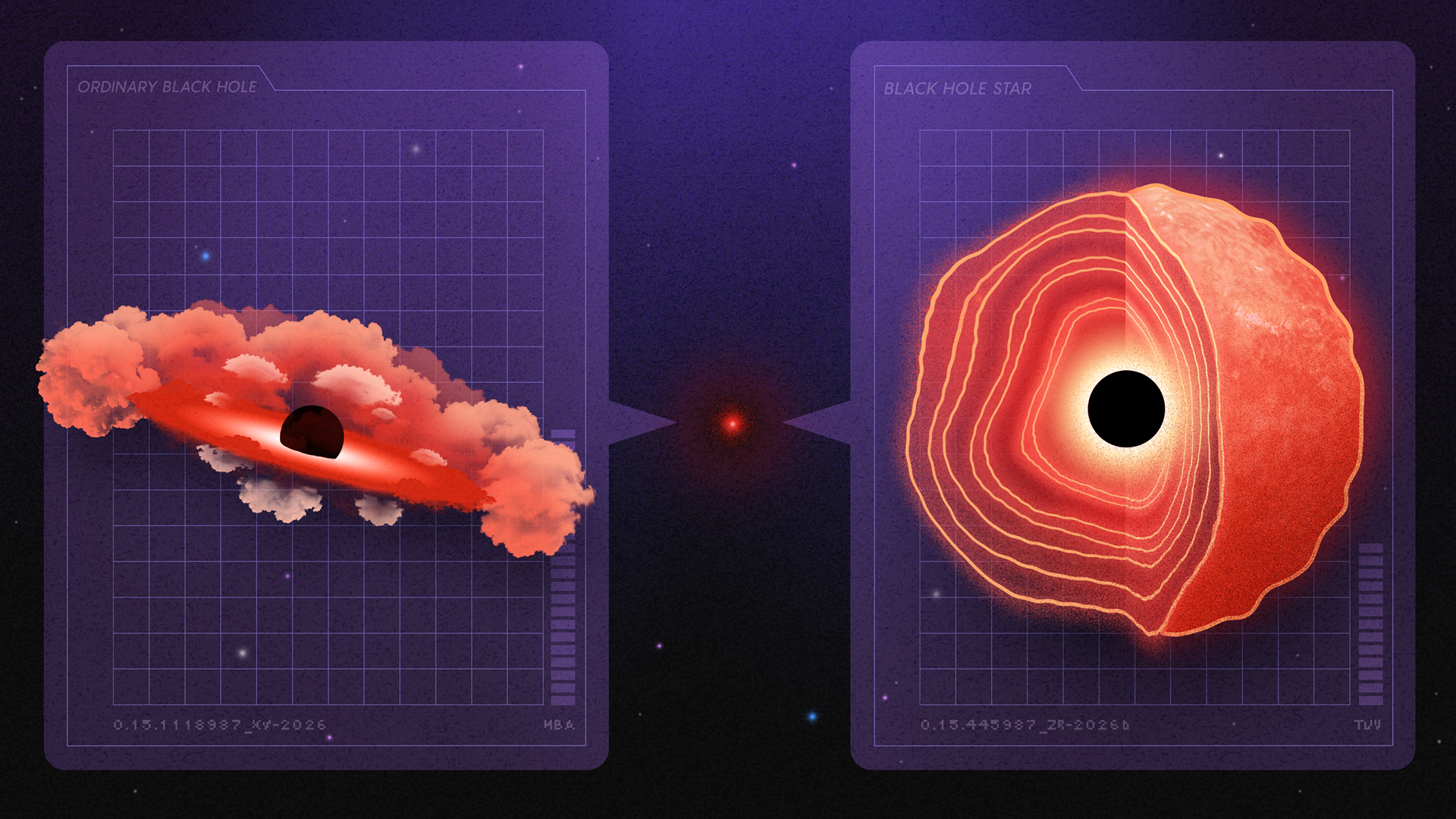 Figure: Conceptual illustration of a black hole star (quasi-star), with an outer hydrogen envelope shrouding a central black hole engine. Source: Quanta Magazine / Mark Belan
The Spectrum Tells a Different Story: A Black Hole in the Wrong Clothes
Had these little red dots simply been standard black holes, astronomers might have breathed a sigh of relief. That peace of mind shattered on March 20, 2025. The date was quickly dubbed “Black Hole Star Day” by the research community. Three independent research teams simultaneously released new observational data on that day. Analyzing the spectra of two benchmark little red dots, researchers discovered a peculiar spectral signature: a Balmer break—a steep cliff-like drop in emission when hydrogen atoms absorb light, typically observed only in relatively cool hydrogen envelopes.
This distinctive break can only form in a hydrogen sphere maintained at roughly 5,000 Kelvin (approximately 4,700 degrees Celsius). Surrounding a bare supermassive black hole, however, is a violent accretion disk churning at millions of degrees. Such an infernal environment could never sustain a relatively cool, gentle hydrogen envelope. A black hole, by all accounts, had no business wearing such an outfit. Even more paradoxically, this lukewarm hydrogen sphere was pumping out the dazzling luminosity of billions of suns combined.
Normal stars could never produce such staggering amounts of energy, while ordinary black holes could never support such a cool gas cocoon. The astronomical community was caught in an impasse. What manner of celestial object could simultaneously harbor the immense powerhouse of a black hole and the exterior of a lukewarm hydrogen sphere?
A Black Hole Inside a Hydrogen Cocoon: Expanding Beyond Pluto’s Orbit
To resolve this contradiction, astronomers revisited a theoretical study from 2006. Theoretical astrophysicist Mitchell Begelman had proposed a hypothetical model known as a “quasi-star”—a speculative celestial body featuring a colossal outer hydrogen envelope powered by a black hole engine at its core, also known as a “black hole star.” In the wake of the 2025 debates, research teams applied the black hole star model to the little red dot data. From the outside, a black hole star would look like a gargantuan balloon of hydrogen gas. If placed at the center of our solar system in place of the Sun, its outer boundary would stretch to 12 times the orbital distance of Pluto. It would completely engulf every known planetary orbit in the solar system.
Deep inside this super-sized sphere sat a massive “seed black hole” acting as its engine. The central black hole fed voraciously on the surrounding gas, releasing intense radiation and thermal energy. This outward radiation pressure counterbalanced the immense gravitational pull of the bloated outer hydrogen envelope, keeping the giant gas sphere from collapsing inward. The architecture neatly reconciled the contradictory signatures of the little red dots: the central black hole generated torrential luminosity, while the massive outer hydrogen envelope absorbed high-energy radiation, ultimately emitting the 5,000-Kelvin thermal glow with its characteristic Balmer break.
The black hole star model serendipitously solved two other puzzles surrounding the little red dots. The thick outer envelope acted like a radiation shield, suffocating the high-energy X-rays typically unleashed during black hole feeding frenzies. At the same time, this stable gas reservoir smoothed out the accretion flow, explaining why the radiance of the little red dots did not flicker erratically the way ordinary feeding black holes do.
 Figure: Portrait of researcher Anna de Graaff, set against an illustration of a little red dot. Source: Quanta Magazine / Max Borchardt
The Counter-Argument: Little Blue Dots and the Angle of View
As ingenious as the black hole star hypothesis was, the astronomical community remained far from unanimous. A skeptical camp, led by University of Cambridge professor Roberto Maiolino, urged caution. They argued that there was no need to invoke exotic, hypothetical objects like black hole stars. Standard astrophysical mechanisms, the skeptics maintained, were entirely adequate to explain the observational data. In the gas-rich early universe, black holes enjoyed an abundant, uninterrupted food supply, which naturally suppressed intense flickering.
To explain the mystery of the vanishing X-rays, the opposing camp proposed a dusty doughnut hypothesis. A dense torus of gas and dust might encircle the black hole. If this torus happened to lie directly between the telescope and the black hole, high-energy X-rays would be almost entirely absorbed. As for why the spectrum appeared reddish, the skeptics argued that it was purely a matter of viewing angle.
Viewed from the side through the veil of dust, the object would appear red. Viewed head-on down an unobstructed line of sight, it would appear blue. Indeed, astronomers have identified corresponding “little blue dots” in deep-field images. Based on this, the counter-camp suggested that little red dots and little blue dots represent the exact same class of ordinary black holes, differing only in the angle from which they are observed. Addressing the broad spectral lines cited by black hole star proponents, a team led by Rusakov offered an alternative explanation: the broadening could be accounted for by electron scattering—a process in which photons change direction and energy upon colliding with high-density electron clouds—without requiring a colossal hydrogen envelope.
 Figure: Portrait of astrophysicist Roberto Maiolino. Source: Quanta Magazine
Red Dots Vanish by Age Three Billion: Catching Monster Black Holes in Their Infancy
Despite the ongoing dispute, observational evidence has increasingly leaned toward the black hole star hypothesis. In August 2026, a team led by Dale Kocevski completed an extensive census of objects in the early universe. Their analysis demonstrated that by the time the universe grew to 2 to 3 billion years old, little red dots had virtually vanished from the cosmos. This disappearance matches theoretical predictions: the black hole star phase is inherently unsustainable over long periods, representing a brief, turbulent adolescence in the genesis of supermassive black holes.
As the outer hydrogen envelope is gradually consumed by the central black hole or blown into space by radiation, the black hole star eventually sheds its cocoon, settling into the familiar, bare supermassive black holes seen across the modern universe. On September 8, 2026, a joint research team published newly calibrated mass calculations: the seed black holes lurking inside these little red dots could reach up to one million times the mass of the Sun. Researcher Rohan Naidu noted that we may well be witnessing the primordial seeds of black holes—the very birth process that produced every supermassive black hole in the cosmos. Kocevski offered a pragmatic synthesis, suggesting that both camps might hold part of the truth: some little red dots may indeed be genuine black hole stars, while others are standard black holes veiled behind thick shrouds of dust.
The minuscule red specks captured by the Webb telescope have illuminated profound mysteries lurking in the depths of cosmic dawn. From single red pixels to the behemoths anchoring galactic centers, astronomers are reconstructing the nascent forms of black holes through starlight and spectra. These ancient rays suggest that supermassive black holes may not have grown incrementally across cosmic epochs; rather, they burst into existence during the universe’s earliest dawn in the colossal guise of black hole stars.
References:
- Quanta Magazine Report