In the first half of 2026, ASML’s equipment sales in Europe dropped to exactly zero. The semiconductor giant, valued at roughly $660 billion, did not book a single lithography machine sale in its home territory. While European policymakers staked the continent’s chip ambitions entirely on supply-side factory subsidies, no one addressed the fundamental question: who is actually going to buy the leading-edge silicon produced?
Europe’s Largest Tech Giant Sells Zero Machines on Home Turf
ASML’s financial filings trace a steep downward trajectory in its domestic market. In 2024, Europe still generated 5% of the company’s total net sales. By 2025, that figure had shriveled to 1%. Through the first six months of 2026, European tool shipments were wiped out entirely.
| Year | Share of European Revenue |
|---|---|
| 2022 | 2% |
| 2023 | 4% |
| 2024 | 5% |
| 2025 | 1% |
| 2026H1 | 0% |
Frank Heemskerk, Executive Vice President of Public Affairs at ASML, laid the cards on the table during a panel discussion in Amsterdam: “We are selling absolutely nothing here. Because there is no investment, there is no fab.” As Europe’s most valuable tech company, ASML ships the world’s most sophisticated manufacturing equipment to foundry hubs across the globe, yet drew a complete blank in its backyard. The continent’s semiconductor supply chain, long celebrated as a pillar of strategic autonomy, has severed at the critical juncture of leading-edge procurement.
Billions in Subsidies Cannot Buy Leading-Edge Wafer Fabs
Over the past few years, the European Union has poured unprecedented public subsidies into wooing advanced wafer fabs. Capital flows, however, have proven far colder than political talking points. Intel had planned an ambitious €80 billion mega-fab campus in Magdeburg, Germany, with the first phase alone budgeted at over €30 billion and backed by €10 billion in state aid. That landmark project has now been shelved indefinitely.
In Ireland, Intel did commit roughly €5 billion to expand Fab 34 for Intel 4 and Intel 3 production. Yet this represents the incremental upgrade of an existing operational site rather than the launch of a new greenfield manufacturing cluster. It does little to alter the broader reality: Europe’s expansion into leading-edge capacity has ground to a halt.
 Figure: Cutaway view of a lithography system. Source: ASML (via Tom’s Hardware)
State subsidies cannot conjure market demand out of thin air. A fab line built without guaranteed downstream purchase orders is little more than a balance-sheet liability waiting to be written down. Chipmakers may entertain grand architectural visions while lobbying for grants, but when the time comes to write nine-figure checks for extreme ultraviolet (EUV) scanners, they demand concrete customer commitments.
Legacy Fab Expansion Masks the Collapse of Advanced Nodes
Europe is not entirely barren of semiconductor investment; rather, available capital has flowed almost exclusively into legacy and mature nodes. ESMC—a €15 billion joint venture between TSMC, Bosch, Infineon, and NXP—is currently breaking ground in Dresden. Infineon also inaugurated a €5 billion smart-power fab in July 2026, the largest single investment in its corporate history, effectively doubling site capacity.
Both major outlays target proven process geometries ranging from 12nm to 28nm. These production lines cater primarily to automotive, industrial automation, renewable energy systems, and analog or mixed-signal power components for AI data centers.
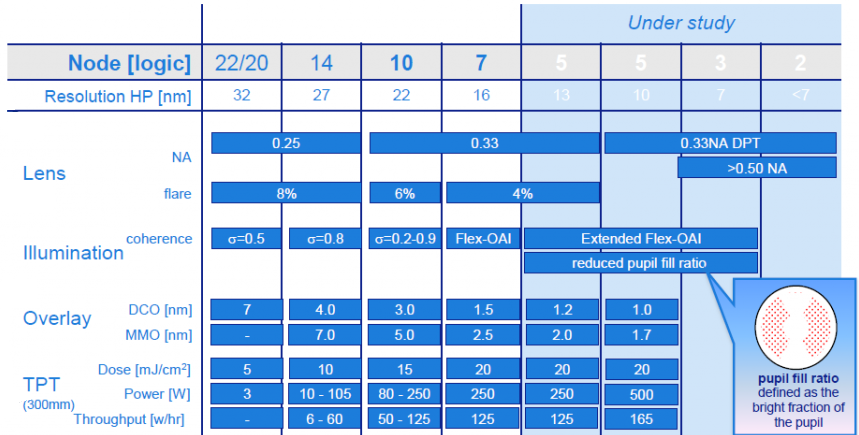 Figure: ASML’s EUV lithography equipment roadmap. Source: Wikimedia Commons
These mature, utilitarian nodes remain Europe’s industrial stronghold. The European automotive sector easily absorbs mature-process volume, but across the entire continent, there is not a single domestic customer designing leading-edge silicon that requires ASML’s cutting-edge EUV systems. From ASML’s vantage point, “there is simply no demand for these kinds of highly specialized machines here.”
Supply-Side Industrial Policy Hits a Dead End Without Real Demand
Heemskerk pinpointed the structural flaw in European policy: throwing public funds at supply-side fab construction is nowhere near enough. What Europe truly needs is policy that actively drives demand. The buyers of leading-edge lithography scanners are global hyperscalers and fabless tech giants designing state-of-the-art processors, not abstract geographical territories.
Heemskerk has taken this message directly to European Commission President Ursula von der Leyen, advocating for coordinated frameworks that pool and guarantee demand for European-manufactured chips. By bringing prospective buyers into direct, long-term procurement dialogues with fabricators, Europe could anchor advanced capacity around real domestic needs. He noted that emerging domains like industrial AI still offer Europe a fighting chance—provided the continent’s industrial leaders organize collectively.
Forcing fabs into regions devoid of downstream consumption inevitably leaves expensive cleanrooms idling under empty order books. When ASML’s domestic revenue share reaches zero, a subsidy-driven industrial policy has officially hit a brick wall. If semiconductor manufacturing is to take genuine root in Europe, policymakers must organize the buyers before they subsidize the factories.
The fundamental reason ASML cannot sell tools at home is that European companies no longer design or consume chips at the technology frontier. Without authentic buyers to fill high-cost, leading-edge fabrication lines, capacity bought purely with taxpayer subsidies will ultimately end up serving foreign customers—or sitting dark.
Reference Links:
- Tom’s Hardware Report
- Hacker News Discussion (item?id=49844663)