
The Los Angeles Metro escalator design specification caps operating speed at 90 feet per minute—roughly 0.46 meters per second. A comparative survey across 139 cities in 58 countries reveals that this figure sits below the allowable upper limit of every single transit system on the list, running 64% slower than the standard operational velocity of the Hong Kong MTR.
This sluggishness is not a hardware constraint. Across town, Los Angeles International Airport (LAX) runs its escalators at the maximum 100 feet per minute permitted by California state building code. In fact, the original 1984 subway system criteria even specified a 120-foot-per-minute tier. Over decades of bureaucratic updates and procurement revisions, that speed was steadily dialed down layer by layer—leaving daily fare-paying commuters to foot the bill in lost time.
Capped at 0.46 m/s: LA Metro Ranks at the Bottom of Global Transit
A comparative dataset spanning 139 global cities exposes an institutional time sink. LA Metro’s engineering guidelines explicitly mandate an operating escalator speed of 90 feet per minute (~0.46 m/s).
Across the surveyed transit networks, the vast majority run escalators at or above 0.5 m/s. Cross-referencing municipal regulations with real-world operating figures shows that only four cities adopt the lower 0.42 m/s tier. Tied with Los Angeles at 0.46 m/s is New York City—another transit system notorious for legacy infrastructure and deferred maintenance.
Most global transit authorities deliberately chose faster operational bands. Eleven cities, including Tokyo, Seoul, and Berlin, benchmark their networks at 0.5 m/s. Sixteen systems, such as Shanghai, Paris, and Madrid, set baseline speeds at 0.65 m/s. Hong Kong, London, Singapore, and Moscow operate at 0.75 m/s, while Kyiv pushes units to 0.9 m/s—the practical upper boundary of civil passenger escalators. Faced with identical gravitational mechanics, transit system designers across the globe differ by more than a factor of two in how they define commuter throughput.
Even setting international benchmarks aside, LA Metro stands out as exceptionally conservative within its own region. The nearby Los Angeles International Airport (LAX) uses the full 100-foot-per-minute ceiling allowed under California code. By contrast, Metro’s procurement guidelines voluntarily surrender 11% of that legal performance window.
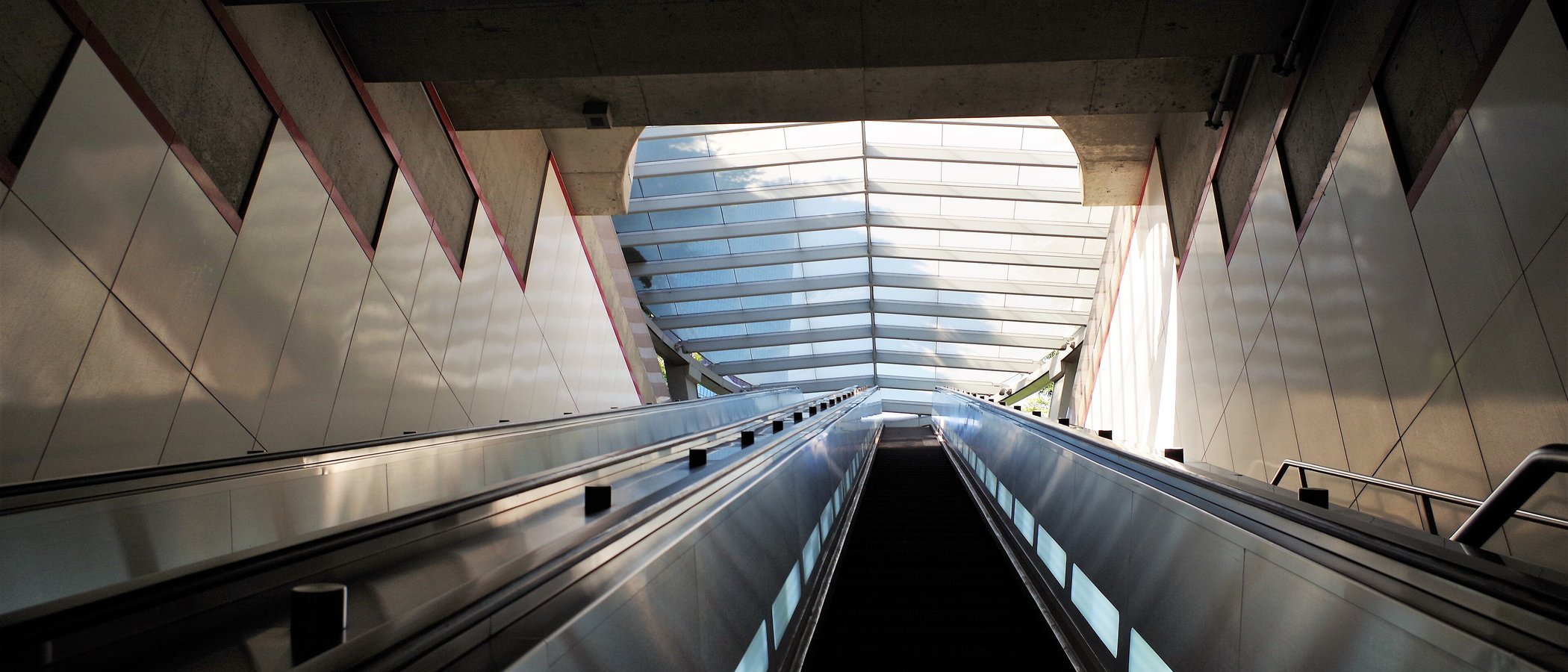 Figure: Looking up an empty escalator toward the glass canopy at Pershing Square station in Downtown Los Angeles. Source: Joey Zanotti (CC BY 2.0, via Wikimedia Commons)
Across a 65-Foot Vertical Rise, Hong Kong Commuters Save 34 Seconds
When velocity differentials are projected across deep subterranean stations, vertical rise magnifies the delay exponentially. Take LA Metro’s Civic Center/Grand Park station as an example: the vertical distance from platform level to street exit is approximately 65 feet. At Los Angeles’s 0.46 m/s design speed, a passenger standing still requires 87 seconds to reach the surface.
If that exact same installation ran at the Hong Kong MTR standard of 0.75 m/s, completing the climb would take just 53 seconds—a 34-second reduction on a single trip. While a 34-second difference might sound trivial for an individual journey, aggregating it across a regional transit network yields staggering economic deadweight.
 Figure: Crowded escalators at Central station on the Hong Kong MTR. Source: Wikimedia Commons (CC0)
A macro model clarifies this temporal balance sheet. LA Metro encompasses 115 stations with 171 escalators. Isolating its 27 deep underground stations as a core sample and applying FY 2026 ridership metrics, passengers spend an aggregate of roughly 300,000 minutes standing on subway escalators every single weekday. Over a full year, Angelenos burn approximately 1.7 million hours simply riding escalators within stations.
If the network were accelerated to Hong Kong’s 0.75 m/s benchmark, the system would reclaim roughly 119,000 commuter minutes each day, returning around 670,000 hours annually to the urban economy. For a dedicated daily commuter making round trips between two underground stations, existing specifications force them to spend an extra 9.5 hours a year standing on a slowly climbing tread. The speed shaved away in procurement contracts and risk-aversion protocols ultimately manifests as an invisible, compulsory “time tax” levied on urban riders.
The 1984 Blueprints Contained a 120-Foot-Per-Minute Option
Los Angeles did not always plan to move this slowly. Archival records reveal that the Southern California Rapid Transit District’s (SCRTD) original 1984 System Design Criteria explicitly established two operational speed tiers: 90 feet per minute and 120 feet per minute. At the higher 120 ft/min rate (~0.61 m/s), scaling the aforementioned 65-foot vertical rise would take roughly 66 seconds—closely aligned with modern international standards.
That engineering ambition was quietly crossed out over the decades. Agency records leave it unclear during which revision cycle the 120 ft/min tier disappeared, nor is there definitive proof that early subway equipment ever operated at that upper limit in regular revenue service. A broader tightening of American safety codes framed this retreat: in 2000, national ASME standards dropped the escalator speed ceiling from 125 ft/min down to 100 ft/min, and California’s Title 8 §3141.11 anchored itself to that same 100 ft/min (~0.508 m/s) threshold.
LA Metro then stepped back even further, locking its internal specifications at 90 ft/min. Yet recent observations tell a different story. In late September 2026, transit community observers brought tachometers into stations and clocked newer Schindler escalators running at 98.4 ft/min in practice. The mechanical equipment being procured today is readily capable of reaching the state’s 100 ft/min ceiling; it is institutional policy that suppresses the system’s operational throughput.
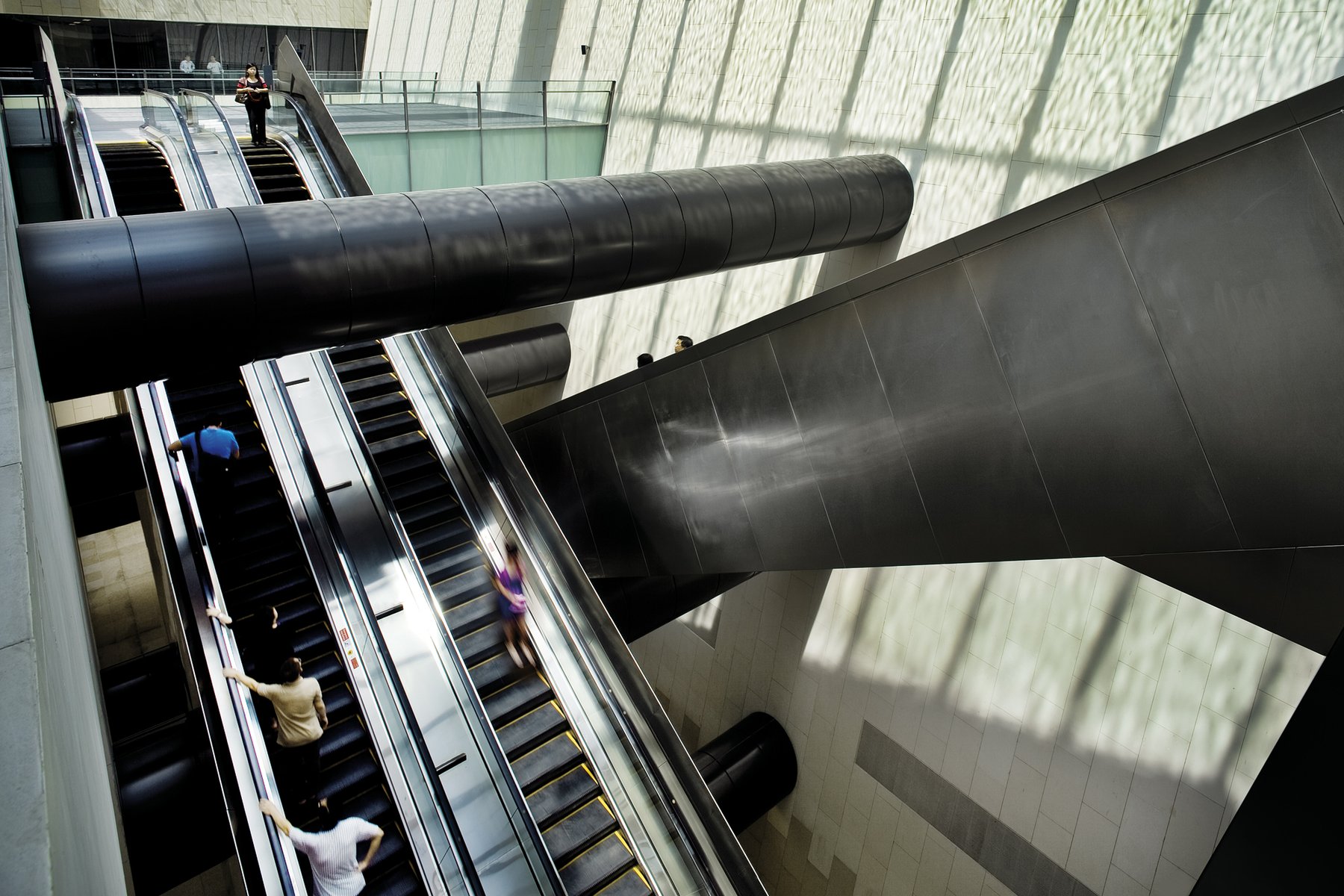 Figure: Deep underground escalators at Bras Basah MRT station in Singapore. Source: Wikimedia Commons (CC BY-SA 3.0)
Doubled Mechanical Vibration: Why Transit Agencies Step on the Brakes
Engineering parameters are rarely dialed back without justification. When transit administrators hit the brakes, they are weighing a competing balance sheet: the efficiency gains of higher speeds are accompanied by exponential increases in mechanical vibration, component wear, and fall risks.
Engineers at Singapore’s MRT previously carried out precise vibration testing on operating escalators, and the physics was unambiguous: running at 0.75 m/s nearly doubles step vibration amplitude compared to operating at 0.5 m/s. To strike a balance between passenger throughput and safety, Singapore MRT adopted dynamic scheduling. Escalators run on the fast tier during morning and evening rush hours to rapidly clear platform congestion, then drop back to the slower tier during off-peak hours to reduce mechanical stress and guarantee ride stability.
The divergence between North American and European regulatory frameworks highlights contrasting risk tolerances. European standard EN 115 permits speeds up to 0.75 m/s for escalators with an incline under 30 degrees, whereas American codes impose an indiscriminate 100 ft/min cap regardless of incline angle. LA Metro’s 90 ft/min specification adds an extra cushion on top of federal and state rules—designed to mitigate maintenance cycles, spare aging parts, and insulate the agency against slip-and-fall tort liability.
The sluggish pace of LA Metro escalators is not an insurmountable technical hurdle. Newly installed machinery can easily run faster, and the airport next door operates under a higher speed cap. Rather, transit officials settled on a deeply conservative engineering equation: trading hundreds of thousands of hours of societal commute time each year for predictable maintenance sheets and minimized liability exposure. That low-risk compromise was codified into administrative manuals—and permanently ground into every slow-moving gear in the system.
Reference Links:
- Original article: “Ninety Feet a Minute”
- Hacker News discussion (item?id=49833444)