Four Decades of Weathering Cannot Break Down 8-Micron Radioactive Fallout
Forty years of weathering, precipitation, and freeze-thaw cycles should have broken down the microscopic debris spewed by the world’s worst nuclear disaster. Yet reality proves otherwise. German scientists recently analyzed six “hot particles” recovered from the soil of the Chernobyl Exclusion Zone using a particle accelerator. Their findings confirm that the internal crystal structure of the fuel remains remarkably intact.
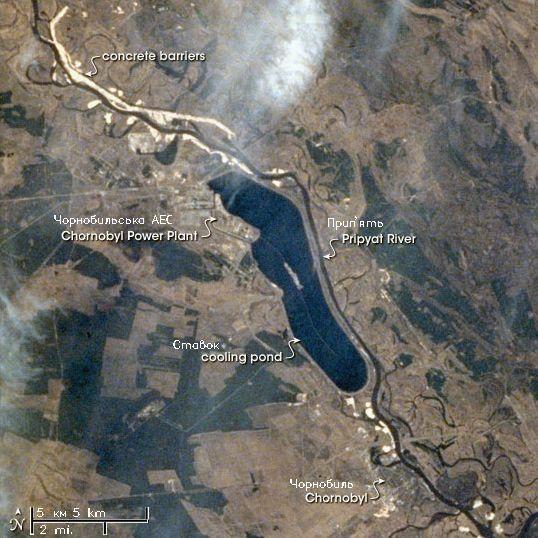
When Reactor 4 exploded in 1986, tons of nuclear fuel fragments were hurled kilometers into the upper atmosphere. Today, lush vegetation conceals the exclusion zone’s surface. Beneath the soil, however, radioactive dust measuring between 8 and 50 micrometers remains pervasive. Four decades on, these particles retain extreme levels of radioactivity. Field researchers entering the inner core must wear full protective gear to avoid inhaling this toxic dust.
A joint research team from Leibniz University Hannover and the Helmholtz-Zentrum Dresden-Rossendorf (HZDR) transported these soil samples from Ukraine. Conventional environmental transport models had long assumed that acidic rainfall would steadily leach and dissolve such minute fragments. Yet the corrosion resistance of these soil-bound particles far exceeded expectations. Nature has failed to dilute them on schedule; they remain entrenched in solid, mineral-like form.
Seasonal wildfires regularly sweep across the abandoned exclusion zone during arid months. Dense smoke can loft this fine radioactive dust back into the air, granting surface contaminants a secondary pathway for atmospheric redistribution.
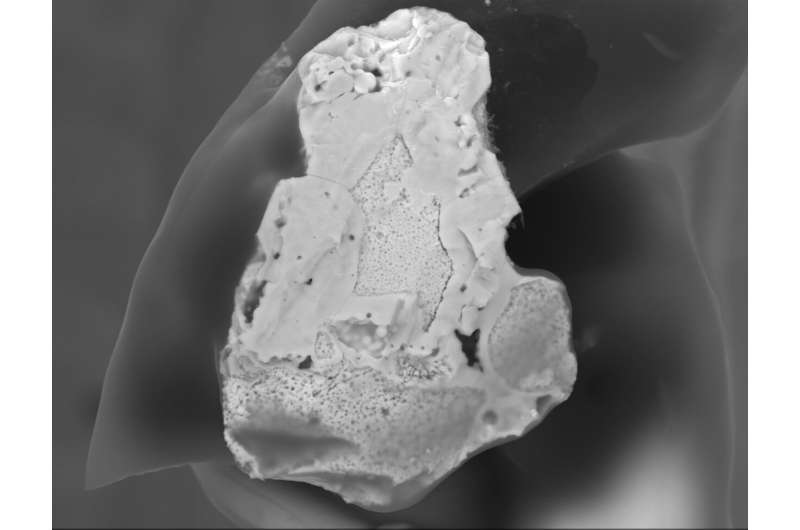
A 100-Micrometer X-Ray Beam Across 2,000 Diffraction Angles
To determine the atomic arrangement inside this radioactive dust, the team transported the encapsulated samples to France. Crystallographer Christoph Hennig led measurements at the Rossendorf Beamline (ROBL) at the European Synchrotron Radiation Facility (ESRF). Each microscopic particle was mounted on the tip of an ultra-fine tungsten electrode and sealed within multi-layered biosafety containment.
Conventional laboratory X-rays cannot penetrate the heavy shielding, requiring the power of a high-energy synchrotron light source. The synchrotron beam was focused down to a diameter of 100 micrometers—roughly the width of a human hair. As the tungsten electrode rotated slowly, detectors recorded X-ray diffraction patterns across 2,000 discrete angles, capturing every subtle lattice reflection.
Powerful computational reconstruction converted the massive diffraction dataset into three-dimensional topological models. Physicist Tobias Weissenborn systematically classified the structural data. The 3D imaging confirmed that the internal crystal lattices have not collapsed. Despite decades of self-irradiation bombarding adjacent atoms, the unit cells preserve their crystalline order.
This breakthrough fills a major gap in Chernobyl microstructure research. Previously, scientists had to deduce compositions from surface spectroscopy, while traditional mechanical sectioning destroyed the delicate crystalline integrity. High-precision synchrotron scanning has, for the first time, non-destructively unveiled the true interior of dispersed nuclear fuel.
Core Meltdown and Graphite Fires Produced Three Distinct Morphologies
By comparing diffraction profiles, the researchers classified the debris into three distinct morphological groups. The first group remains chemically and physically near-identical to pristine nuclear fuel. These particles were ejected during the initial mechanical shock of the explosion, escaping subsequent high-temperature melting and oxidative environments.
The second group preserves a snapshot of the core meltdown. Under normal operating conditions, corrosion-resistant zirconium alloy cladding hermetically seals the uranium dioxide (UO₂) pellets. When reactor temperatures surged to thousands of degrees Celsius, molten fuel fused with the softening zirconium. Upon rapid cooling, this interaction formed an exceptionally hard, corrosion-resistant U-Zr-O solid solution.
The third morphology emerged from the catastrophic 10-day graphite fire. The RBMK reactor design relied on thousands of tons of graphite moderator blocks to slow fast neutrons and sustain the fission chain reaction. Following the explosion, red-hot graphite exposed to atmospheric air ignited into an inferno.
The prolonged fire supplied intense heat and abundant oxygen, progressively oxidizing the exposed uranium dioxide into porous triuranium octoxide (U₃O₈). This oxidative transformation caused significant lattice expansion, leaving the mechanical structure brittle and porous. Such particles easily crumble into fine airborne dust. If inhaled into the lungs, they pose severe, persistent internal radiological hazards.
Radiation Release Defies Standard Environmental Leaching Models
While various uranium oxide phases were detected, the overall resilience of the crystal cores surprised researchers. Early theoretical models posited that internal alpha decay would cause sufficient lattice damage to trigger self-destruction. In reality, these particles demonstrated remarkable phase stability, locking fission products tightly within their crystalline matrix and preventing outward leaching.
In the near term, this offers a silver lining for hydrological systems surrounding Chernobyl. High-risk radionuclides have not dissolved and migrated en masse into groundwater; contamination remains sequestered within microscopic particles. For safety engineers and environmental modelers, however, this stability creates a profound challenge.
Deep geological repository designs rely on waste matrices maintaining long-term physical stability, whereas environmental dispersal models depend on predictable release rates into the biosphere. The findings show that natural degradation of these particles proceeds far slower than computational models predicted. By avoiding early hydrological flushing, the particles have substantially delayed their peak radionuclide release timeline.
In groundwater transport modeling, insoluble particles do not equate to a resolved crisis. Rather than being diluted and washed out via the Pripyat River basin, these solid radionuclides act as microscopic time bombs, lying dormant in the soil until reaching a future physical breaking point.
Six Micro-Particles Cannot Guarantee Regional Long-Term Safety
Despite the apparent stability, the study authors emphasize significant technical caveats. This resource-intensive investigation examined only six hot particles collected from two specific sites. Given that tons of fuel debris were scattered across tens of kilometers in 1986, six particles cannot define the safety envelope for the entire exclusion zone.
Every fragment experienced unique micro-environments during the disaster. Some were quenched rapidly on wet marshes or asphalt, while others endured prolonged thermal annealing. Divergent heating profiles and cooling media endowed each speck of dust with distinct lattice defect densities and corrosion resistance. Formulating universal environmental laws will require much broader sampling campaigns.
Even if an average dissolution curve is eventually derived, toxicological risks cannot be dismissed. In environmental toxicology, individual health impacts are driven by statistical outliers. If weathering rates vary widely, exceptionally durable particles will linger deep in the soil, potentially fracturing centuries later to release concentrated bursts of lethal radionuclides.
The unexpected durability of Chernobyl’s hot particles explains why radiation levels in the exclusion zone remain tenaciously high. The catastrophe four decades ago did not extinguish radioactivity—it merely destroyed its engineered containment. Scattered through the soil, these micrometer-scale fragments continue to follow their own physical rhythm, dictating when their hazardous burden will be surrendered to the surrounding environment.
References:
- phys.org / Helmholtz Association
- Journal of Hazardous Materials
- HN Discussion (item?id=49986919)