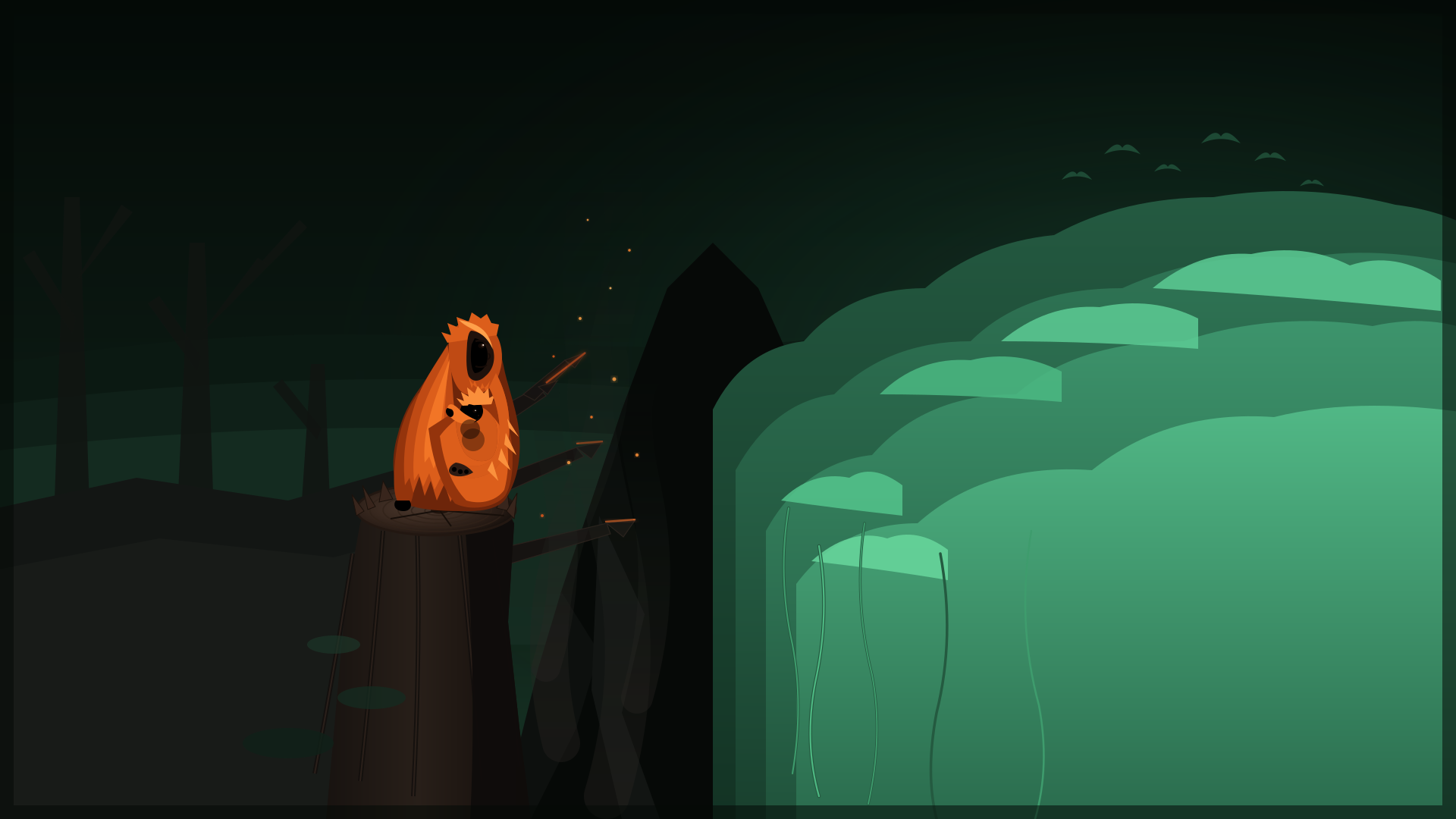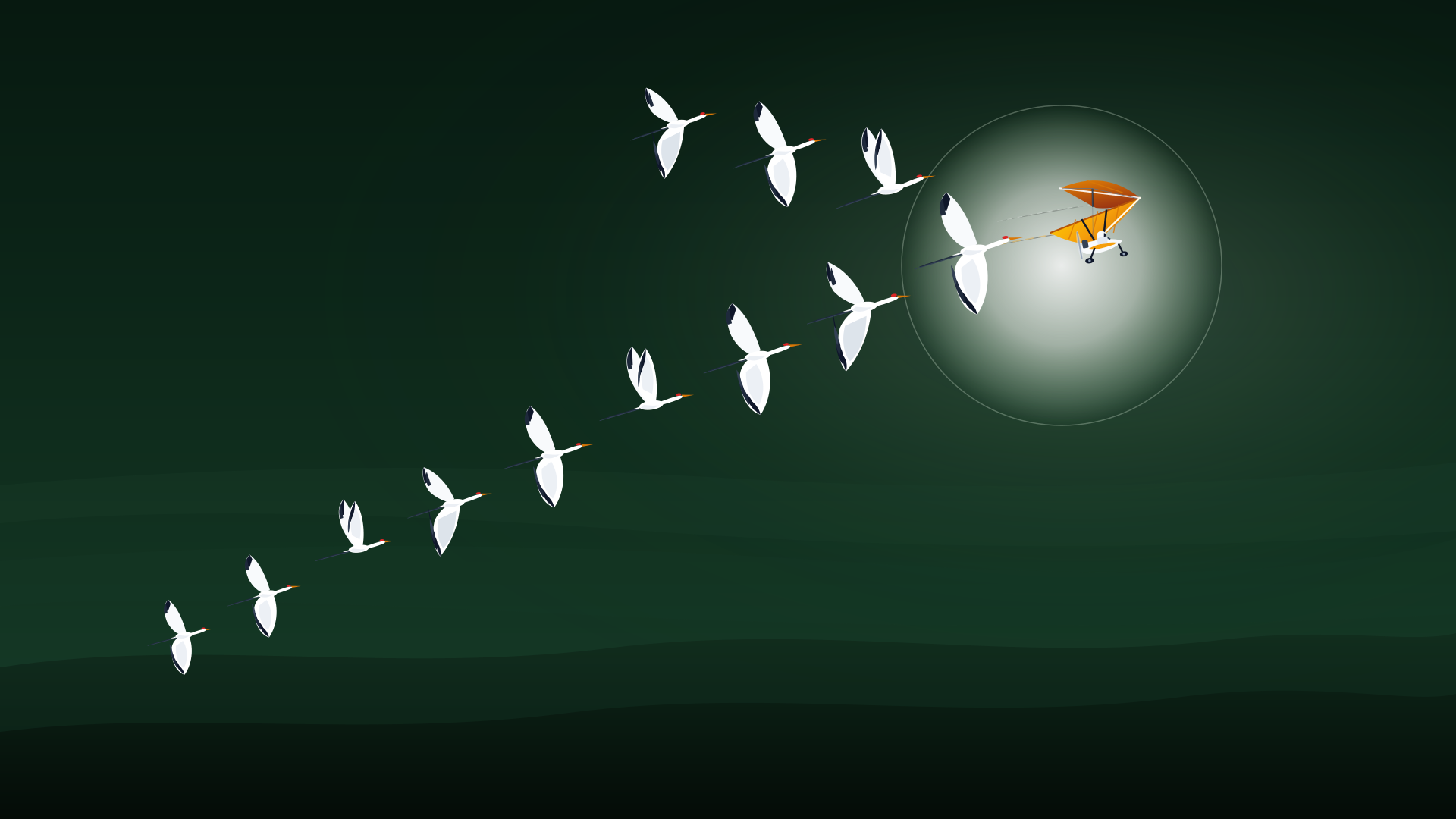
A migration route absent from eastern North America for nearly a century was brought back by human ingenuity. Pilots wearing white hooded crane suits took to the sky in open-cockpit ultralight aircraft, guiding flocks of young birds south one leg at a time.
Between 2001 and 2015, Operation Migration clocked an astonishing 17,457 flight miles. Pilots led 186 captive-hatched juvenile whooping cranes from their breeding grounds in Wisconsin down to the salt marshes of Florida.
Conservation officials once hailed the effort as wildlife biology’s moonshot. Through sheer human dedication, the daunting navigation challenge of a 1,200-mile journey was overcome. The young cranes memorized the landmarks and thermals, and by the following spring, they flew back north on their own without human escorts.
Yet in January 2016, federal wildlife officials abruptly pulled the plug on ultralight-led migrations. A conservation program that appeared triumphant on the surface was ultimately undone by the very biological data it generated.
Down to Just 21 Birds: Buying an Ecological Insurance Policy
The whooping crane (Grus americana) is North America’s tallest native bird, standing nearly five feet (1.5 meters) tall as an adult. In 1941, the entire wild population crashed to roughly 21 individuals.
Within that razor-thin margin of survival, only 15 or 16 belonged to the wild, migratory flock. Every living whooping crane on Earth today descends from those few hardy survivors.
That surviving flock undertook an annual 2,500-mile journey between Wood Buffalo National Park in northern Canada and the Aransas National Wildlife Refuge along the Texas Gulf Coast. The entire survival of the species rested upon a single wintering habitat.
Concentrating all eggs in one geographic basket carried catastrophic risks. A single severe hurricane, an avian disease outbreak, or a massive coastal oil spill could wipe out the remaining wild birds overnight.
Establishing a second self-sustaining migratory flock in the East was designed as an insurance policy. If disaster ever struck the Texas flock, the eastern population would safeguard the species’ gene pool.
Federal authorities launched captive-breeding programs as early as 1967. While captive rearing solved incubation and hatching, it introduced a biological impasse: whooping cranes do not migrate by pure instinct alone. Without experienced wild adults to guide them, hand-reared chicks facing their first winter had no idea which way to fly.
White Hoods and Absolute Silence: Airplanes as Surrogate Parents
Unlike songbirds or waterfowl, cranes rely entirely on learned social transmission for migration. Chicks must follow their parents during their first autumn to map out landmarks, wind patterns, and resting grounds. Because eastern North America had no surviving wild adult cranes, humans stepped in to play the parents.
In 1985, the International Crane Foundation established a strict costume protocol. Handlers wore full-length white hooded gowns and mirrored mesh face shields, holding hand-carved crane head puppets to offer food and demonstrate foraging behavior.
Strict silence was enforced around the chicks at all times. Birds were identified strictly by band numbers rather than pet names to prevent handlers from developing emotional attachments. The core objective of this ascetic regime was absolute: prevent the chicks from imprinting on humans.
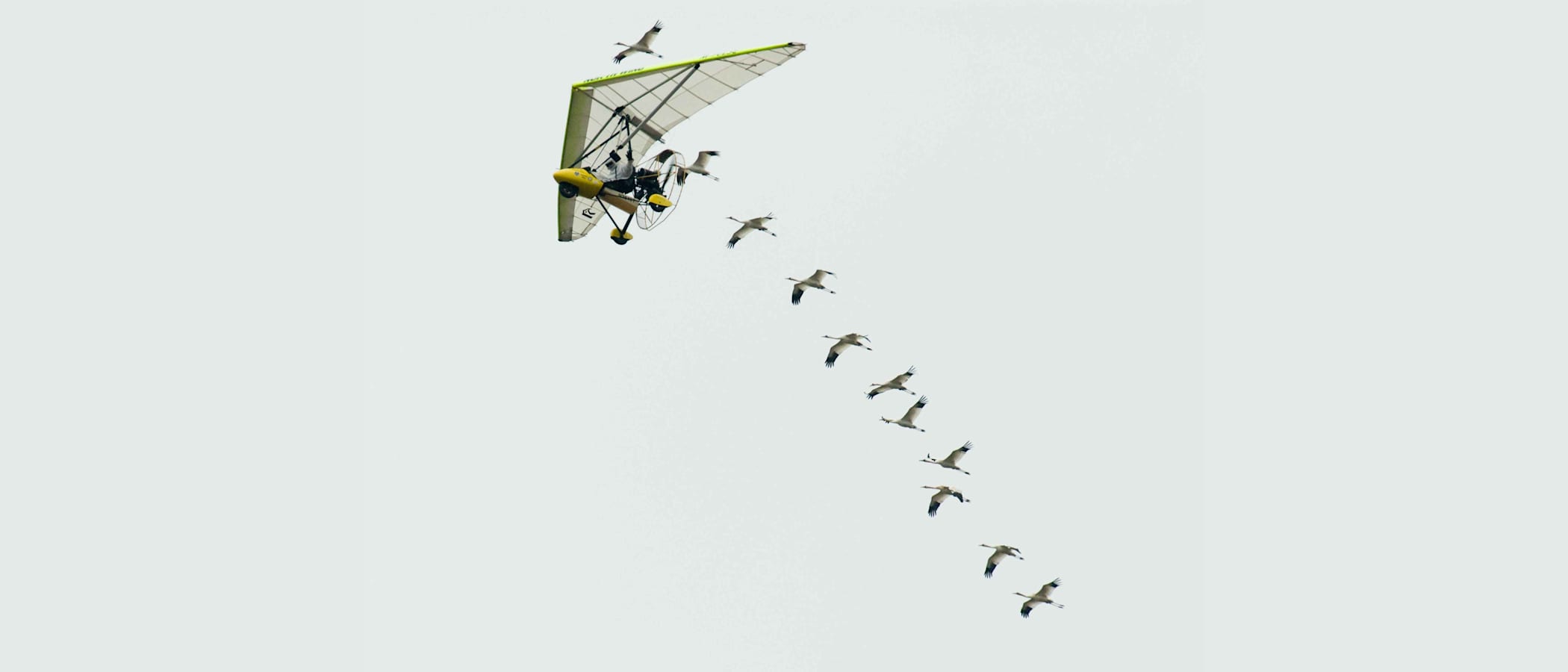 Photo: A pilot wearing a white hooded costume flies an ultralight aircraft, guiding captive-hatched juvenile whooping cranes in formation. Note that the pilot is completely concealed and sworn to absolute silence to prevent chicks from imprinting on humans. Credit: Keith Ramos / U.S. Fish and Wildlife Service
The engineering team initiated acoustic conditioning before the chicks even pipped. Inside incubators, unhatched eggs were played continuous audio recordings of ultralight aircraft engines. By the time they broke through their shells, the roar of a two-stroke engine was already comfortingly familiar.
At eight weeks old, the chicks began running behind taxiing ultralights across grassy runways. By 80 to 90 days of age, fledged juveniles took to the sky alongside the wings.
This artificial intervention reshaped the birds’ concept of parentage. To the young cranes, the noisy, wing-spreading machine was mother and father rolled into one.
Cruising at 38 mph Across 1,200 Miles: Memorizing the Sky
Guiding a flock of young cranes from central Wisconsin to Florida required careful synchronization between aeronautical engineering and avian biomechanics. Conventional light aircraft flew far too fast, easily outrunning the birds.
The team deployed specialized ultralight trikes cruising at roughly 38 mph (about 60 km/h)—matching the comfortable long-distance soaring speed of juvenile cranes.
Loudspeakers mounted on the landing gear broadcast adult whooping crane contact calls, keeping the young birds focused and flying in formation through turbulence.
The cranes proved quick learners in the air. They figured out how to surf the ultralight’s wingtip vortices, drafting on the induced updrafts to conserve precious flight energy.
The 1,200-mile interstate journey often stretched across several months due to adverse autumn weather. Farmers along the flyway offered pastures for overnight stopovers, where ground crews quickly erected portable predator-proof pens to shield the birds from outside human contact.
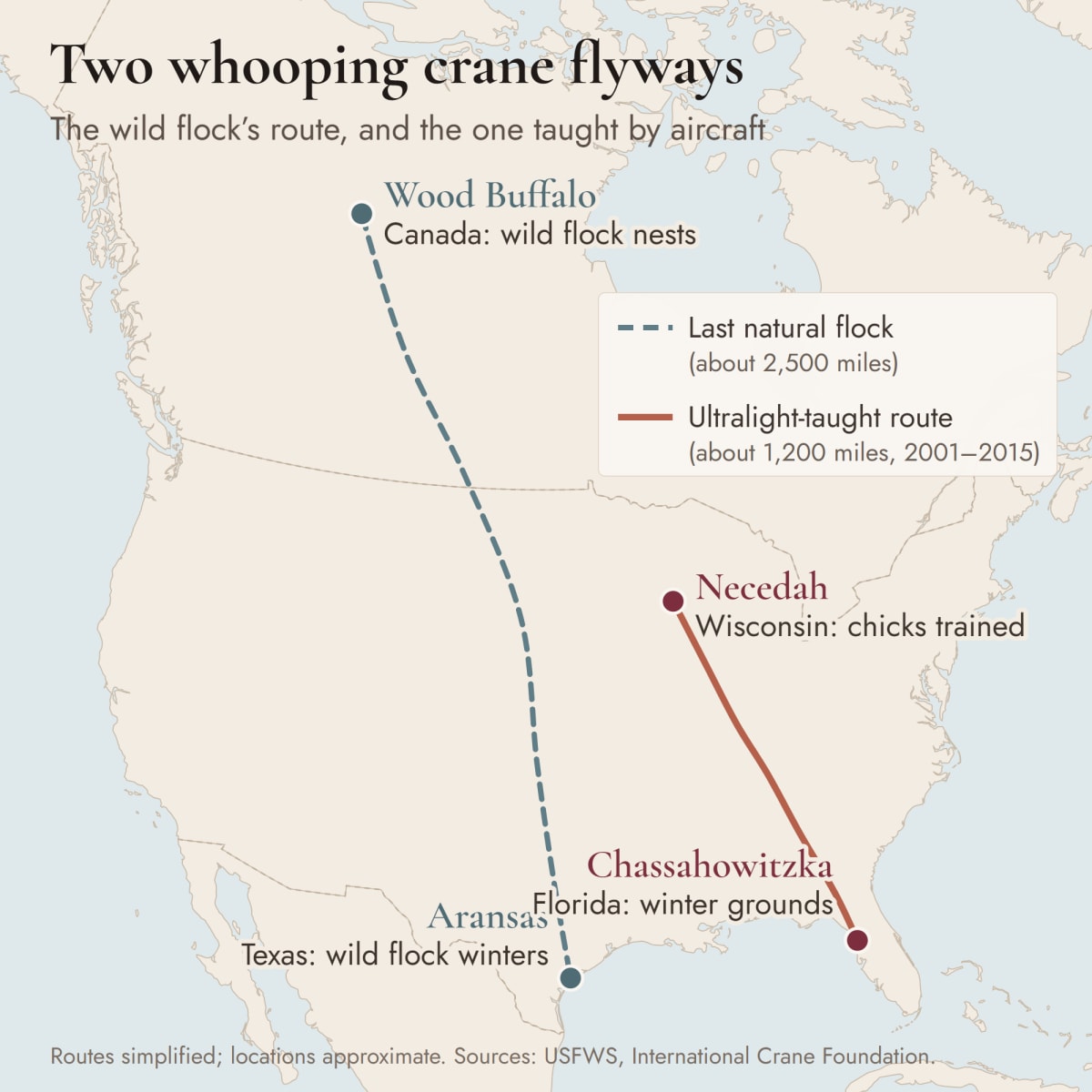 Photo: Comparison of North America’s two whooping crane migration corridors. Left: The natural Canada-to-Texas corridor (~2,500 miles). Right: The human-engineered Wisconsin-to-Florida corridor established via ultralights (~1,200 miles). Credit: The Verified Post
The aerial curriculum passed its definitive test in April 2002. The first cohort of ultralight-led cranes took off from Florida on their own, navigating back to Wisconsin purely by memory without any aircraft assistance.
In 2006, cranes reared by aircraft successfully hatched wild chicks in Wisconsin. For the first time in over a century, a wild whooping crane had pipped in the wetlands of the American Midwest.
The Flawed Triumph: Only 10 Wild Chicks Reached Fledging in 15 Years
Had the story ended with successful migratory navigation, it would stand as an unvarnished miracle of wildlife management. But the true benchmark of endangered species recovery is natural reproduction. Flying thousands of miles means little if a population cannot sustain itself demographically.
Between 2001 and 2015, roughly 250 captive-reared whooping cranes were released into the eastern flyway. Yet by the time federal biologists conducted a comprehensive review in 2016, only 93 birds remained alive in the wild.
The most damning failure was in wild reproduction. Over that entire 15-year period, the entire eastern flock managed to successfully fledge only 10 wild chicks.
Even more troubling, virtually all of the chicks fledged since 2005 were the offspring of just five dedicated breeding pairs. The overwhelming majority of adult pairs built nests and laid eggs year after year, but almost none of their offspring survived to fledge.
The natural landscape presented artificial cranes with an evolutionary trial they were never equipped to handle. Wisconsin wetlands harbor severe seasonal infestations of hematophagous black flies (Simulium spp.). Clouds of biting black flies would swarm the heads, eyes, and bare patches of nesting cranes.
Naturally raised wild cranes tolerate the torment and defend their nests with stoic parental tenacity. But cranes reared by costumed handlers and airplanes lacked that behavioral resilience. Under black fly swarms, adult pairs routinely deserted their clutches, leaving eggs to cool or fall prey to predators.
Wildlife biologists arrived at a painful diagnosis: excessive artificial intervention had crippled the birds’ parental drive. The white costumes had successfully prevented human imprinting, but airplanes could never teach young cranes how to be good parents in the wild.
Engineering Can Redraw Migration Corridors, but Cannot Fabricate Wild Instincts
In January 2016, the U.S. Fish and Wildlife Service officially terminated its partnership with ultralight aircraft-led migrations. A 2018 comprehensive assessment concluded that the method was simply too artificial, noting that costume-reared cranes lacked essential behavioral fitness for wild parenting.
Operation Migration leadership contested the decision, maintaining that ultralights provided unparalleled juvenile survival during the vulnerable first migration. After federal funding ceased, the nonprofit attempted to operate independently for three more years.
In 2018, Operation Migration formally dissolved. Its founders conceded that ultralight aircraft alone could not deliver a self-sustaining wild population in the East.
The eastern flock, however, was not abandoned. By August 2026, the International Crane Foundation recorded approximately 63 birds in the eastern population, of which only 17 were wild-hatched.
During the 2026 breeding season, 14 pairs constructed 20 nests and hatched 11 chicks, but only 4 survived into late summer. Biologists still rely on targeted black-fly management and parent-rearing techniques to keep the fledgling numbers from zeroing out.
In contrast, the original wild flock migrating between Canada and Texas demonstrated remarkable wild resilience. That self-sustaining population grew to approximately 540 birds in the winter of 2025–2026, remaining comfortably above the 500-bird recovery threshold for nine consecutive years.
Worldwide, whooping crane numbers have rebounded from the brink of 21 in 1941 to roughly 830 birds today. Engineering can conjure the aerial spectacle of a thousand-mile migration, but it cannot short-circuit the parenting instincts forged over millions of years of evolution.
References:
- The Verified Post
- U.S. Fish and Wildlife Service
- Smithsonian National Air and Space Museum
- International Crane Foundation
- Associated Press
- HN Discussion (item?id=50016696)