
Many commuters casually scroll past animal rescue videos during their morning train ride. On October 9, 2026, footage emerging from deep within the Indonesian jungle captured widespread attention: two young orangutans clung tightly to their mother’s belly before swinging up into the verdant canopy the moment their transport cages swung open. It marked Indonesia’s first cross-regional release of wildfire-rescued orangutans this year.
The eight animals granted a second chance belong to the Bornean orangutan species (Pongo pygmaeus). These critically endangered, strictly arboreal great apes spend virtually their entire lives high in the forest canopy, sharing approximately 97% of their genetic makeup with humans. Their destination—the Batu Nyambu protected forest—remains untouched by the fires consuming much of the province.
While viewers celebrate an uplifting wildlife rescue, the reality on the ground is stark. Raging fires have ripped apart ancient rainforests, severing high-canopy corridors cultivated across generations. With their native territory shattered into uninhabitable remnants, relocation became the only viable path to survival.
Trapped on a 400-Square-Meter Island: Wildfires Sever the Canopy Highway
Orangutans are the largest tree-dwelling animals on Earth. Adults boast an arm span that easily exceeds their standing height, spending virtually all their days dozens of meters above the jungle floor. Instead of traveling over ground, they swing across interlocking boughs. The contiguous, unbroken canopy functions as an elevated highway system.
Since August, prolonged drought has fed forest fires creeping across West Kalimantan. As flames devoured natural timber, once-seamless canopy routes hit dead ends. Mama Nopi and her family of four found themselves stranded in a rubber plantation in North Kayong. The forest corridor behind them—the canopy pathway arboreal wildlife relies on—had burned to ash, eliminating any retreat.
Another mother and infant faced an even more precarious ordeal. On September 18, rescue teams located Mama Lifa and her baby in a patch of acacia trees measuring roughly 400 square meters—barely the size of a standard basketball court. Hemmed in on all sides by sprawling oil palm plantations, that isolated cluster was the only remaining perch for miles.
Curled at the treetop, the mother held her infant tight, unable to flee without an interconnected canopy. Mama Man and her young family endured a similarly fraught escape; conservationists monitored their movements along the forest fringe starting in June, finally administering emergency sedation on September 3 as flames closed in. Between August and early October, rescue units pulled 46 imperiled orangutans from the burning perimeter.
A Grueling Nine-Hour Journey: Rescuers Carry Cages on Shoulders
Rescuing the primates was only the initial hurdle; transferring them proved an endurance test. The eight individuals selected for release included three mother-infant pairs and two young males. Following thorough veterinary checks, all were cleared as healthy and fully equipped for survival in the wild.
Conservation authorities selected the Batu Nyambu protected forest in Ketapang, West Kalimantan, as the release site. Spanning 23,000 hectares—equivalent to 32,000 standard soccer pitches—the reserve boasts abundant freshwater streams, native fruit-bearing trees, and zero recorded fire activity this season.
Transporting massive great apes deep into primary forest permits no shortcuts. The convoy began with a jarring six-hour drive over rutted mud and gravel tracks. Rescuers then hoisted the heavy iron crates onto narrow wooden boats for an hour-long voyage upstream through rapids. Entering roadless swamp forests, teams carried the heavy crates on their shoulders, trekking through deep mud on foot for nearly two hours.
After a rigorous nine-hour human relay, the crates reached the designated release zone. When the thick mesh doors opened, a young orangutan lunged toward the nearest canopy giant, scaling 20 meters overhead in seconds. An older female surveyed her surroundings from the cage threshold to confirm safety before carrying her baby steadily up into the green canopy.
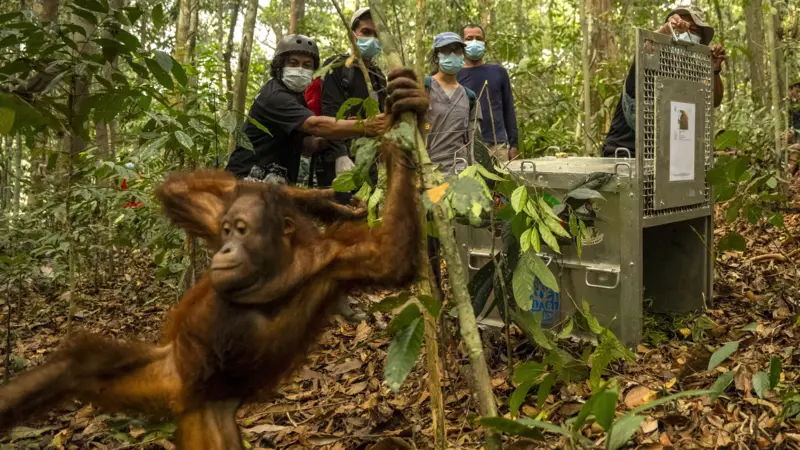 Photo: A juvenile orangutan swings up a tree trunk after being released from a transport cage, watched by rescuers. Credit: Muffidz Ma’sum/YIARI/MoEF (via BBC)
Broken Corridors: Scorched Forests Can No Longer Sustain Survivors
Many observers ask why these apes were not simply returned to their original home ranges. The pragmatic answer is sobering: their former habitats have been incinerated into fragmented patches incapable of supporting large arboreal mammals.
Orangutans serve as keystone frugivores in tropical rainforest ecosystems. A single adult consumes substantial quantities of wild fruits, inner bark, and fresh foliage daily. To forage sufficient calories, an individual requires contiguous forest tracts covering dozens or even hundreds of square kilometers. When crown fires burn through high canopies, unified ecosystems fracture into isolated pockets.
Survivors left behind face acute starvation. Shrinking home ranges also trigger violent territorial clashes among displaced apes. When fragmented forests can no longer sustain surviving populations, cross-regional translocations become the only defense against starvation and casualty.
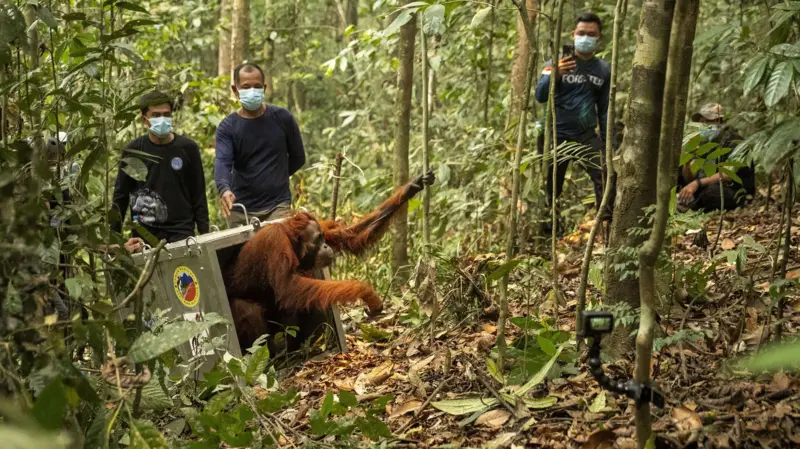 Photo: An older orangutan climbs out of a transport crate onto a tree trunk as masked rescuers observe from a distance. Credit: Muffidz Ma’sum/YIARI/MoEF (via BBC)
With canopy links gone, orangutans are forced to risk moving on foot across agricultural land. These frequent encounters with human settlements inevitably lead to conflict and injury. Relocating survivors to secure forest blocks represents the most practical emergency strategy to preserve viable breeding populations.
Record-Setting El Niño Rages: Emergency Relocations Become the New Routine
The persistent fires stem from a devastating combination of climatic extremes and human activity. The tropical Pacific has witnessed exceptional warming, with an El Niño climate cycle breaking 40-year records and projected to prolong dry spells well into next year.
Human land clearing drastically amplifies the devastation. Slash-and-burn agricultural practices remain prevalent across the region. Extensive peatland forests have been drained and cleared for commercial plantations; when parched, the porous, organic-rich soil turns small sparks into uncontrollable subterranean infernos.
The International Union for Conservation of Nature (IUCN) sounded the alarm last month, warning that ongoing fires are sweeping through territory encompassing 52% of the Bornean orangutan population. More than half of all remaining orangutan families face direct wildfire threats.
Baseline populations are already perilously fragile. According to World Wildlife Fund (WWF) records, Borneo and Sumatra supported over 230,000 orangutans a century ago; today, fewer than 104,000 survive across both islands—a figure smaller than the population of an average small town.
In the face of relentless fire fronts, long-distance translocation has become an inevitable operational response for rescue charities. Karmele Llano Sanchez, director of Yayasan IAR Indonesia (YIARI), noted that as long as native forests remain surrounded by fire, emergency relocations provide the best chance for survival. Under accelerating climate volatility, these ad-hoc evacuations are solidifying into an annual operational routine.
Relocation Buys Time, but Saving Primary Rainforest Is the Only True Solution
Translocation spared the lives of these eight orangutans, yet it cannot heal the wider ecological trauma. Argitoe Ranting, operations manager for the rescue team, stressed that releases must ensure lasting survival in the wild rather than becoming a mechanical exercise in wildlife dumping.
High-quality release havens are strictly finite. While Batu Nyambu spans 23,000 hectares of forest, its carrying capacity has ecological limits. Even healthy sanctuaries cannot absorb an indefinite influx of displaced climate refugees.
Flames can wipe out a forest canopy in days, but natural regeneration takes decades. Cross-regional translocations remain a desperate human effort to buy time for an iconic species at the edge of fire. Protecting surviving peatlands and stamping out deliberate burns remain the only lasting answers to keeping orangutans from becoming permanent refugees.
References:
- BBC News
- ANTARA News Agency
- Agence France-Presse (AFP)