€1,000 per day until the blocking obligation expires on November 14, 2026—Quad9 calculated the fine would accumulate to approximately €24,000, excluding legal costs. A Swiss non-profit operating a global recursive resolver has abandoned the entire French market for a fine of just over €20,000. The organization could afford the payment, but what Quad9 couldn’t afford is written in the numbers beyond the judgment.
On October 21, 2026, the Paris Judicial Court issued its ruling in the beIN Sports piracy blocking case, case number RG 26/11882, ordering Quad9 to block 58 domains. Quad9 blocked none of them and subsequently announced it would cease serving French users on November 24. The fine was explicitly stated in the judgment, but the real conflict lies beyond it: the court required an anonymous resolver service to implement geoblocking, a concept that doesn’t exist in its architecture.
 Figure: Quad9 official blog announcement titled ‘Au revoir, France’ bidding farewell to French users. Source: Quad9 official blog
58 Domains, None Blocked
beIN Sports obtained the blocking order in May 2026, initially targeting other entities before expanding to 58 sports piracy domains. beIN’s claim calculated €10,000 per unblocked domain per day, totaling €580,000 daily for 58 domains; the court ultimately imposed a daily fine of €1,000 for the collective 58 domains, with the obligation extending until November 14. Quad9 calculated the accumulated fine from the judgment date to the obligation expiration date at approximately €24,000, excluding legal costs.
There’s a 580-fold difference between these two figures. The court didn’t treat Quad9 as an ATM; the fine here was a behavioral lever—and the premise for its effectiveness is that the other party will bend. In its written submission to the court, Quad9 explicitly confirmed: it never blocked a single domain from start to finish. The path to settlement had already closed before the judgment was issued.
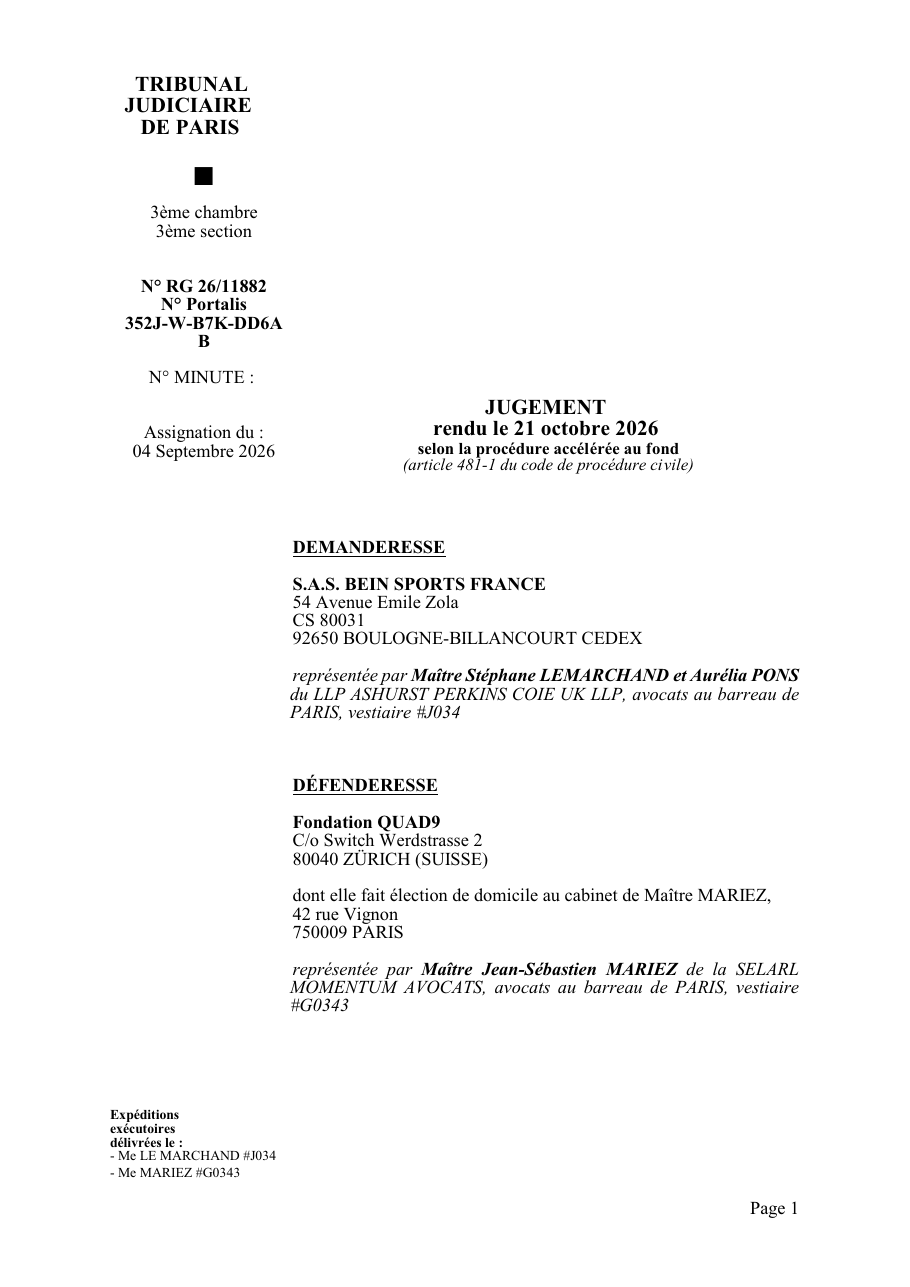 Figure: Cover page of the Paris Judicial Court judgment, case number RG 26/11882, dated October 21, 2026—both the fine standard and blocking obligation list are referenced under this case number. Source: Paris Judicial Court judgment PDF (publicly shared by TorrentFreak)
The Court Offered a Path: Block at Least Some
The court’s penalty logic was based on the “reasonable effort” standard: Quad9 lost because it took zero action, while the effectiveness of the blocking belonged to a separate category. Comparing with other cases handled by the same court, this line is clearer—in the same month, the Paris court dismissed beIN’s fine requests against Cloudflare and several VPN (Virtual Private Network) service providers, arguing these companies had blocked at least some domains; in September 2026, Canal+‘s similar fine request against Cloudflare was also rejected.
Those who made symbolic blocking attempts were exempt from penalties, while those who didn’t move a single domain were fined. From an enforcement consistency perspective, this standard makes sense for Quad9. The disagreement arose on the next step: the court assumed Quad9 had the capability to take action, while Quad9’s response was that it was architecturally incapable and shouldn’t have to.
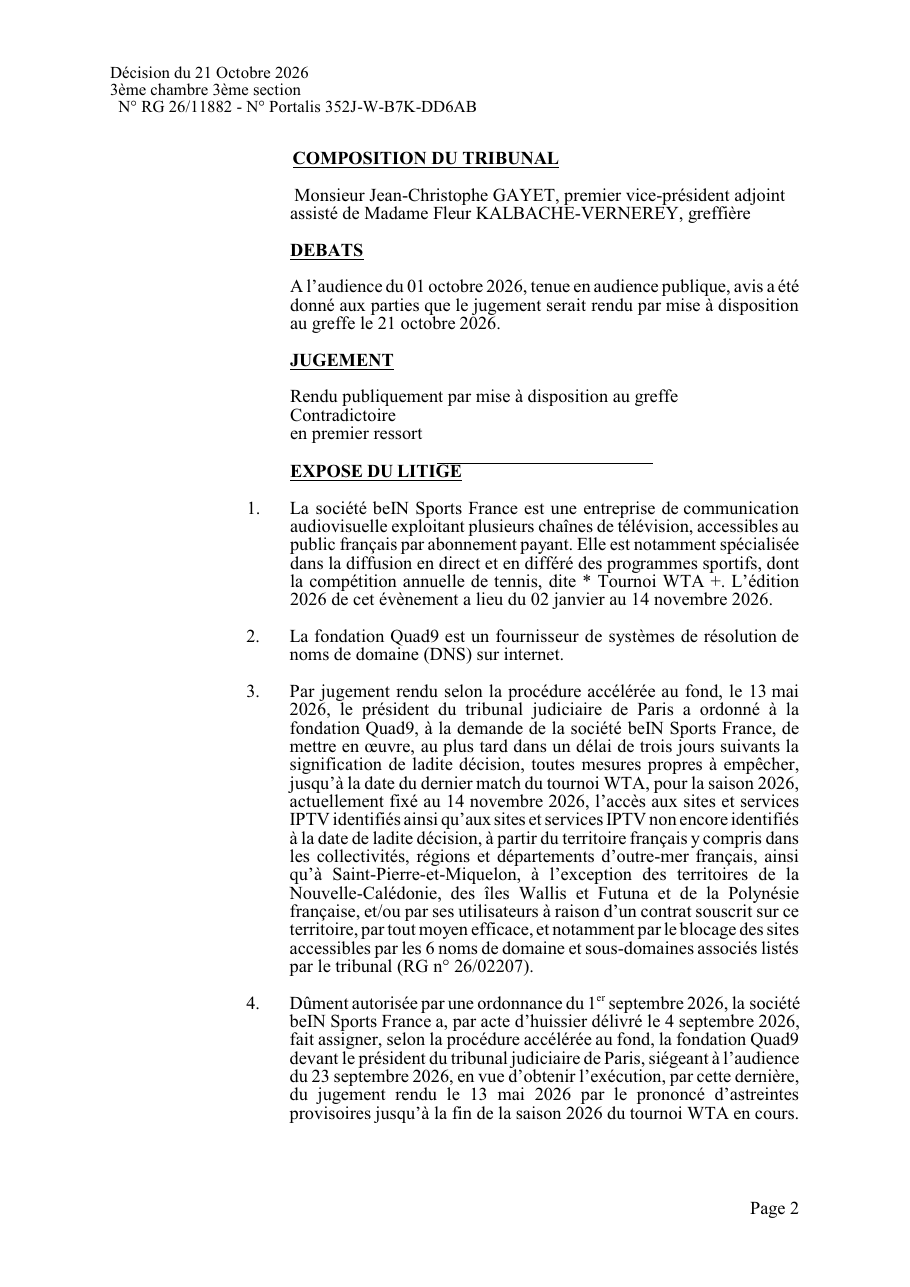 Figure: Page 2 of the judgment document, showing the court’s reasoning and argumentation—the wording of the fine standard and blocking scope are in the judgment’s main text. Source: Paris Judicial Court judgment PDF (publicly shared by TorrentFreak)
No Registration, No Logging, geoIP Isn’t Reliable
Quad9 is operated by a Swiss non-profit foundation, providing free recursive resolver service (the DNS component that completes domain queries upstream for users), with two defining characteristics: no registration and no logging of user queries. The premise of geoblocking is knowing where queries come from—services without registration have no account location to check, leaving only geoIP (geographic determination based on IP) as a path, which Quad9 itself admits is unreliable.
The engineering details are stuck here: recursive resolvers only see the source IP of the query packet, behind which are layers of NAT (Network Address Translation), VPNs, and residential proxies. Making it effective only in France would require inserting a geographic determination layer in the resolution path, with two potential failure points—French users slipping through, violating the court order; foreign users incorrectly blocked, returning false answers to innocent users. The DNS protocol was never designed with a “user location” field, and Quad9’s architecture cannot produce the data the court requires.
Geographic enforcement requires location information, while anonymous resolver services don’t produce location information. The conflict occurs at the design level, regardless of the operator’s stance.
Global Blocking Would Comply, But Quad9 Refuses
A technically compliant path exists: don’t distinguish user location and block the 58 domains globally, satisfying the court’s command. Quad9 specifically rejected this option, stating in its declaration: “We explicitly refuse to change or lie to you in ways contrary to your expectations.” Applying a French court’s command to global users would mean having a Swiss institution perform censorship enforcement for France, and Quad9 refused to become that outlet.
The blocking effectiveness itself is also questionable. Those wanting to access pirated content can simply switch to a public resolver—with thousands of options available. Quad9’s analogy references: “It’s like standing in front of a packed stadium holding up a newspaper to block a concert.” Concerns at the principle level were also included in the declaration: “Once censorship tools are built, they are rarely used with restraint or impartiality.”
From the perspective of the court and beIN, this stance is equivalent to declaring that it accepts no geographic enforcement: any country’s blocking order would collide with the same principle. What the enforcement side sees as a vulnerability is exactly what users see as a feature. The same architecture receives opposite evaluations from both sides, and in this conflict, there is no ruling that can satisfy both simultaneously.
€24,000 Fine is Affordable, 20 Cases Are Not
Beyond the fine ledger are larger numbers: approximately 20 other blocking cases are pending in France. Quad9’s exact words were: “Quad9 cannot survive the accumulation of penalties”—it can withstand one judgment, but not a cumulative mechanism. The €24,000 in a single case is symbolic; the real threat is the cumulative nature of fines across cases. The timing of the exit, set before fines accumulate, is the answer given by the arithmetic of ledgers.
The cost of exit is borne by users who did not participate in piracy. In Quad9’s published query source statistics, French users include national public data centers, national railway operators, multiple public healthcare institutions, and defense electronics sector supplier networks, listed individually by Autonomous System number. For individual users, changing a resolver is a one-minute configuration change; for public institutions, it’s a network policy change requiring a security review.
The specific method of service termination has not been determined; Quad9 states that none of the options are ideal. The appeal continues, and it will continue to oppose court-ordered DNS blocking at the legal level; meanwhile, it has confirmed it is subject to the fine application—it will not block any domains before November 14.
OpenDNS Walked This Path Two Years Ago
OpenDNS walked this path before Quad9: in 2024, Cisco’s OpenDNS suspended service in France due to a Canal+ blocking order. Quad9 is the second public resolver to exit France due to DNS blocking orders, with two years separating the exits following the same script structure—local court orders resolvers to block, resolvers determine that architecture or principle doesn’t permit it, and service exits the country.
These cases are pushing public recursive resolvers onto the candidate list for court orders, forcing the industry to answer the question anew.opyright enforcement execution points. Neutral resolvers have only two options when faced with geographic orders: comply or exit. OpenDNS and Quad9 have exited in succession, leaving every remaining resolver tore-answer the same question when the next blocking order arrives.
Quad9’s exit puts this multiple-choice question on the table: when a geoblocking order encounters an unregistered, no-logging resolver service, there are only two exits—output a country’s command to global users, or the service exits that country. The Paris court can fine money, but it cannot finesse a technical solution that would make Quad9 effective only in France.
After November 24, the blocking order for the 58 domains remains valid, with one less entry on the enforcement list. French users have one more opportunity to change their resolver, while the 20 pending cases indicate that this enforcement tool won’t stop with the beIN case. As long as fines continue to be imposed at the DNS layer, the boundary between public resolvers and national law can only be drawn with two exits.
Reference links:
- Quad9 official blog announcement (Au revoir, France)
- Paris Judicial Court judgment (RG 26/11882)
- TorrentFreak coverage