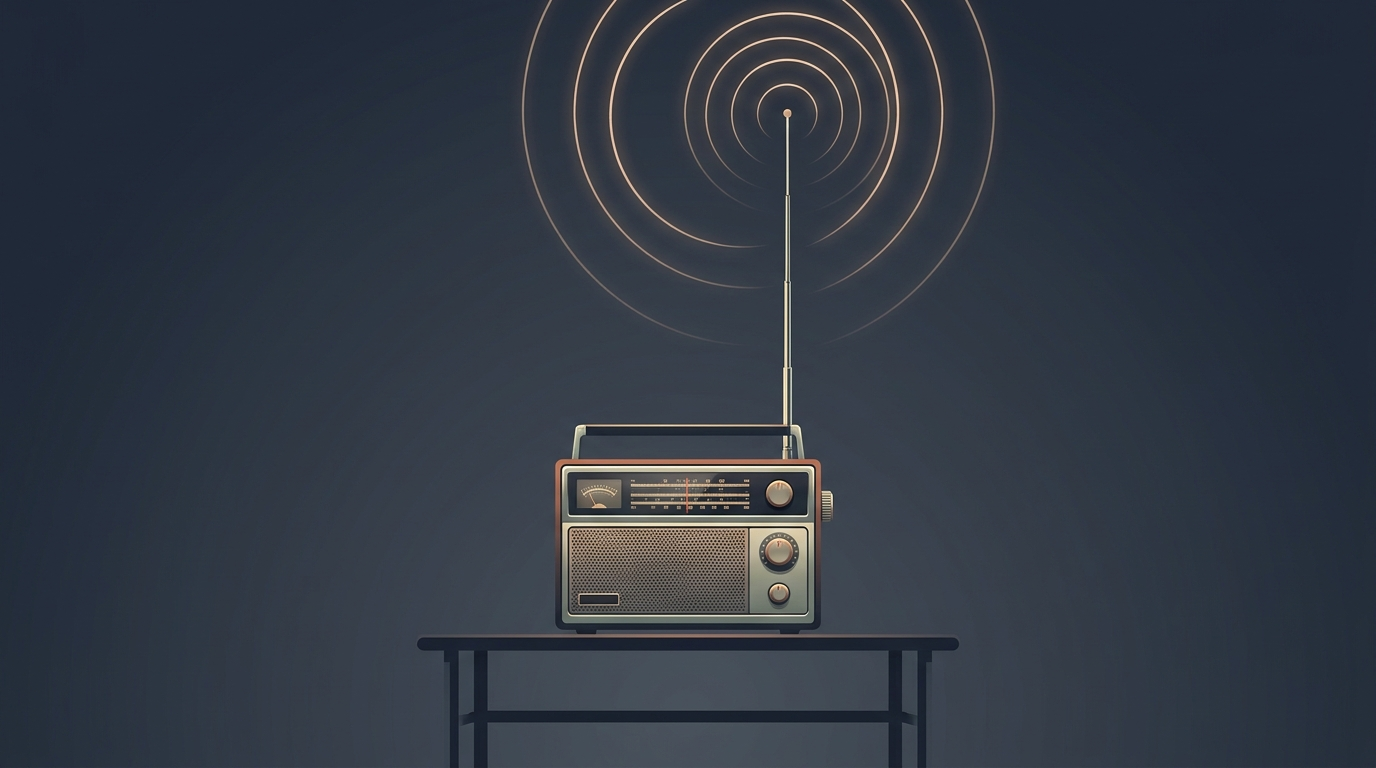
Z · 2026-10-23 · KPH (Point Reyes, CA)
56HETYAW4C5WFGB3EAGI2PI5Q63W47
The 30-character alphanumeric string above is an authentic U.S. military nuclear command radio transmission. Shortwave station KPH in Point Reyes, California, intercepted it on October 23, 2026. Anyone with a $30 shortwave receiver capable of Upper Sideband (USB) reception can tune to 11,175 kHz and hear these raw, unvarnished voice transmissions. The most secretive link in the nuclear command chain has always operated on open shortwave; security rests strictly on the codebook, never on frequency obscurity.
Former U.S. Air Force nuclear missile launch officer Daniel Frenkel turned this monitoring process into a live dashboard: missileer.watch. Since launching on September 21, 2026, the site has archived 4,812 raw audio recordings and decoded 233 Emergency Action Messages (EAMs), capturing 29 in the last seven days alone. The project transforms decades of Cold War folklore into public, verifiable reality: anyone in the world can listen in on the nuclear command net, but no outsider can decipher what is being said.
Thirty Alphanumerics, Read Twice Across the Airwaves
The frequency 11,175 kHz serves as the primary daytime channel of the U.S. military’s High Frequency Global Communications System (HFGCS). This worldwide shortwave network spans 14 primary ground stations—stretching from Andrews, Offutt, and Grand Forks across the continental United States to Guam, Yokota in Japan, Diego Garcia, and RAF Croughton in the UK. Anchored by just 14 ground nodes, this legacy Cold War infrastructure bathes the entire planet in analog radio signals.
Whenever an EAM is ready for transmission, the operator broadcasts an all-stations call before entering a strict phonetic protocol. The announcer first speaks the six-character preamble three times, punctuated by the command “standby.” The announcer then declares “message follows,” reads the complete string, immediately follows with “I say again,” and repeats the entire string verbatim.
Occasionally, high-priority emergency orders designated “Skyking” break through the noise. The dispatcher calls out “Skyking, Skyking, do not answer,” followed by a brief timestamp and an authentication code. Ground stations and airborne crews also trade randomized letter groupings on schedule to conduct double-blind authentication.
Removing Four Digits: When Error Prevention Trumps Density
Examining the transmission 56HETYAW4C5WFGB3EAGI2PI5Q63W47 reveals that the numbers 0, 1, 8, and 9 never appear. The HFGCS transmission character set is strictly capped at 32 symbols: all 26 uppercase English letters, plus the six numerals 2, 3, 4, 5, 6, and 7. Eliminating four digits may seem like a sacrifice in data density, but it eliminates the single most catastrophic failure point under extreme stress: human transcription error.
Shortwave radio is perpetually fraught with static, atmospheric fading, and erratic signal-to-noise ratios. Duty officers must transcribe every character by hand amid harsh acoustic noise. In both handwriting and low-resolution printouts, 0 easily blends with O, 1 with I, 8 with B, and 9 with G. Miscopying even a single character invalidates the cryptographic checksum, triggering disastrous delays during high-stakes launch windows.
Faced with life-or-death operating margins, engineering design must accommodate human perceptual limits. Thirty-two symbols map directly to a 5-bit ($2^5=32$) binary encoding. This fits cleanly into teleprinter and digital modem boundaries while structurally eliminating both visual and auditory ambiguity. Trading four omitted digits for zero read errors represents a classic defense engineering calculation: buying absolute certainty with deliberate redundancy.
Four Years Underground in Sweatpants Waiting for Ciphertext
Frenkel, who brought these shortwave recordings to the public, served as a missile combat crew commander in the 321st Missile Squadron at F.E. Warren Air Force Base in Wyoming between 2012 and 2016. According to the U.S. Air Force’s March 2023 Sentinel Deployment and Minuteman III Decommissioning and Disposal Final Environmental Impact Statement (Vol. 1), the active strategic arsenal relies on three Minuteman III wings. Each wing oversees 15 Missile Alert Facilities, with each facility housing an underground launch control center controlling 150 launch silos across the wing. The final safeguards on hundreds of intercontinental ballistic missiles rest directly in the hands of these young officers in their early twenties.
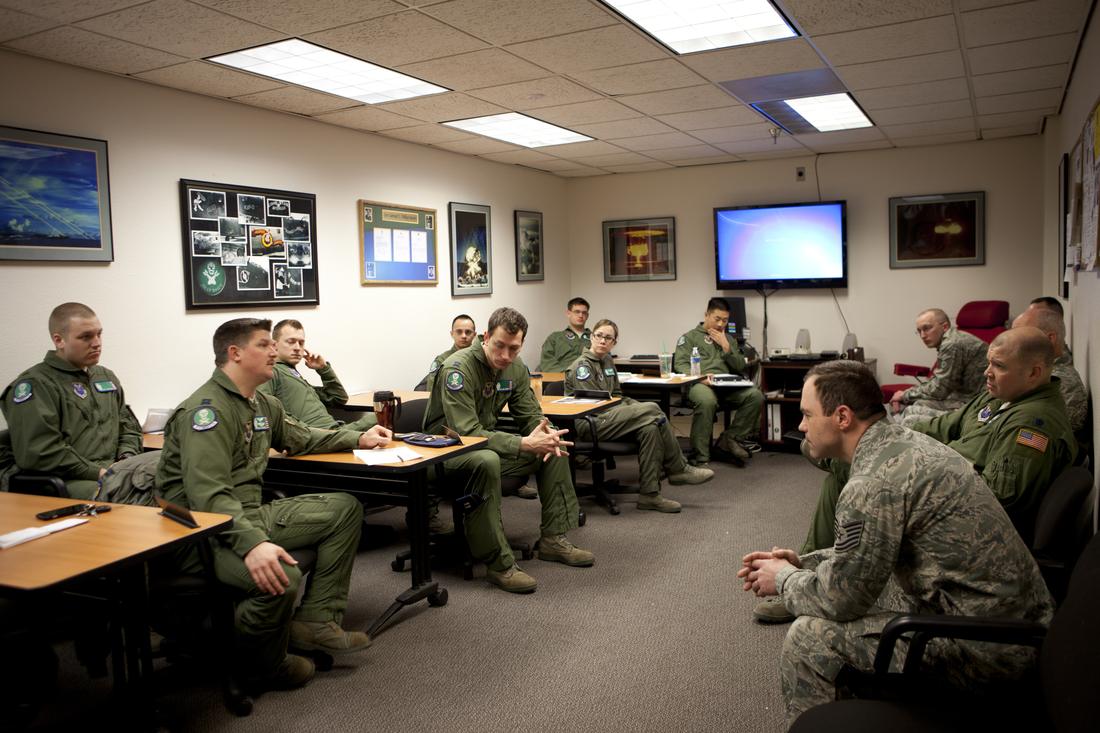 Figure: A March 2013 mission briefing; the site creator appears in this photograph. Source: missileer.watch / U.S. Air Force
Hollywood portrays nuclear launch capsules as tense, high-tech command decks; real underground alert duty is stiflingly routine. As Frenkel noted in his personal reflections: “I hated the job, but I’m proud of it. It was a grind. I was always tired, bored, or stressed, usually two of the three. You train for years to do absolutely nothing: sit in a capsule in your sweatpants and wait.” He added that base food was plentiful and cheap: three full meals a day, which is how many missileers ended up gaining weight during their tours.
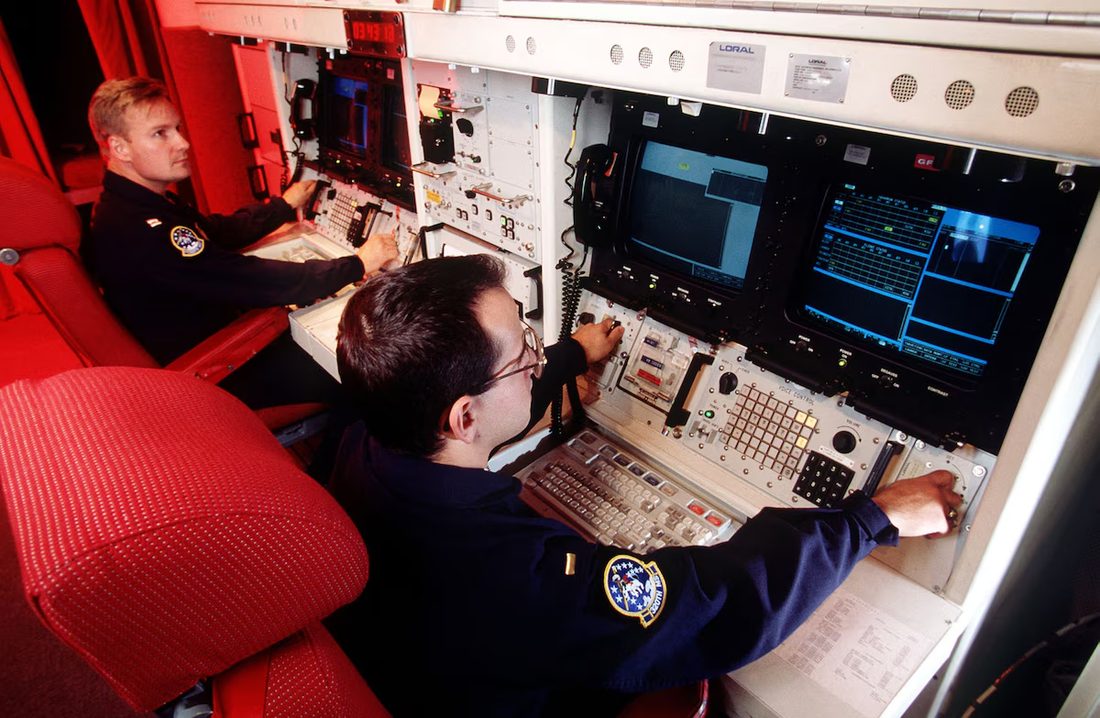 Figure: The REACT console inside the launch control capsule. The overhead red digital clock runs on Zulu time; crews synchronize daily with the U.S. Naval Observatory master clock. Source: missileer.watch / U.S. Air Force
When those 30 characters crackle through the shortwave speaker, the two officers underground must transcribe the message concurrently. They unlock a dual-custody red box, retrieve the day’s sealed authenticator cards, and match the preamble against validation keys. The operational reality stated on missileer.watch is clear: the messages are encrypted; anyone outside the loop can only listen. Radio waves can carry the characters into any living room receiver on Earth, but without the physical codebooks locked in that underground steel box, the transmission remains pure static.
Nuclear Detonations Burn the Ionosphere: Shortwave Is Only the First Layer
Given how easily HF signals can be intercepted, why does the military maintain this analog voice network? High-frequency radio possesses a unique physical advantage: it skips between the ionosphere and Earth’s surface, crossing thousands of miles from a single transmitter without relying on undersea fiber cables or satellite repeaters. Shortwave remains the lowest-cost, infrastructure-independent path for global direct connectivity.
Yet the ionosphere is both shortwave’s greatest asset and its fatal vulnerability. In his landmark January 1985 paper in Scientific American (Vol. 252, No. 1), Ashton B. Carter detailed the physics: high-altitude nuclear detonations unleash massive bursts of X-rays and gamma radiation, flooding the ionosphere with electrons. This creates ionospheric disturbances lasting hours. High-frequency signals striking the perturbed layer are absorbed rather than reflected, transforming a global radio mirror into an RF acoustic sponge.
This physical vulnerability sparks a perennial debate within defense communication circles. Proponents point out that placing nuclear commands on open channels demonstrates the engineering power of Kerckhoffs’s principle: system security depends entirely on key secrecy, meaning an adversary recording every bit of channel traffic gains zero tactical advantage. Critics counter that shortwave would be knocked out in the opening salvo of a nuclear exchange, noting that modern command structures rely heavily on Very Low Frequency (VLF), survivable satellites, and trailing wire antennas aboard airborne command posts; 11,175 kHz is merely the only audible component of a much larger, survivable network. Both viewpoints reflect a unified engineering philosophy: redundant, heterogeneous pathways ensure the message arrives, while the codebook ensures it cannot be broken.
Locking State Secrets on Open Channels: The Codebook as the Ultimate Citadel
Reviewing the 29 messages captured by missileer.watch over the past week reveals that the vast majority represent routine link checks, shift handover drills, or logistical coordination. Outside observers cannot deduce strategic intentions from message cadence or transmission length; drill traffic uses the identical format, cadence, and length as real-world operational orders. Flooding the spectrum with routine encrypted broadcasts hides genuine crisis directives inside dozens of daily calls—the quintessential traffic-flow security mechanism.
Frenkel and the Oregon-based Valar Systems team have released these audio transcripts and custom illustrations under the CC0 1.0 Public Domain Dedication. Decades ago, outsiders could only glean fragmented details of the Minuteman Weapon System History and Description from declassified Cold War archives. Today, anyone can open a web browser and read raw alphanumeric streams captured minutes earlier by antennas in California.
Every few hours, the mechanical voice on 11,175 kHz rings out across the globe. It demonstrates a counterintuitive law of security engineering: maintaining secrets requires neither burying cables under the ocean floor nor scrambling radio spectra with exotic frequency hopping. Broadcast the ciphertext openly to the entire world, and lock the solitary key in a hardened safe tens of meters underground. As long as mathematical rigor and physical isolation hold, transparency itself becomes the ultimate shield.
References:
- missileer.watch live monitoring platform and technical documentation
- Ashton B. Carter, “The Command and Control of Nuclear War,” Scientific American, Vol. 252, No. 1 (January 1985)
- TRW, Minuteman Weapon System History and Description (July 2001, FOIA release)
- 319th Reconnaissance Wing Public Affairs, “HFGCS open house showcases critical comms mission at Grand Forks AFB” (June 2, 2023)
- U.S. Air Force, Sentinel Deployment and Minuteman III Decommissioning and Disposal Final Environmental Impact Statement, Vol. 1 (March 2023)
- Number Stations Research, High Frequency Global Communications System (HFGCS) overview
- National Park Service, Minuteman Missile National Historic Site guide
- Hacker News discussion thread