In September 2026, the École polytechnique fédérale de Lausanne (EPFL) published details of LogSync in the IEEE Journal of Solid-State Circuits (JSSC)—a miniature implantable neural chip integrating 32 signal channels alongside an on-chip machine learning engine within a total power envelope of just 196 microwatts. While conventional neurotechnology typically focuses on single brain regions, LogSync departs from this localized view by becoming the first implantable system designed to decode synchronous rhythmic interactions across distributed brain regions directly on-chip.
Traditional neuromodulation treats the brain largely as an assembly of independent modules. Clinical treatments usually deliver continuous electrical stimulation to a designated nucleus in an effort to suppress symptoms. LogSync rethinks this operational paradigm by treating the communication quality between distinct brain regions as a primary biomarker, extractable and classifiable directly on-chip in real time. Many psychiatric and neurological disorders stem from disruptions in coordinated network communication. The true therapeutic target is the communication pathway itself, rather than an isolated anatomical node.
Stimulating Single Sites Cannot Reset Distributed Neural Circuit Failures
Deep brain stimulation (DBS) has been deployed clinically for decades, but existing clinical therapies rely primarily on open-loop architectures. Once electrodes are surgically positioned inside a target nucleus, the device delivers high-frequency electrical pulses continuously. This continuous, uncalibrated stimulation fails to account for transient neurological states, draining battery life and often inducing adverse side effects.
Even advanced closed-loop systems restrict their sensing to a single localized region. A solitary electrode monitors local field potentials and triggers stimulation whenever local amplitude spikes or abnormal oscillatory bursts occur. While single-target modulation effectively suppresses motor tremors in Parkinson’s disease, it has repeatedly fallen short in treating neuropsychiatric conditions such as major depression and obsessive-compulsive disorder (OCD).
Complex mental and psychiatric states rarely originate within an isolated region. Breakdown in functional connectivity between the prefrontal cortex and amygdala, for instance, frequently precipitates severe affective dysregulation. A single-site recording electrode can capture local firing rates, but remains blind to whether distributed networks are operating in phase or out of sync. Open-loop or single-channel stimulation misses the critical intervention window, failing to restore desynchronized brain circuits.
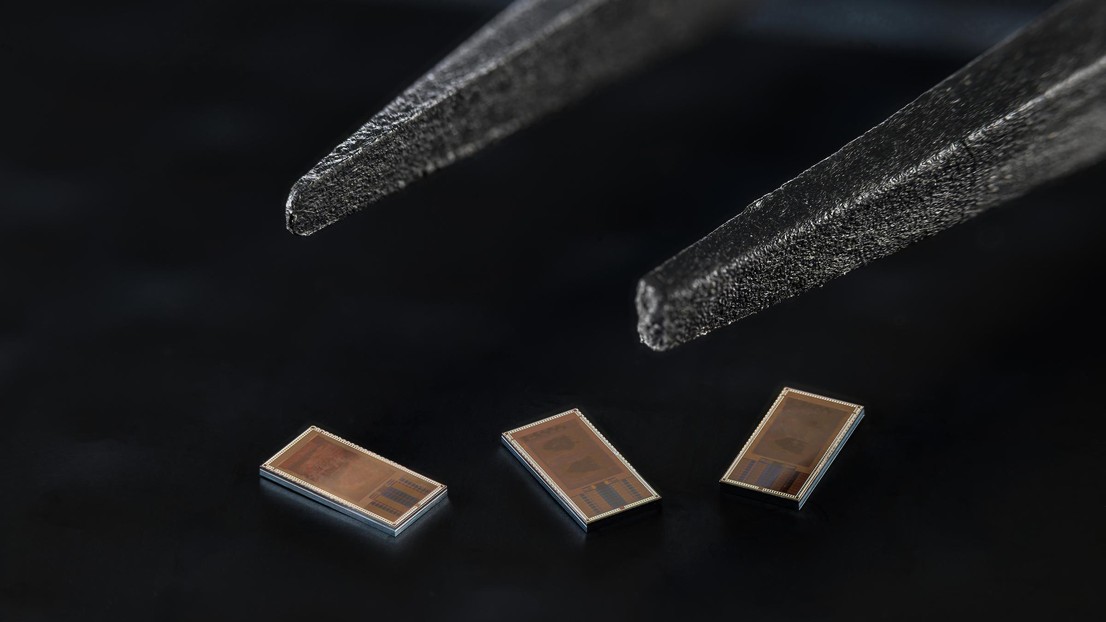 Figure: The LogSync neural chip, measuring approximately 4×2 mm. Credit: EPFL / Lundi13 (CC BY-SA 4.0).
Compressing 32 Channels into 196 Microwatts via Logarithmic Domain Processing
Translating multi-site network synchrony analysis into an implantable format faces prohibitive thermal and power boundaries. To prevent tissue damage, implantable chips must limit surface temperature increases to less than 1°C, restricting total power budgets to a few hundred microwatts. Standard cross-correlation and phase-synchrony algorithms demand massive floating-point matrix operations that easily consume several milliwatts—far exceeding the safe dissipation limits for intracranial hardware.
To circumvent this computational wall, the Integrated Neurotechnologies Laboratory (INL) at EPFL rebuilt the mathematical architecture from the ground up, mapping signal processing entirely into the logarithmic domain. In logarithmic coordinates, high-overhead multiplications and divisions transform into lightweight additions and subtractions, while exponential computations reduce to simple linear bit-shifts. Eliminating power-hungry multipliers removed roughly 90% of the computational overhead.
This architectural shift allowed LogSync to pack a complete closed-loop processing chain into a compact 4×2 mm silicon footprint. The system integrates a 32-channel low-noise analog front-end, a logarithmic feature extraction engine, and an adaptive classifier. Across results showcased at the 2025 IEEE Symposium on VLSI Technology and Circuits and detailed in the JSSC paper, total system consumption was measured at an ultra-low 196 microwatts.
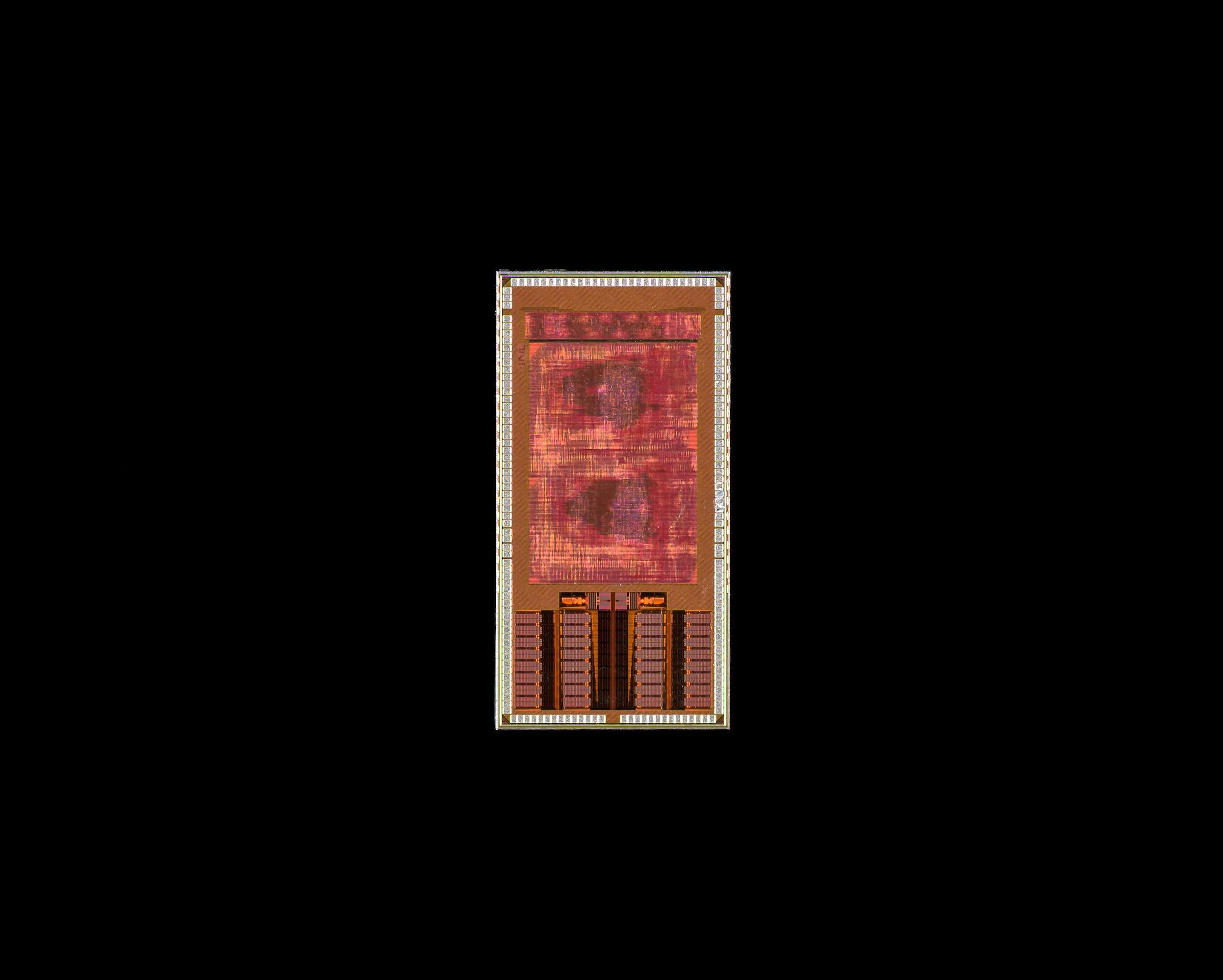 Figure: Close-up micrograph of the fabricated LogSync silicon die. Credit: EPFL / Lundi13 (CC BY-SA 4.0).
The chip continuously extracts two complementary network biomarkers: localized spectral power within discrete frequency bands, and phase-locking values quantifying cross-regional synchrony. The on-chip classifier continuously synthesizes both metrics to classify ongoing functional states. Logarithmic hardware compression tames previously prohibitive processing loads, making 24/7 on-chip adaptive monitoring clinically viable.
Decoding Emotional Arousal and Locking Phases in Vivo
The researchers evaluated the system through two rigorous experimental protocols. The first validation drew on human intracranial recordings from prior clinical psychiatric studies, evaluating two experimental paradigms: cognitive workload variation and neuroaffective arousal evoked by emotional video clips.
Relying strictly on inter-regional phase synchrony and spectral features, LogSync accurately differentiated distinct levels of cognitive effort and emotional arousal. Crucially, the classifier achieved this without needing secondary physiological inputs such as facial expression tracking or heart rate metrics. This offline analysis confirmed that cross-regional synchrony provides a reliable, quantifiable digital signature of shifting emotional states.
The second validation was conducted in vivo at the University of Minnesota. Collaborators interfaced the prototype chip with the motor cortex of anesthetized rats. The chip tracked ongoing cortical oscillations in real time and delivered closed-loop electrical stimulation timed precisely to specific phases of the target neural rhythm. LogSync reacted with microsecond-level latency, meeting the demanding temporal resolution required for phase-specific neural intervention.
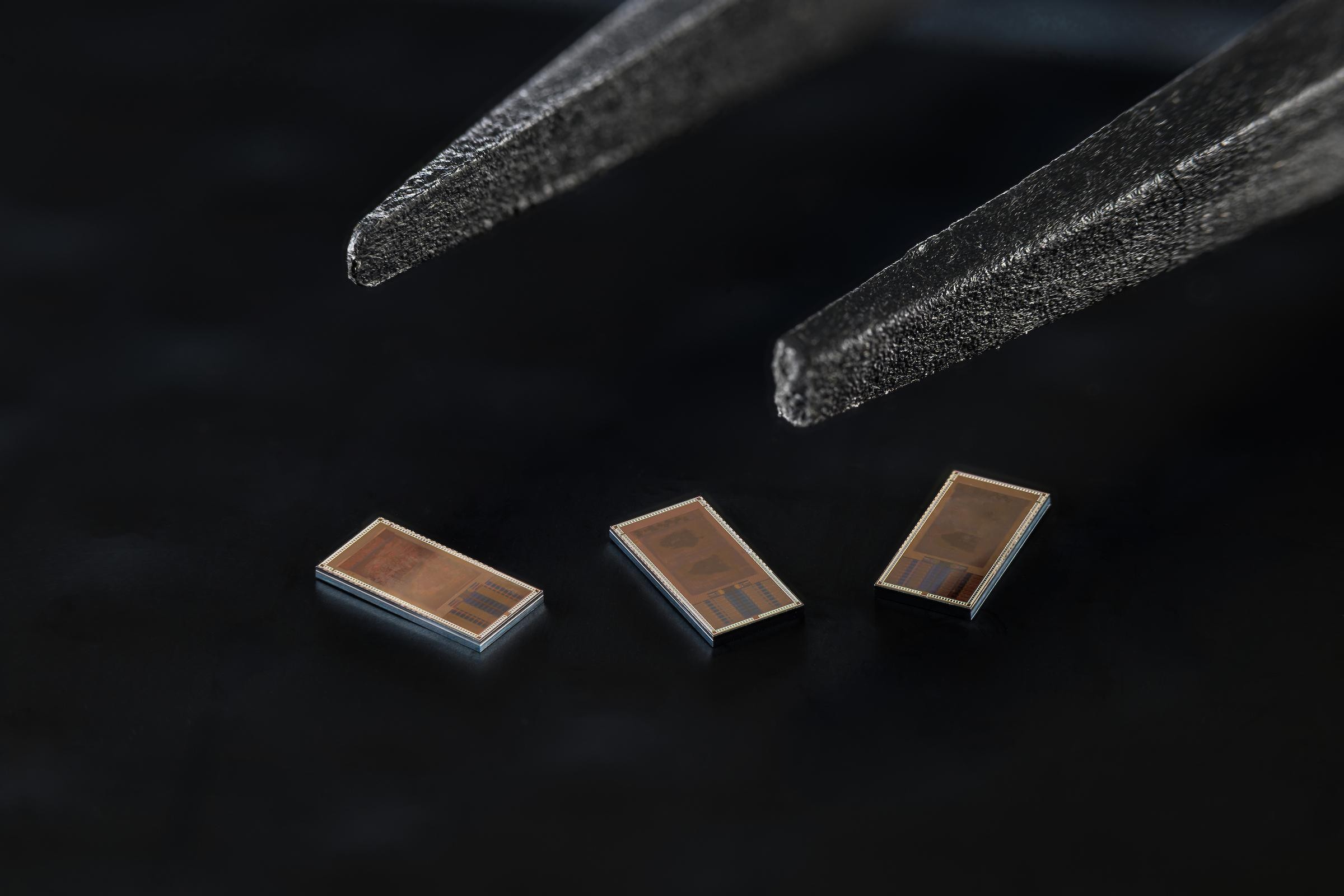 Figure: Professor Mahsa Shoaran and members of the INL team at the EPFL Geneva Campus. Credit: EPFL / Lundi13 (CC BY-SA 4.0).
Modulating Distributed Networks with Adaptive Closed-Loop Pulses
The research program was backed by 6.6 million Swiss Francs in funding from the U.S. National Institute of Mental Health (NIMH), specifically focused on developing targeted physical neurotherapies for treatment-resistant depression, PTSD, and OCD. To address these complex disorders, the INL group had previously pioneered brain-to-text interfaces and responsive neuromodulation systems.
LogSync advances this progression by shifting the diagnostic lens from static anatomical sites to dynamic inter-regional communication. In parallel, INL director Mahsa Shoaran presented RECTOR, a self-supervised neural decoding model, at ICML 2026 to further advance latent behavioral representation. Laboratory spin-off Infera Neuro is already pursuing commercial translation and clinical development of the hardware platform.
Targeting network-level dysfunction fundamentally transforms stimulation protocols. Because the device monitors the real-time health of inter-regional connections, it eliminates the need for relentless round-the-clock pulse trains. Interventions are triggered selectively at the exact instant synchrony degrades, delivering micro-dosed phase adjustments to nudge the neural network back into healthy balance. Transient closed-loop pulses substantially extend battery lifespans while minimizing the risk of neural adaptation and desensitization.
From Retrospective Datasets to Active Clinic: Challenges Ahead
Despite remarkable hardware efficiency, substantial ground remains before clinical translation is realized. The initial emotion decoding benchmarks were established through retrospective analysis of existing clinical recordings. Living human brains exhibit substantial movement artifacts, cognitive noise, and electrode-tissue interface drift; real-time online decoding in awake, ambulatory patients represents a much higher engineering hurdle.
Furthermore, while the rodent experiments demonstrated sub-millisecond phase tracking precision, they were conducted in healthy motor cortex rather than psychiatric disease models. Rigorous clinical validation will be required to establish whether phase-targeted stimulation can reproducibly alleviate depressive episodes or anxiety symptoms in humans. Definite conclusions await future double-blind clinical trials.
The team views LogSync as a versatile, low-power neural computing engine. Beyond invasive deep brain stimulation, its logarithmic architecture can readily interface with non-invasive transcranial electrical stimulation devices and focused ultrasound neurotechnology.
LogSync proves that sub-milliwatt silicon can execute complex network-level neural computation. By shifting the clinical paradigm from isolated anatomical targets to dynamic inter-regional dialogue, psychiatric medicine gains a powerful new ally. The future of neuromodulation lies not in overriding single brain structures, but in tuning the intricate harmonies that connect them.
Reference Links:
- EPFL News: Neural chip decodes interactions between brain regions
- IEEE JSSC Paper: LogSync: A Low-Power Logarithmic SoC for Cross-Regional Synchrony Extraction and Adaptive Psychiatric State Classification
- EPFL Integrated Neurotechnologies Laboratory (INL) Homepage: INL Research