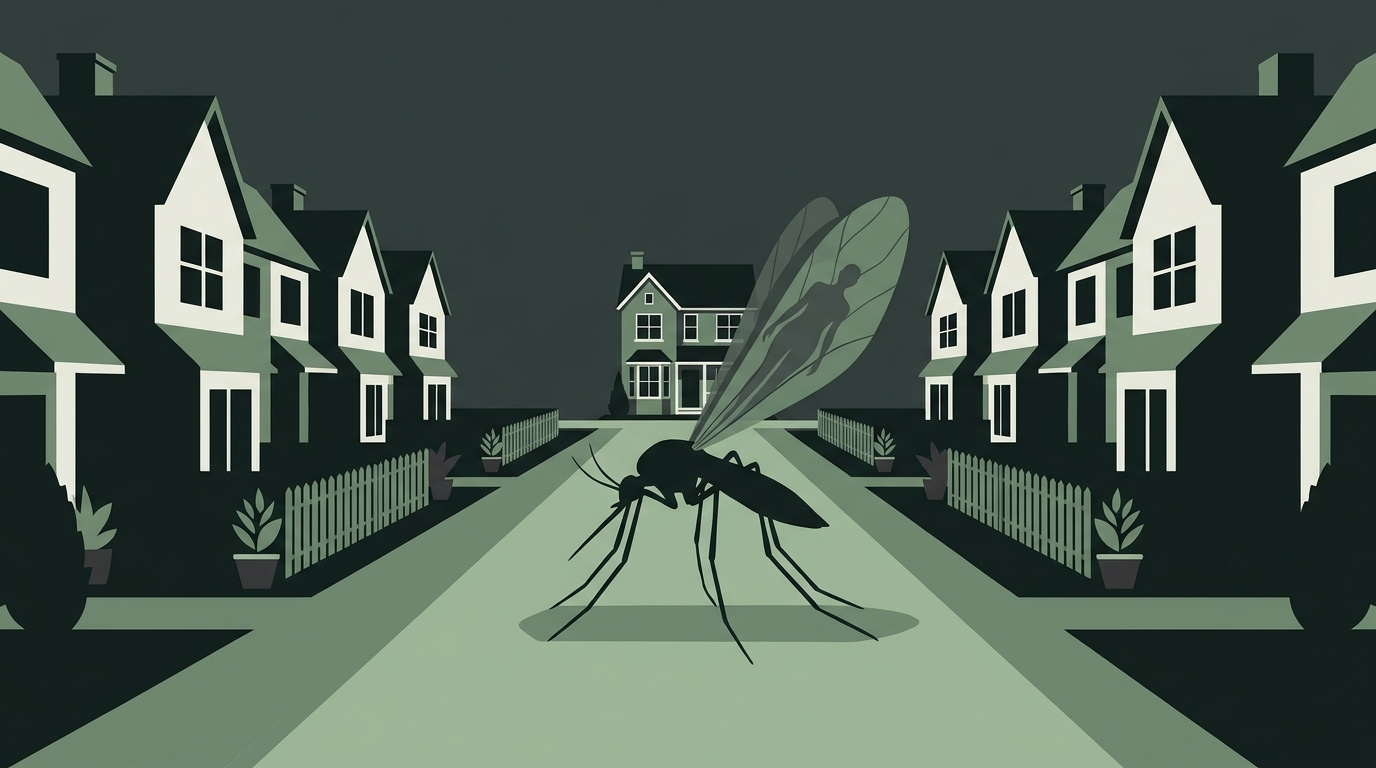
On a quiet Sunday morning, you step into the backyard holding a cup of coffee. Just as you reach down to water the plants, a sharp prick hits your ankle. Looking down, a small mosquito with distinct black-and-white markings darts away. Most people assume mosquito infestations belong exclusively to remote tropical rainforests, believing that moving into neatly planned suburban subdivisions keeps them well away from tropical infectious diseases.
The reality is precisely the opposite. In late October 2026, Florida set a grim epidemiological record: statewide dengue fever cases crossed the 700 mark, marking the largest modern outbreak in the region. Dengue fever is an acute mosquito-borne viral disease characterized by high fever, severe headaches, and debilitating joint and muscle pain. More than 400 of Florida’s cases stem from local transmission—meaning patients contracted the virus right outside their doorsteps rather than importing it from international travel.
The geographic expansion of disease vectors mirrors humanity’s development footprint with uncanny accuracy. Urbanization is expanding mosquito habitats. Every new suburban development provides the two things they need most: artificial containers of standing water and people.
$6M Spent on Mosquito Control in a Single County: Florida’s Historic Outbreak
Hillsborough County, home to Tampa, has become the epicenter of the current crisis, logging over 350 confirmed cases and at least one fatality. Further south in Miami-Dade County, cases quickly surged past 200. Hillsborough County alone has poured more than $6 million into mosquito abatement this year, yet widespread insecticide fogging still fails to seal every vulnerability.
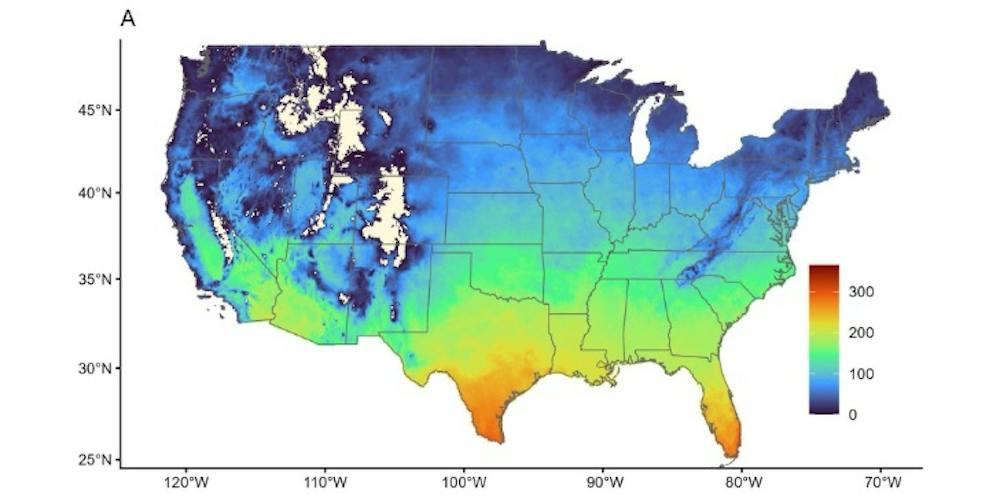 Figure: Days per year with suitable temperatures for Aedes aegypti dengue transmission in 2025. Source: The Conversation / Sadie Ryan / Climatology Lab.
Warmer average temperatures have widened the seasonal window for mosquito activity. Between 1999 and 2024, New York State gained 20 additional days in its warm season favorable for mosquito reproduction. Three extra weeks of active breeding grant mosquitoes far more opportunities to feed and lay eggs.
Epidemiological models project an even starker future: by the 2030s, roughly 70% of Florida’s population could face dengue transmission risks for nine months out of the year. For three out of four seasons, residents would need insect repellent just to step outside. Climate warming sets the welcoming stage, while rapid residential sprawl acts as a powerful amplifier for pathogens.
A Bottle Cap of Water Is Enough for Five Generations of Aedes Mosquitoes
The primary driver behind Florida’s outbreak is Aedes aegypti, the yellow fever mosquito. This species thrives near human dwellings and serves as the primary vector for dengue and Zika viruses. Arriving on American shores centuries ago aboard transatlantic cargo vessels, it has thoroughly adapted to suburban neighborhoods. Drawn intensely to human scent, it bites predominantly during daytime hours when people are active outdoors.
A female Aedes aegypti lives for only about a month, but its reproductive rate is staggering. Over her lifetime, she can complete approximately five egg-laying cycles, producing over 100 eggs each time. In just 30 days, a single female can seed hundreds of offspring across a single backyard.
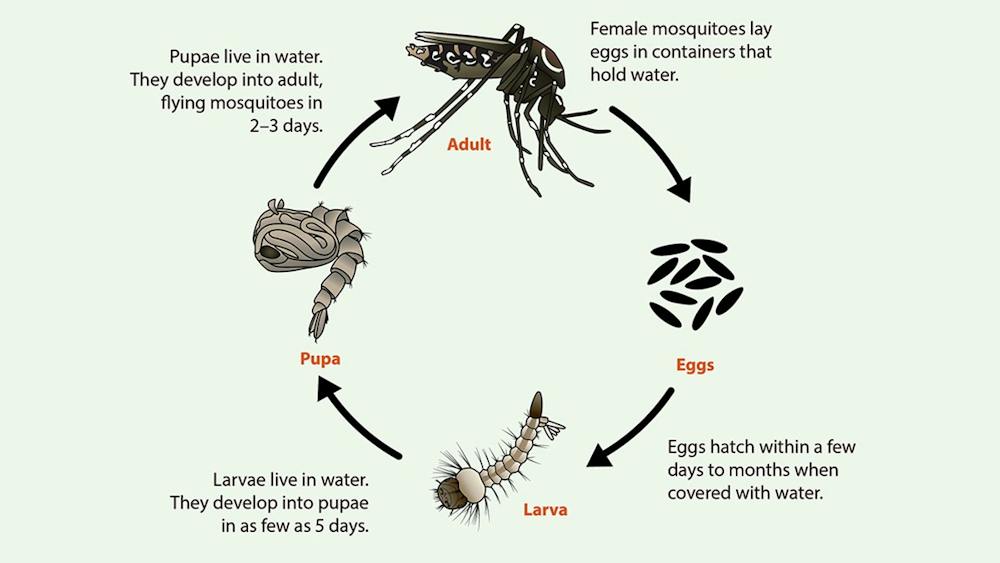 Figure: The life cycle of Aedes mosquitoes, highlighting larval development in standing water. Source: The Conversation / CDC.
Aedes larvae require remarkably little water to thrive. Plant pot saucers, clogged rain gutters, and discarded tires serve as prime nurseries. Even an upturned plastic bottle cap left on a lawn holds enough water for larvae to mature into biting adults. A dense landscape of artificial micro-containers creates predator-free incubators right under our noses.
Hitchhiking Along the Interstates: How the Asian Tiger Mosquito Colonized 40 States
Aedes albopictus, commonly known as the Asian tiger mosquito, has proven an even more aggressive invader. Native to Southeast Asia and sporting bold black-and-white stripes, it slipped into the Port of Houston during the 1980s inside shipments of used tires. The dark, water-trapping interiors of tires provided the perfect mobile breeding chambers.
The Asian tiger mosquito capitalized directly on national transit networks. Freight trucks traversing interstate highways carried used tires and shipments of lucky bamboo to every corner of the country. In Iowa, the earliest established populations surfaced right in the Des Moines metropolitan area.
In Pennsylvania, researchers maintained an eight-year trapping network. Surveillance data showed heavy clusters of tiger mosquitoes tightly concentrated around the greater Philadelphia area, mirroring human population density maps almost perfectly. By 2017, the species had established residency across 1,368 counties in 40 U.S. states.
Standing Water After the Rain: How Suburbs Accidentally Built Nurseries
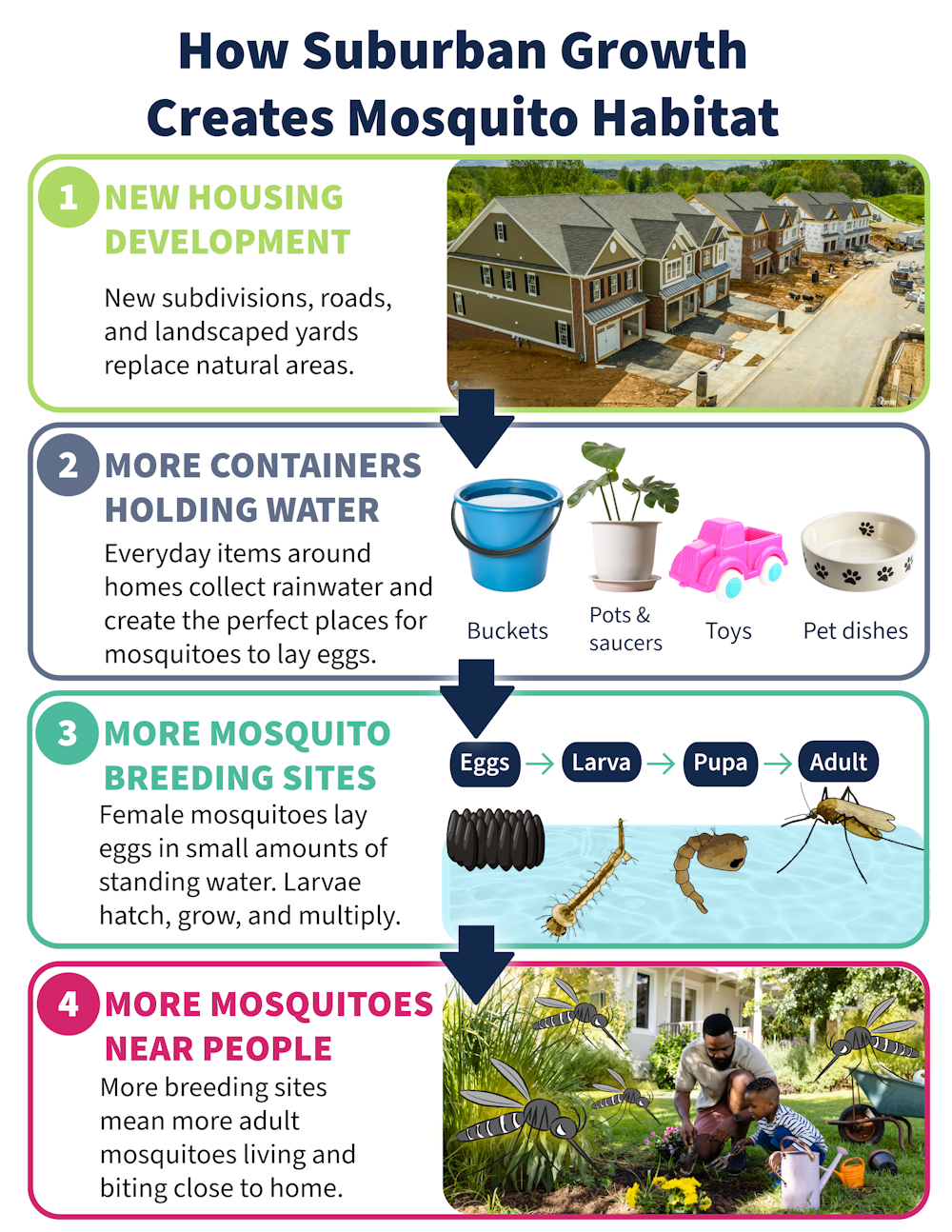 Figure: How suburban sprawl inadvertently engineers ideal mosquito habitat. Source: The Conversation / Kylee Rae Noel.
Modern suburban communities pride themselves on tidy landscaping and quiet streets, yet this development pattern upsets natural ecological checks and balances. Bulldozers clear woodlands, displacing native predators like frogs and dragonflies. In their place come paved driveways, stormwater catch basins, and manicured lawns.
Suburban environments also provide a haven for Culex mosquitoes. Active around dusk, these brownish mosquitoes are primary carriers of West Nile virus—the most widespread mosquito-borne disease in the continental U.S., capable of causing severe neuroinvasive illness. Underground drainage basins and shallow roadside puddles offer Culex ideal sheltered breeding grounds.
Research led by Oxford geographer Janey Messina projects dengue’s transmission boundaries through 2050: rising temperatures, shifting rainfall patterns, and burgeoning mosquito populations will dramatically enlarge hospitable zones. Newly minted suburban homes come standard with automatic irrigation and air-conditioning condensation drains. The very amenities designed to maximize modern residential comfort inadvertently supply every ingredient mosquitoes need to thrive.
Three Backyard Hotspots to Check: Interrupting Transmission Starts at Home
As case numbers climb, residents often await municipal fogging trucks spraying insecticides along street curbs. Yet experiences in Hillsborough County demonstrate that aerial and truck spraying struggles to penetrate private backyards. The most effective line of defense against mosquito-borne infections falls directly on homeowners.
Breaking the reproductive chain requires inspecting three critical yard zones. First, eliminate standing water: empty, scrub, and invert flowerpot saucers, bird baths, pet bowls, and children’s toys once a week. Second, clean gutters regularly to remove leaves and sediment that dam up rainwater. Third, seal rain barrels and outdoor water cisterns with fine-mesh screens to block mosquito entry.
Florida’s record-setting 700-case outbreak delivers a clear warning: disease-carrying mosquitoes do not need untamed wilderness. They follow the contours of modern human construction. As long as backyards retain standing water, the first line of defense remains in our own hands.
Reference links:
- The Conversation Research Report
- CDC Dengue Surveillance & Data