The world’s largest training ground for large language models is being poisoned by the very text those models produce. On English Wikipedia, patrolling editors wage a daily battle against incoming waves of machine-generated articles. According to monitoring from detection tool Pangram, roughly 20% of new Wikipedia entries at the end of 2025 showed synthetic fingerprints. As model outputs flow back into the knowledge base, they quietly contaminate the raw materials needed to train future generations of AI.
At first glance, the cleanup effort launched by Wikipedia volunteers looks like routine community maintenance. In reality, this defensive campaign defends the core data foundations of the entire artificial intelligence industry. A repository of knowledge verified by human editors over more than two decades is in danger of deteriorating into a swamp of manufactured facts.
Five Long Articles in Five Minutes: Patrollers Uncover 20% Synthetic Content
Wikipedia’s backend has been hit by an unprecedented flood of submissions. A human editor researching sources and carefully crafting sentences often spends days producing a comprehensive, multi-thousand-word entry. Yet in backend logs from 2026, newly registered accounts were submitting five lengthy draft articles in under five minutes.
Automated scripts have driven the marginal cost of content generation to zero. Facing this industrial deluge, Ellia Lebleu, an AI PhD researcher at Inria Rennes in France, decided to take action. In December 2023, she joined forces with fellow volunteers on Discord to launch WikiProject AI Cleanup. Their mission: identify and remove thousands of encyclopedic articles fabricated en masse by machines.
These pieces of algorithmically assembled text share a recognizable stylistic fingerprint. They lean heavily on predictable rule-of-three phrasing, mechanical cadence, and cookie-cutter paragraph structures. While the prose flows smoothly, it is packed with hollow adjectives and almost devoid of original, verifiable facts.
Data monitored by Pangram indicated that around 20% of new articles at the end of 2025 were suspected to be machine-generated. Sustained cleanup pushed that figure down to approximately 16% in early 2026. Even so, synthetic submissions still accounted for nearly one out of every six new entries. The barrier to mass-producing digital garbage has dropped to zero, while the human cost of verification remains strictly non-negotiable.
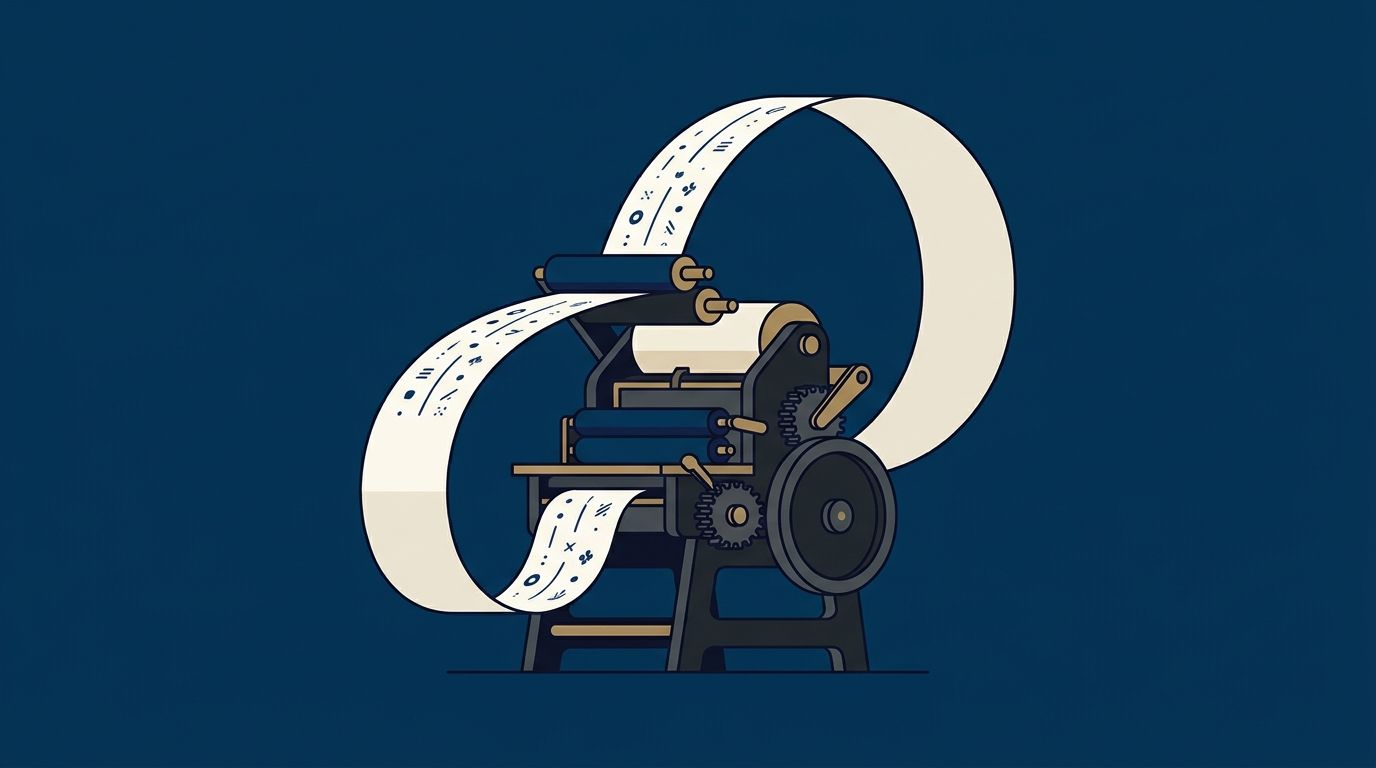
 Figure: Visual artwork combining Wikipedia’s globe insignia with editing instruments. Source: IEEE Spectrum
Fewer Hallucinated Citations, but Real Sources Don’t Back the Claims
Volunteers on the cleanup project noticed that generative techniques underwent a noticeable shift over the past year. Early AI hallucinations were crude and obvious. Models routinely fabricated nonexistent scholars or made up fake journal volume numbers. Patrollers could debunk an entry in seconds simply by pasting the citation into an academic search engine.
Modern generation pipelines now routinely incorporate Retrieval-Augmented Generation (RAG). Before drafting, the script scrapes authentic literature and attaches real book titles and working links as references. The sources exist and the links work, creating the illusion that hallucinated citations are gone.
This makes the deception far more pernicious. The prevailing issue now is that while the citations are real, they don’t actually support the assertions in the text. For example, a historical entry might cite an authoritative monograph with precise page numbers; when volunteers consult the physical book, the author makes no mention of the supposed events described.
This refined counterfeit cannot be caught by casual skimming. Patrollers must act like academic fraud investigators, tracking down physical books or reading dozens of pages of research papers. Fact-checking a single reference has ballooned from seconds into half an hour.
To stem the bleeding, English Wikipedia formally implemented the WP:LLM policy guideline in March 2026, barring editors from using large language models to draft or rewrite article bodies. The community also activated WP:G15, an expedited speedy deletion criterion for LLM-generated submissions. When machines wrap falsehoods inside genuine academic citations, painstaking manual verification becomes humanity’s only defense.
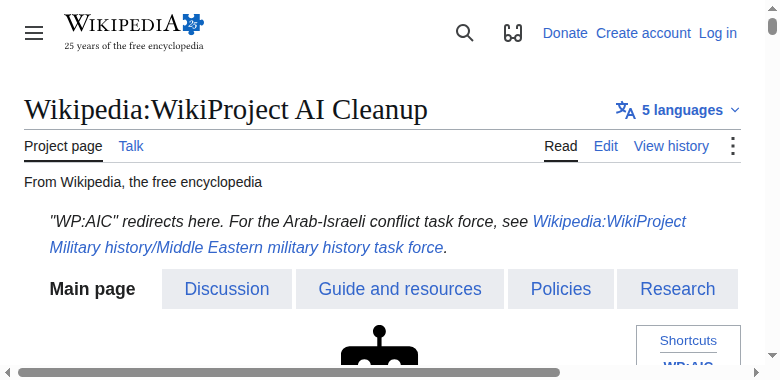 Figure: The WikiProject AI Cleanup home page, identifying the mitigation of automated text abuse as a primary goal. Source: Wikipedia
Corpus Contamination and the Threat of Model Autophagy
If Wikipedia were merely an ordinary online forum, spam floods would simply degrade the reader’s experience. But across the entire artificial intelligence pipeline, Wikipedia holds a uniquely foundational role. Nearly every major frontier model assigns an exceptionally high sampling weight to Wikipedia corpora during pre-training.
Wikipedia’s quality is the product of over twenty years of rigorous scrutiny by global volunteers. Frontier labs have relied on this curated archive to instill common sense and reasoning into models. Once Wikipedia is diluted with machine-generated filler, future models ingest synthetic outputs as ground-truth facts.
Researchers call this phenomenon model autophagy disorder or model collapse. When generative models train extensively on synthetic data, initial errors compound exponentially over successive generations. Outputs homogenize toward the mean, rare but critical long-tail knowledge disappears, and the system eventually descends into functional gibberish.
An earlier investigation by MIT Technology Review documented how this played out in low-resource language editions of Wikipedia. In language editions lacking a robust community of human editors, synthetic articles accounted for a staggering fraction of total pages. Subsequent models trained on these corrupted datasets suffered severe degradation, hallucinating wildly and losing coherence.
Models evolve when nourished on high-quality knowledge; feeding on synthetic waste causes them to degrade. Every bogus entry volunteers purge preserves clean sparks of genuine knowledge for the models of tomorrow.
Pre-2022 Archives: The Digital World’s Low-Background Steel
In tech community discussions, developers have begun likening pre-2022 internet archives to what physicists call “low-background steel.” It is a chilling metaphor drawn from industrial history and nuclear physics.
Following the detonation of the first atomic bomb in 1945, the Earth’s atmosphere was contaminated with anthropogenic radionuclides. All terrestrial steel produced after that date absorbed atmospheric radiation during the blast-furnace process. To build ultra-sensitive radiation detectors, scientists had to scavenge uncontaminated steel from World War I battleships resting at the bottom of the ocean.
The launch of ChatGPT in late 2022 marked the digital equivalent of that nuclear detonation. Ever since, the public web has been inundated with machine-generated output. Mass-produced digital debris fills search results, while pristine, human-authored text has become an increasingly scarce resource.
Web archives saved prior to 2022 now hold the same irreplaceable status as low-background steel. Frontier AI labs have spent fortunes acquiring book publishing rights and have even been caught buying up collections of physical library books. These maneuvers all follow the same strategic imperative: securing original human thought untainted by machine generation.
Online content once felt practically limitless. Yet as synthetic fallout settles across the web, uncontaminated human writing has turned into a finite strategic reserve.
Manual Line-by-Line Fact-Checking Guards the Human Baseline
Faced with this synthetic deluge, purely algorithmic countermeasures are showing their limits. Statistical AI detectors frequently suffer from false positives and false negatives. Attackers need only tweak prompts or substitute a few synonyms to slip past algorithmic filters.
Project founder Ellia Lebleu acknowledges that it is too early to know whether the new policies will suffice. Clear rules deter honest contributors, but they barely slow down automated bot operations producing mass submissions.
The actual bulwark remains Wikipedia’s traditional human editors. Volunteers pull out physical copies of old books and review digitized scans of academic journals. Using this slow, painstaking method, they weed out fabricated statements sentence by sentence. Calling an API script to churn out tens of thousands of synthetic words takes a few seconds; verifying whether a single paragraph is true takes a human half a day.
It is an asymmetric war of attrition. Yet it is this cadre of unpaid volunteers that holds the line for objective truth against endless clouds of synthetic sludge.
AI is poisoning its own textbook. Wikipedia’s push to clean up machine-generated text protects the baseline truth upon which the entire AI industry depends. If humanity surrenders its vigilance over foundational facts and lets models feed on their own digital emissions, our collective knowledge base will hollow out into an algorithmic illusion. Preserving truth still demands the presence of real human hands.
Reference Links:
- IEEE Spectrum in-depth feature
- English Wikipedia policies WP:LLM and WP:G15
- WikiProject AI Cleanup volunteer project page
- MIT Technology Review investigation on corpus pollution
- Technical community discussions on low-background steel and model collapse