
Open Local Wikipedia, set your location to St. James’s area in London (SW1A), and a line appears at the top: “500 articles within 0.4 miles.” That’s 500 Wikipedia entries packed into just 640 meters—hitting the website’s own limit.
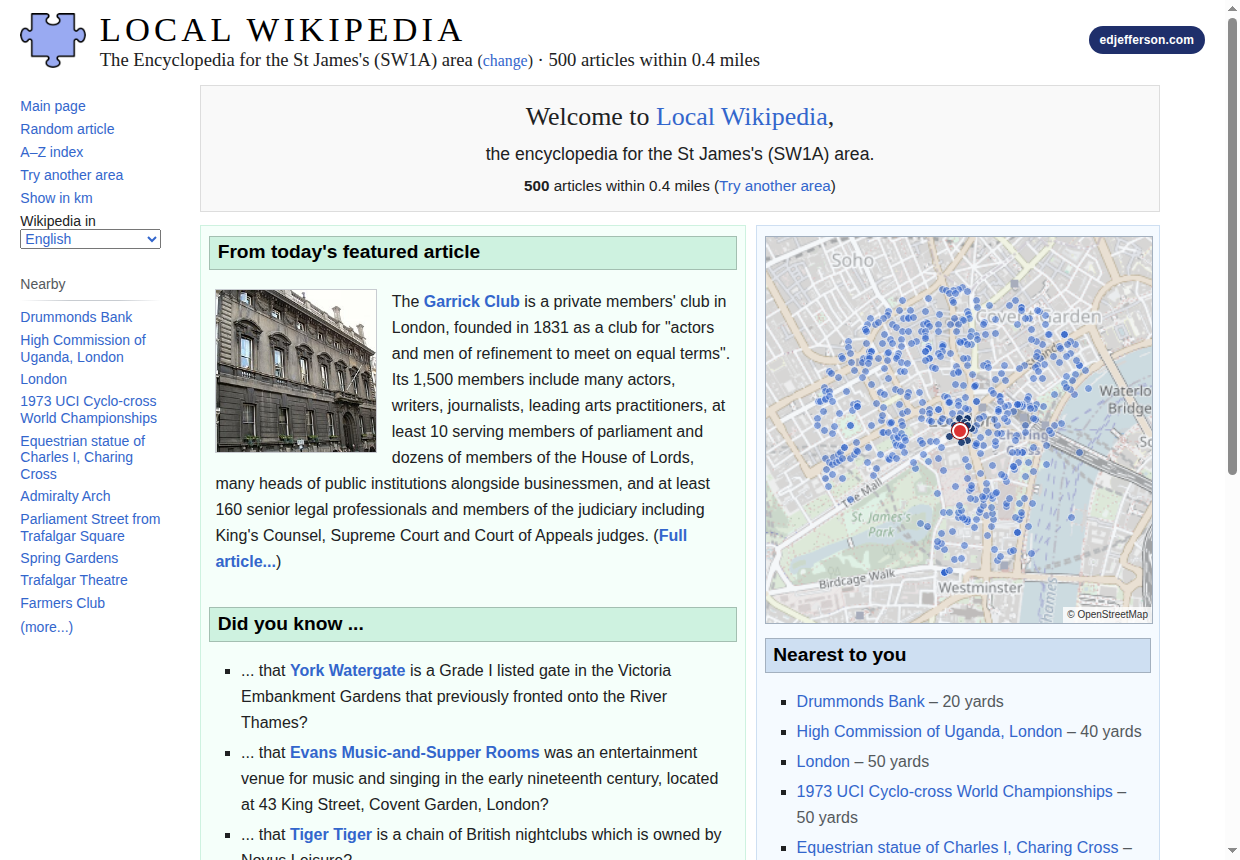
Figure: Local Wikipedia with location set to SW1A (St. James’s area) shows “500 articles within 0.4 miles” at the top, hitting the 500-entry limit. Source: Author’s screenshot
This is a personal project by developer Ed Jefferson hosted under his own domain, with a clear disclaimer: “This website is not affiliated with the actual Wikipedia.” His only description: “Wikipedia, but only for things a half hour walk from you.” The project reached the top of Hacker News, even though the official Wikipedia had already implemented something similar.
Wikipedia Has ‘Nearby Articles,’ Yet This Frontend Still Topped the Charts
Wikipedia’s “Nearby Articles” feature has existed for years: it lists entries with coordinates near you based on straight-line distance. It answers questions using GIS language—a radius of X kilometers from your location.
Local Wikipedia changes that radius unit to time. At an average walking speed of 4-5 km/h, a half-hour walk covers 2-2.5 km, overlapping with the official feature’s common search range. But these two questions form different mental images. Kilometers are for engines; half-hours are for people.
The same coordinates, asking “what’s within 2 kilometers?” gives you a functional radius, but asking “what’s within a half-hour walk?” gives you a lived human experience.l list; asking “what can I encounter on a half-hour walk?” gives you candidates for awalk route. When the search radius shifts from engineering units to everyday language, how we interpret the data changes.

Figure: The site’s tagline “Wikipedia, but only for things a half hour walk from you”—replacing kilometers with time. Source: edjefferson.com
Only Shows Entries with Coordinates, Hides the Rest
The implementation is lightweight: it only pulls Wikipedia pages with geographic coordinates, sorts them by distance, and entries without coordinates simply don’t appear. Two numbers handle extreme cases—fewer than 25 nearby entries, and the search radius expands to about 6 miles (10 km) to show the closest 25; more than 500 entries, and only the nearest 500 are displayed.
25 and 500 act like bookends. On one end, the density of central London with 500 entries in 640 meters; on the other, the wilderness where even 25 entries can’t be found within a 10 km radius. The same function, two different worlds.
Privacy deserves special attention: location data stays in the browser, and shared links contain no position information. A product that depends on “where you are” separates “seeing what’s around” from “sharing your location.”
The tech stack is equally minimal: search uses Photon’s geocoding service (photon.komoot.io), with base maps from OpenStreetMap. The entire project is built from public services with no proprietary data sources.
500 Entries in 0.4 Miles, Zero in 3 Hours of Walking
The same website shows extreme differences in testing. In St. James’s area, London, 500 entries in 0.4 miles hit the limit. One user in the discussion said the nearest Wikipedia entry was a 3-hour 15-minute walk away—at 5 km/h walking speed, that’s 15 km distant.
Does nothing exist near him? According to him, yes: a perfectly curved log, a deer carcass eaten by coyotes, the spot where he found a perfect arrowhead. His conclusion: maybe these places should stay in your heart.
One place can’t fit 500 entries in 640 meters, another has zero entries in over 3 hours of walking. Wikipedia’s coverage density is sediment from written history: where directories have been compiled, battles fought, monuments erected, and people lived, it’s dense. Local Wikipedia doesn’t change this distribution—it just shows it to you as is.
Tourists Complain About Residential Areas, Debates Reach Miles and Meters
Criticism is specific: some testers find the concept great but tourist-unfriendly. Many interesting nearby places aren’t shown; instead, the page lists mostly residential areas and roads.
The counter-argument holds equally well: this tool doesn’t judge “what’s interesting.” It faithfully transcribes what Wikipedia has written. Residential areas and roads appear frequently precisely because they have coordinates and actual entries. Uneven distribution is Wikipedia’s own attribute—any coordinate-filtering tool would yield the same results.
Someone in the discussion asked why not use Grokipedia instead. The answer was blunt: a purely AI-generated encyclopedia, easily manipulated and prone to hallucinations, can’t support the question of “what’s worth recording.” The entire value of this project rests on the premise that entries are written by humans—behind each coordinate is a specific person’s judgment at a specific moment that this place deserves an entry. With generated content, the density distribution loses its subject.
The remaining debate is the least serious yet most real: whether 0.4 miles should be displayed in yards or meters. When distance enters everyday scenarios, even units can become controversial.
How Many Entries Are Near You Has Nothing to Walking Distance
What this project does is take Wikipedia’s existing geographic coordinates and reorders them by walking time. This reordering makes the same data reveal two different things: in London, it’s a candidate list for “where to stroll this afternoon”; in the wilderness, it’s a mirror reflecting which places have been written into history and which haven’t.
How many things near you are worthy of an encyclopedia entry has nothing to do with how far you’re willing to walk. This number was fixed the moment each Wikipedia entry was finalized. Local Wikipedia simply lets everyone walking down the street see it for themselves.
Reference links:
- Local Wikipedia project homepage
- HN discussion
- OpenStreetMap
- Photon geocoding