When strolling through an aquarium or snorkeling over a shallow tropical reef, the corals people encounter are typically modest in size—often no bigger than an outstretched hand. Seen from above, these scattered formations resemble underwater bonsai arrangements, easily mistaken for fragile, delicate garden flora.
Far out in the open ocean, however, the deep sea conceals marvels of scale that defy human intuition. Along the outer reef slopes of the remote Cocos (Keeling) Islands, far off the Australian coast, scientists have unveiled an extraordinary living formation: a continuous, 1.56-kilometer corridor of deep-sea rose coral that shatters previous perceptions of colonial marine life.
100 Buses Long: A 56,000-Square-Meter Wall of Life in the Deep
A length of 1.56 kilometers is difficult to grasp in an underwater setting. To visualize its scope, imagine 100 urban transit buses lined up bumper-to-bumper along a single road. Walking that distance on flat ground takes nearly 20 minutes; navigating it in the dim, pressured twilight of the deep sea feels vast and monumental.
The megacolony is constructed by rose coral (Pachyseris speciosa), an encrusting to foliose scleractinian species whose sweeping fronds resemble layered rose petals or undulating heads of lettuce. Microscopic coral polyps—cylindrical marine invertebrates that secrete calcium carbonate to build rigid communal skeletons—have steadily accreted mineral layers over centuries. The formation spans an average width of 36.5 meters and blankets approximately 56,940 square meters of seabed. That surface area exceeds three Melbourne Cricket Grounds combined, with fragmented extensions trailing outward for hundreds of additional meters.
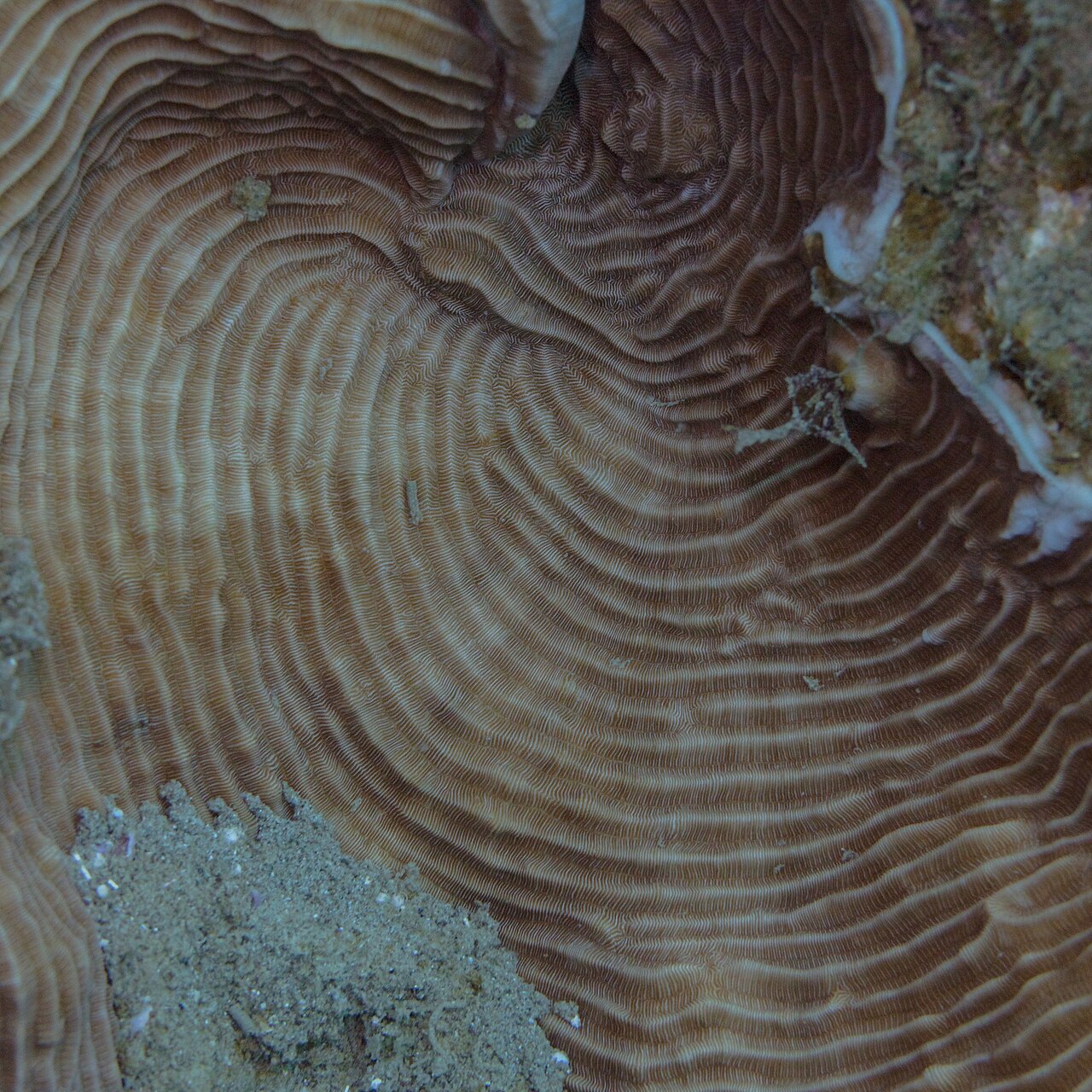 Figure: Close-up of the layered foliose tiers of rose coral (Pachyseris speciosa). Source: Wikimedia Commons (Diego Delso)
The colony cascades from an upper depth of 14 meters down steep slopes into the dim reaches of 65 meters. This vertical elevation difference equals a 20-story building submerged beneath the waves, with coral growing uninterrupted from rooftop to foundation. This steep bathymetry provided the vast, unobstructed room required for sustained multi-century growth.
In 2024, researchers in the Solomon Islands documented a massive standalone coral colony measuring 34 meters across. Earlier in 2026, a 111-meter formation comparable to a soccer field was cataloged on the Great Barrier Reef. The discovery at Cocos (Keeling) Islands raises that benchmark by more than an order of magnitude.
Passed Daily for Decades: A Dive Master’s 30-Year Mystery
Enormous size does not guarantee easy discovery underwater. More than thirty years ago, veteran local dive operator Dieter Gerhard first noticed expansive sheets of foliose coral along the outer reef slope. The pristine, gin-clear waters surrounding the atoll had long welcomed regular diving expeditions and visiting travelers.
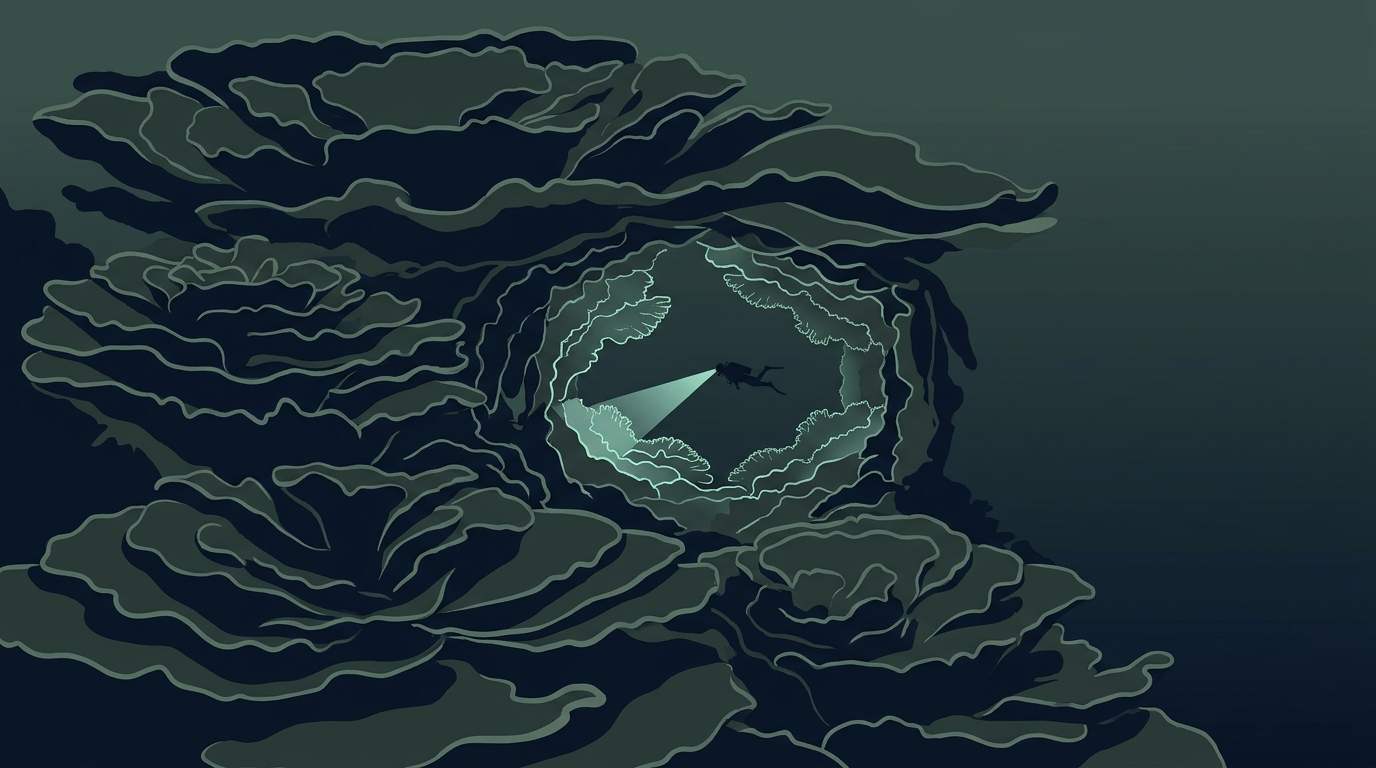
Yet the inherent limits of human vision underwater masked the true grandeur of the formation. Scuba divers peering through masks with dive lights can only pierce ten to fifteen meters into the surrounding gloom. Suspended along a sheer drop-off, a diver sees only the undulating leaves within immediate arm’s reach.
For decades, dive guides and scientific visitors navigated directly over the formation. Thousands floated past without suspecting that the scattered patches below were part of a single, coherent superstructure. Most assumed they were observing separate, self-contained colonies growing side by side.
The full scale only came to light during systematic surveys conducted by a collaborative consortium of universities and museum institutions, funded under a marine scientific program supported by Parks Australia. Focusing on the remote Cocos (Keeling) Islands Marine Park in the eastern Indian Ocean, researchers armed with surveying equipment tracked the slope contours, matched coordinate logs, and realized that these seemingly isolated stands formed one unbroken living chain.
Twelve Exhausting Dives: Mapping the Perimeter by GPS
Documenting the continuous border of the coral wall tested the team’s logistical limits. Led by marine ecologist Jean-Paul Adrian Hobbs, researchers descended expecting the formation to taper off within several hundred meters. Instead, as divers traversed the slope, the tiers of rose fronds stretched forward continuously like green-brown rolling waves.
Operating at depth imposed strict physiological constraints. Because much of the colony lies between 14 and 65 meters down, divers consumed their compressed air reserves rapidly and hit decompression thresholds before reaching an end. Swimming the full 1.5-kilometer span in a single excursion was physically impossible.
The team adopted an iterative leapfrog approach. Whenever a diver ran low on air and surfaced, researchers recorded their exact location with a handheld GPS (Global Positioning System) unit on the surface vessel. On the subsequent descent, divers returned precisely to that marker and continued tracking the outer perimeter.
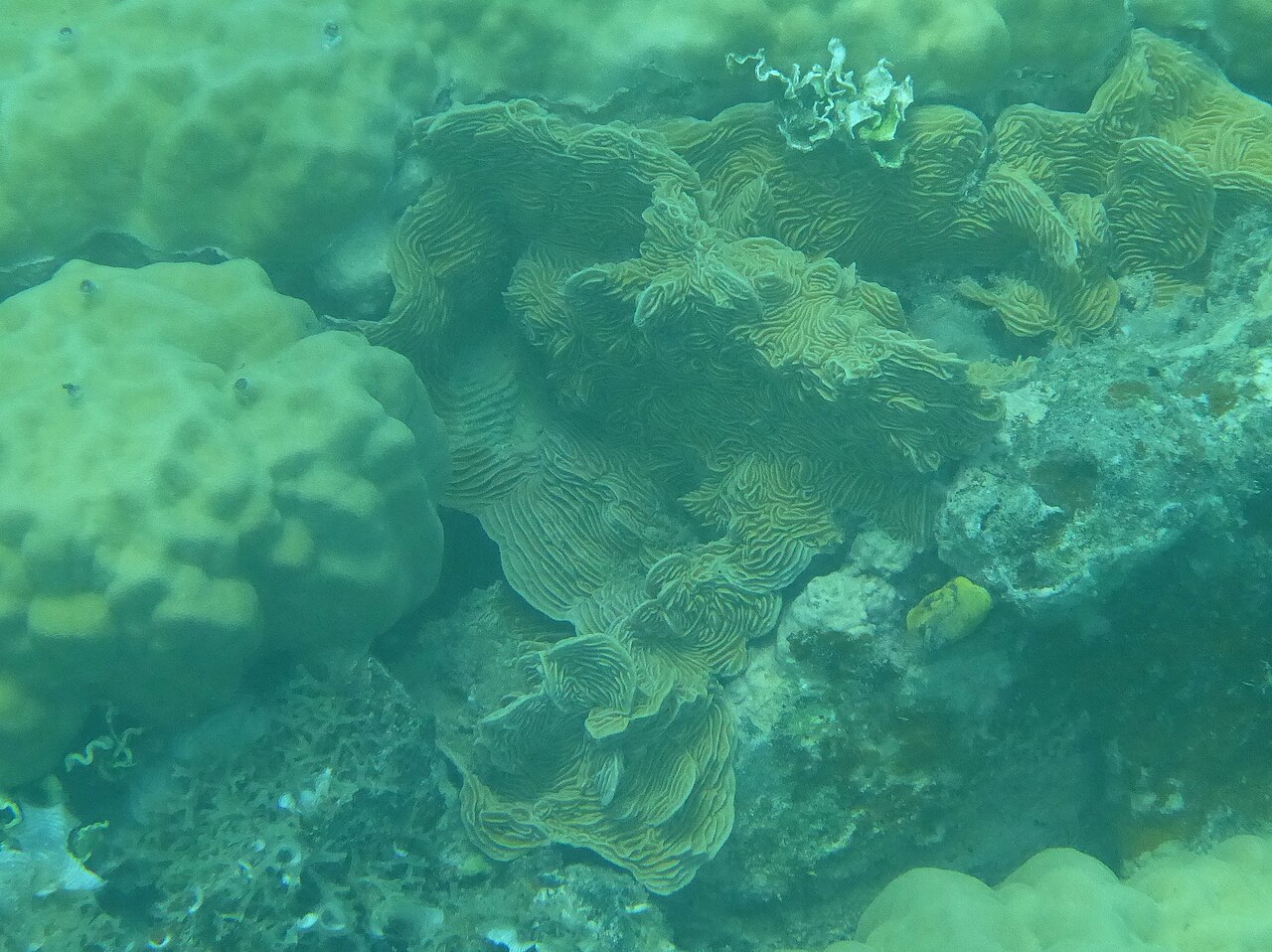 Figure: Clustered underwater growth habit of a Pachyseris coral colony. Source: Wikimedia Commons (Mila Zinkova)
With fresh cylinders, the divers resumed their downcurrent path along the reef edge. It ultimately required 12 intensive, coordinated deep dives before the team successfully closed the boundary loop and mapped the colony’s complete perimeter.
Genetic Testing: A Single Giant Clone or Fused Colonies?
With the physical mapping complete, researchers face an intriguing biological question: Did this 1.5-kilometer living wall originate from a single fertilized larva through continuous clonal budding, or did dozens of genetically distinct colonies fuse seamlessly together over centuries?
Both pathways are well-documented among colonial marine invertebrates. Many reef-building corals excel at asexual reproduction, spreading across hard substrates through repeated cloning as identical polyps bud outward. On stable rock surfaces, a single colony can advance across square kilometers much like creeping turf grass. Conversely, when adjacent distinct colonies meet, they may exhibit competitive aggression, or under specific compatible conditions, fuse their calcareous skeletons into a unified framework.
Publishing initial findings in the Raffles Bulletin of Zoology, the research team outlined genetic sequencing plans to analyze tissue samples from across the reef. If samples from opposite ends show identical genomic profiles, the formation represents the largest individual clonal animal colony ever documented on Earth. Even if it proves to be a chimera of fused colonies, the scale of continuous, multi-century skeletal cohesion remains unprecedented.
Deep Reef Refuges: Cooler Slopes Cushion Against Climate Heat
This megacolony’s existence carries heightened ecological significance amid escalating global climate pressures. In recent years, sea surface temperatures have broken historical records, triggering severe, widespread coral bleaching across shallow reefs, including repeated mass-mortality events along the Great Barrier Reef. In many shallow coastal zones, once-vibrant coral gardens have deteriorated into stark, white skeletons.
The steep outer reef slope provides natural protection against thermal stress. Rooted along the deep drop-off between 14 and 65 meters, this colony thrives well below the warmest upper layer that bears the brunt of atmospheric heatwaves.
Water depth acts as an environmental buffer. While shallow lagoons experience sharp temperature spikes during peak summer months, deeper oceanic waters remain comparatively stable and benefit from periodic upwelling of cooler currents. Shielded from intense solar irradiance and surface heating, this rose coral sanctuary was afforded the environmental stability needed to grow undisturbed across centuries of human history.
Stretching 1.56 kilometers through the Indian Ocean, this monumental reef challenges the perception that corals are inherently fragile organisms doomed by the first wave of environmental change. While shallow reefs urgently require global emissions cuts, this colossal living wall reveals that the ocean’s deeper slopes hold vital refugia, keeping ancient genetic lineages alive in a rapidly warming world.
Reference Links:
- Raffles Bulletin of Zoology research paper: Mapping the giant coral colony of the outer reef slope at the Cocos (Keeling) Islands
- Scimex Science News: Queensland Museum announces mapping of one of the world’s largest known coral colonies
- Xinhua News: Scientists map one of world’s largest known coral colonies