First Batch of 470 Units, Most Arriving in 2027
On November 16, 2026, wall-mounted e-paper hardware maker TRMNL officially announced Frame on its blog: a 31.5-inch full-color electronic paper display encased in a wooden enclosure, designed to hang on a wall and display calendars, weather forecasts, and artwork. With an initial production run of roughly 470 units, the founder plans to ship a small batch before the end of 2026, with the bulk following in early 2027. The first wave will ship only to four countries: the United States, Canada, Mexico, and Australia.
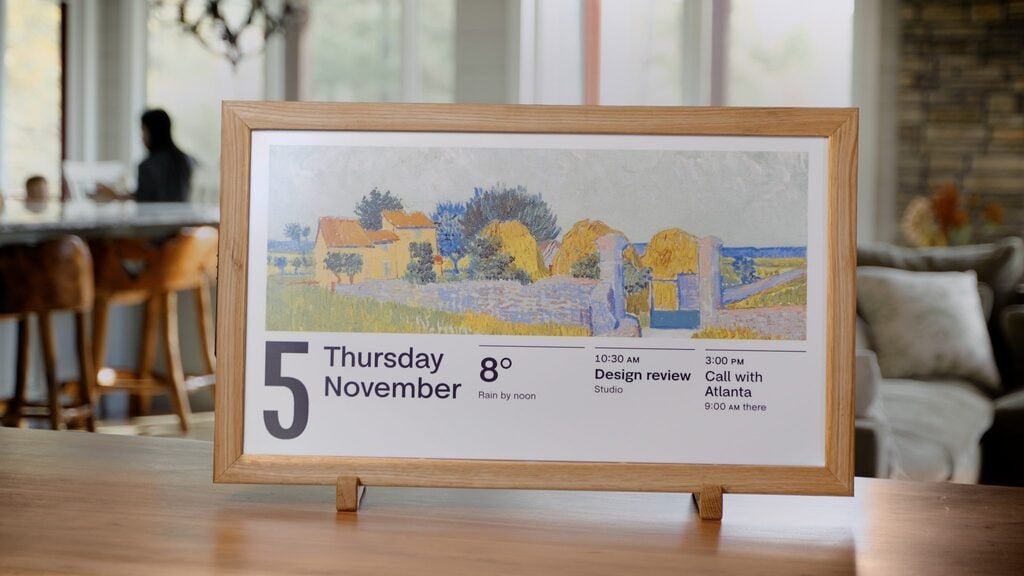 Photo: Frame in action, displaying a calendar, weather widget, and artwork side by side on a single panel—exactly the kind of static layout where e-paper excels. Source: TRMNL official blog.
The same blog post included another photograph: the company’s dedicated woodshop in Pine Mountain, Georgia, where every single wooden frame is cut, sanded, and assembled. A hardware company selling displays decided to set up its own dedicated woodworking facility for enclosures. They built everything they could build themselves; what remained was the one thing they couldn’t.
On the Supply Sheet, Only the Panel Takes Months
TRMNL published its complete bill of materials and inventory status without redactions, detailing the source, lead time, and stock level for every component. That table hides two distinct temporal scales:
| Component | Source | Lead Time | Stock Status |
|---|---|---|---|
| 31.5-inch E-Paper Panel | Overseas | 2 to 3 months | 300 units in warehouse, 200 in transit |
| Driver Board (PCBA) | Overseas | 2 to 3 weeks | 1,000 component kits |
| Battery | Overseas | 2 to 3 weeks | 800 units |
| Packaging | Alabama, USA | — | Sourced locally |
| Plastic Parts | HQ in LaGrange, 3D printed | Made daily | — |
| Wooden Frame | In-house woodshop | 1 week | — |
Reading down the table reveals a contracting funnel: 1,000 sets of driver board components, 800 batteries ordered, and just 500 panels—barely enough for the 470 finished units. Lead times also fall into two tiers: driver boards and batteries arrive on a weekly cadence, while panels are measured in months. The closer you get to the display panel, the thinner the inventory and the longer the lead time; the wait for the entire device hinges entirely on this single component.
Wooden frames take just one week to produce, arriving faster than overseas batteries. By bringing the frame enclosure in-house, the company effectively eliminated the last controllable variable in its delivery cycle—and after cutting everything possible, the only item left on the books measured in months was the screen.
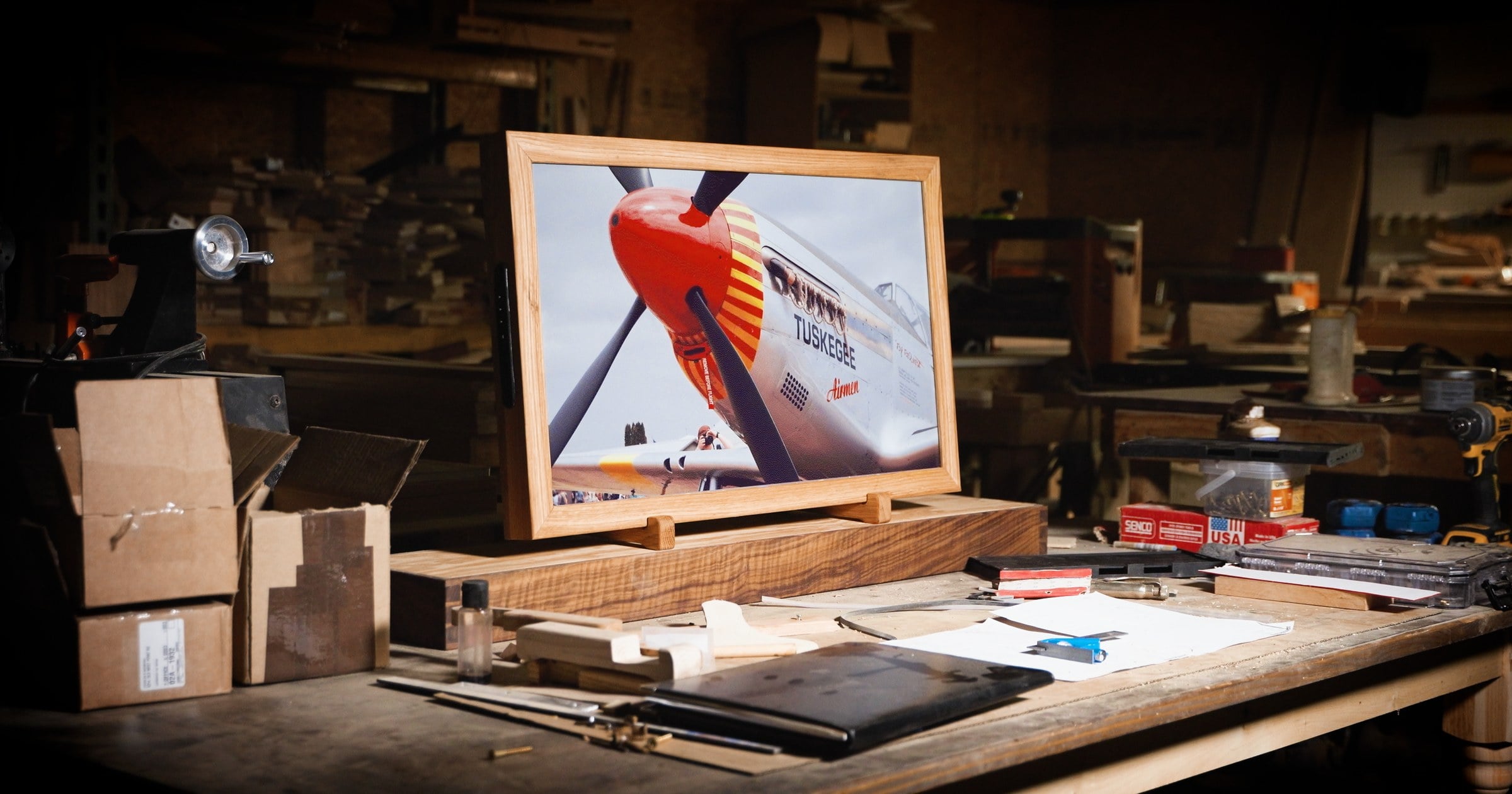 Photo: The woodshop in Pine Mountain, Georgia, as shown on the official blog. Handcrafted wooden frames take 1 week; plastic parts are 3D-printed daily at HQ in LaGrange—every process that could be localized was brought in-house. Source: TRMNL official blog.
Supermarkets Covered in Small Screens, Large Screens Stuck at the Fab
The broader context circulating in community discussions is clear: electronic paper won the supermarket battle long ago. On grocery shelves across the UK, Canada, Hungary, and the Nordics, 2-to-3-inch electronic shelf labels (ESLs) have been ubiquitous for years, their unit economics long past the threshold for mass deployment. Yet a single 31.5-inch panel has the surface area of well over a hundred price tags. The consensus explanation in discussions points to two culprits: patents and manufacturing capacity. Supply remains concentrated in the hands of very few manufacturers, production lines are scarce, and costs have stayed stubbornly high.
In electronic paper, each pixel is a microcapsule filled with charged pigment particles. Applying an electric field drives the particles into position; once the charge is removed, they stay put. Because static images require zero power without refreshes, a single frame can persist indefinitely. The tech consensus is that e-paper is naturally suited for static visuals: full-motion animation struggles to break single-digit frame rates, rendering video impractical, but hanging a still painting is ideal. The larger the screen, the more pigment particles must be precisely coordinated during each refresh; adding color introduces even more pigments per pixel. Small screens compete on unit economics; large screens compete on yields and fab capacity, both tightly controlled by upstream panel makers.
They Once Said They Would Never Do Color
TRMNL previously stated on the record that it had no interest in building color devices, offering a single rationale: “TRMNL is not a television, and it is not a clock.” What altered that perspective was content evolution: once grayscale rendering was refined, photos and artwork proved surprisingly legible in black and white. One community member even rendered the entire movie Jaws on an e-paper screen via 1-bit frame-by-frame dithering. A wall-mounted display built to showcase visual art finally earned the justification to go color.
The founder is no stranger to content outpacing hardware. In 2013, he launched ArtSpot, installing displays on the walls of cafes and independent galleries to curate and sell art for artists. Finding artists was straightforward, and building the platform was manageable; the bottleneck was that nobody opened their wallets to buy digital prints. After five years, he wound down the venture, repaying his investors in full with 13% interest.
Thirteen years ago, that project failed because its critical bottleneck went unsolved. This time, the playbook reversed: panel capacity is scarce, so 500 panels were stockpiled in advance; wooden frames are manageable, so they opened a dedicated workshop to build them. The difference between the two ventures lies right there—the single scarcest link in the chain was anticipated and tackled head-on.
Fully Offline Capable, Refreshes Scheduled to the Minute
New hardware features deliberately align with the physical realities of e-paper. Clock Sync shifts refreshes from a relative interval (“every N minutes”) to an absolute, scheduled time: the screen flashes only at the exact minute information changes, reducing flash cycles and conserving battery life. An offline mode adds a microSD card slot—whatever is on the card is what the display presents, meaning the device can run perpetually without touching the internet or transmitting telemetry to any server. Powered by a 10,000 to 20,000 mAh battery, the device also includes rear mounting holes and a recessed USB-C port for users who prefer continuous power.
Together, these choices point to a cohesive design philosophy: the closer a screen gets to real paper, the less it should depend on power grids and network connections. Because e-paper holds an image without power, the most natural form factor for a wall-hung terminal is one that stays unplugged, stays offline, and only wakes up when strictly necessary.
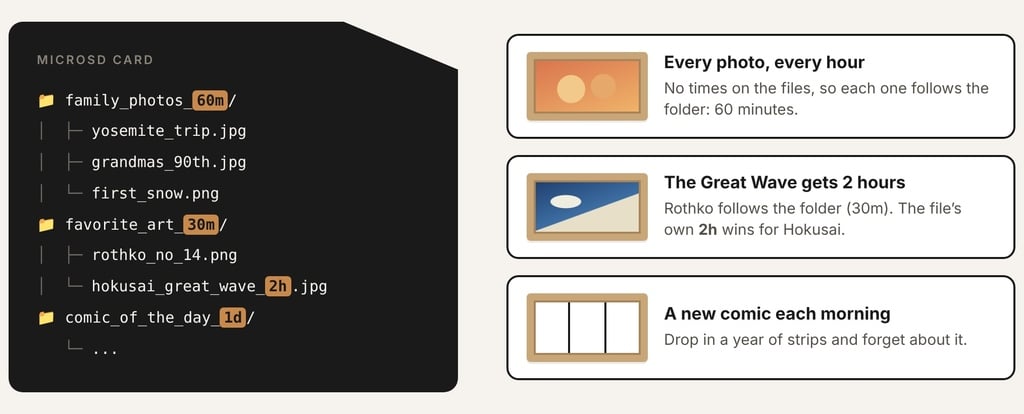 Photo: Illustration of offline mode. Whatever is on the card is what appears on screen; the device can run entirely without network connectivity. Source: TRMNL official blog.
The Woodshop Can Move to Berlin, But Panels Cannot
According to the company’s roadmap, a second woodshop will open next to its Berlin warehouse in early 2027, allowing European customers to receive their units without international shipping fees or import duties. Woodworking craftsmanship can be replicated, and the one-week turnaround for frames holds anywhere. But the 2-to-3-month panel lead time remains entirely fixed; the next batch of screens will still have to cross the ocean from overseas fabs.
470 units, lead times measured in months, and a chain of company-run woodshops: combined, these three details lay bare the realities of the large-format color e-paper industry. Driver boards, batteries, enclosures, and packaging are all solvable problems. Only the panel has a hard ceiling on global fab capacity. For supermarket price tags, the cost economics of e-paper were settled years ago; the 31.5-inch Frame plays by entirely different rules—the product works, but scale remains trapped in the production schedules of upstream panel foundries.
Reference Links:
- TRMNL official blog: Frame announcement
- TRMNL bill of materials and production schedule
- Community discussions on electronic shelf labels and large-format panel capacity