On November 9, Io Was Ten Minutes Late
In September 1676 at the Royal Academy of Sciences in Paris, Danish astronomer Ole Rømer made a bold prediction: on November 9 of that year, Jupiter’s moon Io would emerge from Jupiter’s shadow ten minutes later than calculated by its orbital tables. On November 9, it was indeed ten minutes late. Had light traveled instantaneously, it would have appeared ten minutes sooner.
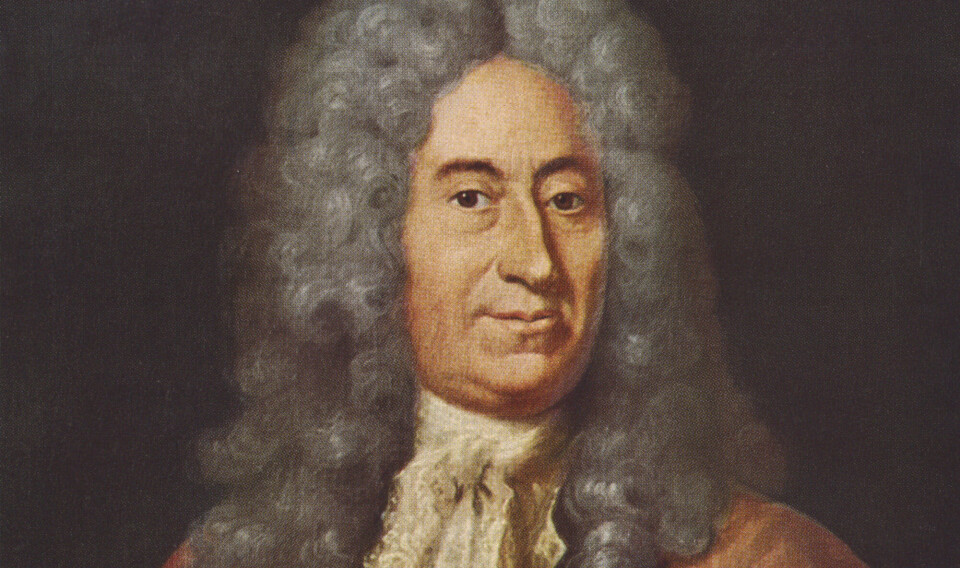 Figure: Portrait of Ole Rømer. He arrived in Paris in 1671 and spent the next decade as an astronomer at the Paris Observatory. Source: Wikimedia Commons / Science Norway
Rømer had moved from Denmark to Paris in 1671, spending the next ten years as an astronomer at the Paris Observatory. The moon in question was Jupiter’s closest companion: orbiting very close to the giant planet, Io plunges into Jupiter’s shadow with every revolution, disappears for a time, and reemerges on the other side. Astronomers call this an eclipse, essentially the same mechanism as a lunar eclipse. Io is eclipsed by Jupiter roughly every 42.5 hours.
An Eclipse Every 42.5 Hours: Reliable Enough to Serve as a Clock
Every 42.5 hours, without fail. This regularity was so steady that it could serve as a cosmic timepiece: the moments of entering and exiting the shadow functioned like a celestial clock ticking in the sky. Astronomers of that era sorely needed such a clock, hoping to use it to synchronize time for oceanic navigation.
Yet this cosmic clock had an observational quirk. Because Io orbits so close to Jupiter, an observer on Earth can only see either the ingress (disappearance) or the egress (reemergence) during a single night, never both. Which one is visible depends entirely on where Earth is in its orbit: before Earth and Jupiter reach their closest approach (opposition), observers see Io vanish into the shadow; after passing opposition, they observe it emerging.
Rømer meticulously compiled timing records for both types of events over several years. Taken individually, each night’s observation seemed routine. But plotted against Earth’s orbital position, an inescapable pattern emerged: the same celestial clock was drifting.
The Farther Earth Traveled, the Later the Light Arrived
The reason for this drift was explained plainly by Professor Jacob Wüsthoff Linder from the Department of Physics at the Norwegian University of Science and Technology (NTNU): when Earth moves away from Jupiter, eclipses occur slightly later than expected; when Earth moves closer, they happen slightly earlier. The reason is that light has to travel a greater or lesser distance.
The celestial clock had not malfunctioned. The discrepancy stemmed from Earth itself: Earth was moving, meaning the distance light had to travel from Jupiter changed constantly. That extra distance translated into minutes of delay. Before Rømer, prevailing wisdom held that light propagated instantaneously: the moment the Sun rose, daylight illuminated the Earth with zero delay.
The notion that light takes time to travel was not entirely new. Empedocles in ancient Greece, Ibn al-Haytham and al-Biruni in the Islamic Golden Age, and Roger Bacon in medieval England had all pondered whether light has a finite velocity. Yet none could offer empirical proof; light moved far too fast for terrestrial rulers to catch. Rømer’s breakthrough was to scrutinize the timing anomalies of a satellite clock: amplified across astronomical distances, the discrepancy grew large enough to be captured by a telescope and human eyes.
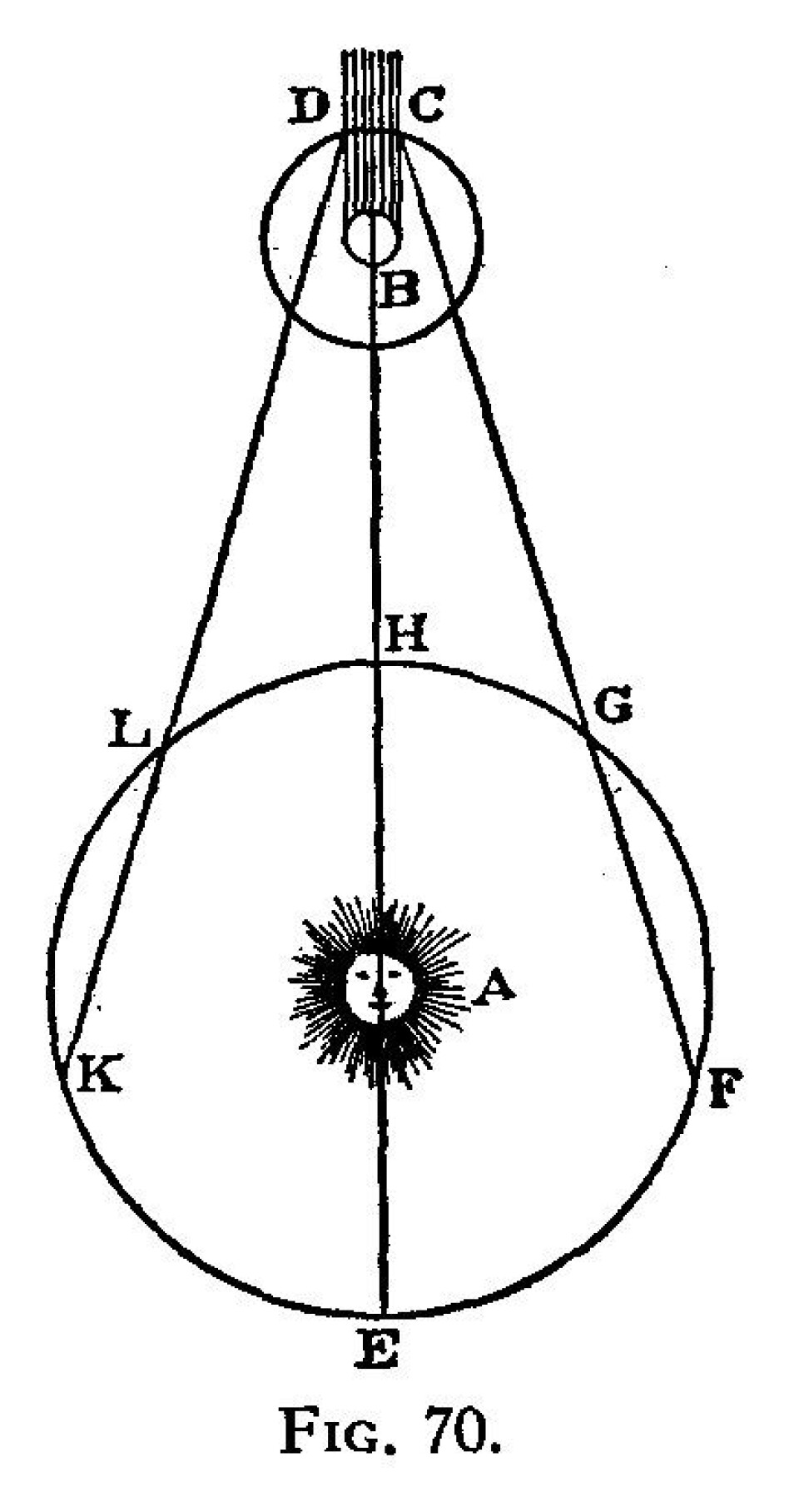 Figure: The original diagram from Rømer’s 1676 paper. B represents Jupiter casting its shadow (hatched), while K, F, L, and G mark Earth’s positions along its orbit when observing Io’s eclipses. This diagram illustrated why light arrived with a delay of several minutes. Source: Ole Rømer, 1676 / Science Norway
Off by 25%, Yet Unshakable for 350 Years
Going from an observed time discrepancy to the actual speed of light required a geometric conversion. Rømer deduced that light takes roughly 22 minutes to cross the diameter of Earth’s orbit—the full width of the circle Earth traces around the Sun. Converted to modern units, this yielded a speed of approximately 225,000 kilometers per second. Compared to today’s accepted value of roughly 300,000 km/s, his figure was about 25% too low.
“It is not very accurate by modern standards, but for 1676, it was a remarkable achievement,” Linder remarked. A 25% margin of error did not undermine his breakthrough, because Rømer’s triumph was never about an exact number. He cataloged the sources of uncertainty back then: from imperfect planetary orbital models to imprecise timing tools. The theoretical framework was sound, leaving the numbers to be refined by sharper instruments.
Linder emphasized a more fundamental takeaway: what truly mattered was that Rømer demonstrated that the speed of light is finite and measurable. The exact figure was secondary.
Huygens Agreed; the Observatory Director Did Not
Rømer’s findings were published promptly on December 7, 1676, in the Parisian scientific journal Journal des sçavans. Yet acceptance was far from immediate. Early skeptics voiced doubts, and the head of the Paris Observatory, Giovanni Domenico Cassini, refused to fully embrace Rømer’s explanation—even working under the same roof, he remained unconvinced.
External validation, however, arrived swiftly. Prominent scientists like Christiaan Huygens rallied behind Rømer, and Isaac Newton later accepted that light travels at a finite velocity. The definitive proof came roughly 50 years later, when English astronomer James Bradley discovered stellar aberration. As Earth orbits the Sun, starlight appears slightly tilted in the direction of orbital motion—much like running in the rain causes raindrops to hit your face at an angle. This phenomenon can only occur if light moves at a finite speed. Bradley’s discovery had nothing to do with Io and relied on an entirely independent mechanism, yet it pointed to the exact same truth.
The Stars You Gaze at Tonight Belong to the Past
The finiteness of the speed of light became a cornerstone of modern astrophysics. Every star you look up at tonight shows you what it looked like in the past—its light took years, decades, or millennia to reach your eyes. This was humanity’s first instance of turning celestial mechanics into an experimental timing apparatus: a moon in the solar system was transformed into a laboratory clock; sources of error were rigorously documented, the numbers could be updated, and the conclusion was verified half a century later by independent methods.
Returning to that ten-minute delay in November 1676: the clock had not broken, and the satellite had not strayed. What changed was the distance between Earth and Jupiter. As light traversed varying expanses of space, those extra minutes were simply the toll of the journey. Rømer turned what had seemed an immeasurable constant into a quantity that observational discrepancies could pinpoint and refine. His number was off by 25%, but for 350 years, no one has overturned the method he used to measure the cosmos.
References:
- Science Norway reporting
- Commentary by Professor Jacob Wüsthoff Linder, Department of Physics, NTNU
- Wikimedia Commons Ole Rømer portrait page
- Journal des sçavans publication, December 7, 1676