To test the multi-link aggregation throughput of the world’s first Wi-Fi 8 router, the review lab faced an immediate hurdle. Testers had to acquire a second identical unit just to establish a point-to-point wireless bridge.
In late 2026, client devices supporting next-generation wireless standards have yet to surface in the consumer market. Yet the $900 ASUS ROG Rapture GT-BN98 Pro is already on retail shelves, packing a quad-core Broadcom processor and a quad-band radio array. The IEEE 802.11bn specification it targets, meanwhile, is not scheduled for formal ratification for another two years.
Launching hardware ahead of ratified standards is a well-worn playbook for networking peripherals. This preemptive rollout uses bleeding-edge specs to capture early mindshare. So long as hardware enthusiasts are willing to pay the premium, the lack of an ecosystem will hardly stop vendors from getting an early start.
Client Vacuum: Bridging Two $900 Routers to Hit 5 Gbps
Unboxing the hardware, Wired reviewer Simon Hill encountered the awkward reality of testing a protocol with zero native clients. Every PC, MacBook, and PS5 in the lab remained locked to earlier generations. Validating Wi-Fi 8’s Multi-Link Operation (MLO) mechanisms required bridging two GT-BN98 Pro units together over wireless backhaul.
In close-proximity, back-to-back testing between the two routers, multi-band concurrency delivered real-world throughput approaching 5 Gbps. That figure showcases the radio frequency ceiling of Broadcom’s latest silicon. Early in the Wi-Fi 7 lifecycle, MLO band switching was notoriously plagued by buggy firmware and erratic latency spikes. Here, across multi-stream high-bitrate video transfers, the cross-band wireless backhaul remained steady and synchronized.
Single-client results predictably retreated to familiar territory. Within line-of-sight in the same room, throughput touched 3 Gbps before falling to 1 Gbps through a load-bearing wall. Moving outside to the garden behind thick brickwork brought bandwidth down to 350 Mbps. Leveraging ASUS’s AiMesh topology, the quad-band architecture lets users reserve one dedicated 6 GHz band for wireless backhaul while leaving the remaining bands open for everyday clients.
Stacked against the previous-generation Wi-Fi 7 flagship RT-BE96U, the GT-BN98 Pro held a slight edge across test points with marginally broader coverage. But for average households, that extra headroom delivers zero tangible benefit on current smartphones. Spending $900 on a future-looking protocol effectively means running it in backward-compatible fallback mode for the next 18 months.
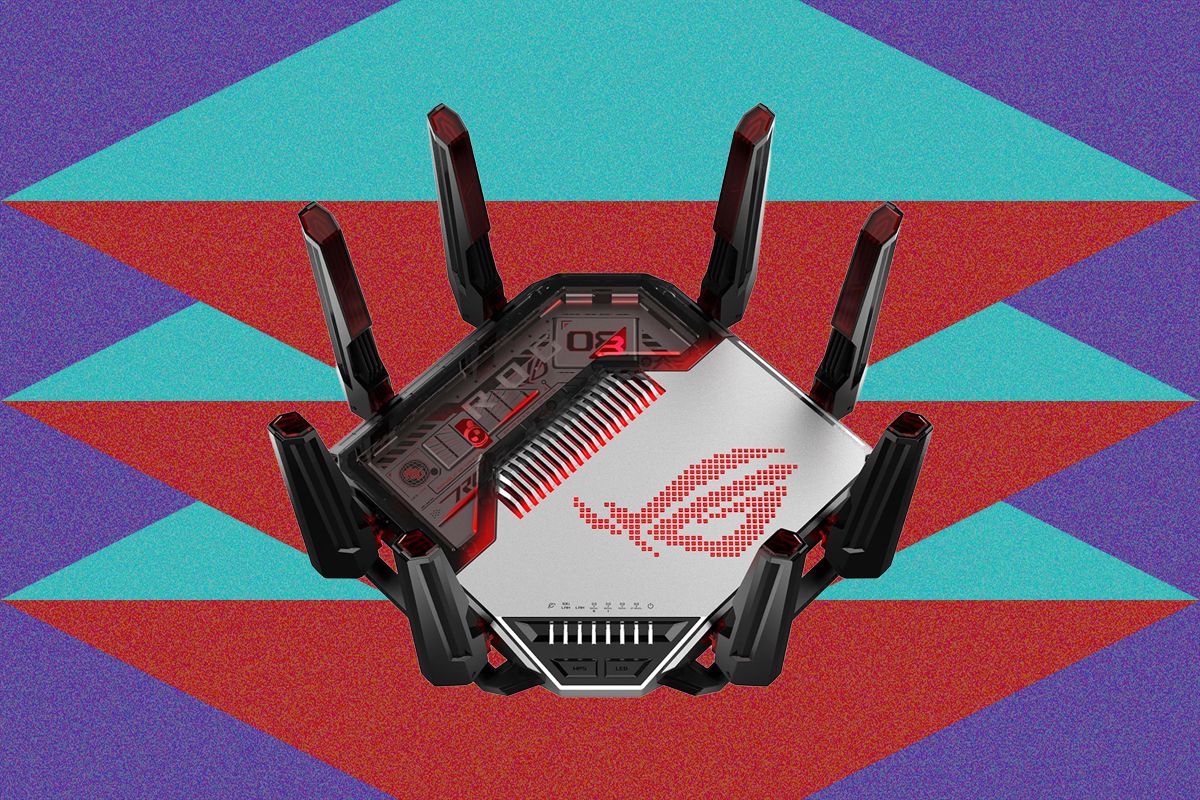 Fig: The ROG GT-BN98 Pro features eight fixed antennas and a semi-translucent top panel. Source: ASUS official
Broadcom BCM6718 Powers Quad-Band Hardware Ahead of IEEE Finalization
Measuring roughly 14 inches square and rising nearly 9 inches tall with its antennas deployed, the GT-BN98 Pro looks like a mechanical spider crab. Its monolithic footprint makes zero concessions to living-room decor. A semi-translucent window on the top shell exposes internal traces, framed around a multi-zone Aura RGB logo. The aggressive industrial design makes no secret of its server-rack aspirations.
That massive chassis volume affords generous headroom for completely fanless passive cooling. Layered aluminum heatsinks and carefully routed airflow channels directly contact the main SoC and front-end RF modules. Even after a month-long sustained load stress test, the chassis remained lukewarm to the touch and dead silent. For core networking infrastructure running 24/7, silent passive operation removes the failure point of tiny, high-RPM fans degrading from dust buildup.
The rear panel hosts an uncompromising port matrix: dual 10 Gbps ports, four 2.5 Gbps ports, a gigabit Ethernet jack, and dual multi-purpose USB ports. A dedicated 10G gaming port supports automated traffic prioritization, while the two 10G ports can be bonded via link aggregation to deliver up to 20 Gbps of LAN throughput. High-speed NAS rigs and local workstations will encounter zero network bottlenecks under this configuration.
Under the hood sits Broadcom’s BCM6718 silicon, driven by a quad-core 2.6 GHz processor backed by 256 MB of flash storage and 2 GB of DDR4 RAM. The RF stage spans 2.4 GHz, 5 GHz, and two discrete 6 GHz bands, culminating in a combined BN30000 rating. All four bands support full 4x4 streams, OFDMA, and 4096-QAM modulation, maxing out concurrency capacity at the physical layer.
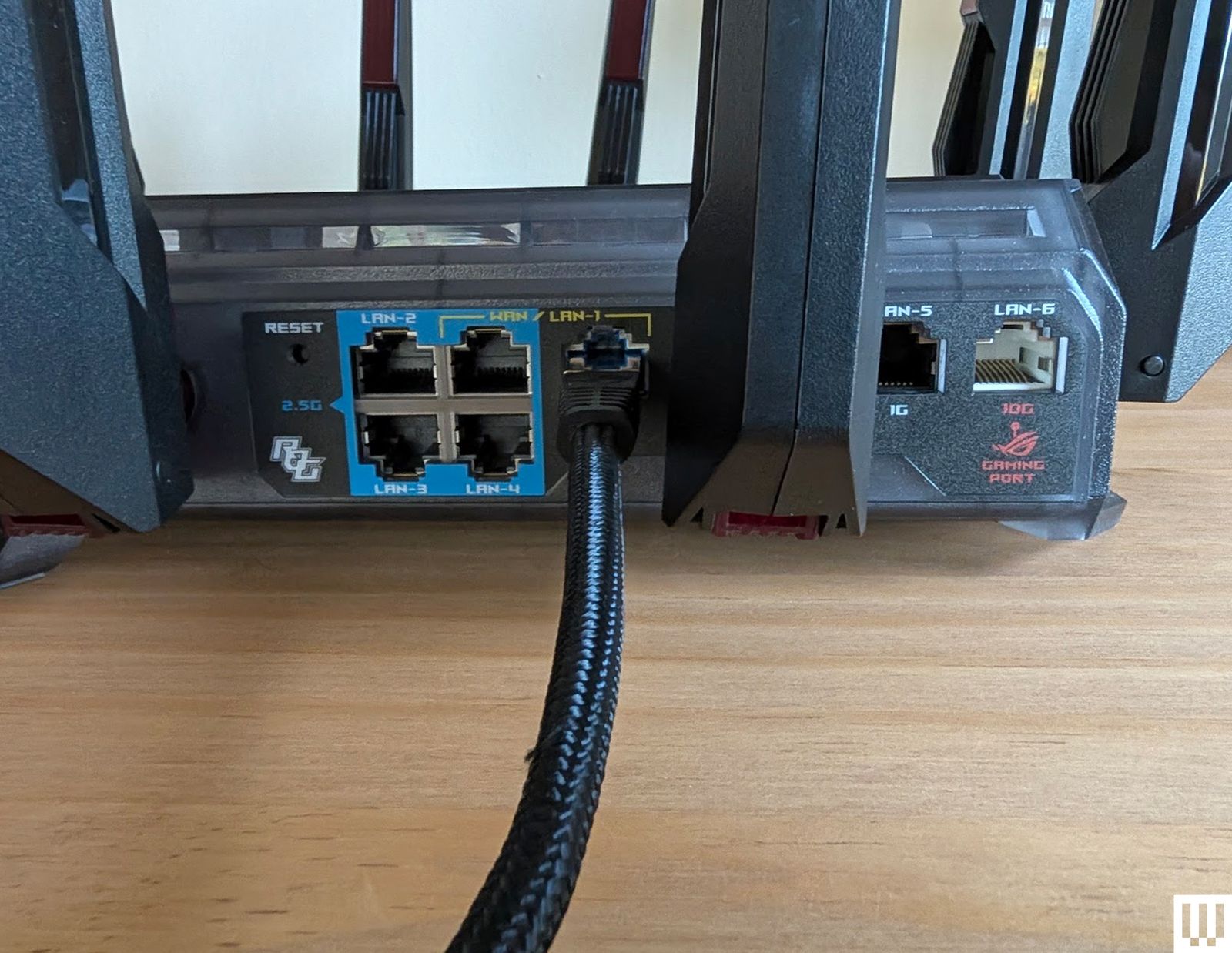 Fig: The rear panel provides dual 10G ports supporting link aggregation up to 20 Gbps. Source: Wired (Photo by Simon Hill)
Shifting Focus from Peak Throughput to Latency and Jitter
From Wi-Fi 6’s 160 MHz channels to Wi-Fi 7’s 320 MHz and 4096-QAM, previous generations relentlessly chased higher theoretical top speeds. Wi-Fi 8 (designated IEEE 802.11bn UHR, or Ultra High Reliability) steps off that spec-sheet treadmill. Retaining 320 MHz channel widths and 4096-QAM, engineering efforts have pivoted toward link reliability, lower latency, and jitter reduction in congested environments.
During multi-device stress testing, two PCs, a laptop, and a PS5 joined competitive matches simultaneously. Between the onboard Game Boost scheduling engine and GTNet server routing acceleration, ping fluctuations remained tightly pinned within single-digit milliseconds. The Adaptive QoE engine actively sniffs gaming traffic, preventing bulk downloads on the network from bottlenecking latency-sensitive packets.
Under the hood, Wi-Fi 8 introduces coordinated beamforming across multiple access points and dynamic sub-channel puncturing. Yet coordinated beamforming requires real-time channel matrix feedback from compliant client chips. In the absence of supporting end devices, these advanced algorithms remain dormant. For now, the router’s buttery-smooth traffic handling is primarily brute-forced by its quad-core SoC and high-gain antenna array.
Regulatory approvals present another hurdle. While jurisdictions like the US and UK are pushing Automated Frequency Coordination (AFC) to unlock higher 6 GHz transmit power, other regions maintain cautious EIRP restrictions. Unlocking the full potential of these radio bands will take coordinated global regulatory alignment.
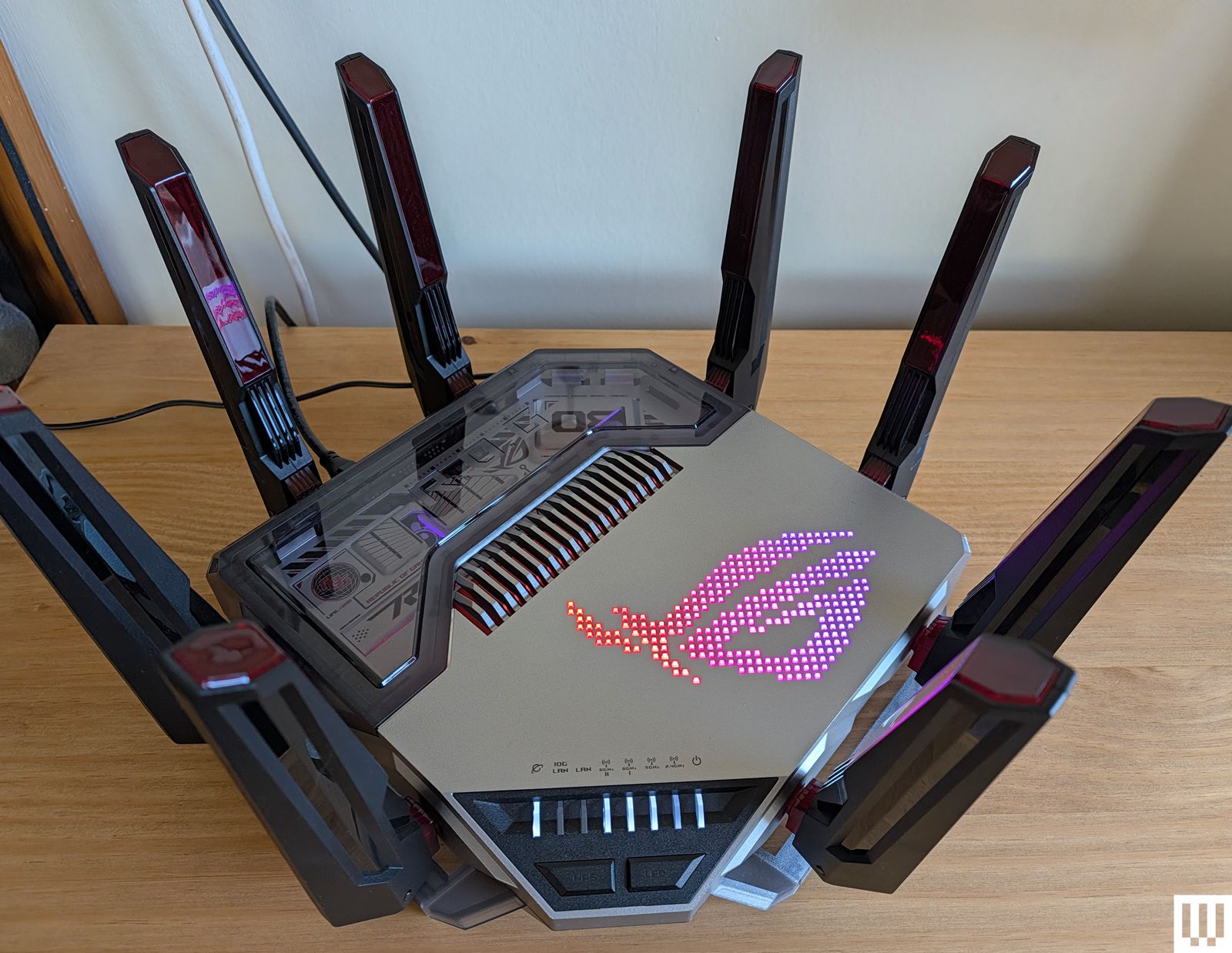 Fig: Front panel equipped with status LEDs and intake vents. Source: Wired (Photo by Simon Hill)
Securing Enthusiast Mindshare While Borrowing Against the Next Gen
Unlike the first batch of Wi-Fi 7 routers that suffered from frequent disconnects and required months of firmware triage to stabilize, the GT-BN98 Pro lands on remarkably mature ground. AsusWRT 6.0 is rock-solid out of the box, with subscription-free security and a bundled one-year NordVPN plan eliminating hidden costs. With TP-Link’s competing Archer 8 Ultra temporarily stalled awaiting FCC sign-off, ASUS holds an open runway in the North American market.
From 802.11ac to Wi-Fi 6 and Wi-Fi 7, releasing hardware ahead of final working-group draft ratifications has become routine practice. The moment next-gen silicon clears early fabrication runs, manufacturers race to ship boxed product. This early-bird strategy accelerates capital recovery while planting an early brand flag at the generational transition point.
That technology premium is unmistakably reflected on the price tag. At $900, the GT-BN98 Pro commands a $200 premium over its quad-band Wi-Fi 7 counterpart, the GT-BE98 Pro, and sits a full $300 above the tri-band RT-BE96U. With underlying hardware specs heavily overlapping existing high-end gear, paying an extra $200 to $300 for an unratified draft standard feels like buying a futures contract.
For power users architecting dual-10G LAN backbones, the GT-BN98 Pro offers bleeding-edge headroom. But for mainstream households, the calculus is very different. Without compatible client devices, upgrading your core network hub today yields no noticeable performance jump. At this stage, jumping the draft standard remains a commercial game played exclusively for the enthusiast fringe.
Reference Links:
- Wired Review Report
- ASUS Official Product Specifications
- IEEE 802.11bn Working Group Status