On November 3, 2026, open-source hardware maker Banana Pi officially launched the BPI-M8 single-board computer. The board retains the familiar credit-card form factor at 85×56 mm. At its core sits the Allwinner A733 octa-core SoC, paired with up to 64GB of onboard eMMC flash storage and native PCIe signals routed directly to an FPC flat cable connector.
For years, SBC enthusiasts and developers have wrestled with the hidden costs of essential accessories. While the Raspberry Pi 5 has been on the market for two years, its base board still lacks integrated storage. System booting continues to rely on sluggish, wear-prone microSD cards. To achieve dependable solid-state storage and dedicated AI acceleration, users must stack multiple HAT add-on boards. What begins as a compact credit-card machine quickly balloons into an ungainly multi-tier sandwich.
The BPI-M8 challenges this paradigm. By integrating high-speed storage, rich peripheral I/O, and an on-chip AI accelerator directly onto the mainboard, the highly integrated SoC delivers a true out-of-the-box edge computing experience.
Farewell to Accessory Stacking: 85mm Card Packs Onboard Storage and PCIe
Storage failures remain the single most common frustration across open-source hardware deployments. Conventional microSD cards suffer from weak random read/write speeds, and repeated write cycles frequently trigger filesystem corruption. In 24/7 edge gateways and industrial appliances, attaching an external NVMe SSD is essentially mandatory.
The BPI-M8 tackles this pain point at the board level. The higher-tier M8A edition integrates 64GB of soldered eMMC flash memory, offering throughput and write endurance that drastically outperform external microSD media. The board can cold-boot Linux straight from the box without inserting any external card. Banana Pi also offers the M8B variant with 16MB SPI NOR flash for tailored embedded deployments.
High-speed system expansion remains readily accessible. Along the edge of the PCB sits a multi-purpose FPC connector carrying both PCIe and DisplayPort signals. Developers no longer need to purchase bulky, rigid HAT expansion shields; a flat flexible cable is all it takes to link an SSD or custom expansion board. Inside cramped industrial enclosures, flexible ribbon cables route far more cleanly than multi-layer PCB stacks.
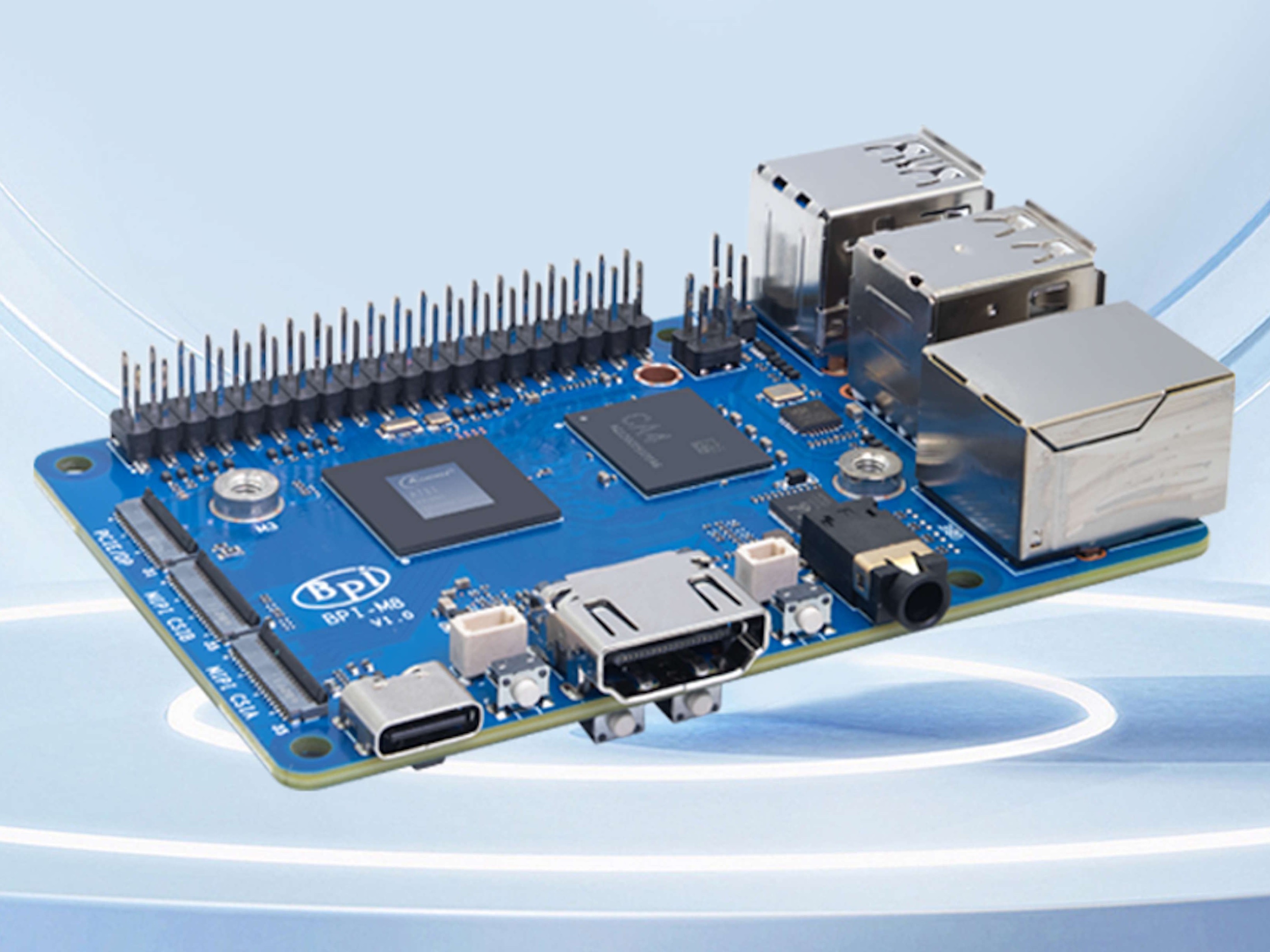 Figure: Front layout of the Banana Pi BPI-M8 integrating the Allwinner A733 SoC and 4GB LPDDR5 memory. Source: Notebookcheck
Inside Allwinner A733: Big.LITTLE Architecture Meets 3 TOPS Edge AI
The choice of processing core highlights Allwinner’s strategic push into edge computing. The A733 processor inside the BPI-M8 adopts a big.LITTLE heterogeneous architecture, packing two Cortex-A76 performance cores running at 2.0 GHz alongside six Cortex-A55 efficiency cores. Graphics rendering is handled by an Imagination PowerVR BXM-4-64 MC1 GPU.
This asymmetrical core layout dramatically improves thermal and power efficiency. The Raspberry Pi 5 runs four identical Cortex-A76 performance cores, which tend to generate excessive heat under light ambient loads. On the A733, six low-power A55 cores easily shoulder background daemon tasks and peripheral polling. The dual A76 cores kick in only when heavy computational workloads demand burst performance. Operating within a standard 5V/4A power envelope, overall thermals remain significantly easier to tame.
Memory and AI subsystem integration push silicon efficiency further. The board features 4GB of onboard LPDDR5 RAM, providing wider data bandwidth at lower operating voltages. A dedicated on-chip NPU delivers 3 TOPS of INT8 inference power, capable of running lightweight edge vision models locally. Developers are spared from buying auxiliary AI accelerator sticks costing tens of dollars; foundational vision computing runs directly on the single SoC.
Ditching Dongles: Full-Sized HDMI and Dual Camera Interfaces
I/O ergonomics often dictate how smoothly a single-board computer transitions from prototyping bench to field deployment. To conserve PCB real estate, both the Raspberry Pi 4 and 5 switched to micro-HDMI sockets. In production environments, fragile adapter plugs wobble loose and break, causing needless troubleshooting headaches on site.
The BPI-M8 returns to a standard, full-sized HDMI 2.0b port. Developers can hook up standard monitor cables without adapters to output up to 4K/60Hz video. The onboard Gigabit Ethernet jack incorporates integrated PoE pins; paired with an optional buck module, a single Ethernet line delivers both network connectivity and power supply, eliminating extra power cables.
Wireless connectivity and camera inputs are similarly comprehensive. The board integrates a dual-band Wi-Fi 6 and Bluetooth 5.0 module with dual external antenna sockets. Two 4-lane MIPI CSI camera connectors and one MIPI DSI display header sit alongside the standard 40-pin GPIO header, allowing binocular stereoscopic camera setups and auxiliary sensors to plug in without daughterboards.
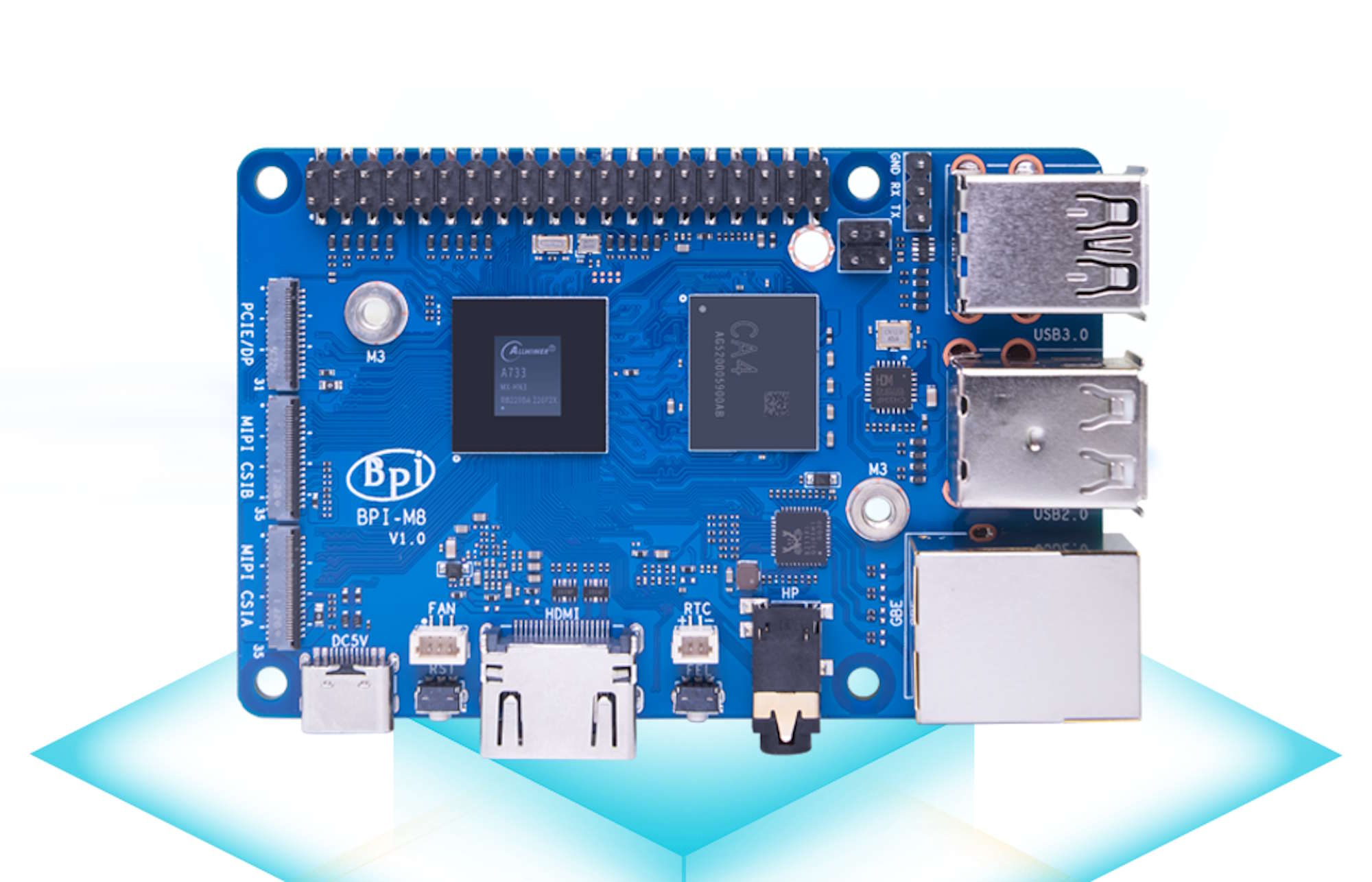 Figure: The BPI-M8 retains the standard 40-pin GPIO header while adding full-sized HDMI 2.0b and four USB ports. Source: Notebookcheck
Starting at $69: Integrated Silicon Redefines Open Hardware Value
Hardware bill of materials (BOM) drives retail pricing strategy. According to official store listings, the top-spec BPI-M8A with 64GB eMMC retails for $103, while the entry-level M8B variant without onboard eMMC starts at $69.
This pricing hits the sweet spot for budget-conscious SBC projects. A 4GB Raspberry Pi 5 carries an official baseline price of $60. However, once you tally up a quality microSD card, an active cooler, an RTC battery, and an NVMe M.2 HAT, the cost of a fully usable system comfortably eclipses $110. Adding a discrete AI accelerator board inflates the budget even higher.
The BPI-M8 demonstrates the cost leverage achieved through silicon-level integration. The Allwinner A733 pulls the NPU, network PHY, and power management circuits onto the chip. The entry version lowers the barrier to entry at $69, while the $103 edition provides an out-of-the-box turnkey package. Competition in the SBC market is shifting from stacking external breakout boards to maximizing on-die SoC density.
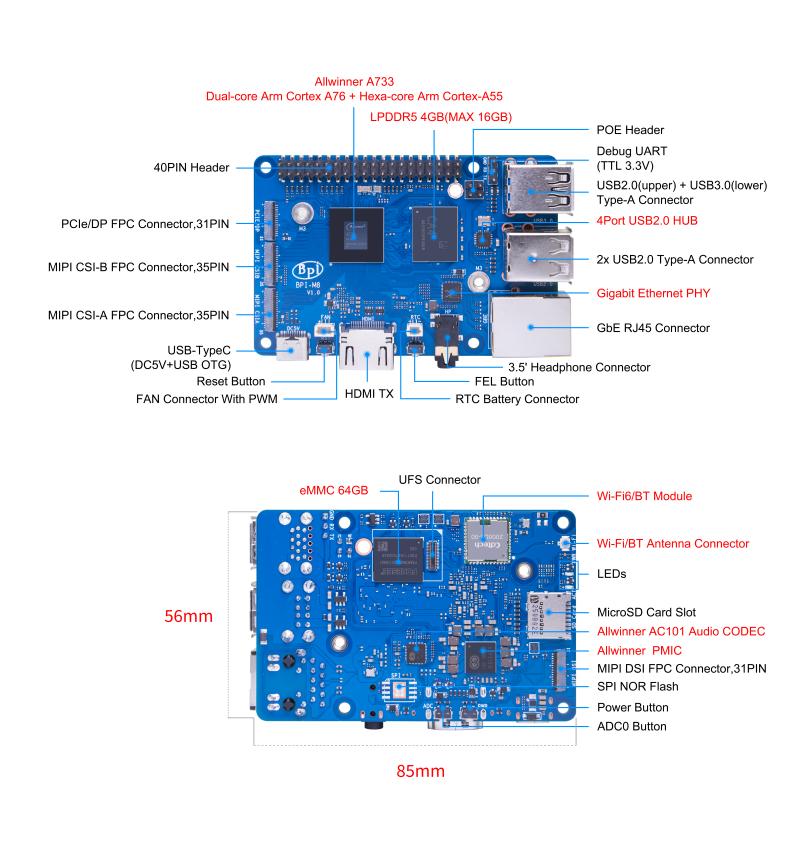 Figure: BPI-M8 pinout diagram and FPC PCIe connector signal routing. Source: Banana Pi Official Docs
The Software Divide: Upstream Mainline Support Determines Ecological Longevity
Impressive paper specifications do not automatically translate into market dominance. The real barrier to entry in open-source hardware lies in sustained software engineering maintenance. The Raspberry Pi ecosystem has dominated the maker space for over a decade thanks to clean upstream kernel merges, polished official OS images, and a massive community codebase.
Historically, alternative SBCs from Chinese silicon vendors have faced scrutiny over lagging software support. Boards frequently lingered on vendor-forked legacy BSP kernels, with upstream mainline support stalled or incomplete, leaving devices stranded without modern kernel security patches. Banana Pi has announced support for Linux, Android, and Armbian on the BPI-M8. Achieving swift, stable mainline Linux kernel support will be the deciding factor in winning over seasoned developers.
Hardware parity is already here; software cadence will decide the winner. With its 8-core architecture and built-in eMMC storage, the Allwinner A733 provides an escape route from the endless accessory tax. It establishes a strong foothold in industrial IoT and edge computer vision. Whichever platform irons out upstream software drivers first will turn raw silicon specs into durable developer loyalty.
Reference Links:
- Notebookcheck coverage on Banana Pi BPI-M8 launch
- Banana Pi Official Documentation: BPI-M8 hardware specifications
- Banana Pi Community Forum: A733 SBC product announcement
- Banana Pi Official Store: BPI-M8 product sales page