On November 5, 2026, the Redmi Pad 3—the next generation of Xiaomi’s entry-level tablet line—surfaced across multiple international regulatory certification databases. Rather than offering minor cosmetic tweaks typical of entry-level refreshes, the new tablet dramatically upsizes its battery to a rated capacity of 9,820mAh. Alongside the standard Wi-Fi variant, Xiaomi is officially introducing an independent cellular edition supporting 4G LTE.
Regulatory filings reveal that two models, codenamed “2610FRP38G” and “26104RPF2G,” have completed compliance approvals across major Southeast Asian and Middle Eastern markets. At a time when sub-$250 tablets routinely trim hardware specs, Xiaomi is equipping its frontline export devices with persistent mobile connectivity and near-10,000mAh endurance. The competitive focus for budget Android tablets overseas is shifting decisively from pure spec-sheet padding to practical, scenario-driven utility.
Regulatory Footprint Across Asia and the Middle East: Dual Variants Reshape the Lineup
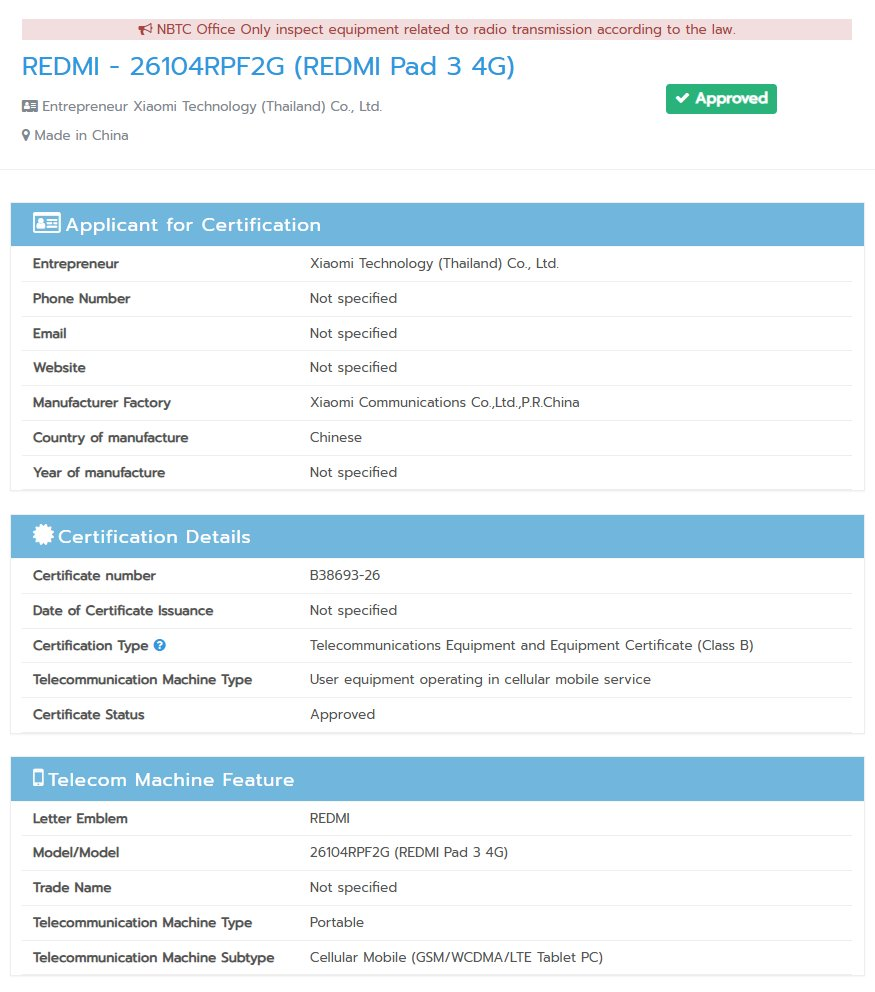
Filings published by Thailand’s National Broadcasting and Telecommunications Commission (NBTC) confirm that model “26104RPF2G” has been granted regulatory approval under the commercial name “Redmi Pad 3 4G.” The certificate explicitly verifies support for GSM, WCDMA, and LTE cellular bands. This marks the first time that Xiaomi’s Redmi budget tablet lineup has pushed an independent cellular edition into its primary global launch cadence.
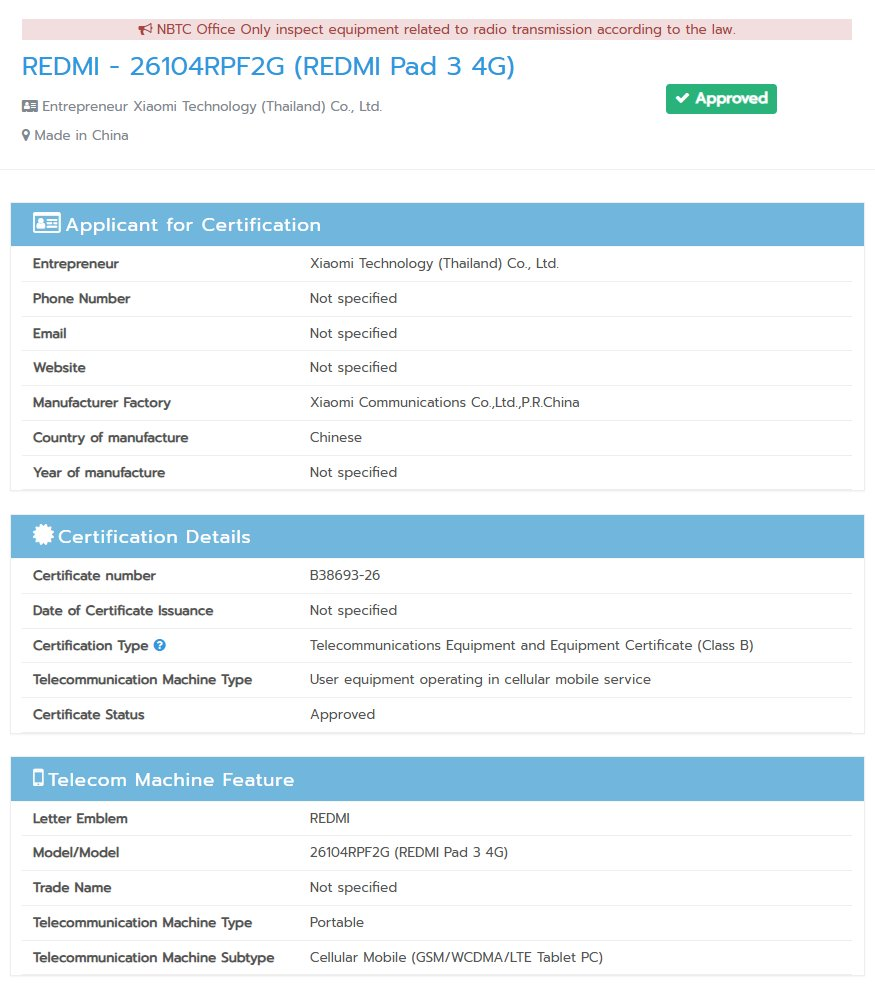 Figure: The Redmi Pad 3 4G regulatory filing in the NBTC database, explicitly detailing model number 26104RPF2G and LTE network capabilities. Source: NBTC (National Broadcasting and Telecommunications Commission, Thailand).
Concurrently, model “2610FRP38G” surfaced in certification registries from the UAE’s TDRA and Malaysia’s SIRIM, corresponding to the baseline Wi-Fi model. In Indonesia, both models completed coordinated clearance procedures: the Wi-Fi unit secured certification from SDPPI on October 27 via Xiaomi’s local Indonesian subsidiary, while the 4G model cleared the Ministry of Industry’s domestic component level (TKDN) manufacturing requirements.
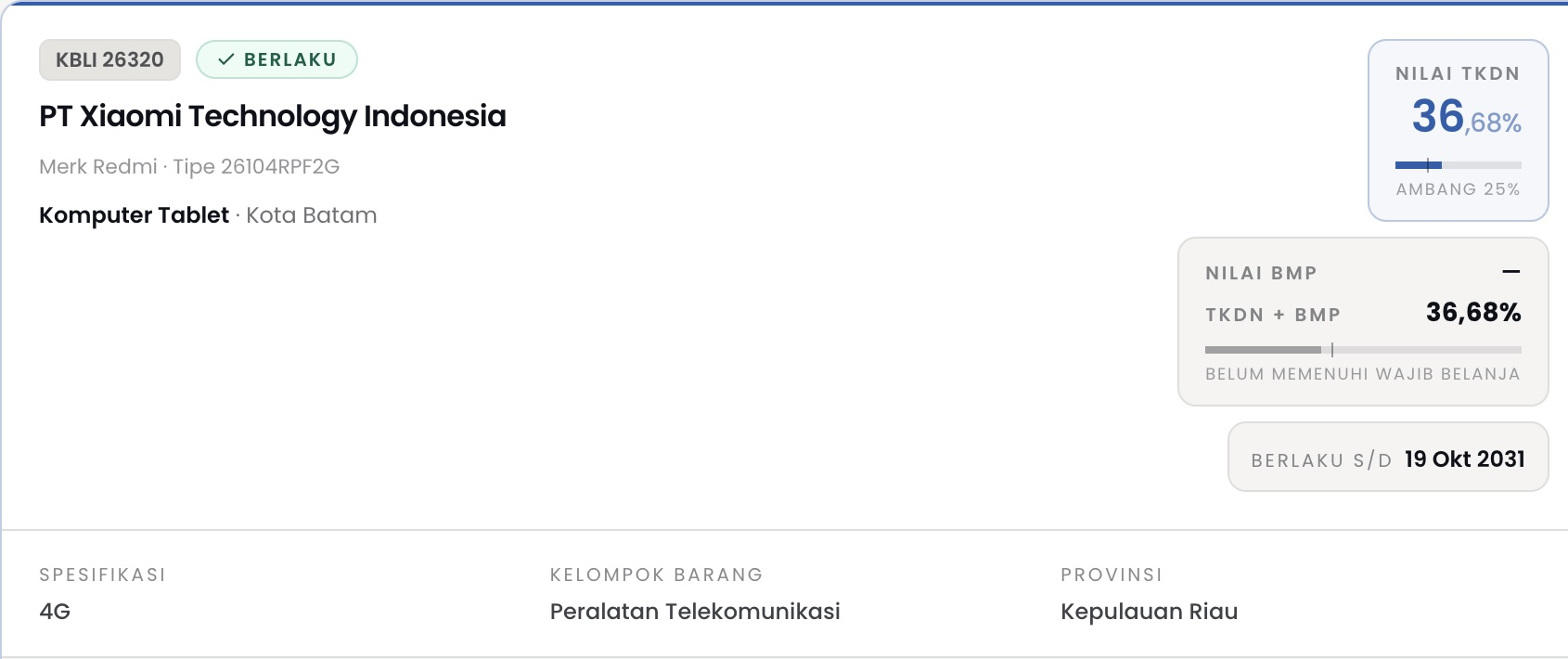 Figure: The Indonesian Ministry of Industry TKDN certification record confirming model 26104RPF2G meets local manufacturing thresholds. Source: TKDN (Ministry of Industry, Indonesia).
This synchronized dual-variant pipeline illustrates Xiaomi’s intent to cater closely to varied regional purchasing power and infrastructure conditions. Its predecessor, the Redmi Pad 2, debuted in June 2025 featuring a MediaTek Helio G100 Ultra chipset and an 11-inch display around a $229 retail price point. By elevating 4G capability to a launch-day priority, the new generation targets offline retail and underserved regions where fixed-line broadband remains scarce.
 Figure: Entry record for the Wi-Fi variant in the SDPPI registry under Indonesia’s Ministry of Communication and Digital Affairs, submitted by Xiaomi Indonesia. Source: SDPPI (Ministry of Communication and Digital Affairs, Indonesia).
9,820mAh Rated Cell and IP52 Protection: Serious Endurance in an Entry-Level Platform
Key battery and durability upgrades have also emerged from early compliance filings. Database entries from Taiwan’s National Communications Commission (NCC) and Germany’s TÜV Rheinland reveal that the Redmi Pad 3 houses a lithium battery pack designated as model “BN90.” It carries a rated capacity of 9,820mAh, translating to an expected typical marketing capacity of 10,000mAh.
Compared to the 9,000mAh pack found in the preceding generation, energy density has increased. Paired with the power-efficient scheduling of a budget SoC, the tablet is expected to deliver upwards of 15 hours of continuous runtime under light office and multimedia workloads. In emerging tropical markets prone to fluctuating power reliability, this substantial reserve easily bridges two to three days of intermittent off-grid usage.
Memory and chassis configurations disclosed via NCC filings include three variants: 4GB+128GB, 6GB+128GB, and 8GB+256GB. The device also retains an IP52 rating for dust and splash resistance. Integrating splash seals at this budget tier noticeably cuts down liquid ingress warranty claims. Xiaomi eschewed razor-thin chassis aesthetics, reallocating tight bill-of-materials (BOM) margins toward a massive battery and ruggedized internal construction.
Breaking Free from Fixed Broadband: Cellular Access Unlocks E-Learning in Emerging Markets
Budget tablets have long been pigeonholed as casual entertainment novelties. Yet across Southeast Asia and Latin America, they fulfill vital digital infrastructure functions. In archipelagos like Indonesia or secondary cities throughout Thailand, residential fiber penetration is low, leaving households heavily reliant on prepaid 4G SIM cards.
When families need to attend remote schooling or handle digital paperwork, standard Wi-Fi tablets must piggyback on smartphone hotspots. Hotspot sharing generates heavy thermal throttling and battery drain on mobile handsets while degrading connection stability. At the same time, compact 6.5-inch smartphone screens induce severe eye fatigue during prolonged reading sessions.
A sub-$200 independent 4G tablet directly resolves this bottleneck. Users can pop in an inexpensive data SIM to create a persistent, autonomous internet terminal. Paired with an 11-inch screen and all-day endurance, the device eliminates the friction of interrupted smartphone multitasking. It delivers a full-fledged, low-cost computing node within a strictly constrained household budget.
Foregoing the 5G Tax to Anchor Budget Pricing: 18W Charging Reflects Cost Realities
Xiaomi’s hardware trade-offs reveal calculated product segmentation. While critics may question sticking with 4G rather than adopting 5G in 2026, the bill of materials explains the rationale. Adding an entry-level 5G baseband modem adds roughly $30 to the hardware cost, while complicating RF antenna layout and motherboard architecture. Outside major metropolitan centers in emerging regions, 5G subscriptions remain costly and tower coverage remains patchy. An aggressive push into 5G would merely inflate the retail price, hurt thermal performance, and erode battery life.
Charging speed is another conscious engineering compromise. TÜV and NCC records show that the Redmi Pad 3 retains the “MDY-18-EJ” power adapter, shipping with a 15W charger in the box and capping input speeds at 18W. Refilling an almost 10,000mAh battery from empty will comfortably take over 2.5 hours.
This charging ceiling stems from razor-thin gross margins. High-wattage charge pump ICs are expensive, and elaborate thermal cooling assemblies occupy precious physical volume inside the chassis. For the target demographic, however, tablets are routinely recharged overnight while idle. Sacrificing daytime fast-charging turnaround in exchange for maximum battery capacity aligns with everyday usage habits in price-sensitive markets.
Moving Past Raw Benchmark Wars: All-Weather Utility Reshapes Global Expansion
For years, the budget tablet category was inundated with generic white-label OEM devices. Many brands competed by cutting corners on display quality and slashing RAM to win low-price bidding wars. Such hardware lacked long-term software support, suffering from rapid battery degradation and chronic wireless instability that created recurring customer service headaches.
With the Redmi Pad 3, Xiaomi applies mature industrial supply-chain discipline. Tuned HyperOS software, standardized regulatory compliance, and IP52 build quality elevate the baseline user experience. By turning an entry-level tablet into an autonomous computing terminal with its own data connection and massive battery reserves, the device substantially extends its usable lifespan in developing markets.
Hardware globalization is no longer about chasing peak benchmark figures. The Redmi Pad 3 skips costly flagship processors and expensive high-refresh OLED panels. By pairing a 9,820mAh battery with reliable 4G mobile connectivity, it secures a strategic foothold as the central digital portal for emerging market households. In price-conscious territories, a durable, large-screen terminal that stays connected anywhere represents the ultimate productivity tool.
Reference Links:
- Notebookcheck: Xiaomi tablet with 4G connectivity heads for global release.
- TheTechOutlook: POCO X8s and Redmi Pad 3 4G Secure Thailand’s NBTC Certifications.
- TheTechOutlook: Redmi Pad 3 Wi-Fi Spotted on Indonesia’s SDPPI Database.
- Thailand National Broadcasting and Telecommunications Commission (NBTC) Public Equipment Certification Database.
- Indonesian Ministry of Industry Domestic Component Level (TKDN) Certification Registry.
- TÜV Rheinland & Taiwan NCC Telecommunication Equipment Certification Filings.