A $3 Chip vs. Five-Figure Tube Amps: Digital Algorithms Mimic Vacuum Tube Distortion
On November 14, 2026, Hackaday featured an audio processing project housed in a retro oscilloscope case. A color screen refreshes a nonlinear saturation curve in real time. There is no vacuum tube inside; the computing core is a microcontroller that costs about $3.
The open-source device, called the ESP32 Tube Sound Processor, was designed by Mirko Pavleski and written up by Hackaday editor Elliot Williams. Spectrum analyzer measurements show the low-cost unit producing a clear second harmonic, with an output waveform that matches the character of a classic tube amp. The bill of materials comes in under 200 RMB (roughly $28).
In the audiophile world, tube amplifiers have long been revered, praised for a warm sound and a sense of air. Classic single-ended tube amps stay expensive, often costing thousands or even tens of thousands of dollars. They rely on tubes such as the 300B or EL34, run at hundreds of volts, and bring high power draw, component aging and heavy heat.
Objective measurement strips away the mystique. The warm sound enthusiasts love is not purity but a specific kind of nonlinear distortion. A bipolar transistor driven into overload clips symmetrically and hard, adding harsh high-order odd harmonics. A tube compresses softly and asymmetrically, producing rich even-order harmonics. The warmth we hear is determined by the nonlinear harmonic content of the distortion.
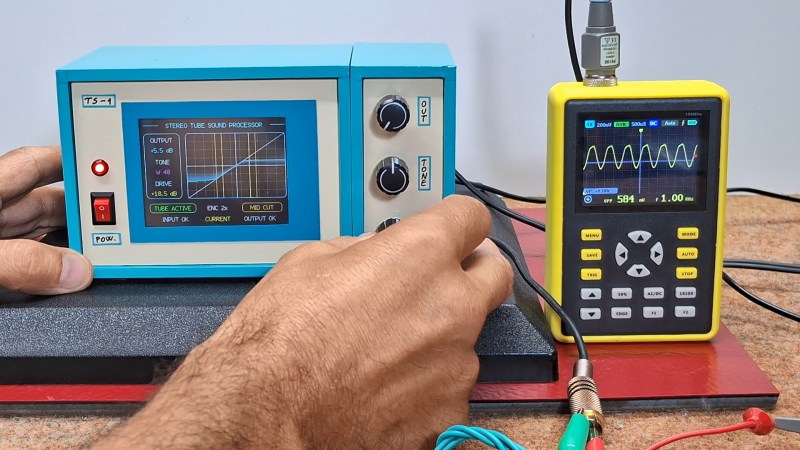 Figure: The ESP32 processor running the tube-sound DSP algorithm, with the transfer curve on a color screen. Source: Hackaday (mircemk)
Asymmetric Soft Clipping Injects Second Harmonics in Real Time at 48 kHz
To recreate analog distortion in the digital domain, Pavleski wrote 1,857 lines of open-source code. The system runs at a 48 kHz sample rate and 16-bit depth, with audio entering over I2S. A single-pole DC-blocking filter first removes DC offset so the nonlinear stage cannot accumulate baseline drift.
Guitar pedals commonly use the hyperbolic tangent to emulate overdrive. That symmetric operation only generates odd harmonics such as the third and fifth, giving a dry, hard tone. In his core function dualKneeClip, Pavleski introduces an asymmetric, two-segment soft-clipping scheme that applies different equations to the positive and negative half-cycles.
The positive half-cycle has two soft-saturation knees, at amplitudes of 0.35 and 0.56, so positive peaks enter gentle compression early. The negative half-cycle thresholds are relaxed to 0.95 and 1.20, preserving ample linear headroom. This up-down asymmetry excites a pronounced second harmonic (H2) in the frequency domain.
Band pre-emphasis improves realism further. Before clipping, the algorithm extracts mid-band energy from 180 Hz to 3.2 kHz and applies gain, then cancels the corresponding linear component after shaping. The drive knob adjusts from 0 to 24 dB, with the second harmonic most prominent at 14 to 16 dB. Asymmetric two-knee clipping deconstructs the physics of the tube and turns even-harmonic injection into a mathematical model that can be tuned quantitatively.
Strict Dual-Core Task Isolation: Espressif’s ESP32 Carries the Real-Time Audio Pipeline
Real-time evaluation of a complex model depends on the underlying microcontroller architecture. The project uses the ESP32 WROOM-32 board from Espressif Systems, headquartered in Shanghai, China. This low-cost chip for general embedded use has a dual-core Xtensa 32-bit LX6 processor running at 240 MHz.
Audio processing tolerates very little latency. The firmware, built on FreeRTOS, enforces strict task isolation between the two cores. The main audio loop, audioTask, is pinned to Core 0 with an 8 KB stack and the highest priority. Core 1 handles ILI9341 color-screen waveform rendering and polling of three rotary encoders.
The external audio stream goes through a Wolfson WM8960 codec. The ESP32 acts as I2S bus master, with Direct Memory Access (DMA) buffers set to 8 segments of 240 sample frames each. At 48 kHz, each buffer refresh cycle is fixed at 5 ms.
Overall audio latency stays at a few milliseconds. Decoupling the cores keeps graphics rendering from interrupting audio. This low-cost, general-purpose chip developed in China handles throughput that once required a dedicated audio DSP. Multicore scheduling and peripheral pipeline coordination form the engineering foundation of ultra-low-latency digital audio.
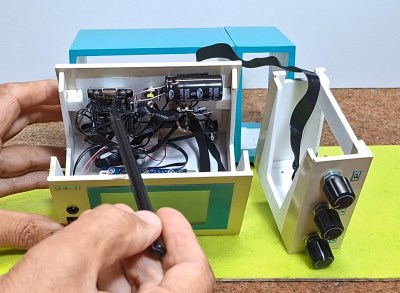 Figure: Inside the device are only an ESP32 board and an audio daughterboard, with no physical vacuum tube. Source: Hackaday (mircemk)
High-Voltage Physics vs. Digital Modeling: Audiophiles Debate Whether Tube Magic Is Real
The device sparked heated debate in the maker community. Practical engineers, represented by reader J.P., accept the digital approximation. They note that tubes have clear drawbacks in modern designs: expensive replacements, tens of watts of heat and cathode poisoning that degrades them over time.
Tube loyalists such as Peter_s pushed back. They point out that tubes don’t require dangerous voltages, and some types run stably at a 12 V anode supply. Inside a tube, thermal motion of the electron cloud, plus the nonlinear hysteresis loop of an external output transformer, produce a multidimensional transient response.
That transient response is hard to capture with a static piecewise curve. Traditionalists say an algorithm can copy steady-state harmonics, but digital models still sound thin on the subtle spatial cues of a complex symphony. The pragmatists cite double-blind listening tests, in which most listeners in controlled trials could not reliably tell a real tube from digital emulation.
The debate has shifted to the technical route to acoustic reproduction. One side champions the native texture and uncontrollable thermal drift of tubes. The other insists on using deterministic algorithms to strip out hardware mysticism. Behind the clash lies a long-running contest between traditional audiophile aesthetics and the philosophy of modern signal processing.
Deconstructing the Sound Ends the Mystique Premium, and Open Source Remakes Affordable Hi-Fi
The engineering value of the ESP32 tube processor lies in breaking the deification long common in audio. Its bill of materials is transparent: the ESP32 board costs about 25 RMB, the WM8960 module about 80 RMB. With the case, color screen and knobs, total hardware cost is under 200 RMB, less than a fraction of the price of a single high-end audio cable.
For decades, the high-end audio market has built up steep brand premiums. Manufacturers lean on strict component matching, point-to-point hand soldering and custom transformers. Ordinary enthusiasts seeking a smooth, listenable sound often bear heavy costs and maintenance. This open-source project overturns the myth: warmth can be precisely reconstructed with deterministic digital math.
Acoustic nostalgia from the analog era no longer depends on scarce physical parts. A cheap microprocessor can output even-order harmonics just as precisely, and the mystique bubble that clung to vacuum tubes has burst. Control over the listening experience is shifting, as the center of gravity moves from closed, expensive workshops to open, transparent code communities.
Reference links:
- Hackaday report
- Hackaday.io project page