Richard Yu Announces the Eighth-Gen Foldable, and the Star-Ring Camera Returns
On November 15, 2026, Richard Yu, chairman of Huawei’s Terminal business, released an official video. He looked back on eight years of Huawei foldables and announced that the Mate X8 is “coming soon.” At the end of the video, Yu unfolded a real unit with one hand and showed off the new design. On the back, the camera module returns to the classic symmetrical star-ring layout. The body is thinner still, with more rounded edges.
Counting from the original Mate X in 2019, Huawei has been in large foldables for a full eight years. The first model used an outward-folding falcon-wing hinge and opened up the large-screen foldable form. The Mate X2 then moved to a dual-rotor teardrop inward fold, and the Mate X3 cut the weight to 239 g. Yu said Huawei’s large-foldable users have passed the ten-million mark. Officially, the new phone improves flatness, performance and photography together. The finely machined metal trim around the centered star-ring lens shows that the large foldable remains the flagship carrier of Huawei’s manufacturing ceiling.
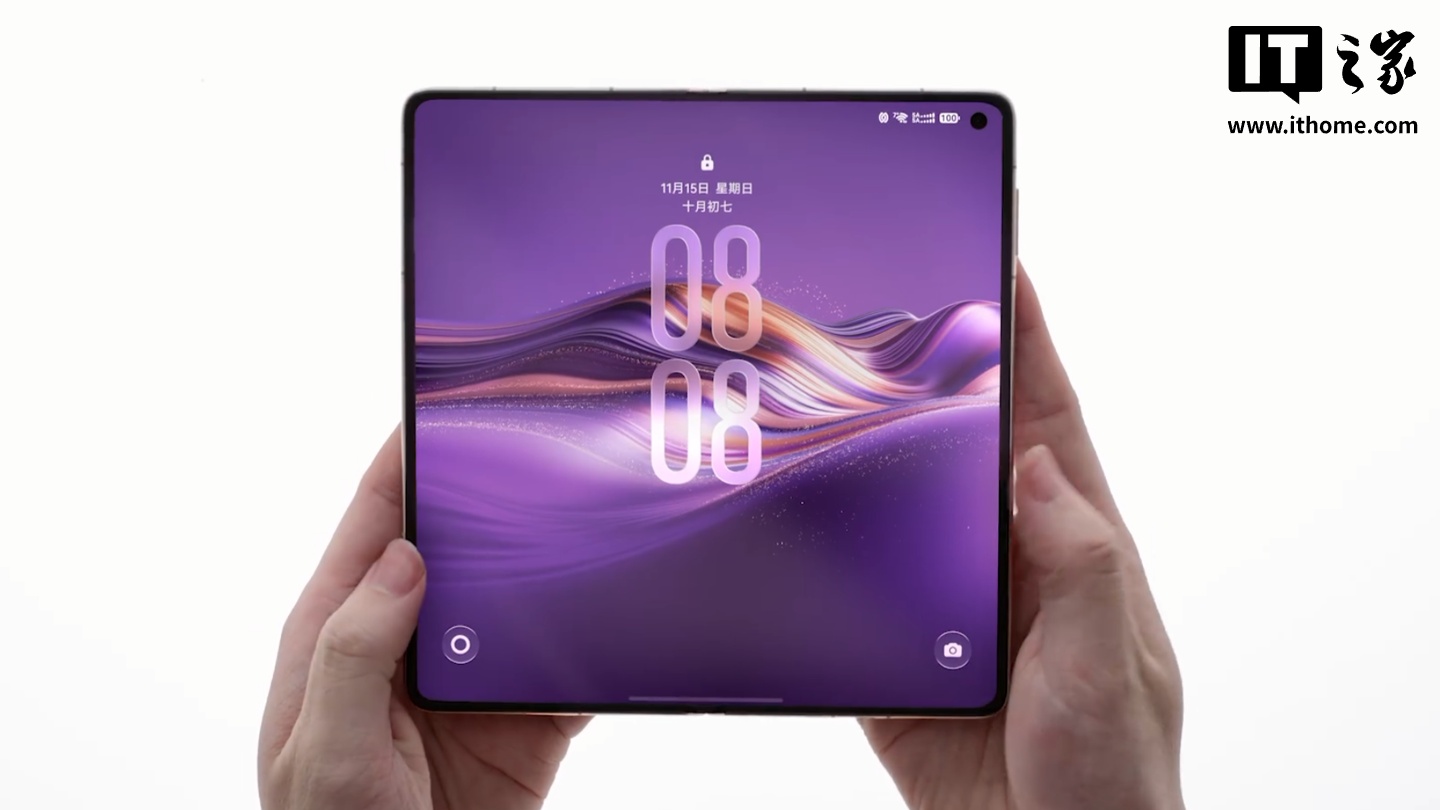 Image: Richard Yu shows the star-ring camera module on the back of the Mate X8 in his official video. Source: Richard Yu’s official video.
Large foldables have always been constrained by space. To make the body thin, the interior is filled with battery and hinge. Once each half is slimmed below 5 mm, the vertical height of the camera module becomes a harsh engineering bottleneck. There is a natural conflict between a thinner body and a large-sensor periscope.
Leaker Claims Collector’s Edition Takes an External Module, Splitting the Sensor to Avoid a Thicker Body
After the design reveal, new hardware rumors emerged from the supply chain. Tipster @RuryRen says the Mate X8 will come in a standard and a Collector’s Edition, and that the Collector’s Edition will support the external modular camera “XMAGE Z10”. This is currently a leaker claim; Huawei has not confirmed such an interface.
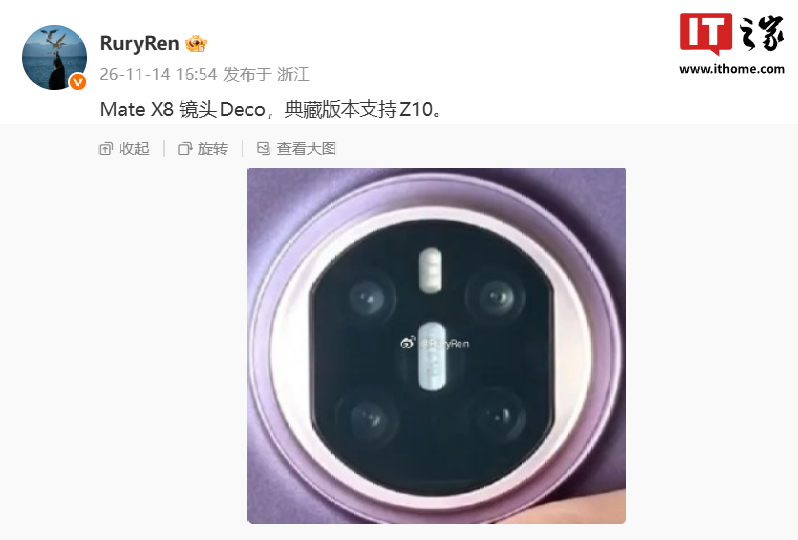 Image: A tipster says the Mate X8 Collector’s Edition may support an external imaging module. Source: Weibo @RuryRen.
Large foldables are limited by internal thickness. A 1-inch sensor has a 16 mm diagonal, and its lens stack needs at least 13 mm of vertical height. Cramming such a large optical module into a foldable would create a big step on the back. A camera bump that large makes the phone wobble when typing flat on a table and badly hurts everyday handling.
To balance size, mainstream foldables mostly use small 1/2-inch periscope sensors. That leaves low-light telephoto quality on large foldables clearly behind conventional slab flagships. An external module offers a split solution. It moves the large sensor out of the body, so everyday carry stays light. Separating lens and body keeps daily handling comfortable while preserving the option of telephoto expansion.
A 1-Inch Sensor at 346 g: Bolt-On Telephoto Gives Up Pocketability
The XMAGE Z10 rumored to be supported is no concept prototype. It is the professional module Huawei launched alongside the Mate 90 series, priced at 5,999 yuan. It packs a 1-inch 50 MP RYYB sensor and a 10x continuous optical zoom from 24 mm to 240 mm. Internally it uses a 6-group, 19-element optical design with an aperture range of F2.0 to F4.5. It also integrates a third-generation Red Maple True-Chroma sensor and a dedicated stabilization motor, with Kirin chips providing coordinated compute.
Those specs come with real mechanical weight. The Z10 module weighs 346 g and is about 80 mm long. An unfolded large foldable already weighs about 240 g, so the assembled total would exceed 580 g. A load close to a DSLR body means the setup only suits specific long-range shooting scenarios.
With the lens attached, the center of gravity shifts sharply forward. Shooting one-handed without a fixed grip makes the wrist sag. The external approach avoids everyday bulk but shifts the weight penalty into the shooting session itself. This hardware clearly cannot serve as an all-day carry.
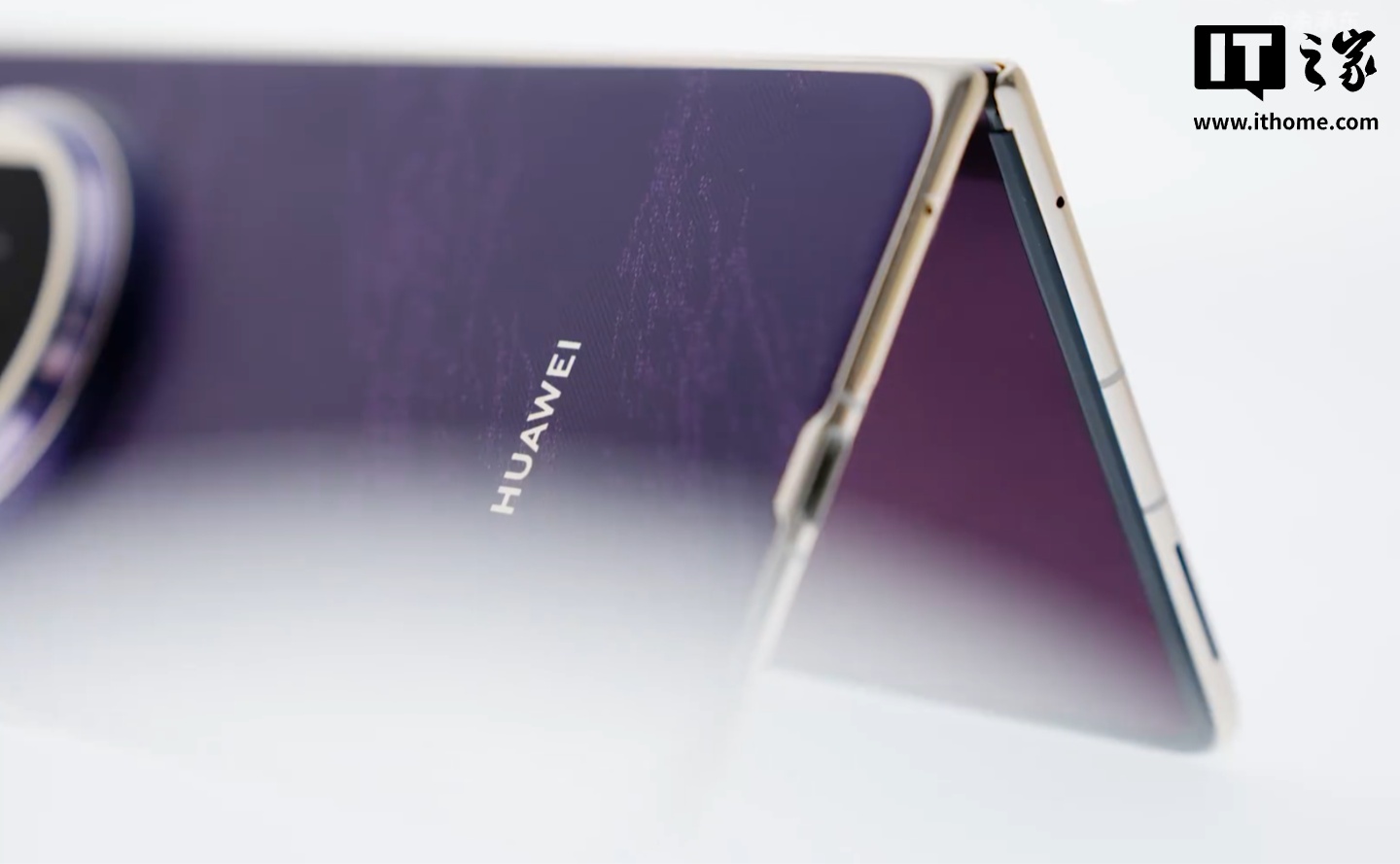 Image: In the video, Richard Yu reviews the technical journey of Huawei foldables from the first generation to the eighth. Source: Richard Yu’s official video.
Past Modular Attempts Mostly Fell Flat, and Split Imaging Remains a Niche Compromise
External add-ons are nothing new in phone history. Motorola launched the Hasselblad True Zoom Moto Mod with 10x optical zoom, and the LG G5 tried a camera grip. Most of these ended because accessories were expensive and protocols were abandoned after a generation change. The high cost of buying extra hardware put most consumers off.
Huawei’s current approach has a different foundation. Its in-house chips and system scheduling protocol let the sensor communicate directly with the core chip. Color reproduction and multi-frame noise reduction are handled by the phone’s chip. An ultra-low-latency transmission bus gives smooth zoom feedback, so the external module avoids the clumsy lag of early products.
Even with the technical upgrades, split designs remain a niche market. People buy foldables for a portable big screen. Carrying a 300-plus-gram metal lens runs against the grab-and-shoot logic of portability. The 5,999-yuan price plus the Collector’s Edition premium means this hardware will serve only a few professional enthusiasts. A high barrier keeps it from becoming a mass-market standard.
Detachable Modules Break the Space Bottleneck, Letting Foldables Keep Top-Tier Optics
Large foldables chase thinness and run into the limits of optical physics. The body interior is already full of battery and hinge. An external module is a compromise that balances slimness with large-sensor telephoto. The phone stays light day to day and connects professional hardware when a shoot demands it.
This compromise extends the technical boundary of foldables. It neither crams components into a 5 mm body nor gives up image quality for thinness. If the Mate X8 Collector’s Edition does ship, a detachable module would offer a pragmatic answer to the imaging problem of large foldables. Imperfect as the split design is, it opens an image-quality path for foldables that doesn’t compromise on thickness.
References:
- Richard Yu’s official video “Huawei Large Foldables: Eight Years On”
- Huawei Terminal’s official XMAGE Z10 modular camera specification release
- Tipster @RuryRen’s Weibo post