After Phones Kept Growing Taller, Manufacturers Are Widening the Screen Again
On November 18, 2026, digital supply chain leaks uncovered Huawei’s product schedule for the end of the year. Beyond the already teased Mate X8 foldable flagship, Huawei is preparing to introduce the Mate 90 Air—a wide candybar smartphone—alongside the Nova 17 series. Meanwhile, the highly anticipated MatePad Mini 2, an 8.8-inch compact tablet featuring cellular connectivity, is also in the pipeline and expected to make its official debut before the Lunar New Year.
Over the past eight years, smartphone screens underwent a steady vertical stretch. Starting from the classic 16:9 ratio, displays elongated to 18:9, and eventually settled into the prevailing 19.5:9 and even 21:9 ultra-tall aspect ratios. While extending device height preserved comfortable single-handed grip, usable horizontal display area shrank proportionately, turning screens into narrow vertical ribbons. Now, making screens wider again is emerging as a fresh product experiment across the industry.
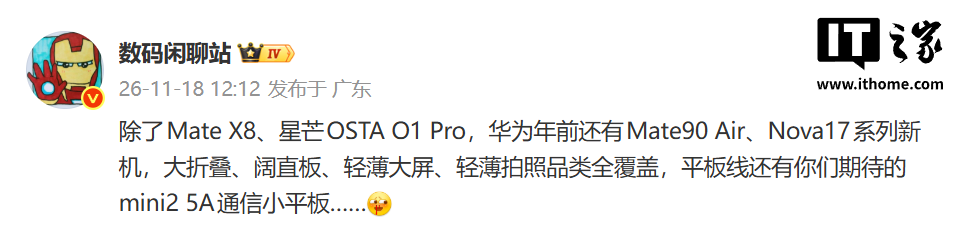 Figure: Tipster reveals Huawei’s year-end product roadmap covering a wide candybar phone and a cellular compact tablet. Source: Weibo @DigitalChatStation.
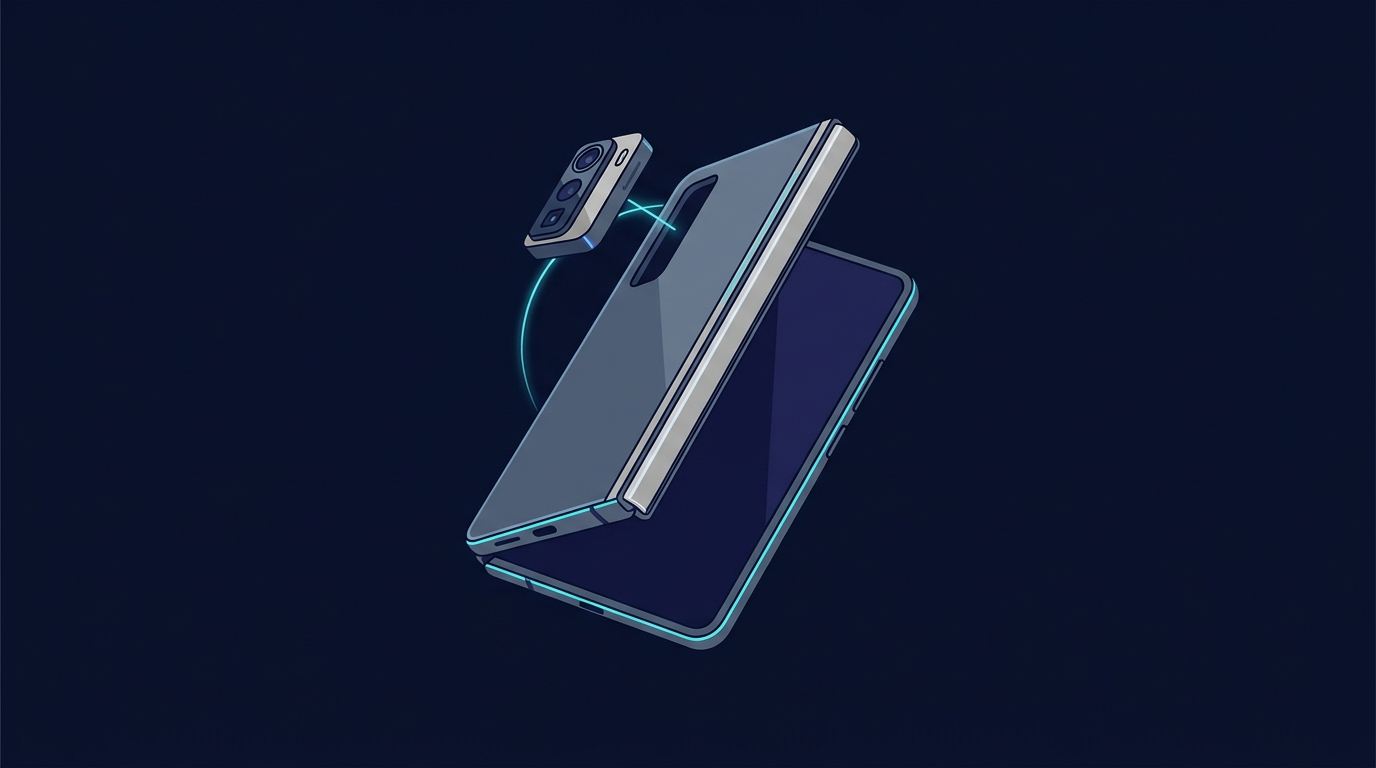
Wider outer screens on large book-style foldables paved the way for this trend. Many users noticed that broader cover displays significantly improved typing accuracy, reading comfort, and feed browsing efficiency. However, foldables inherently weigh upwards of 240 grams and add hinge bulk, creating barriers for daily one-handed carry. The Mate 90 Air directly ports this wider aspect ratio experience back to a conventional candybar slab.
Wide Candybar vs. Ultra-Tall Aspect Ratios: How 16:9 Banishes Video Letterboxing
The debate over aspect ratios has simmered inside display supply chains for months. Leakers noted in comment threads that the industry is weighing between 16:9 and 16:9.5 standards, with 16:9 being slightly more compact horizontally. At present, four major Chinese panel manufacturers—BOE, TCL CSOT, Tianma, and Visionox—have already supplied sample display panels to smartphone OEMs for testing.
The vast majority of streaming video and mobile games are natively authored in 16:9. When users play 16:9 video content on an elongated 20:9 screen, massive black bars (letterboxing) appear on both sides. The actual viewing canvas often shrinks to an effective diagonal below 6 inches. A native 16:9 display eliminates horizontal letterboxing entirely, dedicating 100% of the physical panel to active content.
 Figure: Tipster addresses wide candybar aspect ratio variations and rival launch timelines in comments. Source: Weibo @DigitalChatStation.
Yet this dimensional shift reignites ergonomic debates. Wide candybar devices routinely exceed 76 millimeters in width. For users with small or medium hands, typing one-handed causes noticeable palm fatigue. Detractors argue that effortless one-handed grip remains a fundamental smartphone requirement that widening compromises. Proponents, however, prioritize two-handed productivity: split-screen multitasking and landscape mobile gaming gain immediate visual headroom.
Branding the device under the “Air” moniker signals Huawei’s aggressive pursuit of slimness. By widening the chassis, motherboard components can be laid out in a flatter, side-by-side array, while the battery pack can be spread thin across a broader footprint. The internals no longer need to be densely stacked within a tight 70mm frame. The Mate 90 Air strikes a deliberate balance between an ultra-slim profile and expanded screen real estate.
Small Tablet Adds 5G Connectivity: 8.8 Inches Challenges Handheld Consoles
Surfacing alongside the wide candybar phone is the MatePad Mini 2. Regulatory filings with China’s Ministry of Industry and Information Technology (MIIT) confirm that the device has cleared certification with full 5G cellular connectivity. The refreshed slate comes in five colorways—Aurora Purple, Obsidian Black, Snow White, Midnight Black, and Shimmering White—paired with storage tiers of 8GB+256GB, 12GB+256GB, and 12GB+512GB.
The original MatePad Mini featured an 8.8-inch 2560×1600 OLED display supporting a 120Hz refresh rate, 1800 nits peak HDR brightness, and symmetrical 2.99mm slim bezels. While the first-generation model validated market demand for a pocketable, high-resolution screen, the lack of cellular connectivity restricted it to indoor Wi-Fi zones. Standardizing 5G cellular radios frees the compact tablet from domestic living rooms and desks.
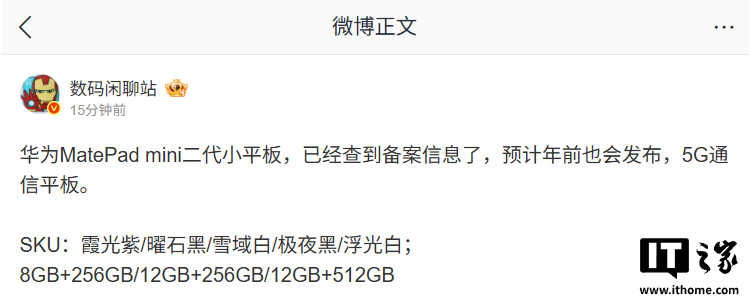 Figure: Early regulatory filing confirms MatePad Mini 2 supports cellular connectivity across three memory tiers. Source: Weibo @DigitalChatStation.
A prolonged market vacuum has persisted in portable entertainment and light productivity. Apple’s cellular iPad mini carries a premium price without high refresh rate support, while mainstream Android compact tablets often settle for entry-level specifications. An 8.8-inch form factor balances one-handed holding with dual-thumb controls, keeping total weight under 300 grams. With standalone cellular connectivity, the mini tablet acts as a versatile daily driver—handling calls and outdoor turn-by-turn navigation, or transforming into a high-fidelity mobile gaming device.
This ultra-portable form factor encroaches directly on dedicated handheld gaming consoles. Many PC-based handhelds weigh over 400 grams to accommodate active cooling, yet lack native cellular networking. Leveraging high chip efficiency and a 120Hz display, the MatePad Mini 2 provides mobile gamers with a streamlined, lightweight travel setup.
Competitor Timelines Lag Behind: Huawei Uses Form-Factor Divergence to Anchor the High End
Pioneering unfamiliar form factors puts OEMs’ engineering execution to the test. Addressing competitor release schedules, leakers noted that rival brands will not be ready before the Spring Festival. While panel makers distributed evaluation samples across the board, competitors remain far behind in structural engineering and thermal validation.
Widening the display also demands comprehensive software and app refactoring. Mainstream Android applications have long adapted to continuous vertical scrolling streams designed for tall ratios. Without dedicated interface tuning, UI layouts can stretch unnaturally or leave excessive whitespace. Leveraging its proprietary operating system and mature multi-window split-screen frameworks, Huawei holds an early software advantage for wider displays.
The company’s tiered product defense is equally apparent. The Nova 17 series caters to mainstream youth demographics, emphasizing lightweight portrait photography to safeguard volume shipments. The Mate 90 Air acts as an avant-garde vanguard in the flagship tier, offering a svelte alternative for users who want wide visual coverage. Together with the Mate X8 in the large-format foldable space, Huawei is establishing a comprehensive form-factor matrix heading into the year’s close.
Moving Beyond One-Size-Fits-All: The Single-Form Era Approaches Its Close
For over five years, smartphones remained trapped in an iterative loop of fine-tuning tall rectangular slabs. Semiconductor process nodes are nearing physical boundaries, while camera modules have hit practical thickness ceilings. Incremental benchmark gains and climbing megapixel counts no longer convince consumers to upgrade existing devices.
Consumer hardware is breaking free from the constraints of a single universal form factor. Book-style foldables maximize visual canvas, compact handsets preserve one-handed usability, and wide screens prioritize media viewing and gaming. Device makers are moving past monolithic compromises to engineer dedicated solutions for distinct usage patterns.
The Mate 90 Air’s exploration of wide candybars and the MatePad Mini 2’s cellular expansion highlight fresh momentum in high-end consumer hardware. As upgrade cycles for conventional tall slabs and large foldables encounter diminishing returns, diverging, specialized form factors are stepping in as the primary engine driving device upgrades.
Reference Links:
- Weibo tipster @DigitalChatStation: Huawei year-end product roadmap and wide candybar leaks
- MIIT Telecommunications Equipment Certification: Huawei MatePad Mini 2 filing specifications
- Huawei Consumer Business Official: MatePad Mini first-generation technical specifications