
Saturated Market Diminishes Benchmark Appeal as vivo Pushes Pre-Holiday Sub-Flagships
With replacement cycles stretching to 34 months, vivo’s supply chain roadmap for early 2026 surfaced on November 20. Two sub-flagships—the vivo S70 series and the iQOO 16R—have emerged. vivo is pushing high-end hardware into the mid-tier segment: 64MP periscope telephoto sensors, an external tele-converter lens ecosystem, and Snapdragon 8-series silicon.
In today’s mature smartphone market, iterative generational upgrades have hit diminishing returns. A 10% uplift in synthetic benchmarks barely moves the needle in daily usage, as casual web browsing and social media fail to stress modern compute engines. Refreshing system-on-chips alone no longer convinces consumers to upgrade. By packing flagship periscope zoom and ultra-thin high-capacity batteries directly into the 3,000 RMB ($415) tier, manufacturers are seeking a decisive hook to break through the stagnant replacement cycle.
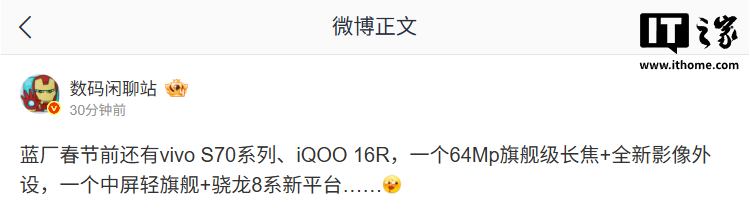 Figure: Leaker outlines vivo’s pre-Spring Festival strategy, focusing on 64MP periscope telephoto optics and Snapdragon 8-series compact-screen devices. Source: Weibo @DigitalChatStation.
The weeks leading into the Lunar New Year remain a prime commercial window. Year-end bonuses combined with family visits drive peak purchasing momentum across China. vivo is pursuing a coordinated pincer movement: the S series commands the offline retail and portrait photography demographic, while iQOO secures the online enthusiast base with high-performance flat panels. This synchronized launch aims to capture consumer spending before the holiday freeze.
64MP Periscope Trickles Down: Slim Portrait Phones Target Full Focal Range
The S series has historically championed slim, lightweight portrait photography. Released in May, the vivo S60 started at 2,899 RMB, paired with a Snapdragon 8s Gen 3 platform and a 7,200mAh BlueOcean battery. For telephoto captures, however, mid-range phones have long depended on digital crops from the primary camera or small-aperture standard lenses. The resulting images suffered from heavy sensor noise, loss of fine detail, and flat, unconvincing depth of field.
The S70 series marks a significant optical leap. The device integrates a 64MP periscope telephoto module. While the exact sensor model remains under wraps, the folded optical path overcomes the physical trade-off between chassis thickness and focal length. Trickling down periscope optics terminates the mid-range compromise of digital-crop telephotos. Photographers gain genuine optical compression and organic depth across the coveted 70mm to 85mm portrait zone.
 Figure: The preceding S60 series laid the hardware foundation with a 7,200mAh BlueOcean cell in a slim profile. Source: Official vivo product announcement.
vivo is also extending modular imaging accessories to this category. The company plans to introduce an external tele-converter ecosystem for the S70, extending effective focal reach to 200mm. Stadium photography and travel sightseeing demand high resolving power at extreme distances. Coupling a high-resolution periscope module with detachable auxiliary optics gives mid-range handsets telephoto capabilities that rival top-tier flagships, turning full-focal-length coverage from a luxury into a standard expectation.
Tired of Bulky Phablets and Throttling Minis: Mid-Size Displays Tap the Third Demographic
Mainstream performance devices face a growing ergonomic dilemma. High-end flagships frequently exceed 6.8 inches and tip the scales near 220 grams, making one-handed grip exhausting. Conversely, compact models under 6.3 inches struggle with thermal volume; their tight footprints restrict vapor chamber dimensions and battery capacities, leading to thermal throttling under heavy gaming sessions.
The iQOO 16R targets the pragmatic middle ground. Equipped with a 6.4- to 6.5-inch flat panel, the handset balances comfortable one-handed navigation with sufficient screen real estate for two-handed gameplay. The flat display also eliminates peripheral glare and accidental palm triggers typical of curved glass. In follow-up comments on November 20, leakers confirmed that the production-run iQOO 16R has been upgraded to a higher-tier Snapdragon 8-series silicon platform.
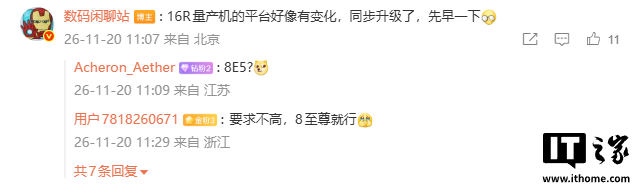 Figure: Leaker confirms the mass-production silicon platform has received a tier upgrade. Source: Weibo @DigitalChatStation.
This late-stage platform swap underscores the fierce competition in the 2,500 to 3,500 RMB segment, where spec sheets are scrutinized down to the silicon stepping. Performance-driven buyers are unforgiving when it comes to sustained framerates. Pairing a manageable screen form factor with updated Snapdragon 8-series silicon provides a compelling middle path for power users who refuse to carry heavy bricks.
High-Density Cells Slim the Frame: Cost Trade-offs Pivot to Peripherals and Cooling
The engine enabling these premium specs down-market is advancing battery chemistry. Leveraging silicon-carbon anodes, the earlier S60 fit a massive 7,200mAh BlueOcean pack into an ultra-slim body. Across both the S70 and iQOO 16R, high-density, thin-cell batteries have shifted from an experimental feature into the foundational baseline of industrial design. Battery endurance is no longer an engineering compromise.
Reduced cell volume frees up critical internal spatial tolerances. In legacy mid-range architectures, periscope camera barrels and high-capacity batteries were mutually exclusive; combining them produced an uncomfortably thick phone. Silicon-anode packaging creates room for engineers to house both folded-path telephoto modules and large vapor chambers simultaneously, keeping chassis thickness comfortably within ergonomic limits.
Hardware margins, however, cannot defy financial physics. Absorbing a 64MP periscope module alongside top-tier Qualcomm silicon at a 3,000 RMB price point demands targeted cost cuts elsewhere. The ultra-wide camera settles for a utilitarian 8MP sensor. Plastic mid-frames and standard vibration motors maintain clear tier separation. Acoustic hardware and exterior chassis materials absorb the financial trade-offs required to balance the bill of materials.
Premium Specs Squeeze Margins: The Pre-Holiday Window as an All-or-Nothing Bet
Pushing flagship-grade components into sub-flagships reflects an aggressive calculation between unit profitability and volume delivery. Procuring 64MP periscope modules and Snapdragon 8-series silicon commands steep prices, eroding gross margins across mid-tier lines. Profit per device has been pared down to bare minimums.
Brands are accepting razor-thin margins because the replacement window is fleeting. The Spring Festival cycle cements annual performance and sets the tone for retail distribution channels entering the first quarter. On store counters, devices lacking obvious differentiators like periscope zoom or slim, hand-friendly profiles quickly lose foot traffic to competitors. Transparent, tangible selling points are essential to close purchases on the showroom floor.
Purchasing behavior is increasingly steered by tangible everyday utility rather than abstract benchmark leaderboards. A sharp 64MP portrait telephoto and a 7,200mAh battery that lasts two days provide immediate gratification that buyers can feel in hand. As vivo lowers the threshold for these flagship technologies, the boundary separating mid-range contenders from genuine flagships continues to blur.
References:
- Weibo tech insider leaks
- vivo S60 series official technical specifications
- iQOO 16 flagship launch event specifications