Pre-orders From ¥129,900, One Trim Per ¥10,000
On November 13, Dongfeng Nissan globally debuted the NX7 plug-in hybrid SUV at its NISSAN DAY brand event in Zhuhai and opened pre-orders at the same time: the 320 Pro at ¥129,900, the 320 Max at ¥139,900, and the LiDAR-equipped 320 Ultra at ¥149,900 — roughly $19,500 to start. A ¥999 pre-order deposit knocks ¥3,000 off the purchase price, with final pricing due at the Guangzhou Auto Show on November 27. The “320” in the names refers to CLTC electric range; all three trims share the same powertrain, with a 4,785mm body and 2,815mm wheelbase, slotting below the N-series NX8.
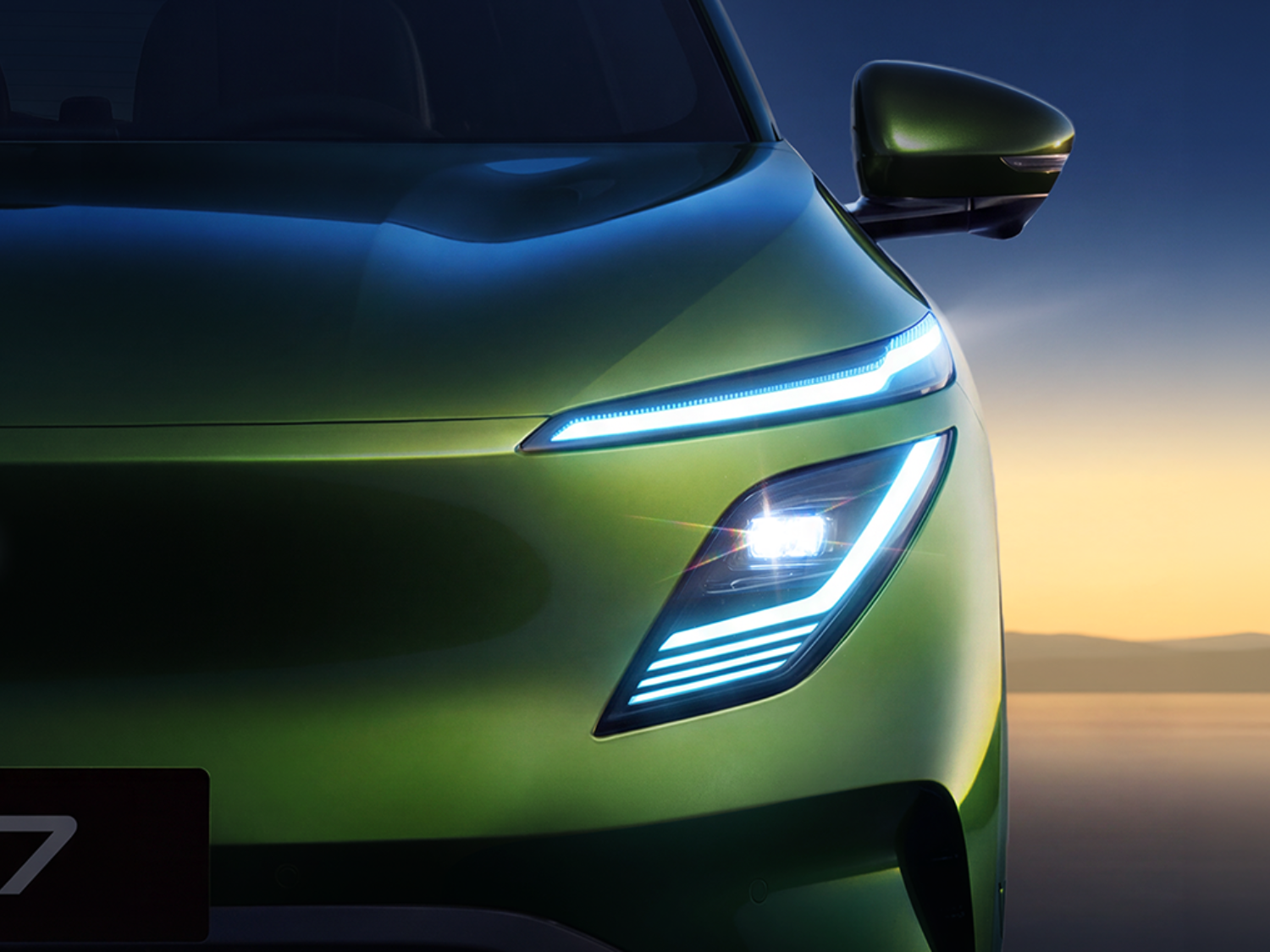
Image: Official NX7 pre-order material. All three trims are named after the “320” figure — CLTC electric range. The WLTC filing value of 220/225 km appears nowhere in the material. Source: Notebookcheck / Dongfeng Nissan
A pricing ladder of ¥10,000 per step is an open invitation to compare the spec sheet line by line. This price band has been owned by Chinese-brand plug-in hybrids over the past two years — think BYD Song and Geely Galaxy — and the usual joint-venture response has been to slash prices a beat too late. Nissan has dropped its pre-order price straight into the heart of the Chinese-brand PHEV price band, and even the LiDAR version stays under ¥150,000.
But pricing is only the entry point; the real sincerity test is the spec sheet. How big is the battery, which test cycle is the range measured on, whose driver-assist stack is inside, and what did the base trim lose? Four questions, four numbers worth checking.
A 40.95kWh Battery Squeezed Into the ¥130,000 Band
One powertrain for all: a 1.5L naturally aspirated engine at 73kW/131N·m, a 170kW/285N·m drive motor (231 hp), a dedicated hybrid transmission (DHT), and a 13-in-1 integrated electric drive — marketed in the spec sheet as “AI Cloud Engine hybrid.” The battery is a 40.95kWh lithium iron phosphate pack supplied by CATL, branded “Cloud Shield Battery 2.0” with no-thermal-propagation cell-to-pack design plus three layers of underbody composite armor.
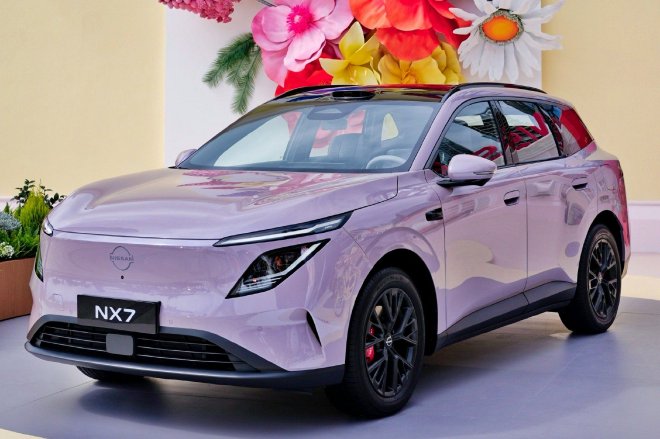
Image: NX7 exterior. At 4,785mm long with a 2,815mm wheelbase, it sits below the NX8; semi-hidden door handles and an active-shutter grille are standard on all three trims. Source: Sina Auto
Most plug-in hybrids under ¥150,000 claim 100–200 km of electric range; the 40.95kWh pack pushes the NX7 to 320 km. Nissan was willing to pay for battery capacity this time, and the small 55L fuel tank signals a split mission: electric in the city, gasoline on long trips. A 6.6kW vehicle-to-load (VTOL) output is on board — no Chinese PHEV checklist item is missing.
On efficiency, the official figures are 3.75L/100km with a depleted battery and 1,666 km combined range (Pro) or 1,630 km (Max and Ultra), all measured by a third-party lab under CLTC. The gap between CLTC and WLTC is the single line on this spec sheet most worth worrying about.
320 km CLTC in the Brochure, 220/225 km WLTC in the MIIT Filing
The 320 km figure in the marketing material is a CLTC (China Light-Duty Vehicle Test Cycle) value — the Pro is rated at 325 km. But in NX7’s filing with China’s MIIT (Ministry of Industry and Information Technology), WLTC (Worldwide Harmonised Light Vehicles Test Cycle) electric range comes in at 220 km and 225 km, depending on configuration.
That’s 320 down to 220 — roughly 30% shaved off. CLTC is a gentle cycle; WLTC is closer to real-world driving. Planning around a little over 200 km of daily electric range is the safer bet, and winter heating will eat into that further. Both numbers are technically compliant — 320 in the brochure, 220 in the filing — the difference is which one you choose to believe.
The footnote on the official spec page says it too: actual range varies with ambient temperature, road conditions, vehicle state, and driving habits. The 3.75L/100km depleted-battery figure is likewise a CLTC lab number — leave some margin when quoting it.
LiDAR Only on the Top Trim, the Whole ADAS Stack From Momenta
Perception hardware comes in three tiers. The Pro and Max get 3 millimeter-wave radars, 8 ultrasonic sensors, and 1 front camera, supporting basic L2 features like adaptive cruise and speed-sign recognition. The Ultra swaps in a roof-mounted LiDAR, 12 ultrasonic sensors, 11 ADAS cameras, plus a driver monitoring system (DMS), and active safety features jump from 15 to 22 — that’s where the price of perception redundancy starts.
The advanced driver-assist package comes from Momenta’s R7 world-model system; urban NOA (Navigate on Autopilot), highway NOA, and parking assist appear only on the top trim, whose cockpit chip moves up from the Snapdragon 8155 to the 8295P. Nissan’s own ProPILOT is nowhere on the spec sheet — the entire high-level ADAS stack rides on Momenta. Airbags follow the price ladder, too: full-length side curtain airbags start from the Max, and the front-center airbag is top-trim only — the base trim’s passive safety is the line on the whole sheet most worth scrutinizing.
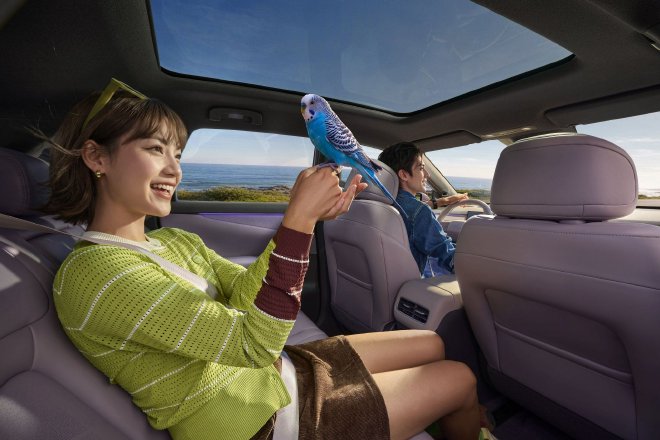
Image: NX7 exterior details. Lights, door handles, and grille are standard across all trims; the real differentiation hides in roof sensors, the power tailgate, and cockpit equipment. Source: Sina Auto
A 55-inch AR-HUD (Augmented Reality Head-Up Display) is also Ultra-exclusive, tagged “limited-time free” during pre-orders. Five items on the sheet carry that tag: a power sunshade, second-row seat heating and ventilation, a smart hot-and-cold fridge, the AR-HUD, and Momenta R7 advanced driver assist. Which of the pre-order freebies become permanent after November 27 — and which get pulled — is the real suspense behind this pricing.
The Base Trim Is Stripped Clean, the Top Trim Actually Loses Trunk Space
What ¥129,900 gets you on the Pro: a 17.3-inch 3K center display, a 10.25-inch instrument cluster, the Snapdragon 8155, basic L2 cruise assist, and 6.6kW V2L. The list of what it doesn’t get is longer: panoramic roof, power tailgate, seat heating/ventilation/massage, 50W wireless fast charging, the 788W 12-speaker audio system (Pro gets only 6 speakers) — plus the full-length side curtain airbags, which is a safety item.
The Max, ¥10,000 more, adds the panoramic roof, heating and ventilation for four seats, the zero-gravity “cloud carpet” seats, and the power tailgate — likely the volume seller. Another ¥10,000 up to the Ultra buys the LiDAR, urban NOA, and the center airbag.
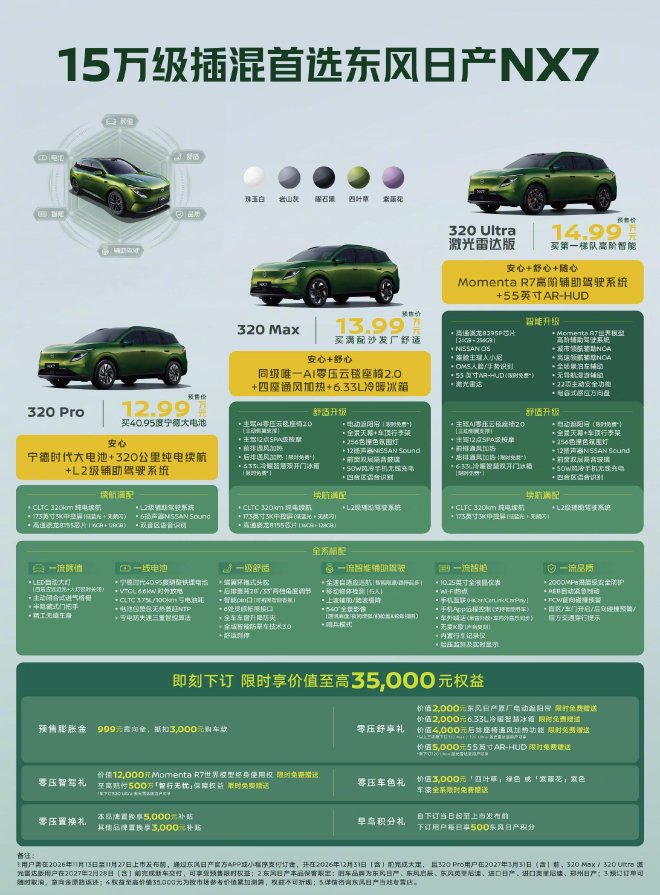
Image: Side profile. The 2,815mm wheelbase sets rear-seat legroom, but the trunk is tiered by trim — 783L on the Pro, 777L on the Max, 674L on the top Ultra, with the underfloor storage bin taking most of the hit. Source: Sina Auto
One easy-to-miss detail: trunk capacity shrinks as you go up. Pro 783L, Max 777L, Ultra 674L. The difference is concentrated in the underfloor storage space — with the rear seats folded, the Pro offers 1,878L versus 1,872L on the Max and Ultra, a 6L gap. The cost of picking the top trim now includes a line item beyond price: trunk volume.
Watch Two Things on November 27
Run through the whole spec sheet and the supplier list is plain to see: battery from CATL, driver assist from Momenta, voice from iFlytek, cockpit chips from Qualcomm, with all three phone-mirroring systems — HiCar, ICCOA, and CarPlay — included. Nissan contributes the brand, the manufacturing system, and the ¥129,900 price tag; whether the NX7 will be exported, Nissan hasn’t said. This is a joint-venture spec sheet filled out by Chinese-brand rules — the equipment density matches, and the price has been pushed down to match.
Final pricing lands at the Guangzhou Auto Show on November 27. Two things are enough to watch: how many of the five “limited-time free” features become permanent, and whether the launch materials put the WLTC range on the table. If the materials keep quoting CLTC only, then 320 should be read as 220 — that 100 km gap is the yardstick for how much sincerity is packed into ¥129,900.
References:
- Notebookcheck: New sub-$20,000 PHEV SUV opens for preorders with 320 km EV range, optional LiDAR
- Dongfeng Nissan official NX7 specs page