Same Chip, So Why the 8/10?
On November 15, 2026, Wired published its Evercade Nexus review: 8/10, with a headline calling it “the best retro handheld yet.” It costs $200, priced identically at Amazon, Best Buy, and GameStop. Nowhere in the list of things Wired praised will you find a performance word — the credits go to a design that feels like a “real” console, better battery life, a bright and smooth screen, and dual analog sticks. All experience items.
The brain is the same 1.5GHz quad-core chip as the previous-gen EXP, with 512MB of RAM — spec-sheet numbers that look clearly dated in 2026. Wired’s complaints are equally blunt: no meaningful performance gain over the older model, HDMI output removed, and a D-pad that sits too high. Not one of those deductions is about “games won’t run.” They’re all the price of deliberate engineering trade-offs.
The scoring axis has shifted from raw horsepower to how complete the cartridge-collecting experience is. Blaze Entertainment has spent the entire 2020s doing one thing: turning retro gaming into a collectible physical business built on stable hardware and a steadily expanding library of licensed cartridges. The Nexus is the biggest leap in that product line so far, and the review’s logic follows the product’s logic.
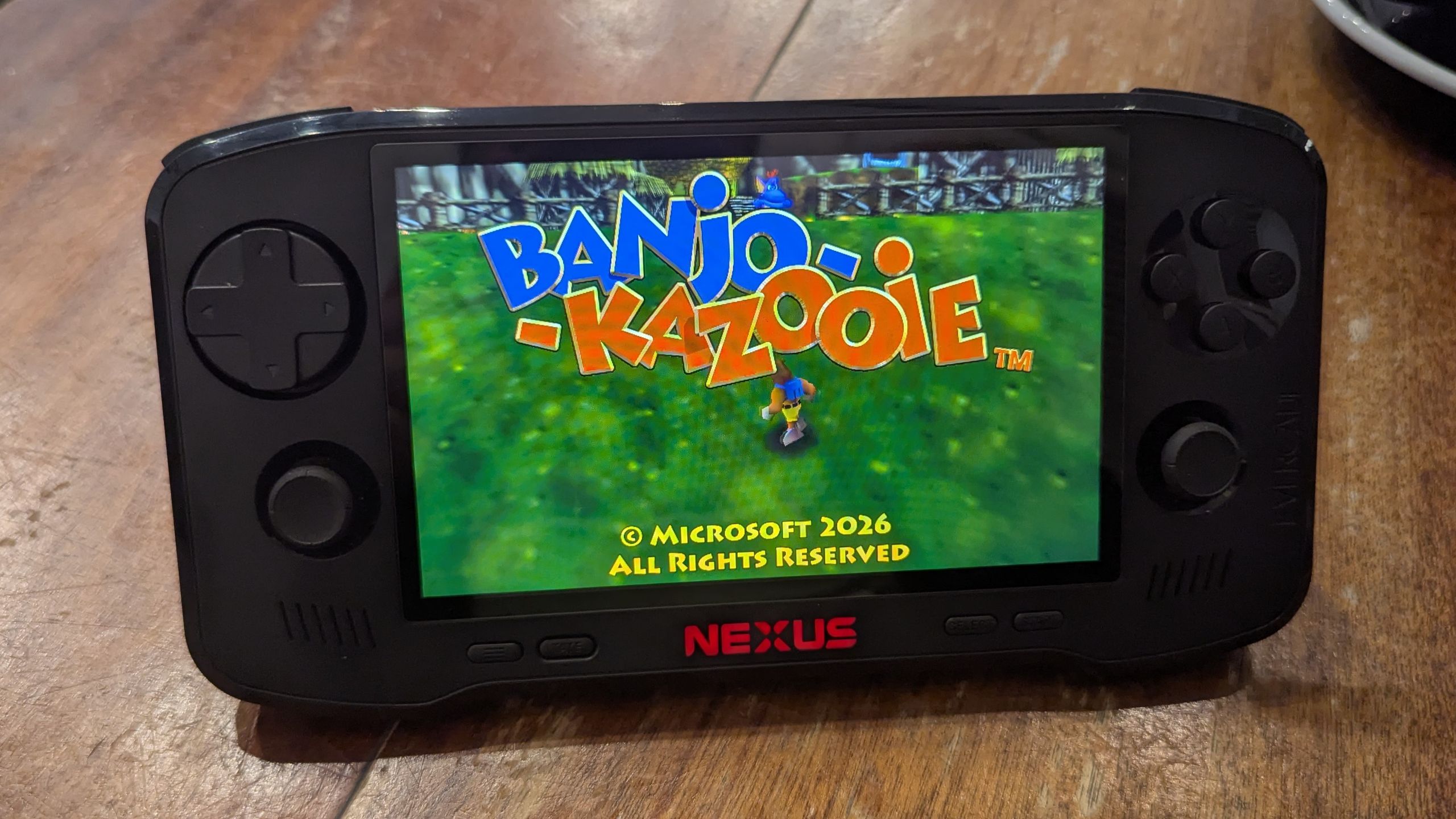 Photo: The Nexus up close. Note the glossy trim on the front edge and the glowing logo on the body — the reviewer flagged the gloss as a scratch magnet, while the logo color can be customized in the system. Source: Wired (photo by Matt Kamen)
Screen Grows to 5.89 Inches, Dual Sticks Save Tate Mode
The previous Evercade handheld prioritized pocketability, sized close to the original Game Boy Advance; the Nexus stretches to 215×111×34 mm and 410 grams, near Switch Lite territory. Wired’s suggested usage: “hard-shell case, toss it in a backpack.” The bigger body buys real grip room: thicker triggers with a curved, fingertip-friendly profile, and anti-slip texture on all four shoulder buttons and the back panel.
The screen jumps from the original’s 4.3-inch LCD to a 5.89-inch IPS panel at 840×512 and 167 ppi, with brightness above 500 nits. 167 ppi is unimpressive on paper in 2026, but retro games only have so many original pixels — high pixel density has inherently diminishing returns here. The 500-nit brightness is the hard requirement for playing outdoors. Wired’s verdict on the display: “crisp, vivid, and fluid.”
The twin symmetric analog sticks are the biggest control change this generation. The EXP’s Tate Mode (vertical play mode, from the Japanese “縦,” pronounced tah-tay) required holding the console in your left hand and using duplicated A/B buttons on the left side — an input area that was always cramped. The Nexus flips the rotation the other way: in vertical mode, the right stick plus a standard ABXY cluster takes over entirely, and the duplicated front buttons disappear. Vertical-scrolling arcade shooters finally run fullscreen in their original orientation, black bars gone.
The battery grows from the EXP’s 3000mAh to 5000mAh, for roughly 5 hours — about an hour more. The brighter, hungrier screen is paid for by the bigger cell. Connectivity catches up on two fronts: Bluetooth arrives for the first time, enabling wireless headphones while keeping the 3.5mm jack; Wi-Fi moves to the 6 standard with 5GHz support, serving system updates, monthly free games, and the Nexus-exclusive EverSync multi-device linking.
Two physical flaws: the D-pad protrudes above the panel and rocks noticeably under presses — sitting flush would be better. And the glossy finish around the buttons and on the front trim looks great, but picks up fine scratches far faster than a matte shell would.
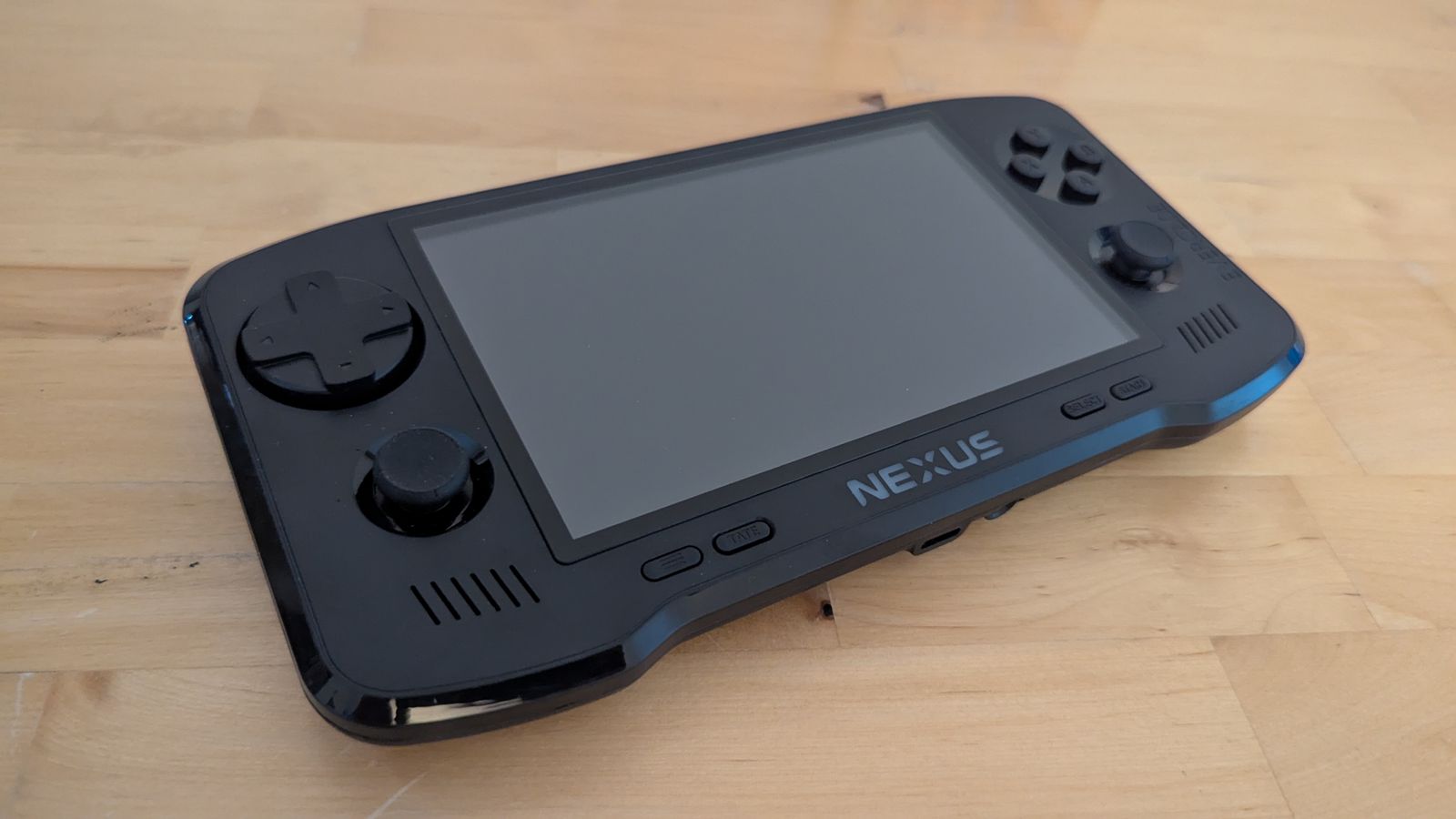 Photo: Look at the height difference between the D-pad and the panel here — the review finds it too tall and wobbly, one of the few knocks on the hardware. Source: Wired
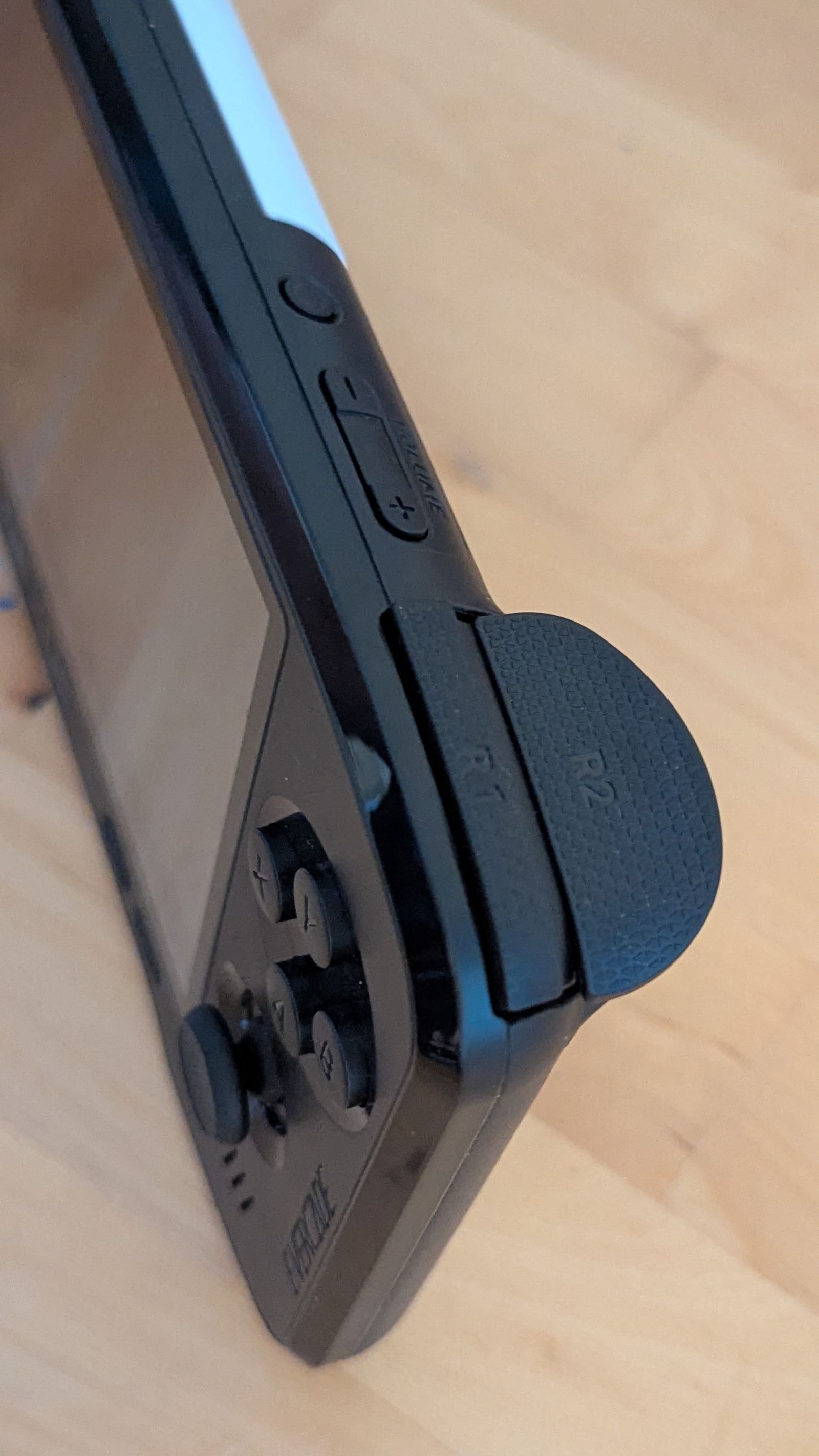 Photo: In Tate Mode the console rotates to the other side, putting the right thumb within reach of both the stick and ABXY — the EXP’s duplicated left-side buttons are gone entirely. Source: Wired
35 Seconds to Boot, Performance Locked by Compatibility
The system-level experience is the Nexus’s ugliest number: boot averages 35 to 40 seconds, and loading a cartridge takes about as long again. The games themselves run fine — all the slowness lives in the waiting. There’s no quick-suspend feature either, so every time you put the machine down you have to do a full shutdown, then pay the 40-second toll again next session. Players grabbing gaming in scraps of free time will have their patience ground down.
Wired explains why the hardware didn’t change: universal cross-device compatibility is Evercade’s calling card, and every cartridge has to run on everything, including the Super Pocket. The 512MB of RAM is a cost paid on behalf of the entire cartridge ecosystem, and the Nexus chose to keep paying it. Swapping in a stronger chip is easy; keeping old cartridges behaving identically on new hardware is not.
One step backward on ports: the mini-HDMI output that earlier handhelds kept is gone this generation — to play on a TV, you now have to buy the Evercade VS-R set-top console. Wired says the feature was always gravy, but losing it still stings. The product line now divides labor instead of making one device do everything — the living room goes to the VS-R, portability to the Nexus.
The system software did get updates: menu color schemes, logo light colors, border styles for non-widescreen games, aspect ratio options, and virtual scanlines are all user-configurable. Retro players care deeply about “authentic” presentation, and these options aim squarely at that.
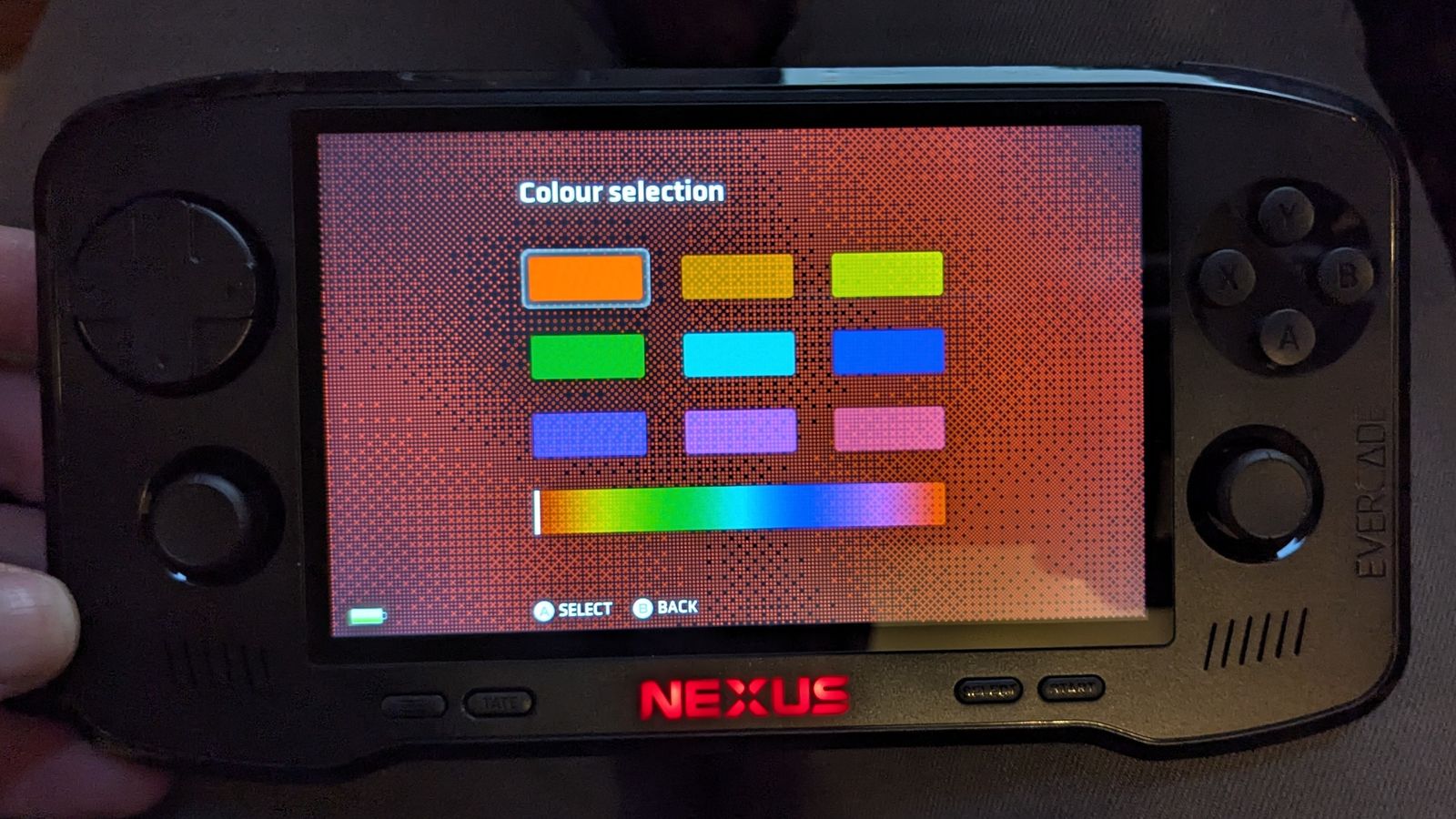 Photo: The cartridge slot defines this machine’s core experience — after inserting a cartridge, expect a 35-to-40-second load. The wait lives in the system layer; in-game performance is unaffected. Source: Wired
First Native-Port Cartridges: 60fps, Widescreen, Saves on the Cart
Up through the Nexus, Evercade cartridges have covered the 8-bit and 16-bit eras and earlier 2D titles, all running via emulation. The dual sticks plus officially confirmed 32-bit and 64-bit support now bring the 3D era within the device’s reach.
The first two cartridges skip the emulator entirely: a Banjo-Kazooie/Banjo-Tooie double pack and a DOOM/DOOM II collection, both native ports. The gains are concrete: better runtime performance, native widescreen matched to the screen’s aspect ratio, higher resolution, up to 60fps, and save slots built right into the cartridge, replacing the emulator’s virtual save states.
The Banjo games are the clear highlight: Rare’s pair of 3D platformers look gorgeous on this screen, and the dual sticks solve what the N64 pad always lacked — independent camera control. Movement and camera are finally separate. Wired’s conclusion is a strong one: this may be the best these games have ever been presented, and you can slip them into a bag. Given what original Banjo-Tooie cartridges fetch on the secondary market, these ports aren’t even playing the same value league. The DOOM collection bundles a set of bonus missions and map packs that hold up, but as some of the oldest first-person shooters, they show their age much harder.
The port cartridges remain compatible with all older devices, including the Super Pocket, with camera control mapped to shoulder buttons at a slower rotation rate. The benefits of native ports spread across the whole ecosystem — there’s no generational break between old and new hardware. Which in turn explains the Nexus’s decision not to upgrade the chip: compatibility is the foundation of the cartridge business, and performance upgrades have to route around it.
Emulation Wins the Spec Sheet, Nexus Wins the Cartridge Slot
Drop the Nexus into the 2026 retro handheld market and the spec comparison is ugly: Android-based emulation handhelds commonly ship with 4GB-plus RAM and boot in seconds, and sub-$100 open-source handhelds hold thousands of ROMs at once. The Nexus’s 512MB, 35-second boot, and lack of suspend lose on every one of those lines.
But the other side of the ledger requires different math. Evercade cartridges are all officially licensed collections, curated by Blaze, giving overlooked gems a second life in physical form; a single cartridge works across the handheld, the set-top console, the arcade cabinet, and the Super Pocket. The emulation camp’s ten thousand ROMs correspond to gray-market sourcing and uneven compatibility; the Nexus’s narrow library corresponds to clean licensing and consistent behavior.
The two product categories answer two different questions: emulation handhelds solve “how do I comfortably play the ROMs I already have,” while the Nexus solves “how do I legally collect and reliably play these old games.” Wired’s 8/10 scores the latter’s completeness — and every deduction lands inside that same system.
The criticisms deserve full listing too: performance stands still, which locks in the ecosystem’s ceiling and keeps more recent gaming generations out; HDMI’s removal narrows single-device use cases; and the D-pad and glossy finish remind buyers that $200 build quality still comes with compromises. For an emulation enthusiast, any one of these could be a dealbreaker. For a cartridge collector, every one has a workaround.
Compatibility Will Break Someday — Blaze Knows It
Wired’s closing offers a directional read: as Blaze keeps porting gaming history onto cartridges, a future Evercade will have to break compatibility to support more recent eras. By sticking with 512MB, the Nexus is betting that the break point comes after native ports scale up — build out the 3D game supply first, then move the hardware foundation.
One caveat on new features: EverSync multi-device linking (one cartridge powering linked play across multiple consoles, similar to Nintendo’s GameShare) wasn’t open for testing at review time, and the reviewer didn’t get to try it. Don’t factor it into a purchase decision.
The path to the Nexus’s highest-ever score is clear: not a single chip changed, but a bigger screen, better-feeling buttons, dual sticks, and two native-port cartridges made the “licensed cartridge” system genuinely solid. The retro handheld scorecard has been reshuffled — the cartridge slot now outweighs the processor. Every one of its weaknesses — the 512MB of RAM, the 35-second boot, the missing HDMI — is precisely where emulation handhelds excel. Blaze is betting that the other half of buyers opens the spec sheet looking for one thing only: where the cartridge slot is.
References:
- Wired review: Review: Evercade Nexus (Matt Kamen, November 15, 2026)